












 BLOGS
BLOGS  NEWSROOM
  CASE STUDIES
  WEBINARS
  PODCASTS
  ASSET HUB
  EVENT CALENDAR


















Ready to Streamline Your Clinic and Improve Patient Care?
➡️Billing and insurance processing (claims adjudication)
Billing and insurance processing, also known as claims adjudication, automates the management of complex billing and insurance claims processes in healthcare. Traditional methods often lead to delays, errors, and administrative burdens for healthcare providers and insurers. Automation in billing and insurance processing streamlines workflows and enhances accuracy, ensuring timely reimbursements and efficient financial operations.
Automation in billing and insurance processing benefits healthcare providers and insurers. It accelerates claims processing by automating data entry, validation, and submission, thereby reducing processing times and enhancing cash flow.
These systems ensure regulatory compliance with healthcare regulations and insurance policies, mitigating audit risks and penalties. Cost efficiency is achieved by lowering operational costs associated with manual claim processing, staffing, and administrative overhead.
It can integrate with existing healthcare IT systems, automated billing, and insurance processing to enhance interoperability and data exchange, ultimately enhancing operational efficiency, reducing costs, and improving financial performance for healthcare providers and insurers.
➡️Healthcare Data automation
Healthcare data automation revolutionizes patient care and clinical operations by leveraging technology to streamline data collection, analysis, and management. Traditional methods often lead to inefficiencies and delays in accessing critical healthcare information. Automation in healthcare data enhances accuracy, efficiency, and patient outcomes through advanced monitoring, analysis of medical images, and lab testing processes.
Healthcare data automation offers numerous benefits for healthcare providers and patients alike. Automated systems enable real-time patient vitals and health metrics tracking, facilitating continuous monitoring and proactive interventions.
Discover How We Automated Data Extraction While Building A Web Scraper for Health & Fitness Organization. Download the Case Study Now!
➡️Chatbot Automation
Healthcare providers now rely heavily on automated chat systems to effectively handle patient queries and support. These services provide 24/7 support and answer questions about symptoms, drugs, and available treatments.
They reduce the workload for medical professionals by streamlining appointment scheduling, making medication refills easier, and offering general health advice.
Notable implementations that have improved patient satisfaction and operational efficiency include those made by Kaiser Permanente and Geisinger Health.
Healthcare practitioners can enhance resource allocation and devote more time to vital patient care by automating routine encounters. This represents a significant development in the delivery of healthcare services.
Related read: Top 10 RPA Use Cases In Healthcare Industry 2024
Benefits of Healthcare Automation
Get expert advice from Mindbowser to build your healthcare automation solution.
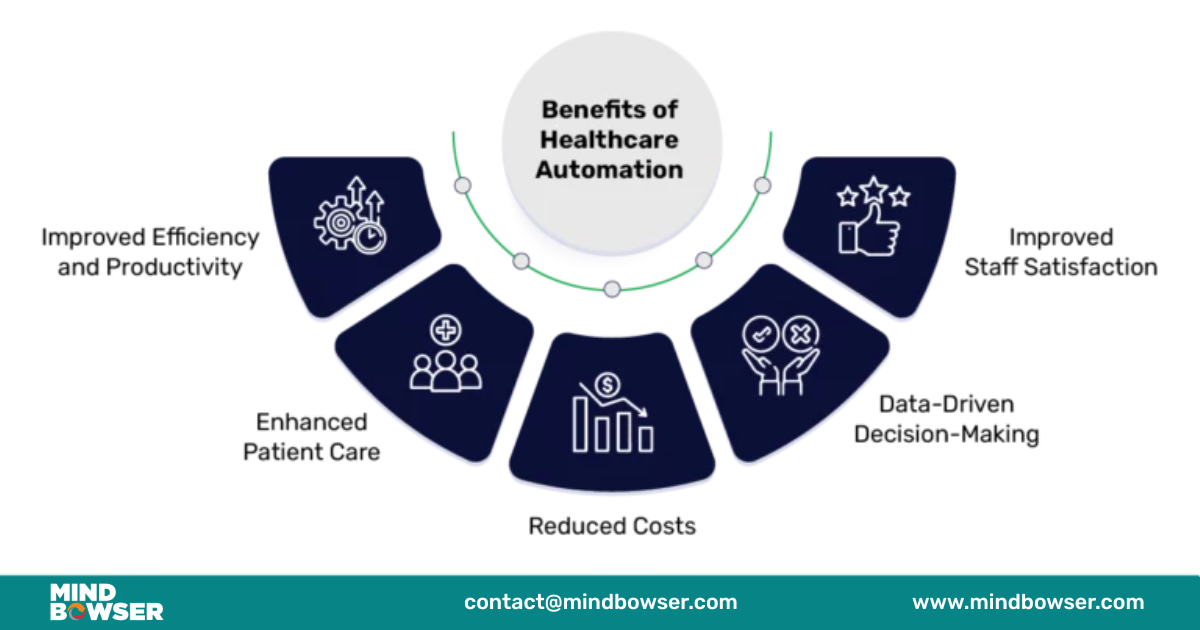
Healthcare automation benefits healthcare executives, hospital administrators, clinic managers, private practice owners, and health insurance directors. Automation streamlines operations, reduces costs, improves patient care, and enhances staff satisfaction. Healthcare organizations can achieve greater efficiency and better outcomes by adopting these technologies.
Mindbowser specializes in building customized healthcare automation solutions tailored to your specific needs. Explore how automation can transform your healthcare organization. Contact us for a free consultation on healthcare automation solutions and take the first step towards a more efficient and patient-centric future.