BLOGS
BLOGS  NEWSROOM
  CASE STUDIES
  WEBINARS
  PODCASTS
  ASSET HUB
  EVENT CALENDAR
























Vertical integration in the healthcare model transforms the industry by addressing rising costs, fragmented care delivery, and regulatory challenges. Patients often struggle with a disconnected system where hospitals, clinics, and insurance providers operate separately, leading to inefficiencies, increased expenses, and inconsistent experiences. Healthcare organizations are now adopting strategic solutions to streamline operations, improve care quality, and control costs.
The U.S. integrated delivery network market, valued at USD 1,442.20 billion in 2023, is projected to reach USD 3,774.84 billion by 2033, with vertical integration leading at 67% revenue share. This growth reflects the industry’s shift toward cost efficiency, better patient outcomes, and streamlined operations. As healthcare organizations seek improved care coordination and financial sustainability, vertical integration is emerging as a key strategy for the future.
Vertical integration in healthcare consolidates multiple phases of patient care within a single healthcare organization. This approach includes hospitals acquiring physician practices, insurance companies merging with healthcare providers, or health systems developing supply chains.
The goal is to create a more coordinated healthcare delivery system, reducing redundancies and enhancing patient outcomes. More organizations are implementing this model to gain better control over resources, strengthen care coordination, and navigate financial pressures effectively.
What is Vertical Integration in Healthcare?
Vertical integration in healthcare refers to consolidating different stages of the healthcare supply chain under one organization. This strategy allows healthcare providers, insurers, and pharmacies to operate within a unified system, improving efficiency and care coordination. Unlike horizontal integration, which involves merging similar entities (e.g., hospitals acquiring other hospitals), vertical integration connects different levels of care, such as hospitals acquiring outpatient clinics or insurers expanding into healthcare services. The goal is to streamline operations, reduce costs, and enhance patient outcomes by controlling more aspects of care delivery.
Forward and Backward Vertical Integration in Healthcare
Forward Integration: This occurs when a healthcare organization expands into services that are traditionally downstream in the care process. For example, a hospital system acquiring primary care practices allows for better patient management and reduced referrals outside the network, ensuring continuity of care.
Backward Integration: This happens when an entity moves upstream to control earlier stages of the supply chain. Insurers acquiring pharmacies or healthcare providers is a common example, as it enables cost control, direct management of prescription services, and more integrated patient care. This approach helps organizations reduce dependency on third parties and improve service efficiency.
Challenges of Vertical Integration in Healthcare
Balancing efficiency with patient care is not always straightforward. Vertical integration comes with hurdles that healthcare organizations must address to avoid unintended consequences.
❗ Regulatory and Antitrust Concerns
Vertical integration in healthcare can reduce competition, raising concerns about potential monopolies. Regulatory bodies closely monitor such integrations to ensure they do not create an unfair market advantage. Organizations must navigate complex antitrust laws to prevent legal hurdles and maintain a competitive landscape.
❗High Initial Investment & Complexity
Acquiring and integrating new healthcare entities requires a significant financial commitment. Infrastructure upgrades, workforce training, and aligning different operational models add layers of complexity. The return on investment may take years to materialize, making it a risky venture for smaller organizations.
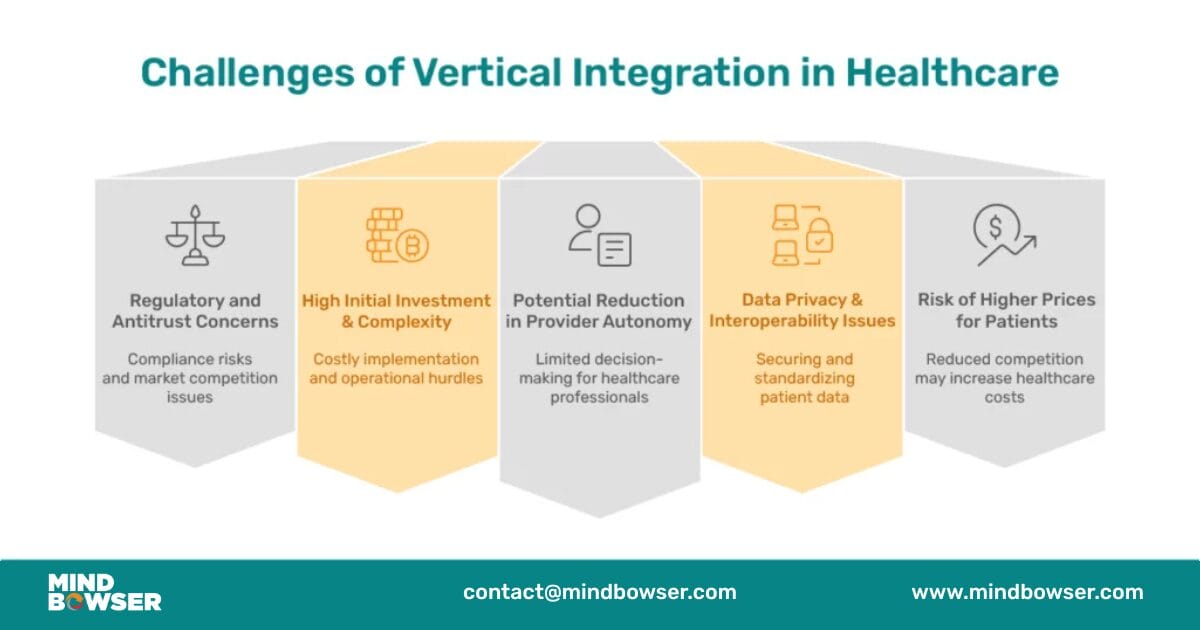
❗Potential Reduction in Provider Autonomy
Standardized protocols and centralized decision-making can limit the independence of healthcare providers. Physicians and specialists may feel constrained by corporate guidelines, impacting their ability to make personalized treatment decisions. Balancing efficiency with clinical autonomy remains a major challenge.
❗Data Privacy & Interoperability Issues
Merging different healthcare entities means integrating multiple IT systems, each with unique data formats and security measures. Ensuring interoperability while maintaining data privacy compliance under HIPAA regulations can be a daunting task. Without seamless data exchange, the intended benefits of vertical integration in healthcare may be compromised.
Related Read: How to Become HIPAA-Compliant?
❗Risk of Higher Prices for Patients
While vertical integration in healthcare aims to control costs, reduced competition in a consolidated healthcare system can lead to price hikes. With fewer independent providers in the market, patients may face higher medical expenses due to limited alternatives. Transparency in pricing and regulatory oversight are crucial to preventing excessive costs.
Conclusion
Vertical integration in healthcare is transforming the industry by bridging gaps between hospitals, insurance providers, and pharmacies. A well-integrated system leads to streamlined operations, improved patient experiences, and better financial efficiency. However, achieving true integration requires overcoming challenges related to data interoperability and security.
Mindbowser provides the expertise and technological solutions necessary to create a connected healthcare ecosystem. By implementing standardized data formats, secure cloud infrastructures, and seamless EHR integration, we help businesses achieve the full potential of vertical integration, ensuring long-term success in an evolving healthcare landscape.
Vertical integration in a hospital refers to the consolidation of healthcare services under one system, connecting hospitals, outpatient clinics, pharmacies, and insurance providers to streamline care delivery and reduce costs.
Vertical integration occurs when a healthcare system expands by acquiring services across the care continuum. For example, a hospital purchasing a pharmacy or an insurance company operating its medical clinics demonstrates vertical integration.
Vertical integration in healthcare is the process of uniting different levels of care—hospitals, specialty clinics, diagnostic centers, and insurers—into a single network to improve efficiency, data sharing, and patient outcomes.
Horizontal equity ensures individuals with similar healthcare needs receive equal treatment, while vertical equity provides additional resources to those with greater medical needs to reduce disparities in care.