A Labor and Delivery clinical decision-support platform needed prediction models accurate enough for physicians and nurses to act on in real time, not just accurate on paper. We built two patented models trained on 35,000+ cleaned clinical records, deployed on AWS SageMaker and integrated directly into Epic workflows.
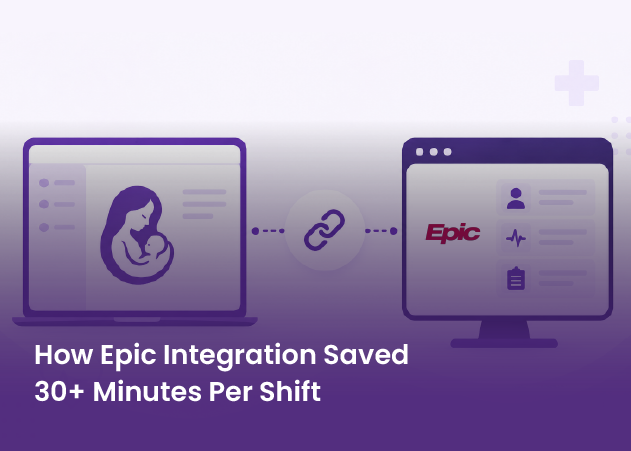
Talk to UsA Labor and Delivery clinical decision-support platform running inside Epic EHR workflows.
Two patented prediction models, a real-time command center, automated coding, and operational forecasting.
Python, AWS SageMaker, REST API, ensemble machine learning.
Live in production, 4.9/5 clinical adoption rating across 150 reviews.
The models are trained on 35,000+ cleaned clinical records and hold delivery timing accuracy to within plus or minus 12 minutes, tight enough to change how physicians schedule C-sections and how charge nurses staff the floor.
Reduction in coding denials
Bed days recovered through operational forecasting
Accuracy predicting the pushing phase
Reduction in unplanned RN overtime
Predicting delivery timing accurately, in real time, during active labor, is not one problem. It is several intersecting ones that all had to be solved together.
60,000+ patient records collected across multiple hospital settings, with missing values, inconsistent formats such as gestational age recorded in weeks in one system and days in another, duplicates, and near-duplicates from data-entry errors. Cleaning, standardizing, and deduplicating brought the set down to 35,000 usable records.
Cervical dilation's predictive power depends on labor-progression status, induction changes the whole trajectory, and age interacts with parity. Identifying which features mattered required clinical domain expertise, not just data volume.
With 35,000 records and hundreds of potential features, it is easy to build a model that memorizes training-set patterns and fails on new patients. Hyperparameter tuning had to balance regularization against missing real signal, evaluated on R-squared, RMSE, confidence intervals, and feature importance.
A patient's condition changes hour by hour, so a model that takes 30 seconds to score is worthless in a clinical setting. A delivery-timing estimate of plus or minus four hours is not useful either; physicians and charge nurses need a window tight enough to plan C-section timing and staffing around.
Two models, trained and served on infrastructure built for real-time clinical use.
The Pre-Admission Model predicts delivery timing from intake data such as BMI, prior deliveries, current weight, and induction status, before active labor begins. The Post-Admission Model takes over once labor starts, incorporating cervical dilation, labor progression, and current vitals to continuously update its prediction. It reaches 99.1% accuracy for the pushing phase, accurate enough for physicians to schedule C-sections around it.
The unit command center shows every active patient on the floor in a single view: predicted delivery timelines, current status, and flagged risks, so charge nurses no longer have to walk the floor or make calls to stay current. A risk-alerting module continuously monitors active patient data and sends real-time alerts for postpartum hemorrhage, preeclampsia, and shoulder dystocia, giving teams time to prepare blood products and have anesthesia on standby before a patient goes into hemorrhagic shock.
The automated documentation module generates delivery notes and produces ICD-10 and CPT codes directly from those notes, without manual coding review. Manual coding under time pressure misses nuances and billable procedures; thorough AI-generated codes capture them. The result is a 76% reduction in coding denials, which for a hospital with 5,000 deliveries a year means capturing revenue that was previously lost.
An operational forecasting module produces a 7-day patient census prediction, staffing ratio alerts, and room and bed turnover forecasting. It recovers 35% of bed days and reduces unplanned RN overtime by 25%, replacing reactive staffing with forecasts built from the same real-time data feeding the prediction models.
Talk to us about model training and deployment architecture for high-stakes clinical environments.
Partner with us to design, build, and scale digital solutions that drive better outcomes.
Global Tech Teams LLC, 525 Washington Blvd, Industrious at Newport Tower, Jersey City, NJ 07310, United States.
Let’s discuss your goals, workflows, and next steps in a focused consultation call.
 Schedule a Call














 BLOGS
BLOGS  NEWSROOM
  CASE STUDIES
  WEBINARS
  PODCASTS
  ASSET HUB
  EVENT CALENDAR