
Recorded at HIMSS23, this episode of HealthTech with Purpose features David D. Bennett, President and CEO of pCare, in conversation with Mindbowser’s Rushikesh Kulkarni. Dave has spent decades in patient engagement, including executive roles at GetWellNetwork and StayWell, and walks through how pCare turns the inpatient TV into an interactive hub for schedules, care team introductions, meal ordering, education care flows and real-time surveys. The most personal part of the conversation is his time as “chief advocate officer” for his wife through advanced ovarian cancer. Visiting top cancer centers, he saw technology fail for the same reason everywhere: tools without organizational buy-in, like portal messages nobody answers for 48 hours. He warns against AI’s “shiny object syndrome,” argues for keeping technology simple, and names what keeps him up at night: turning healthcare’s flood of data into actionable information delivered to the right person at the right time. He closes on the nursing shortage, and on the families who could still see and share photos with loved ones through pCare’s systems during the pandemic. For teams building patient engagement tools, his adoption lessons apply directly.
Dave describes pCare as a patient engagement platform that lives mainly on the inpatient side, built around the television in the patient room. Beyond movies and TV on demand, it shows a whiteboard of the day’s schedule (physical therapy, procedures), identifies who is entering the room, lets patients order meals, and runs “care flows” such as a hip replacement education path with videos and comprehension questions. The record that a patient watched and understood the content is pushed back into the electronic medical record. Real-time surveys on nursing, care and room cleanliness feed service recovery while the patient is still there. Secure video in the room, he says, was adopted fast during COVID and has since become a mainstay. Tim Vaughan, pCare’s Chief Product Officer, told the product’s story from its TV rental origins to a full patient engagement platform in a separate episode.
That write-back step is where most engagement products get stuck: every hospital runs a different EHR. Mindbowser can build the integration for you, or teams can use ConnectHealth, which connects a product to 20+ EHRs through one integration model and runs in your own cloud.
Dave’s view changed when his wife was diagnosed with advanced ovarian cancer and he became what he calls her “chief advocate officer.” Traveling to top-ranked cancer centers, he found a common thread: all of them adopted technology at breakneck speed, and technology still failed in each of them for the same reason. A solution that isn’t embraced across the organization and built into its culture isn’t a real solution.
His example is the patient portal. Every organization offers messaging with the care team, but if nobody on the other end reads and responds, the organization has built a queue of unanswered messages. When 24 or 48 hours pass with no reply, the anxiety and doubt it creates for patients and families “do more harm than good” and hurt adoption. For complex care, he says, patients depend on the organization functioning as a team, held to the same standards across every department. His fix: keep going back to patients and families, ask whether the tool does what you planned, and measure it across every end user, from nurse and physician to scheduler and family member.
On AI, Dave sees real promise in taking workload off clinicians, but worries about healthcare’s “shiny object syndrome”: attention jumps to the newest thing before existing technology has been optimized or embedded in the culture. He points to how many organizations have cycled through multiple EMRs, and asks that the shiny object not consume 95% of innovation. His rule, from his Army days, is “keep it simple.” The technologies with the highest adoption are the simplest, and his example is text messaging: a link to a phone, or a Y for yes and N for no.
What keeps him up at night follows from that: healthcare generates a phenomenal amount of information, still siloed inside organizations, and the challenge is distilling it into something actionable, delivered in the right format to the right person at the right time. A family member doesn’t need everything, but does need a text that the doctor is visiting around noon, so they can be there or join by video.
The complaint Dave hears nonstop from health system C-suites is the nursing shortage and the labor costs that came with it, after many skilled nurses left post-pandemic. Nurses, he says, didn’t go into nursing to push a computer on wheels and enter data into the EMR for a third to half of their time. Technology that moves non-clinical work off their plates would improve productivity and retention, and the same applies to physical and respiratory therapists. That is the case for AI agents that cut nursing documentation burden. He adds a warning: staff have heard many promises, so leaders need to demonstrate clearly how a tool makes their lives better.
Good morning.
Hey, how are you doing today?
I am good, how are you?
I’m doing really well, actually. It’s a gorgeous day here in South Florida today.
Awesome. Dave, welcome to HealthTech with Purpose, and thank you for joining us today.
Thank you for having me. I really look forward to speaking with you today.
Amazing. So to start with, Dave, I would really love to understand what you are doing currently, and your journey so far.
Great, I’m glad to share it with you. I’m with a company called pCare, and we’re very focused on digital transformation of the inpatient room and the overall patient experience that patients and families are engaged in while they’re in the hospital. That’s our primary focus, and it’s an area that is under major digital transformation today.
Great. That seems to be a very important and interesting space to solve challenges in, because it touches not only the patient but also the caregiver and the family of the patient, right? So before we move to the details of that, can you give us a bit of background about yourself, and a bit of history until now?
Sure, I’d be glad to. Currently I’m the CEO of a company called pCare. I’ve been here for about four years, but I’ve been in healthcare for several decades. I’ve worked at a number of other companies, really focused around patient engagement. Some of them are names people may be familiar with: GetWellNetwork, and StayWell, which is a big patient education company that also focused on provider as well as insurer-based solutions. I’ve done that in various roles, from chief technology officer all the way to chief operating officer and CEO.
I also did a stint, and I’m very proud of it and talk about this, in a large academic medical center. So I have a unique perspective of being on the front lines, seeing how the clinical folks work, working in a very large center taking care of lots of patients. So it’s several years of doing this, and I pride myself on having multiple perspectives and playing multiple different roles, which I think gives me a unique perspective on things.
Amazing. And playing these multiple roles, I think there’s a lot you can contribute overall, having these different perspectives, as you rightly said. That takes me to the question about pCare. Can you explain a bit more about what you do, what the tech of pCare is overall, and how you are helping patients with it?
Sure. pCare is really a patient engagement platform, and as I said, it primarily resides on the inpatient side. What it’s designed to do is interact with the patient and the family members while the individual is in the hospital. By that I mean it does everything from traditional entertainment and concierge types of services, so people can watch TV and movies on demand, things like that. But we go beyond that.
Some of the areas that are very important include what we call whiteboard functionality, which lists what the patient’s schedule is going to be like that day: if they’ve got physical therapy planned, if they’ve got a procedure planned. So it’s an information board. As you know, in today’s world the ability to exchange and provide information is really critical. People want to know what to expect while they’re there. It also has the ability to show you who is entering the room. If a doctor or a nurse comes in, in many cases it can display who they are, so a family member who might not be familiar with the person can see them, and in some cases look at their bio and other things. It allows you to order meals electronically and go through that process.
It also does direct interactions, what we call care flows. That might be: I’m in here for a hip replacement surgery, what do I need to do to expedite getting out of the hospital and be discharged on time? So we have digital interactions that can ask you questions, engage you by having you watch a video, ask whether you understood it, and then do documentation around those activities, such as pushing the record that you interacted and understood the video content back into the electronic medical record (EMR). All the way down to simple things like surveying you while you’re in the room: how was your nurse today, how was your care, was your room clean? It gathers that data in real time, and that information can be used in real time for service recovery and a number of things like that, to improve overall performance as well as the patient experience.
It’s really designed to put the patient and the family at the center of their journey, so that it can exchange lots of information, do interactions and document them through digital technology, all through the television set. The television becomes a display and interactive mechanism. We have the ability to do other things, such as voice controls, but if you think about it, the TV becomes the major focal point for interacting with the patient and their family.
Amazing. So it’s like a complete 360 solution for a patient from an engagement perspective, and from some of these critical flows as well, when they are in hospital.
Yeah, that’s right. And as you can imagine, a lot of this has been accelerated during the pandemic, when hands-off care became much more of a big issue. Things like video connect, the ability to have secure video conferencing in the patient room, have been highly adopted. A lot of this technology was accelerating as COVID created unique obstacles, like hands-off care and the need for personal protective equipment. So some of those technologies have been further adopted, and have now become a mainstay as part of the digital transformation of the patient room.
Amazing, amazing. So as a technologist and an entrepreneur, what is your overall take on technology today, especially with respect to healthcare? Would you like to share your experiences on that end?
I would. I think I’ve got some unique experiences, so let me tell you a little bit of personal stuff, and then lay the groundwork for what I see. I share with people that in September of last year I actually got a promotion: I became the chief advocate officer for my wife. My wife was unfortunately diagnosed with metastatic ovarian cancer, advanced ovarian cancer. Needless to say, as we know in healthcare, that really changes your perspective, even if you’re not in healthcare, when you have to take care of a close family member, in this case my spouse.
Why share that with people? Because as a technologist, it also changed my view. Now I’m part of it, on the receiving end, as a family member. I have my wife interacting and being engaged as a patient, and how is all this working and playing out? Two things came out of this. One is obviously that it changes your perspective, and it also re-energizes someone like myself, and I suspect anybody else in healthcare who’s on that receiving end: boy, now I know why I’ve always been in healthcare, and I’m going to double down and really focus on how to create better solutions.
But I will tell you something that became very apparent to me. We are moving very fast in the adoption of technology, and as you know as a technologist, we’re really great at creating technical solutions, software solutions, for problems in many cases. Part of our healthcare journey with my wife has been traveling to the best cancer organizations in the country to seek out the best care, and I noticed one thing that’s a common thread among all of them. It doesn’t matter whether you’re number one or number three ranked in the country: all of them have adopted technology at breakneck speeds, and they use it every day. But it became quite apparent that technology for technology’s sake is not necessarily the sole solution. Even in the best organizations, technology fails in many regards.
One of the common things that became very apparent to me around the failure is that we create a solution, but we forget some of the other elements. The most critical element of any solution we develop is that we have to have internal buy-in, and it has to be ingrained in the culture of the organization. What I mean is, if I create a technology solution but the organization hasn’t embraced it across the organization, only in small elements, then it really isn’t a true solution that’s widely used across the enterprise. Part of that is organizational buy-in and embedding it within the culture of the organization.
I’ll give you an example of something I’ve seen. Patient portals are great, and everybody seems to have a patient portal. Every organization tells you the same thing: you can connect with your physician or your nurse or your caregivers, send them a message, and they’ll respond back. It’s a great tool for all of that, right? The reality is, while the technology offers that solution, and you and I and others know it has the ability to do that, if you don’t have an end user on the other end actually reading those messages and responding back, all you have done is create a solution that captures a great deal of data in the form of a message that sits in the queue with no response. And that can actually do more harm than good.
From a patient standpoint, and as a patient advocate or family member, when you send a message off, even when the organization says, “If it’s a real emergency, this is how you should call us, but if it’s not an emergency and it can wait 24 hours, you can use the portal,” when 24 or 48 hours go by with no response, the anxiety that creates, the additional issues it creates, and the doubts it creates in the minds of the patients and family members using the technology do more harm than good. And it really hampers adoption.
What I find is inconsistency in organizations: some end users within the organization are really great at using it, and others are not. But when you’re receiving care for a complex disorder, you depend upon the organization to function as a team. The team needs to all understand and be held to the same standards, and part of that is ingraining the same mission, the cultural adoption and the same standards across the entire organization, not within one department or one area. Because if it’s only partially used, and not used across the organization consistently, then it breaks down and fails to meet the expectation.
So one of the things I tell people constantly is that through the adoption of technology, you’ve got to go back and reassess. You need to go out and talk to the patients and the family members and ask: is it actually doing what I planned for it to do? What is the problem we’re solving, how are we going to measure it, and how are we determining whether it’s a success? Those are very critical. As technologists we can create great solutions and architect them out, but we need to measure, gauge and look at responses constantly, and remember that there are multiple endpoints, whether it’s the nurse, the physician, the scheduler, the family member or the patient. All of that needs to be encompassed when you’re looking at how technology is being utilized.
It’s something I’ve seen, and even the folks at my organization, when we get one degree of separation, we forget about this. So I’ve become a real evangelist, preaching to folks like you and others that technology is great, but often we need to take a step back, re-evaluate and ask: is it really accomplishing what I need, and is it really ingrained in the organization? Because if it isn’t, then we’re doing something wrong, and that means the solution may not be meeting everybody’s needs, or we need to figure out how to reset, re-engage and win big advocates who are going to see the value of what we’re proposing or deploying.
Great. First of all, thank you for sharing your story, your wife’s story. I hope she’s doing well now.
I would tell you, the good news with all of this is that something good comes from everything bad. My wife was diagnosed as no evidence of disease, which means she’s undergone chemotherapy and surgery, and the end result right now is great. She’ll be in maintenance; unfortunately with cancer you’re never cured. But for us it was fantastic news, and you can’t give enough credit to the doctors and the nurses and all the folks involved in taking care of her.
As a patient advocate and somebody who has lived through this, it’s a great feeling, and it has certainly reinvigorated my focus on why I think all of us are in healthcare. At the end of the day, I think the answer is quite simple: we’re all here to do good. We want to take our skill set, we want to impact patients, we want to help people get healthy and live [inaudible] successful lives. I think it’s a great world we’re in, and being a recipient of great outcomes is even better, from my perspective.
Amazing, amazing. Good to hear this. Coming to the points you mentioned, I think you made two really important points. One is the adoption of technology within the organization itself, and that culture has to get ingrained in the users, so that technology is actually useful for the end user it’s built for. I think that was one really good angle. The second was to talk to the end users more, understand their pain points and see if you can put them into the tech. I think those were the two key points you were focusing on.
I think you’re exactly right. We know there are companies that do a phenomenal job; you and I talked about Facebook. Facebook has always focused on it, and there are others, Amazon and other technology companies, focused on the user experience, the end users, and how they’re going to interact and engage with them. I know that in healthcare we talk about wanting to do that all the time, but I think the reality is we talk a good game and we don’t actually execute on it.
I think that’s also somewhat the environment we operate in. As you and your listeners know, in healthcare we’re extremely conservative. The fact of the matter is we’re way behind in many regards when it comes to adoption of technology, and part of that is the cautious, conservative nature of healthcare. Our motto is “do no harm,” as our physicians would say. So we often slow things down, to our detriment in some regards, but we also have to have a balanced mix between speed of adoption and understanding the overall impact.
But I think there’s a lot to learn. I certainly see it, and you probably see it, particularly in healthcare when we talk about digital transformation: more and more of the large organizations and enterprises now have a chief digital officer or a chief digital transformation officer, and a lot of these folks are coming from outside of healthcare, which is phenomenal. They bring in different viewpoints around consumer and even employee engagement, and I think they will help us on this journey and actually result in a successful outcome at the end of the day.
Great. Thank you for sharing some of these insights, Dave. There’s a lot being talked about AI, especially AI in healthcare, generative AI, ChatGPT. I was at ViVE and HIMSS, and a lot was talked about responsible AI. Any thoughts on that aspect?
Listen, you can’t help but see AI every day. People are talking about it. What I tell people is that I’ve seen a lot of interesting uses for AI. I think AI is one area in healthcare where we really need to step back, think about how we’re going to use it, and look at it very deeply, also from a patient and end-user perspective. While it holds a great deal of promise for us, it also has lots of pitfalls along the way. And because of the conservative nature of healthcare, I have no doubt that, particularly when it comes to interacting and connecting with patients, it will be adopted very cautiously.
But one of the concerns I also worry about in healthcare in particular is what I would call the shiny object syndrome. We have the ability to look at things and say, man, that thing is so cool, and all of our attention focuses on that shiny thing, whereas the last thing we focused on, we really haven’t optimized. We haven’t solved the problem we intended to. So while I expect us to continue to look at AI, and in the future it holds huge promise for improving productivity, particularly for somebody who looks at patient engagement, since it has the ability to engage and take some workload off our clinicians and others, at the end of the day what I would preach is caution. Don’t just follow the next shiny object. Realize there’s a bunch of technology we’ve deployed that we still need to optimize and still need to ingrain within the culture of the organization. And very important: don’t overload an organization through this process.
If I were going to tell you one of the things that’s most critical for success, it’s not only ingraining it in the organization. I started my career in the Army, and there’s an Army acronym I use that people have heard: keep it simple, stupid. The best technologies, the ones with the highest adoption rates that work really well, are things that are simple for people to understand and use. The most basic one is text messaging. Whether it’s sending a link to a phone or responding with a Y for yes and an N for no, we use it every day. It’s so simple, and it’s so easy for the end user, whether you’re a clinician, a patient or someone else, to understand how it works.
So I would tell you AI holds a great deal of promise, but again, step back and remember to keep it simple, so people understand how it’s going to work and what the end result is. And don’t jump to that next shiny object: keep a purposeful focus on the technology I already have, and focus on it being optimized. That’s really critical, because if you don’t do that, you’re going to end up jumping from one area to another, and healthcare organizations are fantastic at throwing dollars after dollars. Just look at the history behind EMRs and how many organizations have gone through multiple EMRs, and the cost of doing that. I would hope we would take a step back and say, let’s really take a look at where we stand. AI does hold huge promise, but let that shiny object not consume 95% of our innovation and make us forget where we stand with the technology we’ve already deployed.
Awesome. That’s a very good take on it, because I think there’s a long way to go, and there are certain basic things that still need to be solved, and then we can jump in and see how AI can help us.
Yeah, I couldn’t agree more.
Awesome, awesome. So as CEO of pCare, what are the challenges that keep you awake at night?
I think the biggest one is trying to focus on providing more information and interaction with the patient. The one thing I’ve walked away with is this: in the whole world of data and data analytics, we’ve used that for processing a number of different things, but one of the biggest things patients and families want is information, and it has to be actionable, understandable, consumable information. We generate a phenomenal amount of information in healthcare. The question is how to distill it down, and the challenge is providing it in a meaningful format: not only in the right format, but at the right place, at the right time, to the right end user. Those are so critical, and that is what keeps me up at night.
There’s still a lot of siloing of data within organizations. How can I understand that information holds power, and how can I unleash that power to further empower patients and their family members? Those are the challenges we see, and things I think about all the time. Having gone on this healthcare journey, the one complaint I would have is that there’s still the inability to know all the details of what’s planned, or what to expect once I’m discharged from the hospital. There are people within the organization and there’s information; how can I bring it together and unite it to make it much more seamless and much more meaningful?
That’s one of the biggest challenges in healthcare, whether you’re a clinician, a nurse, a patient or you’re running dietary. There’s information everywhere, and our biggest challenge is aggregating it, digesting it and making it useful. That’s something I think about, along with making sure it’s the right information and, as I said, that it’s delivered to the right person at the right time. A patient and family don’t need to know all the information all the time. They need to know when it’s meaningful and important to them, and it needs to be delivered in a format that works, whether it’s a simple text message telling you that Dr. Smith is going to be visiting your wife today, expected around noon, so you can be there in the hospital, or be connected by video conference so you can ask the doctor some questions. Those sorts of things. That’s the stuff that keeps me up, making sure it’s correct.
The other thing, like everybody, is the whole world of cybersecurity and the complexity of it. That’s a conversation that’s constant and continues to grow. From a security and risk perspective, as a healthcare provider or a healthcare vendor that touches protected health information (PHI), it’s always top of mind for us from an operational standpoint. But as I said, more so nowadays, having lived the patient journey: what are we missing, or what can we better provide patients that would make their journey more meaningful, comfort them, or help them get through with a good end result?
Amazing. Being in the healthcare space for such a long time, where do you see it moving? What are some key milestones you believe are yet to be achieved that would unlock the true potential of what we’re trying to do?
I think there’s a lot. There’s a lot of timing in healthcare, like any industry, and there’s a lot of potential in helping the clinical team. The reason I raise that is that I’m fortunate to get to talk to hundreds of healthcare organizations, particularly the C-suite, throughout the country. There’s always a flavor of the year, but one that’s lasted a couple of years coming out of the pandemic is the critical shortage of nurses and the labor costs associated with nursing. These organizations lost a lot of fantastic, highly skilled nurses post-pandemic. A lot of them decided it’s time to get out of healthcare and do something different, and part of that is the complexity of their job and the stress we put them under. You cannot say enough about all of our healthcare people during the pandemic and the challenges they faced taking care of patients. Interestingly, we had hundreds of employees working within hospitals as well, so we lived it and walked the walk with them.
One of the big challenges, I think, is how technology can help augment and create a better working environment for the clinical staff. Are there technologies we can put in place that allow nurses to focus on why they got into nursing? Nurses didn’t get into nursing to spend time documenting every aspect of what’s going on in an EMR. They complain: it’s not why I came into nursing. I came into nursing because I wanted to be compassionate, I wanted to take care of patients, I wanted to have that healing touch. So technology that streamlines their work, so they’re not pushing a computer on wheels around entering data into the EMR 50% of their time, or a third of their time, and lets them get back to their roots, will improve the productivity of our nursing staff, and it will help us better retain them. And when I say nursing, that applies to physical therapy, respiratory therapy and other areas.
With the promise of technology, we made lots of promises, and we have not necessarily delivered on them, particularly in the EMR world. In fact, many of them look at it as more of a burden than part of the calling of why they got into healthcare. In some cases organizations have realized this: how can I better incentivize and recognize, and how can I move ancillary, non-clinical tasks off these clinical team members’ plates, so they can focus on being caregivers? They’re caregivers; that’s why they’re in healthcare. So I think technology has the ability to do that, and there are cutting-edge organizations grappling with this, looking at how technology can stop being a burden.
The one thing, as I said when you look at ingraining it into the values and culture of an organization: if I sit down and tell my clinical staff, I’ve got this great technology and it’s going to do X, Y and Z, there’s almost a burnout, like, oh man, we’ve heard all this. That’s because we’ve got to go upstream and sell them the why, and demonstrate clearly how it’s going to make their lives better and get them back to why they’re there doing it. Because I can tell you, having been the recipient of great care from nurses, doctors and these other folks, that’s what they want to do. They want to take care of patients. They don’t want to be document pushers, they don’t like the bureaucracy. They want to be appreciated by the patients, and the way they do that is through lots of care and compassion.
Yeah, yeah. So anything that helps them actually do the core work, rather than, as you mentioned, getting buried in some of those activities, which are probably important but not from their perspective. That is a key thing.
I think that’s so true.
Yeah. So, a final question from my end, and thanks for sharing such amazing insights so far. What is the impact pCare is bringing in healthcare? I would love it if you could share a story about the impact of pCare that has touched you personally.
That’s a good question. I think the biggest thing is helping patients better understand their journey. And I’ll tell you, this is universal. I tell my folks this all the time, and it’s a caveat all of us can relate to as technologists: we will never really have a clear understanding of how we impact people’s lives, because we’re sitting in the background. We have the ability to collect information, but there are times, and I tell my people, healthcare is hard. The work we do is hard, and we don’t always get thanked. To some extent we’re greatly appreciated, and to some extent you’ll never know how you’re appreciated. It’s the little things, such as when somebody sends in an email or a response via our instant surveying, saying that we’ve made a difference.
I’ll share two stories. One thing that was interesting during the pandemic: the human touch element was lost in healthcare. Personal protective equipment was important, there was a shortage of it, and so many patients were left in rooms where they could not experience the human touch. Family members and guests weren’t able to see them. Some of the most impactful things, and some of them are sad, were very rapid things we did that really had no clinical importance, like the ability for people to share photo albums with their loved ones, and the ability to connect patients by video, in real time, with their loved ones.
There were times when patients were not going to survive, and they ended up passing away. But we knew that the ability to share photos and better engage with them, maybe in the last moments of their journey through life, was impactful. It may not have a direct correlation to good outcomes, but we’re human at the end of the day. Our ability and our compassion to create instant solutions like that, which allowed loved ones to share memories and thoughts with someone they cared for and couldn’t be there with, are very impactful. I saw things like that; I got emails back from people saying the ability to interact and video connect with a loved one made all the difference in the world, because it was a frightening time when nurses couldn’t be there holding hands with patients.
So the ability to leverage technology to connect loved ones and let them care for each other is very compelling. I attribute that both to our organization and what my technology team did, but it also gets back to the human touch. We’re in healthcare, and often we think technology can’t play the human role, but we have the ability to touch and make a difference. As I tell my people, you will never know everybody’s life you’ve changed or touched in some small fraction. You may not know where they end up on their healthcare journey, but you may have played some small part in bettering their day, or bettering that moment in time. That’s why we’re in healthcare, and that’s a great thing you should take home every day and be proud of: I’ve been able to make a small difference. You’ll never know, but take solace in the fact that you are making a difference. I think technology, and what we and others and you do, all have the ability to do that, and that’s one of the reasons why, at the end of the day, we’re in healthcare and why we really love what we do.
Amazing. Thank you, Dave, for sharing those experiences, and thank you for sharing your overall view and knowledge about tech and healthcare. I think everybody who’s viewing this has something to take away, and I hope everybody enjoyed it. Thank you for joining us on HealthTech with Purpose.
Yeah, thank you. I appreciate your time.
At the time of recording (HIMSS23, published July 2023), David D. “Dave” Bennett was President and CEO of pCare, a patient engagement platform for the inpatient room, a role he had held for about four years. Before pCare he held executive roles at GetWellNetwork, including chief operating officer and chief innovation officer, and at StayWell, a patient education and engagement company, where he served as executive vice president and chief technology officer. He has also worked inside a large academic medical center, and says he began his career in the Army.
Building a patient engagement product that has to write back to every hospital’s EHR? Tell us where you’re stuck and we’ll show you how we’d approach it.

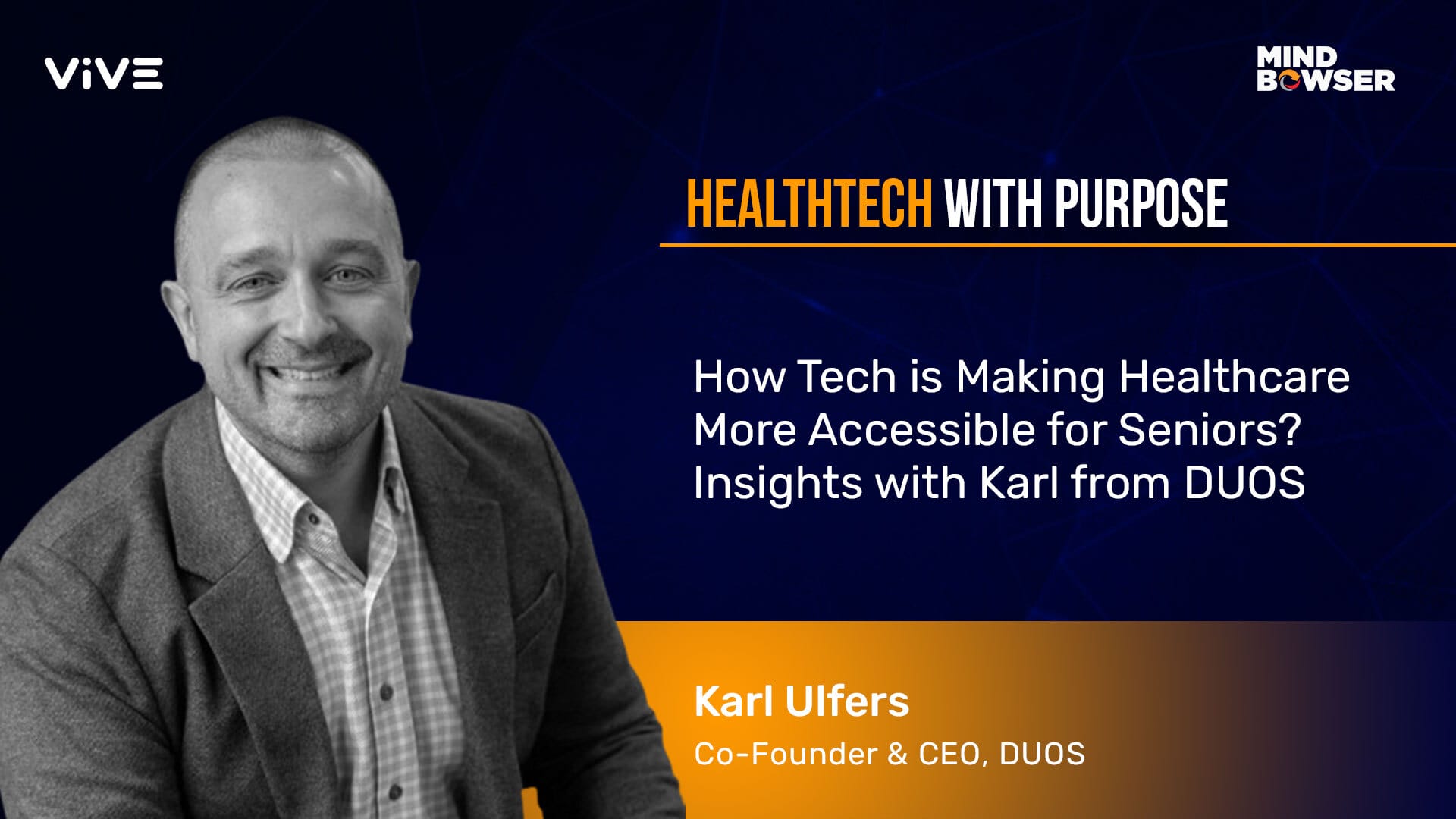
Welcome to HealthTech with Purpose! Karl Ulfers, CEO of Duos, discusses how they use tech to aid older adults in healthcare. Duos helps with daily essentials, employs AI for personalized care, and ensures accessibility without negative coverage decisions. Join us for insights at the tech-healthcare nexus! Learn how Duos leverages digital and human interaction to custom solutions, making healthcare more accessible and impactful for older adults.
Welcome to the HealthTech with Purpose podcast! Join us as Ari Tulla, CEO and co-founder of Elo Health, shares how his company uses AI and biometric data for personalized nutrition plans. Ari, a former athlete, discusses his health struggles and founding Elo Health. He highlights the importance of preventive care and the role of AI and wearables in promoting healthier lives.
Partner with us to design, build, and scale digital solutions that drive better outcomes.
Global Tech Teams LLC, 525 Washington Blvd, Industrious at Newport Tower, Jersey City, NJ 07310, United States.
Let’s discuss your goals, workflows, and next steps in a focused consultation call.
 Schedule a Call













 BLOGS
 NEWSROOM
 CASE STUDIES
 WEBINARS
 PODCASTS
 ASSET HUB
 EVENT CALENDAR