
Recorded at HIMSS 2023, this episode features Alan Hester, President at Nividous, with Mindbowser’s Rushikesh Kulkarni. Alan explains that Nividous combines three technologies it builds itself: robotic process automation (RPA) for discrete tasks, business process management for workflow, and AI. The point is end-to-end automation, where bot steps, human steps and external systems sit in one process that captures data for reporting. He argues against the early RPA mindset of counting how many people a bot can replace. His alternative: humans do what humans are best at, machines do the mind-numbing work, and growth-oriented companies use automation to offset hiring costs and free time for innovation. In healthcare, he sees the strongest demand in revenue cycle management, from setting appointments through claims and payments, with results in call center conversion and patient survey response rates. On generative AI, he predicts that generic models will stay “party tricks” until someone builds healthcare-specific ones.
Alan draws a clear line between task automation and process automation. An RPA tool automates a discrete task, such as copying data from an email or spreadsheet into another application. An enterprise process, though, strings together many such steps, some of which will always need a person: someone in one role talking to someone in another, or a customer support conversation. Nividous builds RPA, workflow and AI into one platform so bot steps, human steps and system steps sit in a single end-to-end process. The real benefit, in his view, is the data captured across all of it, which feeds reporting and dashboards.
Asked where healthcare organizations want automation first, Alan points to revenue cycle management, because that’s where they see direct impact on the bottom line. From setting the first appointment to submitting claims and processing payments, the cycle is full of highly manual steps. That’s the ground RCM automation services cover. He notes the technology is used across payers, providers and clinical settings, and that its value comes from supplementing people. Call centers set up only to book appointments typically convert poorly; when automation supports the humans on the line, he says, callers get a better experience and conversion improves. The same applies to patient surveys after care, where making feedback effortless lifts response rates. Supporting agents rather than replacing them is also the design principle behind healthcare contact center automation.
Alan says a stagnant organization looks at automation as hours saved against a full-time salary. A growth-oriented one sees a different equation: the full cost of the extra headcount needed to hit revenue goals, including recruiting, training, onboarding and attrition. Offsetting some of that hiring with automation, he argues, builds in the margin most teams say they lack for innovation. Michael Archuleta, a hospital CIO, made a similar case on this show for letting doctors be doctors through automation.
On generative AI, Alan’s view in early 2023 was that general models like ChatGPT are useful for “party tricks” and small tasks. To be useful in normal healthcare business processes, he said, someone will have to take the time to build healthcare-specific models.
[The opening, from 0:00 to 0:25, plays under music and is not captioned; the transcript starts mid-answer.]
…it’s just been great for us. This is our second time at HIMSS. Last year we were very overwhelmed by the size, but this year we came into it knowing what to expect, and we’ve had a lot of great conversations.
Amazing, amazing. So Alan, we’d like to know a little bit more about you and your background.
Sure. My name’s Alan. I live in New Jersey and work for a company called Nividous. I’ve been involved in a lot of companies over the course of my career, most notably Xerox and the US Navy. I came to Nividous because I appreciated the passion for trying to make a difference with people. A lot of technology companies are more focused on the tech than on the people.
I’ve always been a tech person, since I was a small child. I was really weird in my youth and saved up my money to buy a computer instead of a bike or a car or something like that. I was very interested in computers at an early age, so I’ve always been interested in technology. But as technology becomes more prevalent in society, I’m a little bit concerned about what that’s doing to our interactions with people. So I was very interested in being part of a company that was focused on the dynamics of people and interactions with people, and on using technology for the advantage and benefit of [inaudible].
Yeah. So thank you for sharing your background; pretty interesting. I would like to know a bit more about your company and what it does.
Sure. Our focus is on intelligent automation, and there are a lot of different components to that from a technology perspective. Without going into any great detail to bore people, I’ll give it at a very high level. There are three main elements of technology combined in our platform, and they’re all integrated together, so that people can build on their own, or we can help them build, or we have partners who can help them build, automation solutions that account for end-to-end automation.
So here are the three pieces of technology at a high level. We have robotic process automation, often called RPA. We have business process management, or business process automation, often referred to as workflow. And then we have artificial intelligence, or AI, and obviously AI is more of an umbrella term; there are a lot of different components in that. All of these technologies are built by us. They’re not licensed from other people, and they’re part of this single platform we’ve built specifically for performing these end-to-end automations.
To give a little more flavor around what I mean by end-to-end automations: if you look at an RPA tool specifically, it will be focused on automating a discrete task. Something involving manual effort, where a human has to, let’s say, copy and paste something from one application to another, or from an email or a spreadsheet to something else. Those kinds of situations come up all the time in people’s workflows. An RPA solution will take that task, and instead of having a human do that work, it will get the bot to do it. That’s really great and can save a lot of time.
But what ultimately happens is that in an enterprise, the complete business process, from an end-to-end standpoint, encapsulates more than just that one discrete task. There might be lots of different steps like that, where data is pulled from different places and then combined. But there might also be tasks where a human will always be required. Maybe a certain person in a certain role has to talk to another person in a different kind of role, or maybe they’re interacting with a customer, or maybe it’s a customer support type of task. Those kinds of things, we recognize, are best done by a human, and you want a human to be able to do them. But you still want to have the benefits of having that process automated, and the key benefit is gathering data around it.
So from an end-to-end standpoint, you can have all these different steps. Some of them will be automated steps done by bots, some will be steps done by humans, and some might be steps done by different systems or combinations of systems. You can build that complete automation together, end to end, using our platform, and capture data around all of it, which means you can report on all of it, build dashboards around it, and ultimately use that as a way to grow your business and make your business better.
Yeah, that’s interesting, because what you’re saying is there are things that need automation, but then there’s certain intelligence behind that as well, and automation along with the key components a human brings in is where the value gets created.
Exactly right. When RPA first came out, you would hear this a lot, where people were using RPA as an offset for humans: “Okay, if I bring in a bot, how many people can I get rid of?” We don’t want that kind of thinking. We want humans to be focused on the tasks they’re best at, and not have to do the stupid, mind-numbing tasks they don’t want to do. Because not only is it going to make them unhappy, and they’ll probably end up leaving their job because they don’t like doing it, but they’re also not going to do it that well. They want to do other things, so they’re going to do it as quickly as possible, and there’s going to be a lot of opportunity for error. So we want humans to do what humans are best at, and machines to do what machines are best at.
It’s optimizing at both ends. Awesome, awesome. So what are certain applications of the platform you see in healthcare? If you can, give a use case you’ve already implemented.
Certainly. I would say we’ve seen a lot of use cases across the board in healthcare, and even outside of healthcare. But with a focus on healthcare, the top area where people are interested in automation is usually revenue cycle management, or RCM, because that’s where they see the direct impact to their bottom line. From the stage of initially setting appointments with patients to the point where claims are submitted and payments are processed, across that complete cycle there are great opportunities for automation, because a lot of highly manual steps are typically involved in the process.
Amazing. And who are the main users, so to say? Is it a technology being adopted by providers, because you mentioned the revenue cycle? And across the span of healthcare, what other use cases do you foresee?
Yes, I’d say it’s being used across the board: payers, providers, even clinical settings. There’s a lot of opportunity for this kind of technology, not just to remove the manual tasks, but also to elevate the customer experience. When you use the technology not in place of humans, but as a supplement for the humans, you can get to a much better patient experience, or patient journey.
Yeah, that’s a very nice take. When we move to automation and AI, which is a big buzzword, the first point that comes to mind is: are we replacing humans, and what jobs will be affected? But what you’re saying is that if it’s done intelligently, it’s actually beneficial for everybody.
Right, right. And we see this especially with companies that are growth oriented. When you think about it from the standpoint of a stagnant organization, and you think about how putting an automation in place saves x amount of hours, then it’s easy to draw that equivalency: “Okay, we’re saving x amount of hours. If that adds up to more than the hours of a full-time employee, why am I paying extra people for that?”
But when you look at it from a growth mindset, it’s a completely different equation. When you look at your revenue goals and what it will take to achieve them in terms of additional headcount, you see the cost of adding that headcount: not just the salaries, but the cost and time involved in recruiting, the education, the onboarding. All of that is difficult, and then you still have fallout from that. So if you can offset some of that employee growth with automations, it becomes a much more attractive equation for growth.
Exactly. And another aspect of it is the hours that are saved: the same employee can put those hours into something they’re skilled in, or give more productivity to the organization, apart from doing certain mundane tasks that can be automated.
Exactly. And one of the things that often comes up as one of those tasks where a lot of organizations feel they just don’t have enough time is innovation. A lot of companies say, “We know we should be spending more time on this. We see other companies emerging that are doing these really cool and interesting things, but we just don’t have enough time. Everyone is busy just keeping the business running, and we can’t afford to take that time.” This is a way you can build in some margin, so you can take some time.
Yeah, exactly. Pretty interesting. So what’s your take on AI? I’ve been hearing something called responsible AI, especially when it comes to healthcare. What’s your overall take on the AI side of things?
Well, obviously there’s a lot of buzz around AI right now, with ChatGPT and the generative AI, the conversational AI, that’s coming to the forefront. Within the healthcare space, one of the things I haven’t heard many people talking about, but which is going to become a problem, 100%, is that it will have to be an industry-focused model that can drive things forward to any advanced level within healthcare. The generic models we have out there right now, like ChatGPT, could be useful for party tricks and maybe some little bits and pieces here and there. But for it to really advance to the level where it’s useful in normal business processes, there are going to have to be more specific healthcare models built. And it can be done; it’s just that no one has taken the time to do that yet. I think that’s where we’ll see this go over time: people are going to start taking the time to do that, because they’re going to start realizing what the possibilities can be. And I think it can take us in a lot of exciting directions in terms of how this additional technology can supplement what we’re already doing.
Amazing, amazing. Awesome. One of the key things I would like to know is what kind of impact is being created because of your technology in the health tech space. Any comments on that?
Sure. We certainly have a ton of case studies posted on our website to give you all kinds of numbers, which I don’t recall off the top of my head as exact numbers, but I can give you some insight into the kinds of things we see. We talked about appointment setting as the front end of RCM. This is often a task that’s not only very manual, but also has a very low conversion percentage. If you have a call center set up just to create appointments, their success rate is typically very, very low. What we’ve seen is that when you build automations in, where you use the technology to supplement the humans, it creates a better experience for the caller, the patient, and you get much better conversions as a result. We see the same thing on the payment processing side, as well as with NPS (Net Promoter Score).
This is another area where a lot of companies struggle to get a quality number of responses. When you’re giving patients surveys after their service, a lot of people just don’t want to be bogged down with stuff like that, and no matter how easy you make it, your response rates are going to be very low. We’ve been able to build some good automated systems that make it very seamless to get that kind of feedback, so the patient isn’t inconvenienced by doing it, and you see much, much better response rates.
Awesome, awesome. To my final question: what is the purpose of Nividous, and how do you see it scaling up?
I think our purpose overall is to help other companies make the best of their business. We always talk about helping them operate at their peak efficiency; that’s really what we’re all about, and we leverage technology to do that. One of our key differentiators, which I didn’t really talk about much already, is that we bring a process-based way of thinking into the mix. You heard me talk a lot about end-to-end business processes. That’s really our differentiator and our pedigree: we have this process way of thinking, and we have the skill set internally to help you build that within your organization.
It’s the way our products are built as well. If you look at how you build a process in our platform, it’s all based around that step-by-step process approach I was talking about. You can see those discrete steps: this automated step is performed by a bot, followed by this human step, followed by this automated step, followed by an interaction with these external systems. And you can see it all broken down into a process [inaudible].
Awesome. Thank you, thank you, Alan, for joining us, and thank you for sharing your insights. I appreciate your time.
Awesome, awesome, thank you.
At the time of recording (HIMSS 2023, published May 2023), Alan Hester was President at Nividous, an intelligent automation company whose platform combines robotic process automation, business process management and AI, all built in-house. Based in New Jersey, he has been involved with organizations including Xerox and the US Navy, and has been interested in computers since childhood.
Stuck with manual steps between your scheduling, billing and claims systems? Walk us through the workflow and we’ll show you where automation fits and where people should stay in the loop.
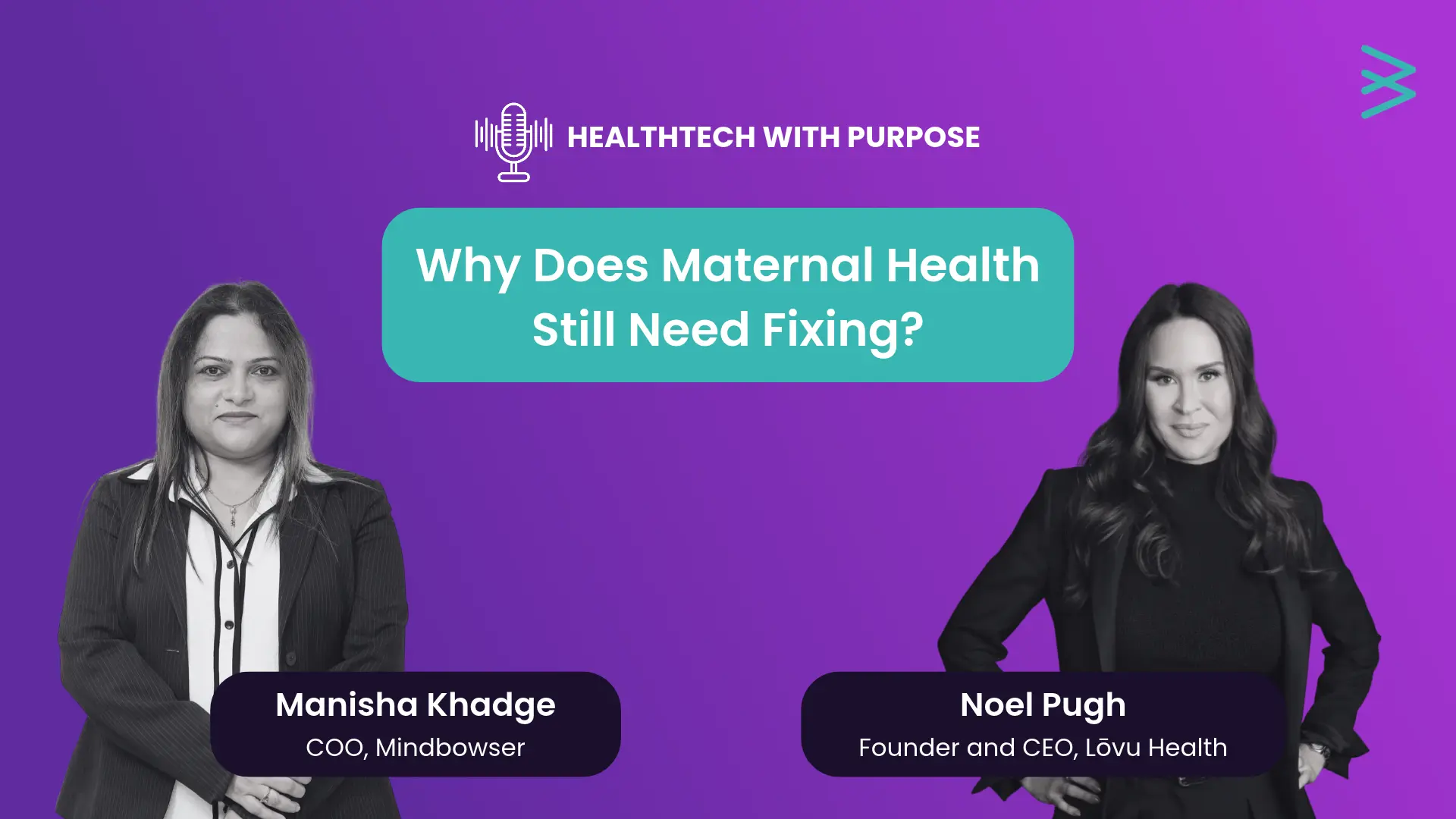
Noel Pugh, Founder & CEO of Lōvu Health, joins host Manisha Khadge, COO of Mindbowser, to unpack why maternal healthcare needs to move beyond monitoring complications toward supporting the everyday needs of mothers. She traces Lōvu Health’s journey building an insurance-reimbursed maternal monitoring and navigation program that connects mothers, clinicians, and community resources.
The conversation gets into the practical side of building that model: remote physiological monitoring, care navigation, EHR interoperability, and bidirectional data exchange. Noel explains how Lōvu’s athenahealth integration helped automate workflows, reduce manual work, and create a foundation for scaling across more healthcare organizations.
She also shares how Lōvu Health is approaching agentic AI, with potential applications across maternal navigation, clinical workflows, revenue cycle operations, and service recommendations, while keeping humans involved in critical decisions. The conversation closes with the realities healthcare founders face around reimbursement, investor skepticism, clinical adoption, go-to-market, and choosing the right technology partner.

Welcome to HealthTech with Purpose! Karl Ulfers, CEO of Duos, discusses how they use tech to aid older adults in healthcare. Duos helps with daily essentials, employs AI for personalized care, and ensures accessibility without negative coverage decisions. Join us for insights at the tech-healthcare nexus! Learn how Duos leverages digital and human interaction to custom solutions, making healthcare more accessible and impactful for older adults.
Partner with us to design, build, and scale digital solutions that drive better outcomes.
Global Tech Teams LLC, 525 Washington Blvd, Industrious at Newport Tower, Jersey City, NJ 07310, United States.
Let’s discuss your goals, workflows, and next steps in a focused consultation call.
 Schedule a Call














 BLOGS
 NEWSROOM
 CASE STUDIES
 WEBINARS
 PODCASTS
 ASSET HUB
 EVENT CALENDAR