














 BLOGS
BLOGS  NEWSROOM
  CASE STUDIES
  WEBINARS
  PODCASTS
  ASSET HUB
  EVENT CALENDAR
















Electronic Health Records (EHR) have evolved significantly since their inception, transforming how healthcare providers store and access patient information. Initially created to digitize paper records, EHR systems now support real-time updates and comprehensive medical histories. This innovation has become a cornerstone of modern healthcare, improving care coordination, reducing errors, and streamlining operations. The global EHRs market reached USD 27.42 billion in 2023, with projected growth to reach USD 41.87 billion by 2033.
Artificial intelligence has made remarkable strides in healthcare, offering applications ranging from diagnostics to predictive analytics. AI helps doctors analyze complex datasets, identify patterns, and aid decision-making processes. The synergy between AI and healthcare advancements is reshaping patient care, as AI can assist in diagnosing diseases faster, personalizing treatment plans, and reducing administrative burdens.
AI integration into EHR systems is becoming a major focus in healthcare technology. AI in EHR systems allows healthcare providers to shift through vast amounts of data, enabling quicker, more accurate decision-making. AI’s ability to predict patient outcomes and suggest optimal treatment plans is driving better care management. The industry is moving toward smarter, more efficient healthcare delivery as AI and EHR converge. This integration improves patient outcomes and simplifies the complexities of managing healthcare data, setting the stage for future innovations.
I. Benefits of AI in EHR Systems
A. Improved Diagnostic Accuracy
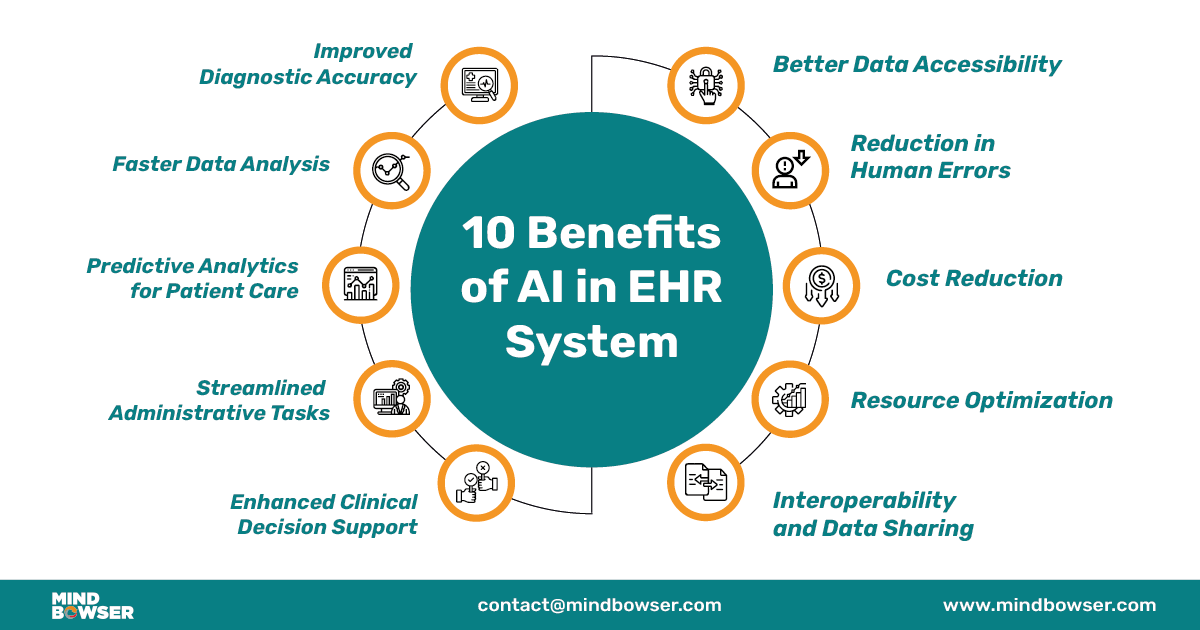
AI in EHR systems enhances diagnostic precision by identifying patterns in patient data. For instance, AI can detect early warning signs of diseases like cancer by analyzing medical histories, test results, and doctor’s notes. It reduces human error and ensures accurate diagnoses, which is particularly important for complex conditions.
B. Faster Data Analysis
AI speeds up data analysis within EHR systems, enabling healthcare providers to extract relevant information from vast datasets faster. By analyzing unstructured data such as clinical notes, AI reduces the time spent on administrative tasks. It allows healthcare professionals to spend more time on patient care, while AI handles data sorting, pattern recognition, and even clinical decision support.
C. Predictive Analytics for Patient Care
AI helps predict future patient outcomes by analyzing existing medical data. For example, AI algorithms can predict the likelihood of readmissions or complications following surgeries. This allows healthcare providers to take preventive measures, improving patient care and reducing hospital costs. Predictive analytics aids in personalizing treatment plans, ensuring that patients receive the care that best suits their medical needs.
D. Streamlined Administrative Tasks
AI significantly reduces the burden of administrative tasks in EHR systems. It automates repetitive processes such as appointment scheduling, billing, and coding, which are typically time-consuming. AI systems can complete these tasks faster and more accurately, minimizing the chances of errors and freeing up healthcare staff to focus on direct patient care.
E. Enhanced Clinical Decision Support
AI in EHRs provides clinicians with valuable decision support by offering evidence-based recommendations. It processes large volumes of data to suggest treatment options, track medication interactions, and flag potential risks. It helps doctors make well-informed decisions faster, improving overall patient outcomes.
F. Better Data Accessibility
With AI, EHR systems can quickly pull relevant data from patient records, ensuring that healthcare providers have the information they need at their fingertips. AI organizes and filters vast datasets, presenting clinicians with a clear overview of patient histories, test results, and treatments, which enhances workflow efficiency and speeds up decision-making.
G. Reduction in Human Errors
AI reduces human errors by automating data entry and analysis processes within EHR systems. This ensures accuracy in patient records, medication prescriptions, and treatment plans. By minimizing errors, AI improves patient safety and decreases the legal and financial risks associated with medical mistakes.
H. Cost Reduction
AI-driven EHRs reduce operational costs by automating routine processes and improving predictive maintenance. By forecasting equipment failures and identifying inefficiencies, AI helps healthcare organizations prevent costly downtimes and reduce labor costs. This allows institutions to save resources while maintaining high-quality care
I. Resource Optimization
AI improves resource management by optimizing staffing levels, inventory management, and resource allocation in healthcare facilities. AI can predict patient inflow, helping hospitals allocate staff and resources more efficiently, reducing wastage, and improving overall operational performance.
J. Interoperability and Data Sharing
AI facilitates interoperability between EHR systems, making sharing data across platforms and healthcare providers easier. The seamless data sharing enhances collaboration among healthcare professionals, leading to better patient outcomes and more cohesive care plans. AI ensures that critical patient data is accessible to the right people at the right time.
Related Read: The Future of Interoperability in Healthcare
II. Use Case of AI in EHR
A. How AI Transformed Childbirth Management and Achieved Significant Cost Savings
AI integration into EHRs played a pivotal role in transforming childbirth management for our clients. By harnessing machine learning, the platform provided accurate delivery time estimates for pregnant women, allowing healthcare providers to plan better and reduce unnecessary interventions. This predictive capability improved clinical efficiency and helped in making data-driven decisions, particularly in labor management.
The integration of Epic, combined with SMART-ON FHIR technology, enabled real-time data updates and automated post-delivery processes, ensuring that all necessary details were promptly recorded in the EHR. This helped streamline the entire workflow, ultimately enhancing patient care.
The results of AI integration were remarkable, demonstrating its real-world benefits. The implementation led to a 15% reduction in average delivery time, a 34% improvement in cesarean delivery rates, and an average cost savings of $23,500 per case. By automating data collection, ensuring secure data exchange, and improving overall accuracy in decision-making, AI reduced operational costs and helped healthcare providers focus on what matters most—delivering safe and efficient care to mothers and infants. This case underscores how AI-driven EHR integration can make a tangible impact on healthcare outcomes.
IV. How AI in EHR Writes Back to Clinical Systems Safely: FHIR + Audit in Practice
A. How Do FHIR APIs Enable Structured, Secure Writebacks?
AI in EHR integrations relies on FHIR (Fast Healthcare Interoperability Resources) APIs to perform structured and validated writebacks. Using RESTful create and update operations with resource validation and transaction bundles, every change is atomic — meaning incomplete writes never reach the record.
Capability statements and server policies further constrain what the AI system can write, preventing unauthorized updates. Each writeback is paired with Provenance metadata (source, agent, purpose), ensuring the entire chain of responsibility is visible for audits and compliance.
In short, FHIR transforms AI-driven EHR writebacks into governed, traceable operations, rather than free-form data edits.
B. What Is the Role of SMART-On-FHIR Launch Contexts in Epic and Oracle Health?
SMART-on-FHIR provides the security context that governs how AI in EHR apps launch inside major systems. Every launch happens in a user and patient context, applying least-privilege scopes so the AI model only accesses the minimum data required.
- Epic EHR: Uses Open Epic LaunchPad with developer tools to emulate production conditions, validate user context parameters, and confirm scope behavior before deployment.
- Oracle Health (Cerner EHR): Operates an authorization and scope negotiation framework to handle AI read/write permissions securely and dynamically.
These mechanisms ensure that when AI in EHR systems act within Epic or Oracle, they do so with contextual awareness, compliance boundaries, and full accountability.
C. How Is Traceability Enforced End to End?
Traceability is the backbone of compliance for AI in EHR writebacks. Each access or modification event is logged through FHIR AuditEvent, capturing who did what, when, and why.
AuditEvent records include time, user identity, affected resource, and action — all linked to application sessions. To strengthen compliance, organizations maintain immutable audit logs and periodically reconcile clinical notes against audit trails.
This end-to-end visibility makes it possible to demonstrate full traceability for regulators and internal compliance teams.
D. Which Controls Keep PHI Safe in AI Writebacks?
Securing AI in EHR writebacks involves multiple layers of defense:
- Encryption & token controls: Scope-limited tokens, refresh, and revocation policies.
- Access governance: Role-based permissions, “break-glass” overrides, and differential privacy for de-identified data use.
- Validation & attestation: Checkpoints and commit approvals, aligned with NIST HIPAA guidance (SP 800-66), ensure that every write meets integrity and compliance standards.
Together, these safeguards make AI in EHR ecosystems compliant by design, not by patchwork.
V. Prompting Patterns for Clinical Notes: Lessons From Early AI in EHR Pilots
A. How Are Models Tuned for SOAP Note Generation?
Early deployments of AI in EHR documentation show the value of section-aware prompting — aligning model outputs to the SOAP (Subjective, Objective, Assessment, Plan) structure. This reduces drift, duplication, and missing fields.
Modular pipelines, audio to transcript to structured note, outperform monolithic models. Adding retrieval and template grounding further standardizes results.
The outcome: AI in EHR systems generate more complete and compliant clinical notes, improving both clinician satisfaction and audit readiness.
B. What Prompt Structures Reduce Hallucination and Bias?
Reducing hallucination in AI in EHR documentation requires structured constraints:
- Checklists and citation tags limit speculative output.
- Few-shot “according-to-source” prompts improve factual accuracy.
- Specialty-specific bias audits and red-team reviews detect gaps before live use.
The result: documentation that’s factual, auditable, and safe for clinical decision-making.
C. How Does This Fit Inside the EHR for Summaries and Discharge Notes?
Within the EHR, SMART launch contexts attach to the patient record, giving the AI system scoped read access and staged write permissions. Clinicians then perform human-in-the-loop review, applying edits, digital signatures, and audit mark-ups before finalization.
Early AI in EHR pilots report measurable benefits — time savings, improved readability, and reduced after-hours documentation — proving that structured automation can coexist with compliance.
VI. The Cost Math of EHR Rollouts: First vs. Subsequent AI Deployments
A. Why Is the First AI + EHR Integration the Most Expensive?
The first AI in EHR integration absorbs one-time costs for:
- Security reviews and HIPAA risk assessments
- New FHIR mapping and exception handling
- Workflow redesign and clinician adoption
These steps establish your compliance and integration blueprint, setting the foundation for scalable rollout.
B. How Do Reusable Components Cut Time and Cost?
Reusable FHIR connectors, audit modules, and mapping libraries shorten future deployments. Standardized prompt libraries and validation playbooks for each specialty further reduce engineering lift.
Across Mindbowser’s client base, repeat rollouts show up to 60% lower cost and deployment time thanks to our templated frameworks and accelerators, including HealthConnect CoPilot and AI Medical Summary.
C. What ROI Benchmarks Should Leaders Track?
To measure the success of AI in EHR adoption, track:
- Documentation time per encounter and after-hours EHR use
- Prior authorization turnaround and denial rates for FHIR-enabled workflows
- Adoption curve, exception rate, and model update cost per site
These benchmarks reveal how compliance-first AI deployment accelerates both operational ROI and clinical efficiency.
How can Mindbowser help you integrate AI into EHR systems?
The integration of AI in EHR systems is transforming healthcare by making clinical data more accessible, accurate, and actionable. EHRs store large amounts of patient information, but the real value lies in how this data is analyzed and utilized. AI is helping healthcare providers move beyond simple data entry by offering predictive insights, streamlining administrative tasks, and improving diagnostic accuracy. For instance, AI tools can analyze patient records to predict health outcomes and assist in personalized treatment planning. The combination of AI and EHR systems allows healthcare providers to manage patient data more efficiently, driving better clinical decisions and improving overall care.
HealthConnect CoPilot from Mindbowser can be a powerful workflow for integrating AI into your existing EHR systems. By providing customizable solutions, it bridges the gap between AI technology and healthcare practices. It enables smoother data exchange, making patient information available for real-time analysis and reducing administrative burdens. Through its AI-driven features, we can help healthcare providers make informed decisions faster, improving patient care while minimizing manual efforts. Whether it’s automating routine tasks or enhancing data analytics, HealthConnect CoPilot ensures that healthcare teams can fully use the potential of AI in EHR systems to achieve better outcomes.
AI in EHR will enhance data accuracy, streamline administrative tasks, and offer predictive insights to assist healthcare providers in diagnosing, treating, and managing patient care efficiently.
AI in EHR systems improves decision-making, reduces manual errors, speeds up documentation, and enhances patient outcomes by analyzing large volumes of health data quickly and accurately.
AI enables personalized treatment plans by analyzing patient history and identifying patterns in data, allowing for more precise and timely care recommendations.
Yes, AI automates routine tasks like coding, documentation, and claim submissions, freeing healthcare providers to focus more on patient care and reducing the overall administrative workload.
AI-driven EHR systems prioritize data security by employing advanced encryption and access control measures to ensure compliance with healthcare regulations like HIPAA, protecting patient information from breaches.