





 BLOGS
BLOGS  NEWSROOM
  CASE STUDIES
  WEBINARS
  PODCASTS
  ASSET HUB
  EVENT CALENDAR


























TL;DR
Every definition calls revenue cycle management a cycle, and almost no organization runs it as one. It is staffed as five departments that do not share a system, with four handoffs between them and nobody accountable end to end, which is why most denials are handoff failures rather than billing failures. The useful question is not what the cycle is, but who owns a claim being paid correctly the first time.
Every definition of revenue cycle management describes a cycle. In almost no organization is it run as one.
That gap is the whole subject. You can read a clean definition of the revenue cycle in about thirty seconds, and it will not tell you why a well-run practice with competent staff still writes off claims it was entitled to collect. This guide gives you the definition, and then it gives you the part that actually explains the money.
What Revenue Cycle Management Actually Is
Revenue cycle management is the set of administrative and clinical processes a healthcare organization uses to capture, bill and collect payment for care delivered. It begins when a patient makes contact, and it ends when the balance for that encounter reaches zero, whether the money came from a payer, the patient, or a write-off.
That is the definition, and it is worth being precise about three things inside it.
It is administrative and clinical, not just financial. The clinician’s documentation is a revenue cycle input. So is the front desk keystroke that records an insurance member ID. Treating the revenue cycle as a back-office finance function is the most common structural error in the discipline, and most of this guide is about its consequences.
It ends at zero balance, not at claim submission. A submitted claim is not revenue. A paid claim at the wrong contracted rate is not full revenue either, and it will close as a zero balance while quietly under-collecting.
It is a cycle in the sense that it repeats per encounter, not in the sense that one team carries an encounter around the loop. This is where the definition and the reality separate.
If you want the operational walkthrough rather than the concept, our comprehensive guide to the RCM process covers all twelve stages in order. This page is about what the stages add up to.
Where The Cycle Really Starts
Ask most people where revenue cycle management begins and they will say billing. Billing is where it becomes visible. It is not where it begins.
The cycle begins at scheduling, at the moment someone records who the patient is, who is expected to pay, and what the encounter is for. Every downstream step inherits that information. When it is wrong, the error travels the entire length of the cycle before anyone notices, and by then it has become a denial with a clock running against it.
This produces the most counter-intuitive fact in the discipline: a significant share of the most expensive revenue cycle errors are made by staff who never see a claim. A scheduler who takes a member ID over the phone and mistypes one character has created a denial that a billing team will spend weeks resolving. The scheduler will never learn it happened.
Eligibility is the clearest case. The ASC X12N 270/271 eligibility inquiry and response has been a HIPAA-mandated standard transaction for well over a decade, which means the technical ability to check coverage before a patient arrives is not the bottleneck and has not been for years. Coverage errors remain one of the largest denial categories anyway. We look at exactly why in our guide to insurance eligibility verification, and the short version is that the problem is when the check fires and how much of the response gets read, not whether the technology exists.
The Five-owner Problem
Here is the thing the definition does not tell you.
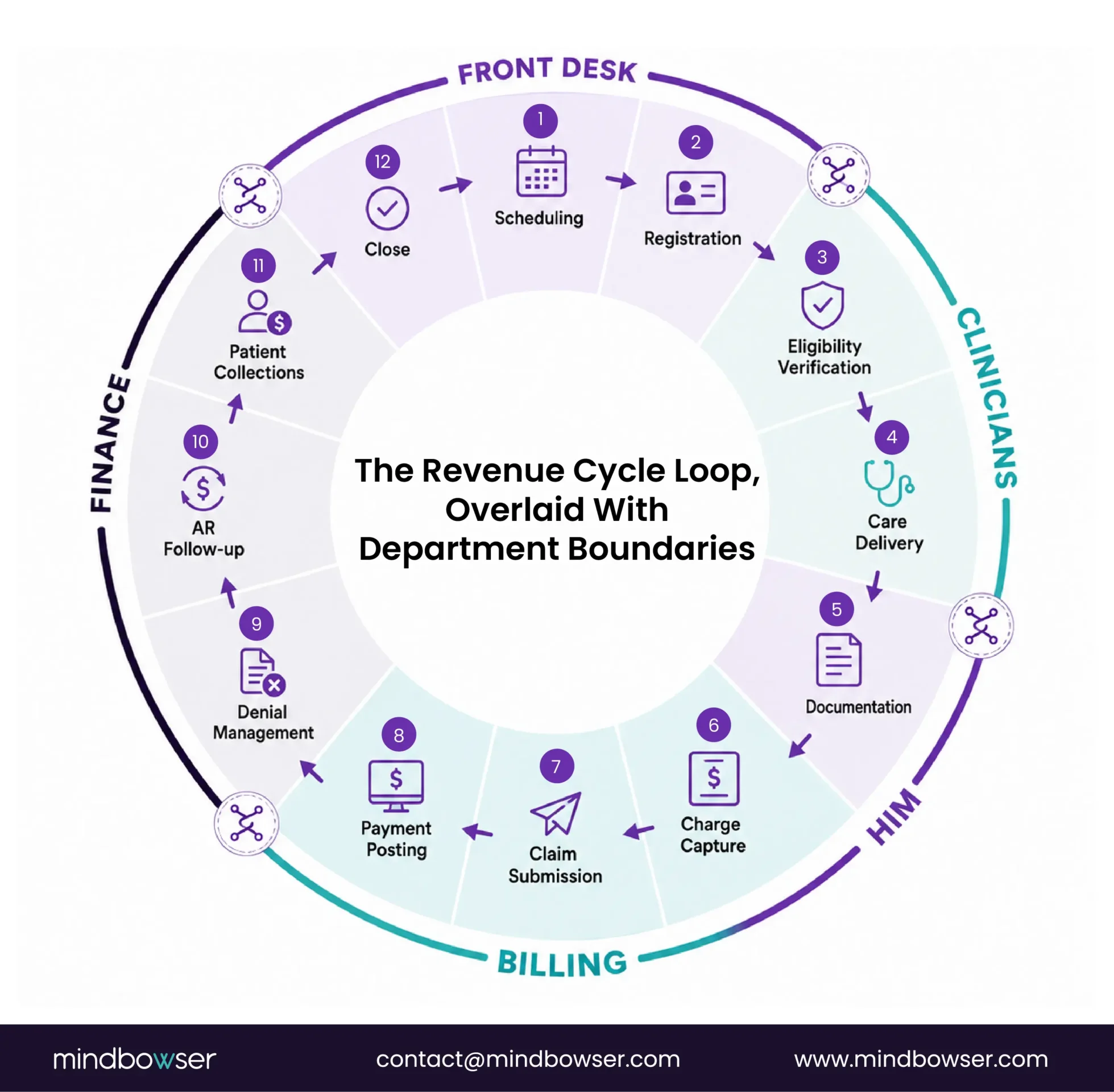
The revenue cycle is described as a loop. It is staffed as five departments that do not share a system.
- The front desk owns registration, demographics and insurance capture.
- Clinicians own documentation.
- Health information management owns coding.
- Billing owns claim submission and follow-up.
- Finance owns accounts receivable and the write-off decision.
Each of those teams has its own manager, its own performance measures, and frequently its own software. Between each pair there is a handoff. Four handoffs, five owners, and no single person accountable for the whole path.
This reframes what a denial is. A denial looks like a billing event because billing is where it lands. Structurally, most denials are handoff failures: information that was correct at one stage and incomplete, mistranslated or stale by the next. The billing team receives the consequence and gets measured on it, which is why denial rates are so resistant to being fixed by working harder in billing.
We did not arrive at this framing from theory. Three separate pieces of work in this cluster reached it independently, from different ends of the cycle: eligibility failures that originate at scheduling rather than billing, credentialing errors that surface months later as underpayments nobody attributes to credentialing, and denial queues that fail on routing long before they fail on appeal quality. Three problems, three teams, one structural cause.
The stages those five owners span
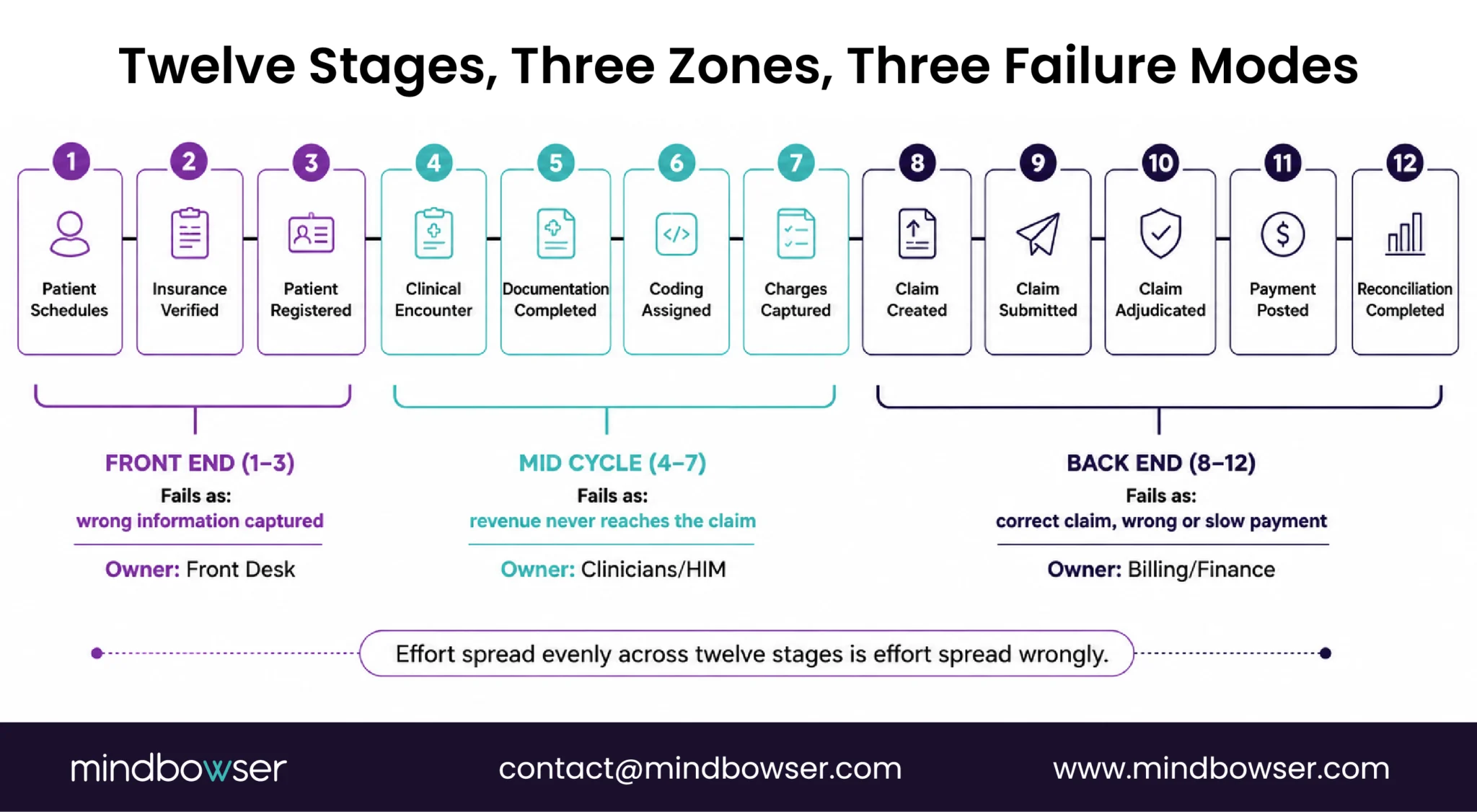
For completeness, the sequence:
- Pre-registration and scheduling
- Registration and demographic capture
- Insurance verification and prior authorization
- Care delivery
- Clinical documentation
- Medical coding
- Charge capture and charge entry
- Claim scrubbing and submission
- Payment posting and remittance
- Denial management and appeals
- Accounts receivable follow-up
- Patient collections and account close
We are deliberately not expanding these here. Each one is a discipline, and a stage-by-stage walkthrough already exists at our RCM process guide. Duplicating it would make both pages worse.
What is worth saying at this level is that the twelve stages group into three zones with very different failure modes, and that grouping is more useful than the list.
Build A Revenue Cycle That Supports Better Financial Outcomes.
Front End: Eligibility, Registration And Authorization
The front end covers everything before the patient is seen. Its failure mode is information that is wrong at the point of capture, and its defining characteristic is that failures are cheap to prevent and expensive to fix.
Three things happen here that decide a large share of downstream outcomes:
- Demographic and coverage capture: Name, date of birth, member ID, plan, coordination of benefits. A single transposed character propagates the whole way through.
- Eligibility verification: The 270 inquiry goes out, the 271 response comes back. The 271 typically carries far more than a coverage yes or no: plan detail, coordination of benefits, deductible status, and often service-level limitations. In many workflows it is read for the yes and the rest is discarded, which converts a rich data response into a binary and throws away the information that would have prevented the denial.
- Prior authorization: Where required and not obtained, the claim is dead on arrival regardless of how well everything downstream is executed. This is also the area facing the largest regulatory change in the near term, covered below.
Two external references are worth having if you are rebuilding this zone. The transaction itself is defined by X12, which maintains the 270/271 eligibility benefit inquiry and response standard. Separately, CAQH CORE publishes operating rules that sit on top of the X12 standard and specify what payers must actually return and how quickly, which is the layer that determines whether that eligibility data is present in practice rather than merely permitted by the standard.
For the detail, see insurance eligibility verification.
Mid Cycle: Documentation, Coding And Charge Capture
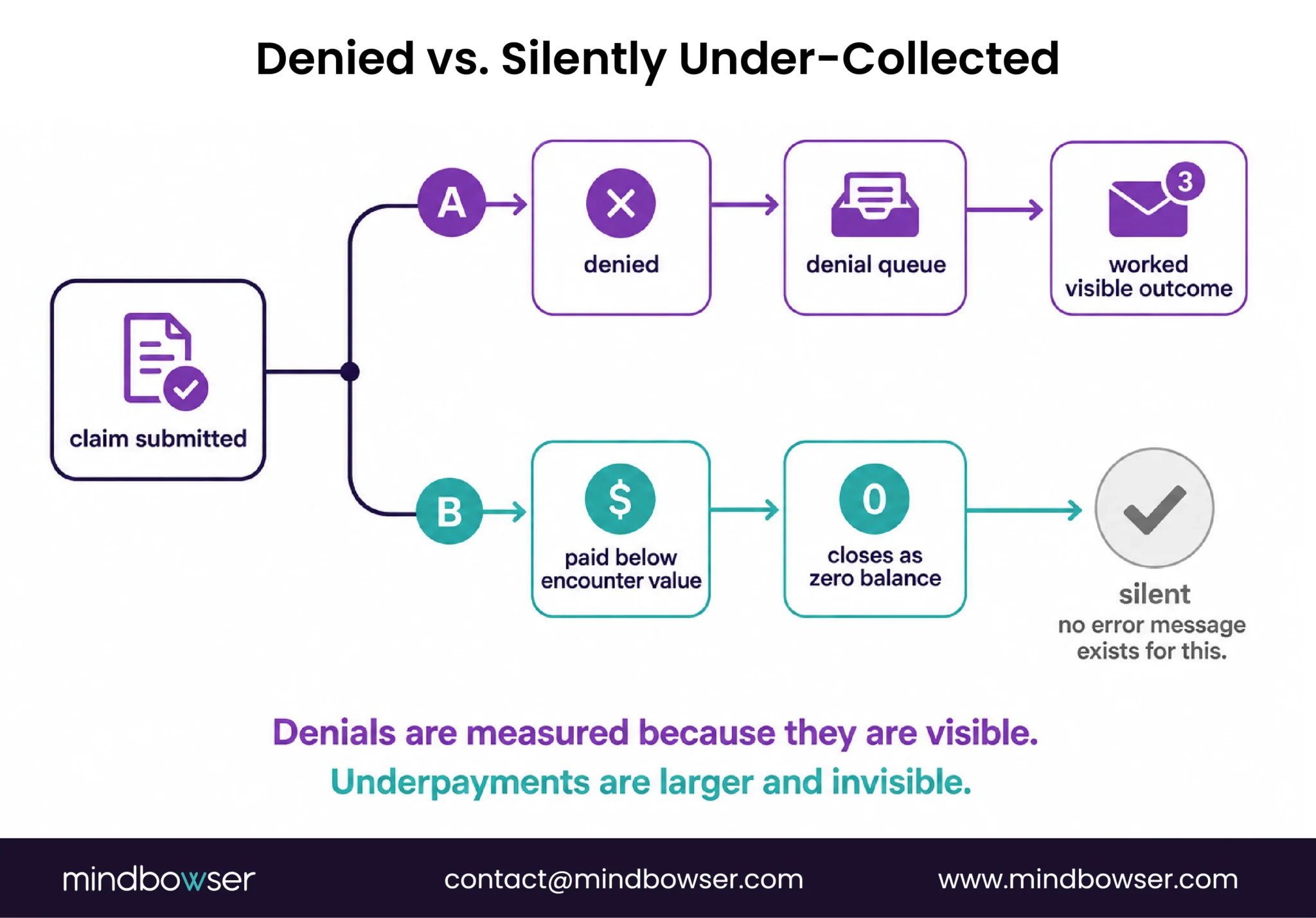
The middle of the cycle is where revenue is created or lost before a claim exists.
Clinical documentation is the source record. Coding translates it into the claim’s language. Charge capture makes sure every billable service actually reaches the claim. When any of the three is weak, the claim that goes out is accurate to a record that was already incomplete, which is why it will pass a scrubber and still under-collect.
Charge capture deserves separating out, because it is the one stage where the failure is an absence rather than an error. A service was delivered, it was clinically documented, and it never became a charge. Nothing rejects, because nothing was submitted. The reconciliation that catches it compares what the schedule and the clinical record say happened against what the charge file contains, and most organizations do not run it because there is no system prompting them to.
Documentation quality sits upstream of all of it and is the hardest to move, because the people producing it are clinicians whose primary job is not revenue. Any documentation initiative that reads to a clinician as an administrative burden will decay within a quarter. The ones that hold are the ones that reduce clicks while capturing more, which is a product problem rather than a training problem.
This is the least visible failure mode in the entire cycle, because nothing is denied. The claim pays. It simply pays less than the encounter earned, and there is no error message for that. Our guide to clinical documentation integrity and charge capture deals with how organizations find revenue that was never billed rather than revenue that was billed and refused.
Back End: Claims, Denials And Accounts Receivable
The back end is where the cycle becomes visible and where most revenue cycle attention is spent, largely because it is the only zone with obvious metrics.
- Claim submission and scrubbing: The claim goes out as an 837 transaction. Payment comes back as an 835 remittance. Where the two are reconciled automatically and where they are handled by hand is one of the better indicators of a revenue cycle’s actual maturity.
- Denial management: The critical and widely missed point is that denial handling is a routing problem before it is an appeal problem. Remittances carry claim adjustment reason codes and remittance advice remark codes. Many workflows key their queues on the reason code, when the remark code is frequently the one that says what actually needs to be done. The result is that structurally unrelated problems land in the same queue and are worked by the same team with the same process, which suits none of them. We work through this in denial appeals and routing in eClinicalWorks.
- Accounts receivable follow-up: Unrouted or slow-moving denials age. Aged denials eventually cross a payer’s timely filing limit, at which point an appealable denial becomes a mandatory write-off. Timely filing limits vary widely between payers, from around thirty days at the aggressive end to two years at the generous end, which means an AR process tuned to an average will systematically lose money on the fast payers. See days in AR and timely filing.
The Layer Nobody Is Assigned: Contracts And Credentialing
There is a fifth area that does not sit inside the twelve stages and does not usually have an owner in the revenue cycle at all.
Payer contracts set the rate. Credentialing and enrollment determine whether a provider is entitled to it. Both are typically handled as administrative paperwork by whoever has capacity, often outside the revenue cycle function entirely.
This is a rate-setting function being treated as a filing function, and it produces the most under-diagnosed problem in the discipline. Credentialing has three failure modes and they are not equally visible:
- Not enrolled – Loud: Claims reject outright and somebody escalates within days.
- Enrolled late – Loud: There is a gap and it is obvious.
- Enrolled incorrectly – Silent: Claims pay, at a rate the contract does not actually say. Nothing rejects. Nothing queues. The money is simply lower than it should be, indefinitely, and the underpayment gets attributed to payer behavior rather than to an enrollment record.
The third one is the reason underpayment patterns often resist investigation. Teams look for the problem in the claims, and it is in the enrollment.
See payer contract management and provider credentialing and enrollment.
Two Parts Of The Cycle That Sit Outside The Three Zones
Both belong in any complete description of the revenue cycle, and neither fits neatly into front end, mid cycle or back end.
Patient responsibility: High-deductible plans moved a meaningful share of collections from payers to patients, which changed the revenue cycle’s last mile from a claims process into a consumer one. The operational consequence is timing: money is far easier to collect before or at the point of service than after the patient has gone home and received a statement weeks later. That makes price estimation and upfront collection a revenue cycle function rather than a front-desk courtesy, and it is the one part of the cycle where the counterparty is a person rather than an institution.
Compliance and data security: Every stage above moves protected health information, and the revenue cycle touches more of it, across more systems and more third parties, than almost any other operational function. Clearinghouses, billing vendors, coding partners and analytics tools all sit in the path. The compliance question is not whether each vendor is compliant, it is whether the chain is, and chains are only as good as the weakest business associate agreement in them. For teams building rather than buying, our RCM compliance in digital health product development covers where that lands during a build.
Neither is optional and neither is a bolt-on. They are properties of the whole cycle rather than steps within it, which is exactly why they get skipped in stage-by-stage descriptions.
How To Tell Whether Yours Is Working
Most revenue cycle reporting measures activity. The measures that indicate health are narrower.
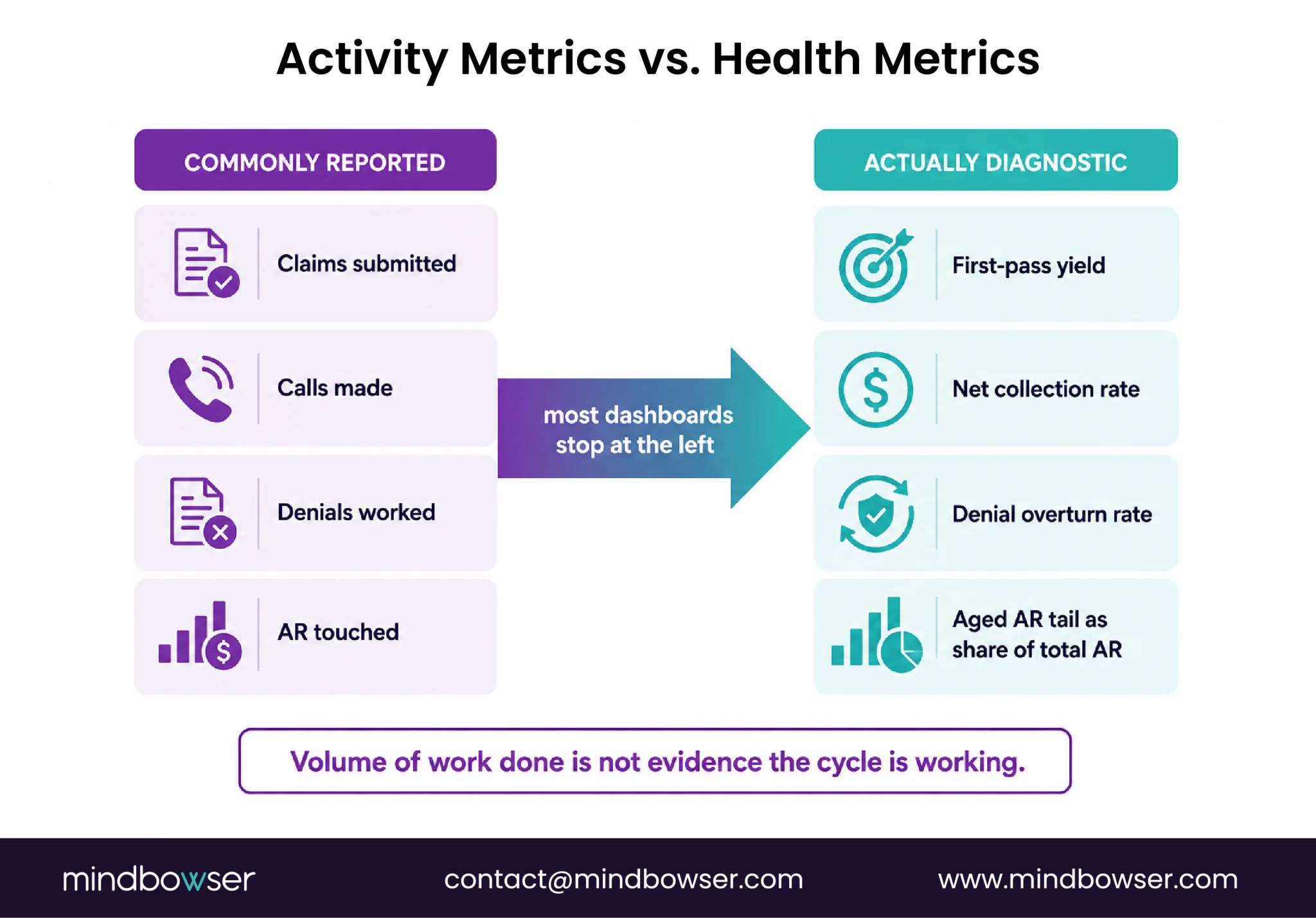
- Days in AR What it tells you: How long money takes to arrive · Watch for: An average that hides a bimodal distribution. A healthy mean with a large aged tail is not healthy
- Clean claim rate What it tells you: Share submitted without needing rework · Watch for: High rates achieved by a scrubber that rejects internally still cost the same labor
- Denial rate What it tells you: Share refused on first submission · Watch for: Meaningless without the overturn rate beside it
- First-pass yield What it tells you: Share paid correctly first time · Watch for: The single most honest number here, because it fails on both denials and underpayments
- Net collection rate What it tells you: Share of collectable revenue actually collected · Watch for: The one that catches silent underpayment
The Healthcare Financial Management Association publishes the MAP Keys, a standardized set of revenue cycle performance measures with agreed definitions. Using a standard definition matters more than it sounds. A large share of revenue cycle benchmarking disagreements are two organizations computing the same-named metric differently.
How to actually run the diagnosis
Metrics tell you something is wrong. They do not tell you where. Two exercises do, and both can be run by an analyst in a week without buying anything.
The denial-origin trace. Take one month of denials, or a random sample of 200 if the volume is large. For each one, do not record the denial code. Record the stage that created the condition the code is complaining about. A coverage-termination denial originated at eligibility. A missing-authorization denial originated at scheduling or at the authorization step. A medical-necessity denial usually originated in documentation. A duplicate-claim denial often originated in billing itself.
Then count by stage rather than by code. The distribution is almost always a surprise, and it is nearly always more front-loaded than the team expects. The value is not the count. It is that the denial stops being a billing statistic and becomes a specific team’s output.
Two cautions. Do not let the billing team run this alone, because the answer implicates other departments and the exercise needs to survive that. And resist the urge to assign blame with it. The finding is usually that a handoff has no owner, not that a person is careless.
The underpayment sample. Take 100 paid claims across your top three payers. Compare the paid amount against the contracted rate for that code, that payer, that date of service. Not the expected amount your system calculated, the rate in the contract.
This is tedious and it is the only way to see the category. Underpaid claims close as zero balance and never enter a work queue, so no report you currently run will surface them. If the sample comes back clean, you have bought real assurance for a week of work. If it does not, you have found a recurring loss that has been running for as long as the contract has.
One caution on benchmarks. Comparing your days in AR to a national average is close to useless without adjusting for payer mix and specialty. A practice heavy in Medicaid and a practice heavy in commercial PPO have structurally different AR curves and neither is doing anything wrong. Our days in AR guide sets out how to build a comparison that survives that objection.
Where Technology Helps, And Where It Does Not
We build revenue cycle software, so treat this section with the appropriate suspicion. It is also the section where being straight is worth more than being persuasive.
Where software reliably helps:
- Eligibility at scale: Automated 270/271 checks at scheduling, at registration and again shortly before the encounter, with the full 271 response parsed rather than reduced to a yes or no.
- Claim scrubbing against payer-specific rules: Rules engines genuinely outperform human review on volume and consistency.
- Remittance automation: Automated 835 posting removes a large, error-prone manual step.
- Routing: Denial worklists that key on the correct code and split by the actual required action, rather than one queue per payer.
- Surfacing the invisible: Underpayment detection by comparing paid amounts against contracted rates is something software does well and humans essentially cannot do at volume.
Where software does not help, and it is worth being honest about this:
- It does not fix the handoffs: If five departments do not agree on who owns a data element, adding a system gives you the same disagreement with an audit log. This is the single most common reason revenue cycle technology projects underdeliver.
- It does not fix documentation quality: No downstream tool recovers information the clinical record never contained.
- It does not fix an unassigned function: If nobody owns credentialing accuracy, no system will own it either.
The practical implication is that a technology decision should follow an ownership decision, not substitute for one. If you are at the stage of deciding whether to buy a platform, configure an existing one, or build, our guide to RCM software, build or buy argues the case against building for most organizations, including the ones we would otherwise be selling a build to.
On the integration question, which is usually the real blocker: the standards involved are stable and well documented. X12 for transactions, HL7 v2 and FHIR for clinical data exchange, and connections into the major EHR and practice management systems including Epic, Cerner and eClinicalWorks. The engineering difficulty is rarely the standard. It is the last-mile cases where a specific payer, clearinghouse or EHR configuration behaves in a way the standard permits but the documentation does not describe.
What Changes In 2027
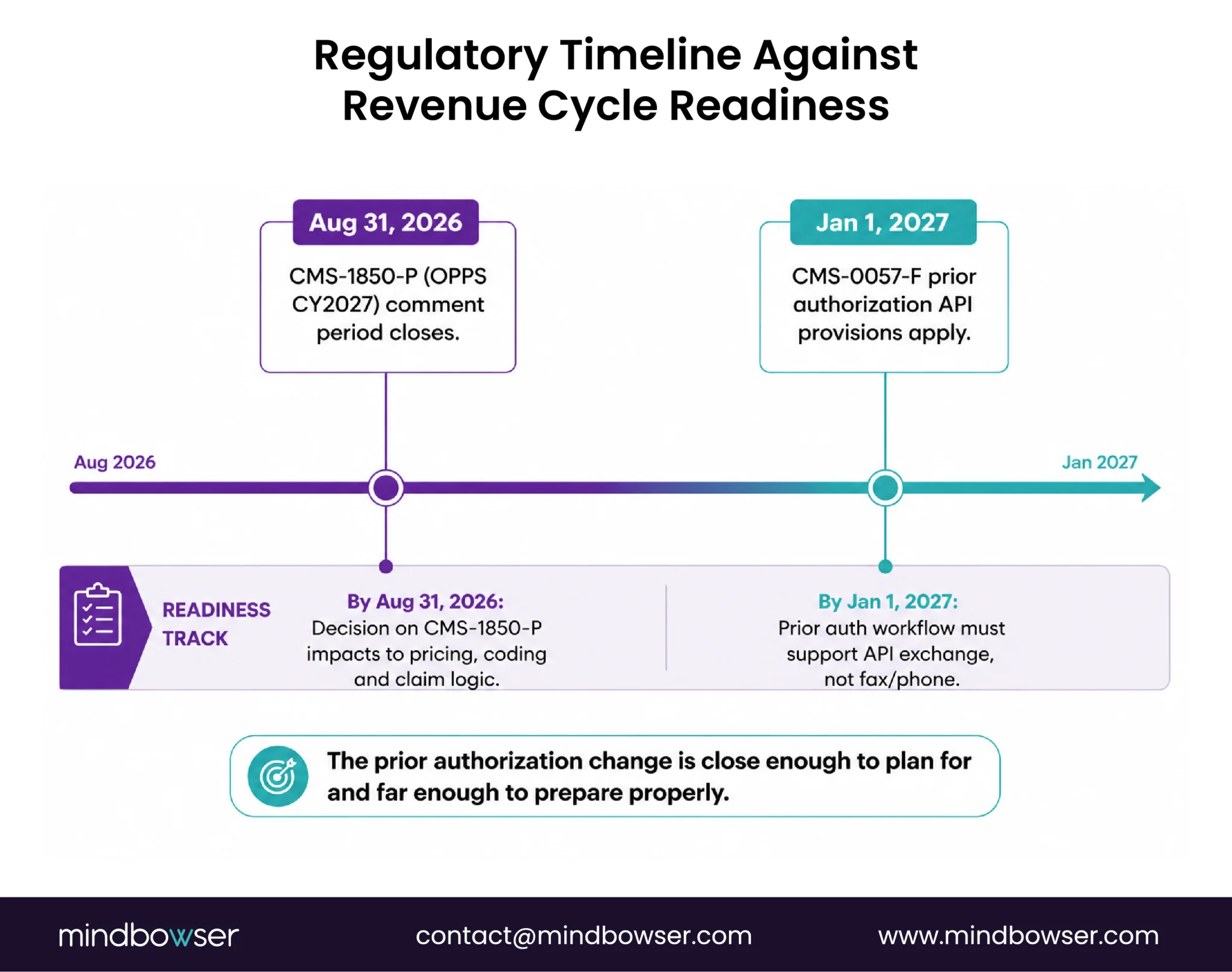
Two regulatory items are worth having on your roadmap now rather than discovering later.
CMS-0057-F, the Interoperability and Prior Authorization final rule. Impacted payers must support API-based prior authorization, with the main provisions applying from January 1, 2027. For providers, the practical significance is that prior authorization stops being a fax-and-phone process and becomes an integration surface. Organizations whose prior auth workflow is entirely manual today will find the transition harder than those who have already structured the data. The rule text and implementation timeline are published by CMS, which is the source worth reading directly rather than through vendor summaries, since the obligations fall on payers and the provider-side implications are inferred rather than stated.
OPPS CY2027, proposed as CMS-1850-P. The outpatient prospective payment system proposed rule affects outpatient reimbursement, and its comment period closes August 31, 2026. If your organization has an opinion on it, that date is a hard boundary. We cover the revenue cycle implications in our CMS-1850-P analysis.
Where Specialty Changes The Answer
Everything above is general. It stops being general at the point where a specialty’s billing structure differs enough to change which stage matters most.
A short orientation:
- Cardiology: procedure coding complexity and the ongoing CPT restructuring make mid-cycle the pressure point.
- Oncology: drug reimbursement and 340B pricing dominate, and the economics differ sharply from procedural specialties.
- Orthopedics: global periods and their modifiers determine whether post-operative work is separately billable.
- Dermatology: high volume, low value per encounter, and code families where sequencing rules decide payment.
- Gastroenterology: screening versus diagnostic distinctions that change patient liability as well as reimbursement.
If your specialty is not listed, the general principle holds: identify which of the three zones carries your specialty’s dominant failure mode, and concentrate there rather than distributing effort evenly.
For a broader operational starting point, how to improve revenue cycle management sets out a sequence, and the 13 key steps is the shorter reference version. If you are weighing whether to run this in-house at all, the outsourcing question is worth reading before committing either way, and medical billing versus revenue cycle management clears up the terminology confusion that causes a surprising amount of scope disagreement.
Where To Start
If you take one thing from this guide, take the ownership question rather than the definition.
Ask who owns first-pass yield end to end. Not who owns billing, not who owns coding. Who is accountable for a claim being paid correctly the first time, across all five departments. In most organizations the honest answer is nobody, and that single answer explains more about revenue cycle performance than any benchmark will.
Three practical next steps, in order:
- Establish where your errors originate, not where they surface. Sample a month of denials and trace each to the stage that created it. The distribution is usually a surprise.
- Check the invisible category: Compare a sample of paid claims against your contracted rates. Underpayments do not appear in any queue, so they will not be found unless you look for them deliberately.
- Only then consider tooling, and scope it to the handoff that is actually failing.
If you want a second opinion on where your cycle is losing money, or you are scoping a build and want an argument against it before you commit, start a conversation. We would rather tell you the fix is organizational than sell you software that will not fix it.
It is everything a healthcare organization does to get paid for care, from the first patient contact through to the account reaching a zero balance. It covers scheduling, insurance checks, documentation, coding, claim submission, payment posting, denials and collections.
At scheduling, not at billing. The information captured when an appointment is booked determines whether the claim can be paid, which is why errors made by staff who never touch a claim are among the most expensive in the cycle.
Medical billing is one stage within revenue cycle management. Billing covers claim preparation, submission and follow-up. Revenue cycle management covers the whole path including registration, eligibility, documentation, coding, contracts and collections. Treating them as synonyms is the most common cause of scope confusion.
Because most denials are not created in billing. They are created upstream, at registration, eligibility or documentation, and they only become visible when billing submits the claim. Working harder in billing does not address a cause that sits three stages earlier.
First-pass yield, the share of claims paid correctly on first submission. It is the only common measure that fails on both denials and silent underpayments, which makes it harder to make look good than denial rate or days in AR.
You will not know from your denial reports, because underpaid claims close as zero balance and never enter a queue. The only reliable method is comparing paid amounts against your contracted rates on a sample, which is why the comparison is worth automating once the contracts are digitized.