













 BLOGS
BLOGS  NEWSROOM
  CASE STUDIES
  WEBINARS
  PODCASTS
  ASSET HUB
  EVENT CALENDAR


















TL;DR:
Middleware like Redox costs $50K/yr + $10K/hospital and locks you out of your own integration IP. Building your own engine gives you ownership, reusable architecture (80% codebase reuse across EHRs), and a stronger story for investors. ConnectHealth lets you build it at accelerator speed — without the from-scratch cost.
Getting into the U.S. healthcare market means dealing with EHR integration early on. For SaMD companies that already have FDA clearance and traction in Europe, integration isn’t just a checkbox. It’s what determines whether physicians can adopt your product or not.
You need to be inside the physician’s workflow. That means letting them order tests, review results, and push data directly from their EHR. If your platform doesn’t integrate, adoption slows down. So, integration becomes less of a technical hurdle and more of a strategic decision.
We recently worked with a CTO from a European company building a smartphone-based heart rhythm monitoring solution. They wanted a fast, flexible way to plug into Epic without relying entirely on external platforms. That’s when we walked through what it takes to scale integration efforts in the U.S.
Middleware Looks Easy. Until It’s Not.
Solutions like Redox and Health Gorilla are often the starting point. They offer prebuilt APIs, faster go-to-market, and lower upfront effort. But for companies planning to scale or raise funds, the downsides add up fast.
Here’s what usually comes up:
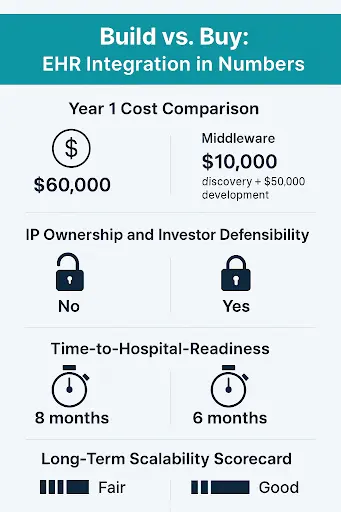
🔸 Recurring fees: Redox alone can cost $50,000 per year, plus $10,000 or more per hospital connection.
🔸 Limited control: You’re stuck working within their architecture. Custom features, experiments, or speed improvements are difficult to implement.
🔸 No ownership of integration IP: This becomes a sticking point when investors or enterprise buyers ask how defensible your tech is.
Several teams we’ve worked with started on middleware. Then they switched, looking for more flexibility and long-term value.
A Better Path: Build It Once, Use It Across EHRs
At Mindbowser, we build your integration engine on ConnectHealth, our EHR interoperability accelerator — so you get a FHIR-compatible, production-ready engine entirely under your control, without starting from zero. You get build-grade ownership and control at buy-grade speed and cost.
Here’s our process:
🔸 Technical Discovery
We start with a $10K technical discovery sprint. This covers feasibility analysis, integration mapping, and architecture planning. If you move into development within 30 days, we convert the discovery cost into dev credits, so you’re not paying extra to plan right.
🔸 SMART on FHIR Development
We build apps that work inside EHR systems like Epic. Physicians can launch your product directly from the EHR, use your dashboard, and interact with patient data without leaving their workflow.
Related Read: Decoding SMART on FHIR for Healthcare Interoperability
🔸 Custom Microservices
We create Docker-based microservices that handle everything from user authentication to secure FHIR/HL7 data exchange. We also ensure your integration meets HIPAA and PHI compliance requirements from day one.
🔸 Full Ownership and Deployment
You deploy everything in your own infrastructure. This gives your team full control over scaling, maintenance, and future development. No lock-in. No surprises.
Want to see what that looks like in real projects? Explore our Healthcare Interoperability Solutions and EHR Integration Services.
Supporting More Than Just Epic EHR
One of the biggest misconceptions is that every new EHR integration requires starting over. That’s not the case with our approach.
We design the architecture to be modular and reusable:
🔸 80% of the codebase works across EHRs like Epic, Athenahealth, Cerner by Oracle, and Meditech
🔸 Future integrations take half the time and budget
🔸 You manage one unified integration engine instead of multiple point-to-point solutions
That’s how teams move faster without rebuilding from scratch each time they need to add a new partner.
Use Cases You Can’t Unlock with Middleware Alone
Owning your integration engine opens up opportunities that third-party middleware can’t support out of the box:
🔸 Patient onboarding flows triggered from within the EHR
🔸 Custom alerts when readings cross clinical thresholds
🔸 Native EHR dashboards that surface real-time insights
🔸 Structured FHIR data pipelines built for AI model training or analytics
You don’t need to depend on someone else’s roadmap. You build what your users need—on your terms.
Summary
If you’re entering the U.S. market, integration with EHRs is one of the most important decisions you’ll make. Going the middleware route works for quick pilots, but it rarely scales well.
A third path exists: ConnectHealth gives you the ownership and control of a custom build, at the speed and cost of an accelerator – no middleware lock-in, no starting from scratch.
This approach has worked for digital health companies looking to move fast without giving up flexibility. If you’re in the same position, we can help you get there.
🎯 Conclusion: Control Your Stack, Control Your Future
For product leaders in digital health, the EHR integration decision isn’t just about timelines and APIs—it’s about the long game. Ownership. Speed. Valuation. And above all, control.
At Mindbowser, we’ve helped remote monitoring companies, digital therapeutics teams, and SaMD pioneers build flexible, scalable EHR integrations that become true engines of growth.
Ready to take control of your integration roadmap?
👉 Book a free discovery call with our healthcare team to explore how we can help you build faster, smarter, and more sustainably.
Redox can cost $50,000/year plus $10,000 or more per hospital connection. Health Gorilla has similar recurring fee structures. These don’t include custom feature development or the lock-in risk on your integration IP.
Building your own engine requires more upfront effort but typically breaks even within 2-3 hospital connections versus middleware fees. You also own the IP, which matters at fundraising.
Yes. Everything is deployed in your infrastructure. You control scaling, maintenance, and future development. No vendor dependency.
ConnectHealth is Mindbowser’s EHR integration accelerator. It gives you a FHIR-compatible, production-ready integration engine that’s fully under your control – the ownership model of a custom build, at the speed of an off-the-shelf tool.