









 BLOGS
BLOGS  NEWSROOM
  CASE STUDIES
  WEBINARS
  PODCASTS
  ASSET HUB
  EVENT CALENDAR
























TL;DR
If you are considering outsourcing revenue cycle management, here is what you gain:
- Lower administrative and staffing costs without maintaining a full billing team
- Faster claims processing and shorter reimbursement cycles
- Access to experienced RCM specialists trained in coding, billing, and compliance
- Reduced claim denials through proactive validation and error checks
- Built-in compliance with HIPAA and evolving payer regulations
- Real-time visibility into financial performance, AR, and denial trends
- Scalable operations that adjust to patient volume and growth
- More predictable cash flow with consistent collections
- Improved patient experience through accurate and transparent billing
- Internal teams freed up to focus on care delivery and strategic initiatives
If your organization is struggling with rising denials, delayed payments, or operational overhead, outsourcing RCM can directly improve financial performance and reduce workload.
Outsourcing revenue cycle management reduces operational burden, improves cash flow, and boosts claim success rates. It helps healthcare teams focus on care while experts handle financial operations.
Revenue cycle management (RCM) directly affects how financially healthy a healthcare organization remains. It ensures timely reimbursements, fewer billing errors, and predictable income when done right. Yet managing it internally can be a constant uphill task. That’s why many hospitals and clinical teams are now turning to external specialists to manage their revenue cycles more effectively, without stretching their internal resources thin.
Watch: Benefits of Outsourcing Revenue Cycle Management (Speed, Security & Better Cash Flow)
What Are the Benefits of Outsourcing Revenue Cycle Management?
Outsourcing revenue cycle management isn’t just about offloading tasks—it’s about improving how your financial system runs daily. From reducing overhead to improving accuracy, here’s how outsourcing can deliver measurable value across every stage of the revenue cycle.
1. Lower Administrative and Overhead Costs
Hiring, onboarding, and managing an in-house billing team come with ongoing expenses—salaries, benefits, training, and turnover. Outsourcing helps you:
- Avoid the cost of full-time staff, especially during low-volume periods
- Skip expensive software purchases, upgrades, or IT support for billing platforms
- Pay only for the volume of services you need, thanks to flexible pricing
To simplify billing and payments, a healthcare platform turned to us for a more efficient solution. We integrated secure ACH payment processing and built automated billing workflows. The result? Faster transactions, fewer manual tasks, and a more transparent payment experience for all parties involved.
2. Faster Claims Processing and Payments
Speed matters in revenue cycle management. Delays in submission or corrections stretch out the time it takes to get paid. An outsourcing partner ensures:
- Faster claim turnaround with fewer manual errors
- Lower Days Sales Outstanding (DSO), which improves working capital
- More consistent claim submission schedules, reducing account aging
3. Access to Specialized RCM Talent
Instead of struggling to recruit or retain skilled billing professionals, outsourcing gives you direct access to:
- Experienced coders, billing specialists, and AR follow-up teams
- Teams trained on current CPT, ICD-10, HIPAA, and CMS regulations
- Professionals who are accountable for accuracy and productivity from day one
Many outsourcing partners now combine services with RCM automation solutions to reduce denials, improve turnaround time, and increase financial visibility.

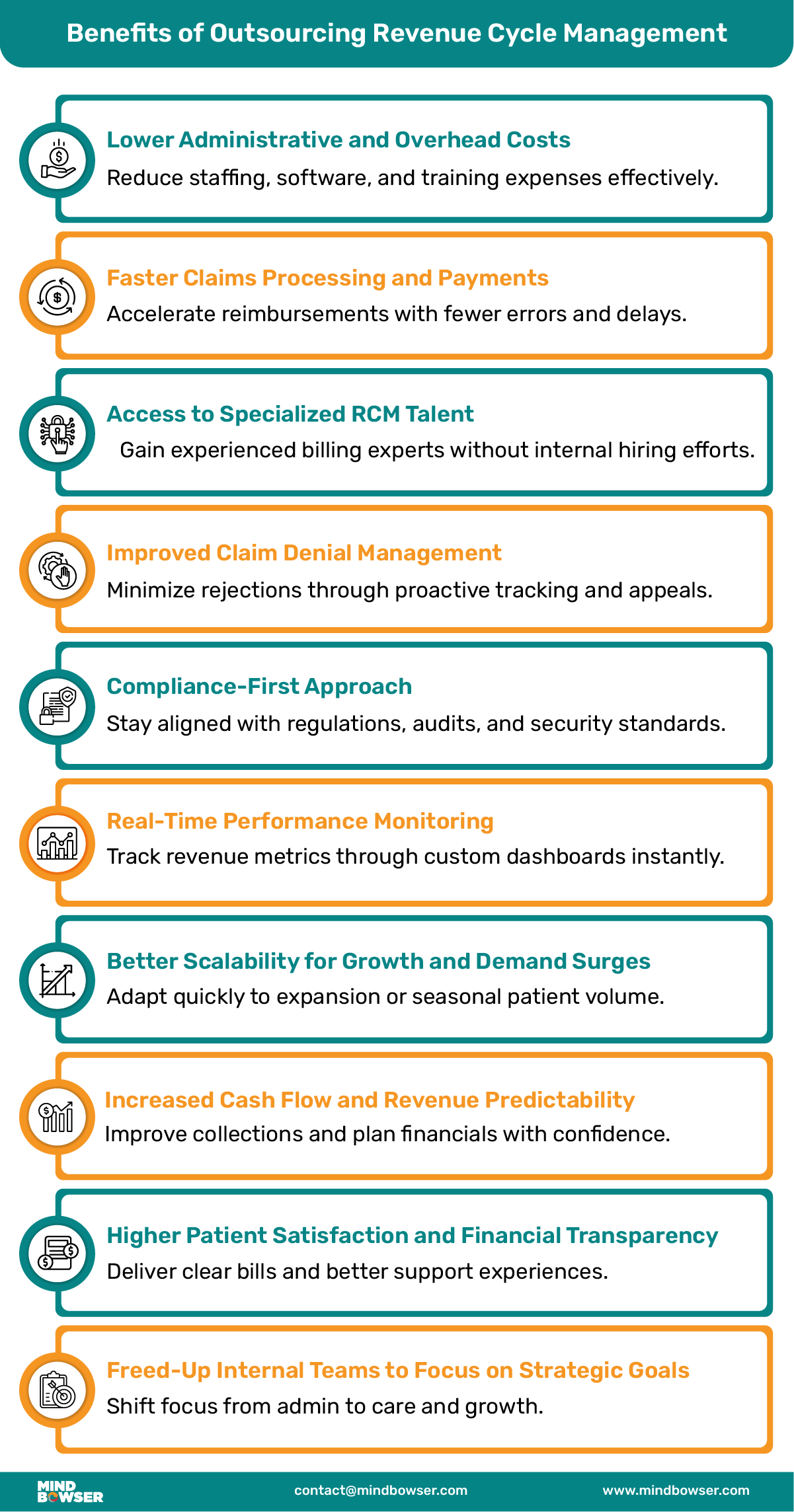
4. Improved Claim Denial Management
Denied claims don’t just cost time—they often go unpaid. With an experienced partner, denial prevention and management become proactive:
- Claims are checked for errors before submission
- Common denial reasons are flagged and corrected early
- Rejected claims are appealed faster, leading to better recovery rates
A home care team needed a better way to manage daily operations. We built a custom CRM that brought referrals, appointments, and billing into one platform. This cut down manual work and gave their team a clear view of financial activity.
5. Compliance-First Approach
Billing rules change frequently, and non-compliance can mean financial penalties or loss of payer contracts. An RCM partner helps you:
- Stay current with changing payer and government regulations
- Ensure all PHI is securely handled and documented
- Avoid audit surprises with compliant workflows and reporting
One healthcare platform was struggling with managing sensitive billing documents securely. We stepped in to streamline their workflows using secure access controls and HIPAA-compliant infrastructure. This protected patient data and kept their system audit-ready at all times.
6. Real-Time Performance Monitoring
Good partners provide dashboards and reports that let you keep track of financial health in real-time:
- See denial rates, collection timelines, and AR aging without delay
- Spot trends or issues early and take corrective action
- Make decisions based on hard data, not assumptions
For instance, a medical device company used a centralized dashboard to track test volumes, turnaround times, and utilization metrics. This improved billing insights and helped teams make faster, data-backed financial decisions.
7. Better Scalability for Growth and Demand Surges
When you expand your services or experience seasonal shifts, your billing team needs to keep up. Outsourcing gives you:
- A scalable team that adjusts with your patient volume
- No hiring delays or understaffed billing cycles
- Built-in flexibility to add or remove services when needed
8. Increased Cash Flow and Revenue Predictability
Every delayed or denied claim chips away at financial stability. A consistent and efficient billing process:
- Keeps money flowing in without frequent disruptions
- Supports better financial planning and budgeting
- Improves payer performance tracking and collections strategy
An elderly care platform needed better control over how it tracked services and submitted claims. We helped them build a billing module that included CPT coding, device tracking, and detailed service metrics. The result? More accurate reimbursements, better compliance, and a scalable foundation to support their growing remote patient monitoring program.
9. Higher Patient Satisfaction and Financial Transparency
Billing issues are one of the top sources of patient complaints. An experienced RCM team helps:
- Minimize billing errors that confuse or frustrate patients
- Improve response times to questions about payments or coverage
- Present clear, accurate bills that patients can trust
10. Freed-Up Internal Teams to Focus on Strategic Goals
Instead of chasing down claims or managing AR backlogs, your internal staff can:
- Concentrate on improving patient outcomes and coordination
- Work on expanding programs, partnerships, or service lines
- Gain time to address root causes rather than repetitive issues
Ready to Cut Denials By 20 %? 👉 Book a 15-min Feasibility Call
Let’s get to know about its challenges first:
Challenges of Managing RCM In-House
Running revenue cycle management in-house often means juggling multiple tasks with limited resources. For most hospitals and clinical teams, the effort required to manage billing, coding, and compliance can quickly overwhelm even a capable back office. Here are some of the common roadblocks:
🔸 Rising Costs of Hiring, Training, and Retaining Billing Staff
Maintaining a qualified billing team isn’t cheap. Salaries, ongoing training, and turnover expenses can eat into budgets fast, especially when payer rules or codes change frequently and demand retraining.
🔸 High Claim Denial Rates Due to Coding or Documentation Errors
Even small mistakes in coding or incomplete documentation can lead to denied claims. This creates extra work for staff who now have to review, correct, and resubmit claims, slowing down cash flow in the process.
🔸 Lack of Dedicated Compliance and Audit Support
Staying compliant with HIPAA, HITECH, and constantly changing payer requirements requires more than just good intentions. Hospitals are at greater risk of costly errors and penalties without dedicated compliance personnel.
🔸 Limited Visibility Into KPIs and Payment Trends
If your financial team relies on spreadsheets or outdated reports, tracking how long claims are sitting in AR or where revenue leakage is happening is hard. That kind of visibility gap affects decision-making at every level.
🔸 Technology Barriers and Disconnected Systems
Many organizations still rely on manual workflows or software that doesn’t talk to their EHR or clearinghouse. These disconnected tools create delays and increase the chances of errors during handoffs.
🔸 Difficulty Scaling Operations During Growth or Seasonal Fluctuations
Expanding services or dealing with seasonal demand spikes often exposes the limits of internal billing teams. Without flexibility, even a small increase in patient volume can lead to backlogs, missed claims, and frustrated staff.
Why More Healthcare Teams Are Choosing to Outsource RCM
Outsourcing revenue cycle management isn’t a shortcut—it’s a strategic move. With financial pressure mounting and expectations around patient experience rising, more hospitals realize that handling billing in-house may not be the best use of time or talent. Here’s why the shift is happening:
🔸 The Shift Toward Value-Based Care Requires Specialized Financial Workflows
As healthcare moves away from fee-for-service models, billing becomes more nuanced. Payers now expect proof of outcomes, coordinated care, and bundled services. This creates a need for RCM teams that understand clinical and financial details—something that’s hard to build internally without deep expertise.
Related read: Value-based Care vs Fee-for-Service
🔸 External Teams Bring Speed, Precision, and Technology
Third-party RCM partners specialize in one thing: making sure your revenue flows smoothly. They already have systems, from claims scrubbers to denial tracking tools. With these resources, they’re often faster and more accurate than internal teams juggling multiple responsibilities.
🔸 Hospitals Want to Prioritize Patient Engagement, Not Billing Logistics
Patients today want clear billing, quick responses, and flexible payment options. But creating a patient-first experience is tough when your staff is buried under paperwork. By outsourcing RCM, your team can shift attention back to the front end—improving satisfaction and reducing friction.
🔸 Outsourcing Helps Reduce Burnout Among Internal Staff
Revenue management isn’t just complex—it’s repetitive and high-stress. Constant changes in payer rules, rejected claims, and backlogged AR can wear out even the best staff. Outsourcing relieves this pressure and gives internal teams room to focus on roles requiring human interaction and critical thinking.
Signs It’s Time to Outsource Revenue Cycle Management
Deciding to outsource RCM isn’t just about cost—it’s about recognizing when internal systems are holding your organization back. If you’re facing any of the following issues, it may be time to look outside for support.
1. Denials Are Increasing and Reimbursement Is Delayed
If your team is spending too much time fixing errors or appealing claims, it clearly shows that your billing processes need help. Frequent denials slow down cash flow and create a cycle of rework.
2. Billing Staff Turnover Is High
Retaining experienced billing professionals is tough, especially when the workload is high and processes are outdated. When turnover becomes a trend, continuity and accuracy start to suffer.
3. Your Team Is Overwhelmed by Changing Payer Policies
Payers update policies frequently, and staying compliant takes time and attention. If your team is always playing catch-up with regulations, errors, and delays are bound to happen.
4. Financial Reports Are Unclear or Inconsistent
If your revenue reports are outdated, incomplete, or difficult to interpret, it’s hard to make confident decisions. Outsourcing partners typically provide clean, accurate reporting with KPIs you can use.
5. Manual Tasks Slow Down Billing Cycles
Spreadsheets, email follow-ups, and disconnected tools may have worked in the past, but they don’t scale. Manual steps increase risk, especially during busy periods or staff absences.
6. You’re Expanding Services or Opening New Facilities
Growth is great, but it also means more billing complexity. If your current team can’t keep up with the added volume or new payer contracts, you risk delayed collections and operational friction.
Key Services Included in RCM Outsourcing
When you outsource revenue cycle management, you’re not just getting help with claims—you’re bringing in a team to manage every financial process with clarity and consistency. Here’s what’s typically included:
🔹 Medical Coding and Charge Entry
Precise coding is the foundation of timely reimbursement. Outsourcing ensures your documentation is translated accurately into the correct CPT and ICD-10 codes, reducing the chance of denials.
Related read: Remote Patient Monitoring Billing Guidelines For Healthcare Providers – CPT Codes, Reimbursement & Compliance
🔹 Eligibility Verification
Before services are delivered, verifying insurance eligibility avoids surprises later. This step confirms coverage, co-pay amounts, deductibles, and authorizations, cutting down on claim rejections.
🔹 Claims Submission and Tracking
Clean claims are submitted promptly to the appropriate payers. The process includes checking for completeness, following payer-specific formats, and tracking each claim until payment is received.
🔹 Denial and Appeal Management
Every denied claim gets reviewed, corrected, and resubmitted quickly. Specialists look for trends in denials and help prevent the same mistakes from happening again.
🔹 Payment Posting and Reconciliation
Once payments arrive, they’re posted accurately and matched with the appropriate services. This keeps your records clean and avoids payment duplication or missed balances.
🔹 Accounts Receivable Follow-Up
Outstanding balances are monitored daily. The team follows up with payers on aging claims, escalates delays when needed, and pushes to bring AR down within target ranges.
🔹 Patient Billing Support and Statements
Clear statements are sent to patients, and trained representatives can answer billing questions or arrange payment plans. This helps reduce confusion and increase collections.
🔹 Monthly Reporting and Audits
You get a complete view of your financial performance—collections, denial rates, AR aging, and more. Regular audits also ensure compliance and flag areas that need attention.
Related read: Comprehensive Guide to the RCM Process in Healthcare
What to Look for in an RCM Outsourcing Partner
Choosing to outsource your revenue cycle is a big decision, but choosing the right partner makes all the difference. Not all RCM vendors offer the same level of service, transparency, or reliability. Here’s what you should look for before signing on:
🔸 Experience with Your EHR and Billing Platforms
Your outsourcing partner should be comfortable working within the tools you already use—whether Epic, Cerner, Athenahealth, or another system. The less friction during integration, the smoother the transition.
🔸 HIPAA and SOC 2 Compliant Infrastructure
Handling patient data requires strict security. Any partner you consider should follow HIPAA protocols and maintain the systems and processes needed for SOC 2 compliance.
🔸 Transparent SLAs and Performance Guarantees
You should know exactly what to expect in terms of turnaround time, claim acceptance rates, and reporting. A good partner will offer clear service-level agreements with measurable outcomes.
🔸 U.S. and Global Support Models
Depending on your needs, it may be helpful to have support teams working across time zones. Ask whether your partner has flexible support hours and how they handle urgent requests.
🔸 Use of Automation Tools for Accuracy and Speed
Look for teams that go beyond manual data entry. Denial prevention tools, claim scrubbing software, and predictive AR follow-ups are all signs of a mature RCM workflow.
🔸 Flexibility to Adapt to Your Workflows
Every organization is different. Your partner should be willing to learn your specific billing process, payer mix, and reporting needs, rather than forcing a one-size-fits-all model.
🔸 References and Case Studies from Similar Healthcare Clients
Ask for proof. A reliable partner should be able to share examples of past success, whether it’s improving AR, reducing denials, or helping a hospital scale up during growth.
How Mindbowser Can Help You
At Mindbowser, we understand that revenue cycle management is more than just billing—it’s the backbone of your financial health. That’s why we offer RCM solutions designed specifically for healthcare teams who want reliability, visibility, and results without the complexity of managing everything in-house.
↗️ End-to-End RCM Services with Built-In Compliance
From coding and charge entry to AR follow-up and denial resolution, our team handles the full spectrum of RCM tasks. All processes are aligned with HIPAA standards to keep your patient data protected.
↗️ Integration with Your Existing EHR via HealthConnect CoPilot
Whether you’re using Epic EHR, Cerner EHR, Athenahealth EHR, or another EHR, our HealthConnect CoPilot simplifies integration. It bridges systems securely while ensuring claims and documentation flow without disruption.
↗️ Support for HL7, CCDA, and FHIR Standards
We follow industry-standard data exchange protocols, which help your clinical and financial data stay connected, essential for accuracy, reporting, and compliance.
↗️ Smart Automation to Reduce Manual Errors
Our workflows include built-in checks for claim completeness, documentation accuracy, and coding compliance. This reduces the risk of denials and speeds up reimbursements.
↗️ Dedicated AR and Denial Management Specialists
Your AR isn’t just monitored—it’s actively worked. Our team quickly tracks outstanding claims, resolves disputes, and appeals rejections to bring down your days in AR.
↗️ Custom Dashboards for Real-Time Financial Insights
We don’t leave you guessing. Our reporting tools give you real-time access to metrics like claim status, denial trends, and revenue performance—updated daily.
↗️ Proven Results Across Healthcare Environments
Whether you’re managing a hospital network, home health operation, or specialty clinic, we’ve helped teams like yours cut down on billing delays, reduce denials, and collect more without increasing workload.
If you are evaluating partners, reviewing top vendors side by side can help you make a faster decision. For a detailed comparison, see our Top Revenue Cycle Management Companies for Healthcare Providers.
Common Myths About RCM Outsourcing
Outsourcing revenue cycle management can seem like a big shift, but much of the hesitation comes from outdated assumptions. Let’s clear up a few common myths.
Myth: Outsourcing Means Losing Control
Truth: You don’t lose control—you gain clarity. With real-time dashboards, SLAs, and performance reviews, you always stay in the loop. A good partner acts as an extension of your team, not a black box.
Myth: It’s Only for Large Hospitals
Truth: Smaller hospitals and clinics often benefit the most. With limited in-house staff, they can’t afford to lose time chasing claims or fixing denials. Outsourcing brings immediate support without requiring a full billing department.
Myth: Patient Experience Suffers
Truth: A well-run RCM operation improves patient experience. Clear bills, timely statements, and prompt support reduce confusion and build trust. Patients are more likely to pay—and feel good about it—when communication is accurate and easy to understand.
These myths often prevent teams from exploring options that could solve some of their biggest pain points. Outsourcing RCM—when done with the right partner—brings more transparency, not less.
Ready to Modernize Your RCM?
Managing revenue in healthcare takes more than just a billing team—it demands precision, consistency, and the ability to keep up with constant changes. Outsourcing RCM isn’t just about cutting costs; it’s about creating a reliable financial system that lets your team focus on patient care instead of paperwork.
Whether you’re struggling with claim denials, looking to scale your operations, or simply want better visibility into your financial performance, outsourcing can give you the structure and support you need. The key is to choose a partner who understands your workflow, meets your compliance needs, and delivers measurable results.
At the end of the day, every dollar collected—and every error avoided—adds up to better outcomes for your team and the people you serve.
Take the pressure off your internal teams—let experts handle your revenue cycle with precision.
Talk to us today to build a smarter, more efficient financial operation.
Outsourcing revenue cycle management helps healthcare organizations reduce administrative costs, improve claim accuracy, and accelerate reimbursements. It gives access to experienced billing teams, advanced tools, and compliance-ready workflows without the need to manage everything in-house. This leads to fewer denials, faster collections, and better financial visibility.
Outsourcing RCM improves cash flow, reduces operational overhead, and increases billing accuracy. Key benefits include faster claim processing, lower denial rates, real-time performance tracking, and better compliance with payer and regulatory requirements. It also allows internal teams to focus more on patient care instead of billing operations.
It’s tracking and managing all the steps leading to payment for healthcare services—from scheduling and insurance verification to billing, claim submission, and collections.
Yes. Reputable partners follow strict HIPAA guidelines and use secure systems to protect patient data. Many also meet SOC 2 compliance standards to ensure safe handling of sensitive information.
Most teams notice improvements within the first 2–3 billing cycles. Common gains include faster claim processing, reduced denials, and better cash flow.
Absolutely. You can access real-time dashboards, custom reports, and regular performance reviews. A good partner will keep you informed and in control at all times.