BLOGS
BLOGS  NEWSROOM
  CASE STUDIES
  WEBINARS
  PODCASTS
  ASSET HUB
  EVENT CALENDAR



















TL;DR
- AI remote patient monitoring helps providers detect risk earlier and reduce manual review.
- Predictive analytics improves intervention timing for chronic and post-discharge patients.
- AI reduces alert fatigue by filtering low-value notifications.
- Personalized alerts help care teams focus on the right patients at the right time.
- RPMCheck AI and structured follow-up workflows make RPM more actionable.
- Strong AI RPM programs depend on EHR integration, compliance, and workflow fit.
- Providers should evaluate implementation scope, device ecosystem, and care-team adoption before rollout.
- The biggest value of AI in RPM is better outcomes with less operational overhead.
AI remote patient monitoring helps healthcare providers track patient health in real time without requiring frequent hospital visits. By combining connected devices, predictive analytics, and intelligent alerts, AI in remote patient monitoring helps care teams detect risk earlier, reduce manual review, and intervene before conditions worsen. This technology is transforming chronic disease management, post-surgical recovery, and preventive care, making healthcare more proactive and efficient.
Traditional healthcare relies on scheduled checkups and reactive treatments, but with AI in remote patient monitoring, doctors receive real-time alerts, predictive insights, and continuous health data. Whether it’s tracking heart conditions, managing diabetes, or preventing post-surgical complications, AI-powered remote patient monitoring ensures that patients receive timely care while reducing unnecessary hospital visits.
The global remote patient monitoring software and services market is anticipated to be USD 11.55 billion in 2024 and USD 312.0 billion by 2035. With AI in remote patient monitoring, healthcare providers can detect issues before they become emergencies, personalize treatment plans, and streamline care delivery.
AI-powered tools analyze patient data in real-time, offering predictive insights that help doctors make faster, more informed decisions. This improves patient outcomes and reduces hospital readmissions and healthcare costs.
Let’s explore how AI-powered remote patient monitoring revolutionizes healthcare by addressing key industry challenges and making patient care smarter, faster, and more effective.
Why AI Remote Patient Monitoring Is Essential for Modern Healthcare
AI-driven remote patient monitoring is revolutionizing healthcare by enabling continuous tracking of patient health without frequent hospital visits. Whether it’s managing chronic conditions, post-surgical recovery, or elderly care, AI in remote patient monitoring ensures timely interventions, improved outcomes, and reduced hospital readmissions.
However, remote patient monitoring devices generate massive amounts of data, making it impossible for doctors to monitor every reading. Without AI, remote patient monitoring becomes an overwhelming flood of information, making it harder to detect real health concerns. AI patient monitoring processes this data in real-time, filtering out unnecessary readings and highlighting only critical trends that require medical attention.
With AI-driven remote patient monitoring, healthcare providers can detect health risks early, predict medical emergencies, and optimize patient care, ensuring smarter, faster, and more efficient healthcare delivery.
The Growing Challenges in Healthcare
Healthcare providers struggle with staff shortages, rising patient numbers, and increasing medical costs. Some of the biggest challenges include:
🔹 Managing Chronic Diseases & Aging Populations – More patients require ongoing monitoring, straining healthcare systems, and increasing hospital visits.
🔹 Staff Shortages & Provider Burnout – Overworked doctors lack the time to analyze endless remote patient monitoring data, delaying interventions and increasing stress.
🔹 High Readmission Rates & Rising Costs – Many hospital readmissions could be prevented if early signs of complications were detected before they became emergencies.
These issues increase operational burdens, delay treatments, and drive up healthcare expenses. AI-driven remote patient monitoring is the key to solving these challenges.
How AI Remote Patient Monitoring Solves Data Overload and Alert Fatigue
1️⃣ AI Turns Data Overload into Actionable Insights
Remote patient monitoring devices generate continuous streams of data—heart rate, oxygen levels, glucose readings, and blood pressure. Clinicians cannot manually review every data point, which leads to missed warning signs and delayed interventions.
AI in remote patient monitoring filters this data in real time, identifying meaningful trends instead of raw readings. Instead of overwhelming care teams with noise, AI highlights only clinically relevant changes.
AI-powered alerts are triggered only when there is a significant shift in a patient’s condition, reducing unnecessary notifications and ensuring timely intervention.
For example, if oxygen levels fluctuate within a normal range, no alert is triggered. But if levels steadily decline over time, AI detects the pattern and flags it early.
This approach is critical for reducing alert fatigue and helping care teams focus on high-risk patients.
2️⃣ Predictive Analytics for Early Intervention
AI goes beyond monitoring current vitals—it predicts future risk.
By analyzing historical data, real-time vitals, and behavioral patterns (like medication adherence), predictive models identify patients who are likely to deteriorate before symptoms appear.
For example, AI can detect early indicators of heart failure by analyzing trends in weight, heart rate, and activity levels—often weeks before a clinical event.
This allows providers to intervene earlier, adjust treatment plans, and prevent hospitalizations instead of reacting to emergencies.
3️⃣ Personalized Monitoring & Smart Alerts
Traditional care models apply the same thresholds to all patients. AI changes that by learning individual baselines and risk profiles.
AI ensures that alerts are personalized, meaning clinicians are notified only when a deviation is significant for that specific patient—not just based on generic thresholds.
It also prioritizes high-risk patients automatically, helping care teams allocate attention where it matters most.
These AI-driven insights support more precise clinical decisions, from medication adjustments to care plan optimization, improving both outcomes and efficiency.
4️⃣ Boosting Efficiency & Reducing Costs
Healthcare teams spend a significant amount of time reviewing patient data, managing alerts, and performing manual follow-ups. This creates delays and increases operational burden.
AI-driven remote patient monitoring automates data analysis, triage, and alert prioritization, allowing clinicians to focus only on patients who need intervention.
By detecting issues early, AI reduces avoidable hospital admissions and emergency visits, directly lowering the cost of care.
It also enables care teams to manage larger patient populations without increasing staffing, improving overall program scalability and reducing provider burnout.
5️⃣ AI Empowers Patients to Take Control of Their Health
AI doesn’t just support clinicians—it improves patient engagement.
Patients receive personalized insights based on their health data, helping them better understand their condition and progress. Instead of generic advice, they get actionable, context-specific recommendations.
Automated reminders for medication, vitals tracking, and follow-ups improve adherence and consistency in care routines.
Real-time alerts also guide patients to take action at the right time—before symptoms worsen—reducing dependency on emergency care and improving long-term outcomes.
Related Read: Patient Monitoring: A Guide for Healthcare Providers
Explore how AI remote patient monitoring fits your care model
How AI-Driven Remote Patient Monitoring Works
AI-driven remote patient monitoring transforms healthcare by combining real-time health tracking with intelligent automation. Traditional remote patient monitoring systems collect vast amounts of patient data but rely on doctors to manually interpret information, making it time-consuming and inefficient. AI in remote patient monitoring changes the game by analyzing, interpreting, and predicting patient health trends in real time, allowing for faster interventions and better patient outcomes.
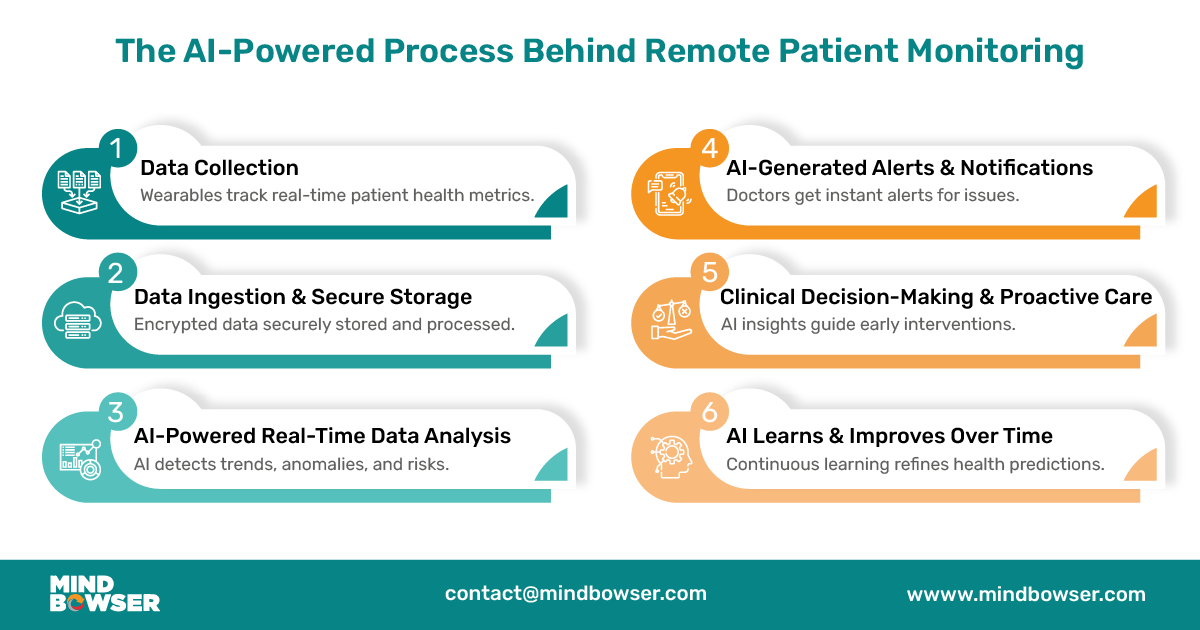
Let’s break down how AI patient monitoring works, from data collection to decision-making, and why it’s becoming an essential tool in modern healthcare.
1️⃣ Data Collection
The foundation of AI-driven remote patient monitoring is continuous health data collection. Patients wear smartwatches, biosensors, and fitness trackers, or use connected medical devices such as:
🔹 Blood pressure monitors – Tracks fluctuations in blood pressure, helping manage hypertension.
🔹 Glucose monitors – Monitors blood sugar levels for diabetic patients.
🔹 Pulse oximeters – Measure oxygen saturation levels; essential for respiratory conditions.
🔹 Wearable ECG monitors – Tracks heart rhythms for patients with cardiac conditions.
These devices continuously track and send vital data to a centralized remote monitoring system, eliminating the need for frequent in-person visits while keeping healthcare providers informed in real time.
2️⃣ Data Ingestion & Secure Storage
Once collected, patient health data must be securely processed and stored. This happens through cloud-based or on-premise remote patient monitoring platforms, which:
🔹 Encrypt and store patient data while maintaining HIPAA compliance.
🔹 Enable real-time access for healthcare teams, allowing for quick decision-making.
🔹 Ensure seamless data sharing across hospitals, clinics, and physicians.
Security and privacy are critical in AI patient monitoring, ensuring patient information remains protected while enabling faster, data-driven care.
3️⃣ AI-Powered Real-Time Data Analysis
AI transforms remote patient monitoring from passive tracking to intelligent decision-making. Instead of doctors manually sorting through thousands of patient readings, AI:
🔹 Identifies Patterns: Detects subtle changes in a patient’s health that could indicate a worsening condition.
🔹 Detects Anomalies: Flags sudden drops or spikes in vitals, alerting doctors to potential emergencies.
🔹 Predicts Health Risks: Uses historical and real-time data to forecast potential health issues before symptoms appear.
🔹 Personalizes Alerts: Prioritizes critical notifications based on a patient’s unique health risks, avoiding unnecessary alarms.
A patient recovering from heart surgery wears a smart ECG monitor that tracks heart rate and oxygen levels. AI analyzes the data and notices a pattern of irregular heartbeats, predicting a potential arrhythmia episode. Instead of waiting for the patient to experience symptoms, the AI system alerts the doctor immediately, allowing for early intervention and preventing a medical emergency.
4️⃣ AI-Generated Alerts & Notifications
Once AI detects an issue, it immediately notifies the right people through:
🔹 Clinician Alerts – AI instantly notifies doctors and nurses when a patient’s vitals show concerning changes, allowing for timely intervention and preventing complications.
🔹 Patient Notifications – Patients receive real-time reminders, health warnings, and personalized recommendations via a mobile app, helping them take proactive steps in managing their health.
🔹 Example – A diabetic patient using a continuous glucose monitor gets a real-time alert when their blood sugar drops dangerously low. Instead of waiting for symptoms, they receive a mobile notification advising them to eat or take medication—helping prevent serious complications.
5️⃣ Clinical Decision-Making & Proactive Care
Once healthcare teams receive AI-generated alerts, they can take action in multiple ways:
🔹 Contact the patient – A nurse or doctor may call the patient to discuss concerns, suggest a treatment adjustment, or schedule a telehealth visit.
Adjust medications or treatment plans – AI insights allow doctors to make data-driven decisions, optimizing care based on real-time patient health trends.
🔹 Intervene before a health crisis – AI’s predictive power helps prevent hospitalizations and ER visits by detecting risks early.
🔹 Example – A patient with chronic obstructive pulmonary disease (COPD) has been experiencing slightly lower oxygen levels and decreased physical activity. AI detects these changes and alerts the physician, who adjusts the patient’s medication before their condition worsens, preventing an emergency hospitalization.
6️⃣ AI Learns & Improves Over Time
Unlike traditional monitoring, AI-driven remote patient monitoring continuously learns from patient data. Over time, the AI system refines its predictions, making it even more accurate in detecting health risks.
🔹 Long-Term Patient Data Analysis – AI tracks and analyzes historical health trends, creating a more personalized and accurate patient profile over time.
🔹 Advanced Predictive Modeling – Machine learning improves risk prediction models, enhancing early detection of potential health issues before symptoms escalate.
🔹 Adaptive Alert System – AI refines real-time monitoring by recognizing individual patient baselines, reducing false alarms and unnecessary interventions.
Example – A patient with high blood pressure initially received frequent alerts due to fluctuations in their readings. Over time, AI learns the patient’s normal variations, reducing unnecessary alerts while catching genuine warning signs.
Check Your RPM AI Readiness With This Free Assessment
The Benefits of AI in Remote Patient Monitoring
AI-driven remote patient monitoring goes beyond simple data tracking—it analyzes patterns, predicts risks, and enables proactive care. AI integration in remote patient monitoring, healthcare providers can improve patient outcomes, personalize treatments, and optimize clinical workflows. Let’s explore how AI is transforming remote healthcare.
Improved Patient Outcomes & Early Diagnosis
One of the biggest advantages of AI-driven remote patient monitoring is its ability to predict health deterioration before it becomes critical. AI continuously analyzes patient data, detects subtle changes in vitals, and flags early warning signs— which would be nearly impossible to do manually.
For example, AI in heart failure monitoring can identify minor fluctuations in heart rate, oxygen levels, and fluid retention patterns, allowing doctors to adjust treatment early and prevent hospitalization. By catching health issues before they escalate, AI ensures timely interventions, reduced complications, and better patient outcomes.
Personalized Treatment Plans with AI
Every patient is different, and AI in remote patient monitoring ensures treatment is customized based on individual health data. Instead of one-size-fits-all medication schedules, AI analyzes patient-specific trends, symptoms, and lifestyle factors to create personalized treatment regimens.
For chronic disease management, AI-powered remote patient monitoring platforms track glucose levels for diabetics or monitor blood pressure for hypertension patients. If a patient’s readings deviate from their usual patterns, AI suggests medication adjustments, diet changes, or doctor consultations, ensuring more effective disease management.
Enhanced Patient Engagement & Adherence
One of the biggest hurdles in healthcare is patient compliance with treatment plans. AI helps by automating medication reminders, therapy schedules, and activity tracking, keeping patients engaged in their own care.
Gamification techniques—such as reward-based progress tracking or interactive health challenges—motivate patients to follow their treatment plans. AI-powered patient engagement platforms provide real-time feedback and encouragement, making healthcare less intimidating and more interactive.
Reduced Hospital Readmissions & Emergency Visits
Hospital readmissions increase healthcare costs and indicate gaps in patient monitoring. AI-driven remote patient monitoring prevents unnecessary ER visits by detecting health anomalies early and triggering timely interventions.
Example: If an AI system notices declining oxygen levels in a COPD patient, it alerts the provider to adjust medication or recommend therapy, preventing a hospital visit. Ensuring that chronic disease patients receive proactive care instead of crisis-driven interventions.
Automated Data Analysis & Reduced Workload
Doctors and nurses don’t have time to review endless patient readings. AI-powered data analysis in remote patient monitoring processes vast amounts of patient data, identifying trends and anomalies in real-time. This eliminates the need for constant manual entry and interpretation, allowing providers to focus only on the most critical cases.
By automating routine monitoring tasks, AI reduces clinician burnout and administrative burden. Instead of spending hours analyzing raw data, healthcare teams can quickly review AI-generated summaries and act on meaningful insights.
AI-Powered Anomaly Detection & Predictive Alerts
AI continuously scans patient vitals and recognizes unusual patterns that might signal potential health risks. If a patient’s heart rate, oxygen , or activity levels show abnormal fluctuations, AI triggers an alert before the situation becomes critical.
AI prioritizes urgent cases for doctors, ensuring that high-risk patients get attention first. This optimizes physician workflow, allowing them to focus on patients who need immediate care rather than routine monitoring.
AI in Remote Diagnostics & Virtual Consultations
Telehealth and virtual consultations are becoming the norm, but without real-time patient insights, remote care has limitations. AI in remote patient monitoring bridges this gap by providing instant access to patient vitals and health trends during virtual visits.
Example: During a telehealth appointment, AI can analyze the patient’s live heart rate, oxygen saturation, and movement patterns—giving doctors a complete picture of their condition. AI-assisted remote triage systems can even prioritize patients based on their risk levels, ensuring that urgent cases get seen first.
Reated Read: Telehealth in Home Health Care: Enhancing Patient Outcomes Through Innovative Solutions
Privacy & Compliance Challenges in AI-Driven Remote Patient Monitoring
AI-driven remote patient monitoring is reshaping healthcare by enhancing patient data security, privacy, and regulatory compliance. Healthcare providers must ensure that AI systems securely process patient data, comply with regulations like HIPAA, and prevent breaches or misuse of sensitive information.
Here’s a breakdown of the key privacy and compliance challenges when implementing AI in remote patient monitoring.
1️⃣ Ensuring HIPAA & Regulatory Compliance
AI in remote patient monitoring collects and processes sensitive patient data, making compliance with HIPAA, GDPR, and other healthcare regulations mandatory. Any failure to properly encrypt, store, or share patient data could result in legal penalties, financial losses, and damaged trust.
To stay compliant, AI patient monitoring systems must be built with a security-first architecture, ensuring data encryption, secure storage, and restricted access to health records. Providers must regularly audit AI systems to confirm patient data handling meets all legal standards.
Related Read: Navigating the Regulatory Landscape: A Guide to Healthcare Compliance Regulations
2️⃣ Data Security Risks & Potential Breaches
One of the challenges in AI-driven remote patient monitoring is protecting data from cyberattacks, hacking attempts, and unauthorized access. Since remote patient monitoring systems continuously collect patient vitals, medical history, and real-time health data, they become a prime target for cybercriminals.
To prevent breaches, strong cybersecurity measures must be in place, including multi-factor authentication, blockchain-based data security, and AI-powered threat detection. Healthcare organizations must regularly update security protocols to prevent emerging threats and ensure patient data remains secure.
Related Read: Data Security in Remote Patient Monitoring (RPM)
3️⃣ Ethical Use of AI in Remote Patient Monitoring
AI in remote patient monitoring analyzes patient data and makes health predictions, but what happens if AI misinterprets data or generates biased outcomes? Ensuring AI-driven healthcare decisions are fair, unbiased, and clinically valid is a major compliance challenge.
To maintain trust and accuracy, healthcare providers must use transparent AI models, ensuring that machine learning algorithms are trained on diverse, unbiased datasets. Human oversight remains essential, ensuring clinicians validate AI-generated recommendations before acting on them.
4️⃣ Patient Consent & Data Ownership
With AI patient monitoring, who owns the health data—the patient, the provider, or the AI system? Patients must fully understand what data is being collected, how it’s used, and who accesses it.
Healthcare providers must clearly communicate data usage policies, obtain patient consent, and provide an opt-out option for data sharing. This ensures that patients remain in control of their medical information, maintaining compliance and trust.
5️⃣ Integration Challenges with Existing Healthcare Systems
AI-driven remote patient monitoring systems must seamlessly integrate with existing EHRs, hospital management systems, and payer networks. However, compliance regulations often require strict data-sharing limitations, making integration complex.
To address this, AI patient monitoring platforms must use secure APIs and interoperability standards like FHIR to ensure compliant data exchange without violating privacy regulations.
While AI in remote patient monitoring drives better patient outcomes and proactive healthcare, privacy and compliance remain top priorities.
Related Read: Healthcare Integration in 2024 – Its Challenges, Solutions and Future
How Mindbowser Transforms AI-Driven Remote Patient Monitoring in Healthcare
Mindbowser builds AI-driven remote patient monitoring systems designed around real clinical workflows, not just data capture. Our platforms integrate with EHRs, connected devices, and telehealth systems to create a unified, real-time view of patient health.
Beyond integration, we focus on making RPM actionable. Tools like RPMCheck AI continuously analyze patient vitals to detect early risk signals, while structured workflows such as post-discharge follow-ups ensure patients don’t fall through the cracks after leaving care settings.
This approach helps providers reduce manual monitoring, prioritize high-risk patients, and strengthen the RPM care manager workflow while moving from reactive interventions to proactive care delivery.
All solutions are built with HIPAA-compliant architecture, FHIR-based interoperability, and audit-ready data workflows, ensuring they are not only scalable but also aligned with reimbursement and compliance requirements.
Case Study: AI-Driven Remote Patient Monitoring for Elderly Care
A leading elderly care provider faced a challenge—how to keep patients engaged in their healthcare while reducing the operational burden on care teams. Traditional monitoring methods were time-consuming, and manual data collection often led to delays in intervention. They needed a smarter, real-time remote patient monitoring system that could seamlessly connect patients, caregivers, and administrators while ensuring compliance and efficiency.
 That’s where Mindbowser stepped in. Our team of healthcare experts, AI engineers, and BLE integration specialists built an intelligent remote patient monitoring solution designed specifically for elderly patient care. We developed a user-friendly mobile app that allowed patients to track their vitals effortlessly, while a centralized web portal empowered care managers with real-time insights. To make the workflow even smoother, we created an admin dashboard for monitoring health trends and optimizing decision-making.
To ensure seamless AI patient monitoring, we integrated BLE-enabled medical devices for real-time vitals tracking, built a billing module for compliance and reimbursement accuracy, and used Medplum’s API for secure, HIPAA-compliant data exchange. The result? A streamlined remote patient monitoring system that cut administrative workload, boosted patient engagement, and enabled proactive healthcare interventions. Now, care teams spend less time on manual tasks and more time improving patient outcomes, making elderly care more accessible, efficient, and connected than ever before.
Conclusion
AI-driven remote patient monitoring is set to become even more intelligent, predictive, and patient-centric. With AI and edge computing, health data can be processed instantly at the source, reducing latency and enabling faster real-time insights. Generative AI will further enhance personalized health recommendations, ensuring patients receive tailored care plans based on their unique health trends.
As AI shifts from reactive monitoring to predictive and preventive care, providers can detect risks earlier, prevent hospitalizations, and improve long-term outcomes. Additionally, AI-powered virtual health assistants will make healthcare more accessible and engaging, guiding patients through medication reminders, symptom tracking, and self-care management.
The future of AI in remote patient monitoring is not just about tracking health—it’s about transforming care into a proactive, AI-driven experience that benefits both patients and providers.
AI improves remote patient monitoring by analyzing patient data in real time, detecting anomalies early, and helping care teams focus on the patients who need attention most. This supports faster intervention and better clinical decision-making.
Predictive analytics uses historical and real-time patient data to identify patterns that may signal worsening conditions, missed medications, or higher hospitalization risk before symptoms become severe. This helps providers act earlier instead of reacting after a decline.
AI reduces alarm fatigue by learning patient baselines and filtering out low-value alerts. This helps clinicians receive fewer unnecessary notifications and respond faster to the alerts that matter most.
Providers should evaluate HIPAA compliance, data security, EHR integration, device compatibility, and how well AI-generated insights fit into existing clinical workflows. The goal is to make RPM easier to use, not harder to manage.
Yes. AI remote patient monitoring can help providers identify risk earlier, intervene before conditions worsen, and reduce avoidable readmissions. It also reduces manual review and helps care teams manage larger patient populations more efficiently.