BLOGS
BLOGS  NEWSROOM
  CASE STUDIES
  WEBINARS
  PODCASTS
  ASSET HUB
  EVENT CALENDAR





















AI agents in healthcare are no longer just a futuristic concept—they’re a fast-evolving reality reshaping patient care, operational efficiency, and clinical decision-making. These agents, powered by artificial intelligence, act autonomously to interpret data, interact with patients or systems, and make real-time decisions or recommendations.
Unlike traditional automation, which follows predefined workflows or rules, AI agents are adaptive and context-aware. Traditional automation might trigger a reminder or execute a single function (like sending an appointment alert). Still, intelligent agents can process real-time inputs, learn from interactions, and dynamically respond, like analyzing patient vitals from wearables and alerting a care team in case of anomalies.
Why 2025 Is a Tipping Point for AI Agent Adoption in Healthcare
The healthcare industry is reaching a critical point of digital maturity. Adopting EHRs, wearables, and telehealth platforms has generated a massive volume of structured and unstructured data. AI agents are now the connective tissue that can unlock value from this data in ways that were not feasible before. With growing demand for clinical efficiency, workforce shortages, and patient-centric experiences, AI agents are becoming essential tools for hospitals and healthcare systems.
With the stage set for transformation, let’s break down what AI agents are, how they work, and where they’re making the biggest impact in healthcare today.
What Are AI Agents in Healthcare?
AI agents in healthcare are autonomous, intelligent systems designed to interact with data, systems, or people to assist with healthcare-related tasks. These agents can perform various functions—from triaging patient symptoms to generating medical notes—while adapting to context, learning from data, and collaborating with human users.
Key Characteristics of AI Agents
🔸 Autonomy: Operate independently without requiring constant human intervention.
🔸 Context-Awareness: Understand user intent, clinical environment, and real-time data inputs.
🔸 Decision-Making: Analyze information, apply reasoning, and make or suggest decisions based on pre-trained models or dynamic inputs.
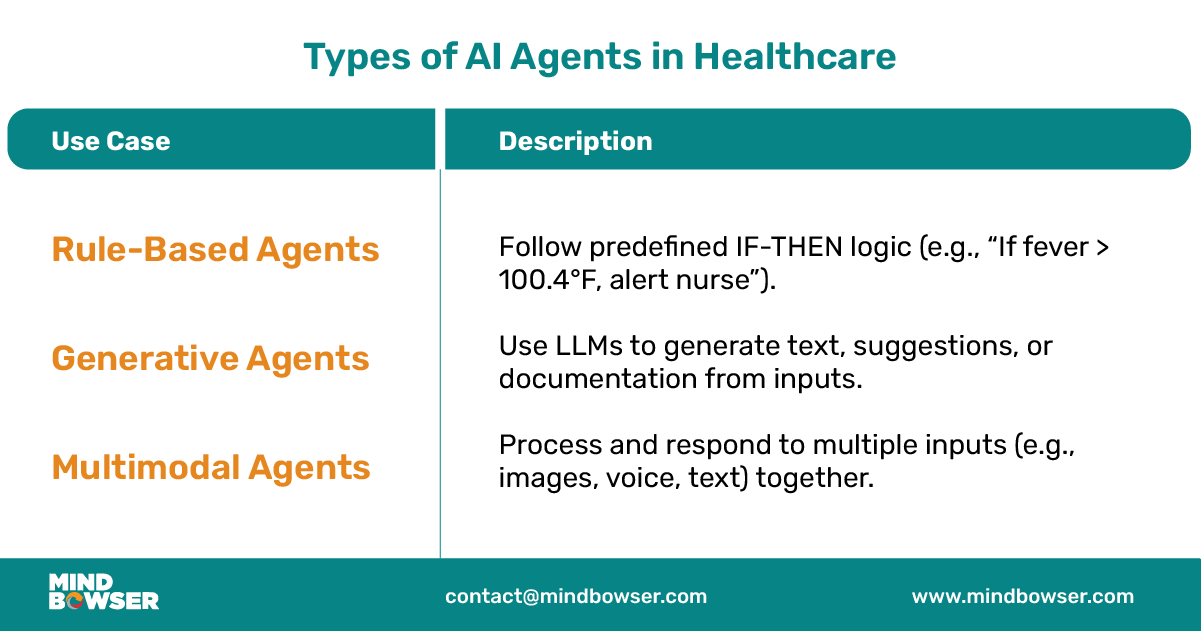
Each of these agent types serves different roles depending on the complexity and nature of the task. For instance, while rule-based agents are efficient for structured decisions, generative and multimodal agents are critical for natural language or image processing tasks.
Examples of AI Agents in Action
- Virtual Nursing Assistants
Provide real-time support to patients via conversational interfaces—handling FAQs, medication reminders, and escalations.
→ Example: Care Angel, Sensely - Medical Summarization Bots
Transform physician voice notes into structured SOAP notes and EHR documentation.
→ Example: Nuance DAX, Nabla Copilot - Triage AI Agents
Analyze patient-reported symptoms and guide them to the appropriate level of care (urgent care, telehealth, ER, etc.).
→ Example: Infermedica, Ada Health, Buoy Health - Medication Adherence Agents
Send automated reminders, track dosage intake, and offer educational prompts for proper medication use.
→ Example: Medisafe, AiCure - Mental Health Companions
Offer CBT-based therapy through chatbots, available 24/7 for mood tracking, emotional support, and crisis guidance.
→ Example: Woebot, Wysa - Remote Monitoring Agents
Continuously monitor patient vitals through connected wearables and escalate alerts to providers in case of abnormalities.
→ Example: Current Health, Biofourmis - Clinical Coding Assistants
Auto-generate billing codes from physician notes, ensuring accuracy and compliance with payer requirements.
→ Example: 3M CodeAssist, Suki AI - Pre-Authorization Bots
Validate insurance eligibility and initiate automated prior authorization processes in the revenue cycle.
→ Example: Olive AI, AKASA - Virtual Intake Agents
Collect patient demographics, history, consent forms, and pre-visit questionnaires via AI-driven chat or voice interfaces.
→ Example: Notable Health, Hyro
These agents represent a move toward continuous, intelligent, and personalized care delivery, acting as digital co-pilots to clinicians and caregivers alike.
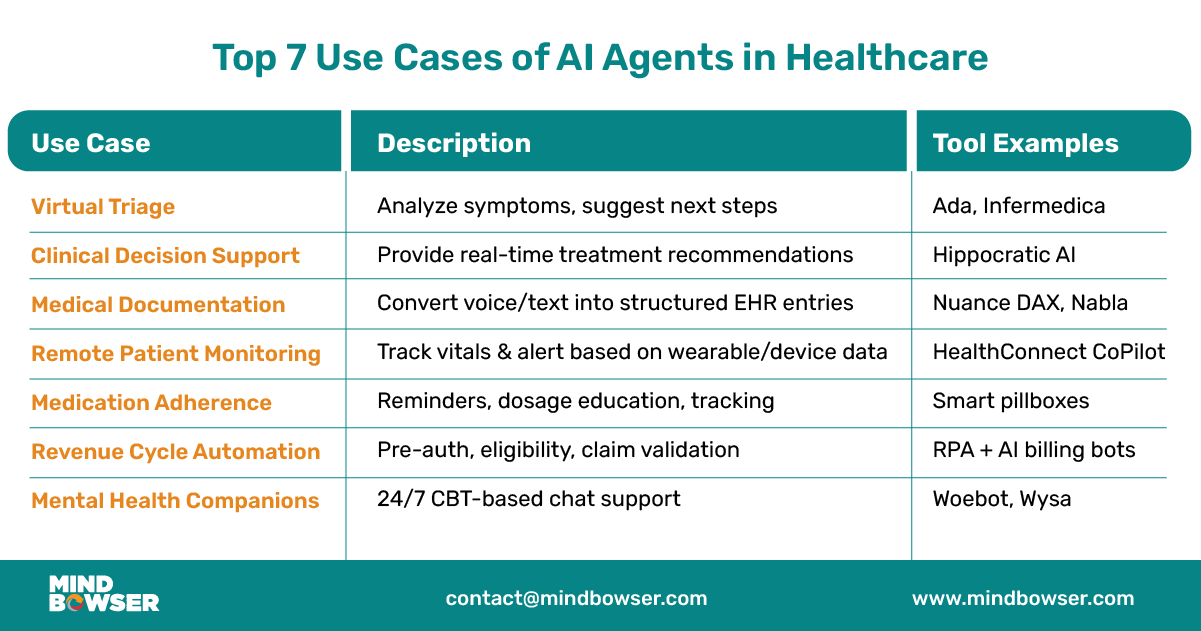
🔍 Top Use Cases of AI Agents in Healthcare
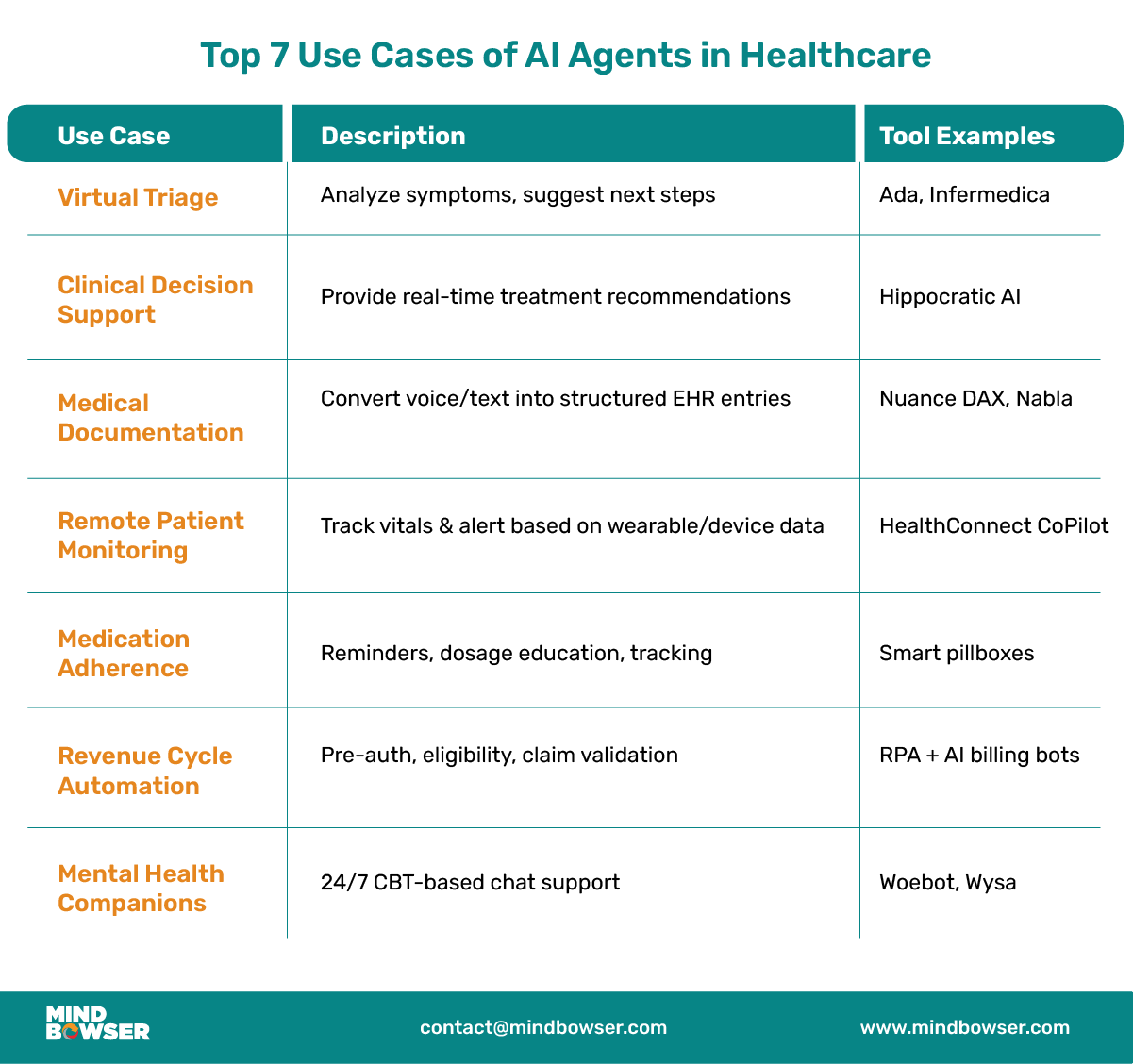
AI agents are transforming nearly every corner of healthcare, enhancing clinical workflows, supporting patient engagement, and automating routine administrative tasks. Below are the top real-world use cases where AI agents are actively creating measurable impact:
1️⃣ Virtual Triage and Symptom Checkers
AI agents in this category assist with pre-diagnosis triage, gathering symptom information, offering probable conditions, and directing patients to the appropriate level of care—telehealth, urgent care, or emergency services.
🔸 How They Work: Patients engage with conversational AI chatbots powered by probabilistic models, symptom ontologies, and ML-trained classifiers. These bots collect patient-reported symptoms, assess severity, and suggest next steps or provider connections.
🔸 Popular Tools:
- Ada Health – AI-powered symptom checker used by millions globally.
- Babylon Health – Combines AI triage with telehealth services.
- Infermedica – Advanced symptom analysis API for healthcare systems.
Impact: Reduces emergency room congestion, improves patient experience at the first point of contact, and enables cost-effective early intervention.
2️⃣ Clinical Decision Support (CDS)
CDS agents enhance diagnostic accuracy and treatment precision by offering evidence-backed suggestions, reducing variability in care decisions.
🔸 How They Work: AI agents analyze clinical documentation, historical EHR data, medication records, and current symptoms to provide real-time recommendations using risk models and rule-based reasoning.
🔸 Key Features:
- Drug-allergy and drug-drug interaction alerts
- Personalized treatment pathways
- Clinical guideline references
- Predictive risk stratification
Impact: Reduces diagnostic errors, minimizes unnecessary testing, and increases clinical efficiency, especially in acute or chronic conditions.
3️⃣ Medical Coding and Documentation
These AI agents simplify the physician documentation burden by automating the creation of structured notes and assigning appropriate billing codes.
🔸 How They Work: Using natural language processing (NLP) and large language models (LLMs), these agents transcribe doctor-patient conversations into EHR-ready documentation (SOAP format) and assign medical codes (ICD/CPT) for reimbursement.
🔸 Popular Solutions:
- Nuance DAX – Ambient clinical documentation integrated with EHRs.
- Nabla Copilot – AI copilot for automatic note generation.
- Glass Health – Generates differential diagnoses and structured notes.
Impact: Reduces physician burnout, enhances note accuracy, ensures billing compliance, and expedites claim processing.
4️⃣ Remote Patient Monitoring and Virtual Nursing
Critical in chronic and post-acute care, these agents offer always-on support by tracking patient conditions remotely and escalating care when necessary.
🔸 How They Work: Integrated with wearables and mobile health apps, AI agents monitor vitals like heart rate, glucose levels, blood pressure, and oxygen saturation. Based on anomalies or behavioral data, they notify care teams or prompt patient interventions.
🔸 Examples:
- Apple Health
- Dexcom – Glucose monitoring for diabetics
- iHealth – RPM kits for vitals tracking
Impact: Enables preventive, data-driven interventions, reduces hospital readmissions, and supports independent aging.
5️⃣ Medication Management and Adherence
Medication adherence agents help ensure that patients follow prescribed therapy plans, which is key to achieving outcomes in chronic care.
🔸 How They Work: AI companions send personalized reminders, provide dosage education, track pill usage, and generate reports for clinicians or caregivers. They may also engage patients using conversational interfaces or smart packaging.
🔸 Use Cases: Ideal for patients managing diabetes, hypertension, asthma, and post-surgery regimens.
🔸 Popular Tools:
Impact: Improves medication adherence, reduces readmissions, and optimizes patient outcomes.
6️⃣Revenue Cycle & Claims Automation
These agents automate the financial and administrative workflows tied to patient care, significantly reducing manual workload and errors.
🔸 How They Work: AI reads and extracts relevant EHR data, verifies insurance eligibility, checks pre-authorizations, suggests accurate codes, and detects claim issues before submission.
🔸 Popular Tools:
- Olive AI – Automates eligibility checks and claims.
- AKASA – Revenue cycle automation through adaptive AI.
Impact: Reduces billing errors, shortens payment cycles, and improves cash flow for healthcare providers.
7️⃣ Mental Health Support Agents
Conversational agents offer scalable, on-demand mental health care, particularly effective for anxiety, depression, and emotional support.
🔸 How They Work: These tools use NLP and clinical psychology frameworks (e.g., CBT, DBT) to engage users in structured conversations, mood tracking, journaling, and mindfulness activities.
🔸 Popular Tools:
Impact: Breaks barriers to access for mental healthcare, offers anonymous 24/7 support, and empowers users to manage stress independently.
These agents are modular and scalable, making them ideal for organizations looking to digitize specific workflows or pilot intelligent systems without overhauling their existing IT stack.
Related Read: Vertical AI Agents: Transforming Business Operations in Healthcare
🔒 Privacy, Compliance, and Ethical Considerations
As AI agents become more embedded in healthcare workflows, ensuring data privacy, regulatory compliance, and ethical usage is critical. These considerations protect patients and ensure long-term viability and trust in AI-driven systems.
✅ HIPAA and GDPR Compliance
Healthcare AI agents must comply with strict data protection standards, particularly the Health Insurance Portability and Accountability Act (HIPAA) in the U.S.
- HIPAA mandates safeguards around Protected Health Information (PHI), requiring encryption, access control, and audit trails.
- GDPR emphasizes consent, transparency, and the right to be forgotten—important for AI agents handling patient data across borders.
⚠️ The Hallucination Risk in Generative AI
Generative agents, especially those built on large language models (LLMs), face a hallucination risk, where the model confidently produces inaccurate or misleading responses.
🔸 Impact in healthcare: Incorrect treatment suggestions, misinterpreted symptoms, or fabricated clinical documentation.
🔸 Mitigation strategies:
- Use of grounded datasets linked to medical knowledge bases.
- Human-in-the-loop review before agent output reaches the EHR or the patient.
- Continuous monitoring and retraining on validated clinical datasets.
👩⚕️ Human-in-the-Loop (HITL) Systems
To balance automation with accountability, most AI agents are deployed with HITL mechanisms, where:
🔸 Clinicians validate AI-generated documentation before finalizing.
🔸 Patients are informed about the nature of their interactions with AI.
🔸 Alert thresholds are reviewed by human staff before escalation.
This hybrid model ensures safe, accurate, and ethical AI deployment, maintaining the clinician’s role as the ultimate decision-maker.
🛠️ Building Custom AI Agents for Your Health System
While off-the-shelf AI agents offer quick wins, healthcare organizations increasingly recognize the value of custom-built AI agents tailored to their unique workflows, patient population, and regulatory requirements.
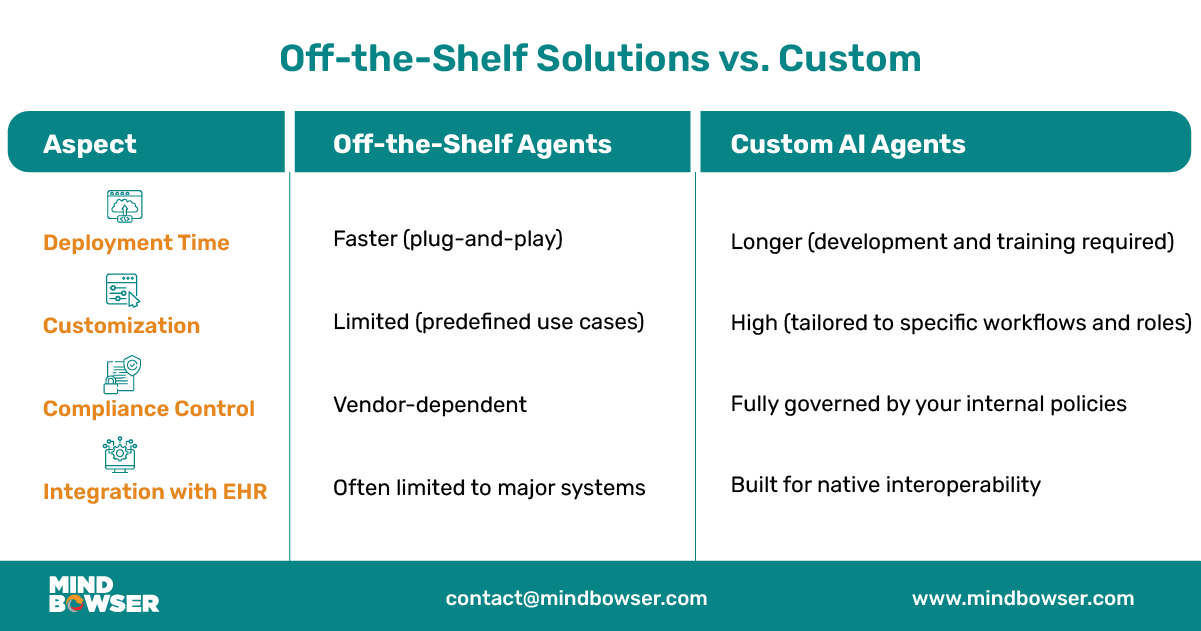
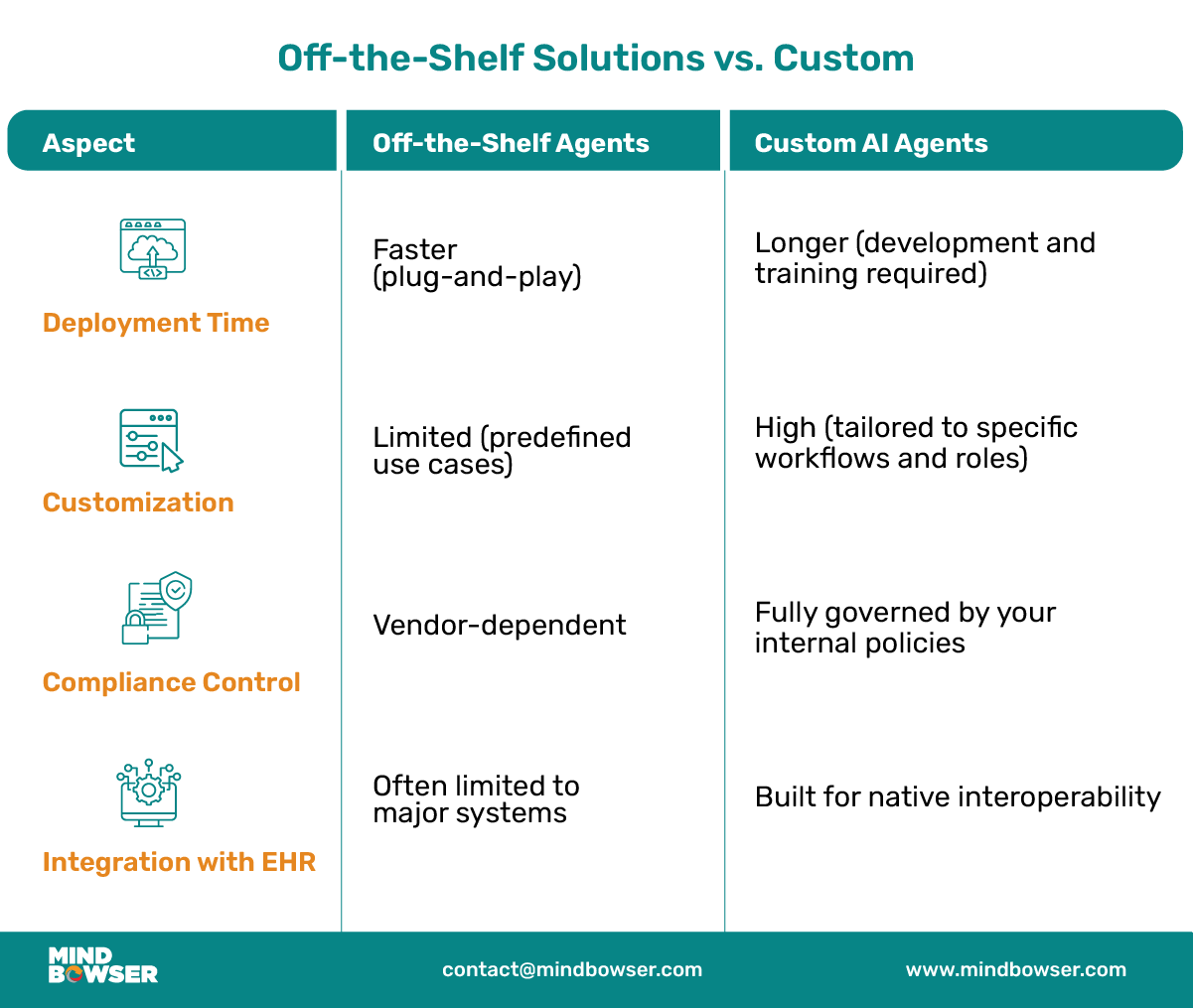
Off-the-shelf agents like Woebot or Infermedica are great for getting started. But a bespoke AI agent offers long-term value and flexibility for health systems with niche workflows, specific compliance protocols, or custom infrastructure.
🏗️ Infrastructure Required to Build AI Agents
To build effective AI agents in healthcare, organizations must invest in a robust and secure backend infrastructure:
🔸 Data Pipeline: Clean, structured access to EHR, wearable, and device data via FHIR APIs. Mindbowser’s HealthConnect CoPilot, for instance, enables integration with EHRs like Epic, Athenahealth, Cerner, and NextGen, standardizing data in FHIR R4 format.
🔸 Cloud Compliance: Use of HIPAA-compliant environments on AWS or Azure for model hosting and data processing.
🔸 LLM/ML Stack: Fine-tuned large language models (like GPT-4 or Med-PaLM), custom NLP pipelines, and clinical knowledge graphs.
🔸 Security Controls: Role-based access, PHI anonymization, audit logs, and encryption protocols.
🧪 Tips for Evaluating and Deploying AI Agents
- Start Small: Choose a narrow, high-impact use case like documentation or triage.
- Pilot & Iterate: Test in a sandbox environment with real users (e.g., use Epic’s Open. Epic sandbox if integrating there.)
- Plan for Integration: Ensure your agent connects seamlessly with your EHR (e.g., via FHIR APIs) and existing clinical systems.
- Monitor Continuously: Set up KPIs like task success rate, false positives, and clinician override rate to evaluate performance.
- Ensure Explainability: Use interpretable models or integrate explainability layers for clinician trust.
📈 Benefits of Deploying AI Agents in Healthcare
Integrating AI agents into healthcare systems delivers tangible, wide-reaching benefits—both clinical and operational. Here’s a breakdown of the key advantages:
🧑⚕️ Reduced Clinician Burnout
AI agents take over repetitive, non-clinical tasks like charting, documentation, symptom intake, and claims filing. This automation reduces the cognitive and administrative burden on providers.
Example: Tools like Nuance DAX and Nabla Copilot reduce documentation time by up to 50%, allowing clinicians to focus more on patient care.
⚡ Faster Diagnosis and Treatment
AI agents working as clinical decision support tools can identify patterns, flag risks, and recommend treatment paths instantly, often before a human would intervene.
Example: Triage bots like Infermedica expedite patient routing, ensuring timely intervention for severe conditions.
🧠 Enhanced Patient Engagement
Conversational agents and virtual nurses offer 24/7 assistance, personalized education, and ongoing follow-up, making care continuous rather than episodic.
Example: Mental health bots like Woebot provide round-the-clock CBT support, helping users manage anxiety or depression outside of clinical hours.
💰 Operational Cost Savings
AI agents reduce overhead by automating claims processing, prior authorizations, and coding validation. This minimizes errors and denials, accelerating reimbursements.
Impact: Payers and providers see savings through fewer manual workflows, decreased paperwork, and faster payment cycles.
📊 Improved Data Utilization
AI agents bridge siloed systems by extracting, analyzing, and using data from EHRs, wearables, and patient-reported outcomes—all in real time.
Example: HealthConnect CoPilot standardizes data from multiple sources (Epic, Athenahealth, Fitbit, Dexcom, etc.) into FHIR R4 format for seamless interoperability.
🧭 The Future of AI Agents in Healthcare
As the healthcare ecosystem digitizes and decentralizes, AI agents will evolve from task-specific tools to collaborative, multi-agent ecosystems. Here’s a look at what the near future holds:
🤝 Multi-Agent Collaboration
Future healthcare settings will feature multiple AI agents working in tandem like a digital care team.
🔸 A triage agent gathers symptoms and sends alerts.
🔸 A documentation agent records the interaction.
🔸 A billing agent processes claims based on the encounter.
These agents will interact with each other, not just humans, to streamline entire workflows across the care continuum.
🧠 Real-Time Decision-Making with Context
AI agents will increasingly leverage real-time data from EHRs, wearables, and imaging systems to make instant recommendations that adapt to the evolving state of the patient.
For example, an agent could monitor a patient’s oxygen saturation via Apple Watch and recommend immediate intervention to the care team via secure messaging.
This kind of context-aware responsiveness is what turns reactive care into proactive care.
🧬 Personalized Medicine Powered by AI Companions
AI agents can build longitudinal patient profiles, combining genetic data, social determinants of health, and historical outcomes to deliver truly individualized care plans.
🔸 Think beyond “Dr. Google” — patients will have “Dr. Personalized,” a digital companion who understands them at a molecular level.
🔮 Predictive, Proactive, Preventive Care
AI agents are already making headway in predictive analytics. In the future, they’ll help prevent issues before they occur.
🔸 Predict hospitalizations in chronic care patients.
🔸 Forecast medication non-adherence
🔸 Identify behavioral health risks early.
This shift from sick care to preventive care is the north star of intelligent agent adoption.
📌 Final Thoughts
AI agents in healthcare are no longer optional—they’re strategic enablers for the future of clinical care, patient engagement, and operational efficiency. From virtual triage and documentation to remote monitoring and revenue automation, these intelligent systems redefine how healthcare is delivered and experienced.
As we move toward 2025 and beyond, healthcare organizations must shift from viewing AI as a tool to treating it as a digital workforce extension. Whether adopting off-the-shelf agents or building custom solutions integrated with EHRs and wearables, the time to explore and implement is now.
Mindbowser, through its HealthConnect CoPilot and healthcare product engineering services, offers the infrastructure and expertise to deploy FHIR-based, HIPAA-compliant AI agents that integrate seamlessly with systems like Epic, Cerner, Athenahealth, and NextGenEpic – FHIR Capabilities.
🔸 Nuance DAX: Real-time medical transcription
🔸 Infermedica: Virtual triage and symptom checker
🔸 Woebot: Mental health support via CBT
🔸 Hippocratic AI: Safety-focused LLM agent for clinical use
🔸 Nabla Copilot: Voice-to-note SOAP documentation