













 BLOGS
 NEWSROOM
 CASE STUDIES
 WEBINARS
 PODCASTS
 ASSET HUB
 EVENT CALENDAR


























TL;DR
- The Quality Management System Regulation (QMSR) has been enforceable since February 2, 2026. It is not an upcoming deadline. 89 FR 7496 replaced the old Quality System Regulation (QSR) in 21 CFR Part 820 with a rule that incorporates ISO 13485:2016 by reference.
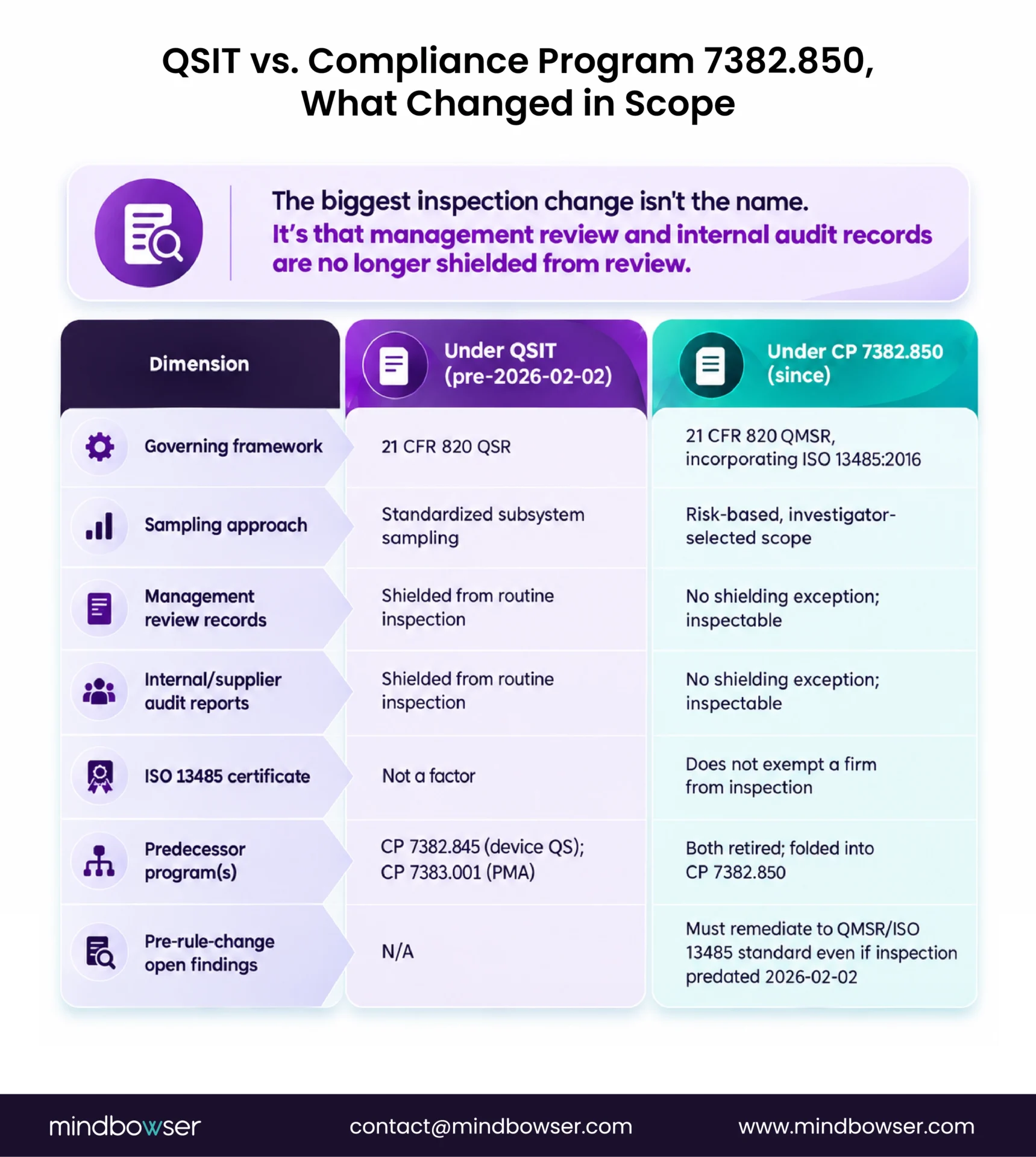
- FDA retired QSIT (Quality System Inspection Technique) the same day and now inspects under Compliance Program 7382.850, a risk-based program with no shielded record categories.
- An ISO 13485 certificate does not exempt a device maker from an FDA inspection. FDA says so directly in its own QMSR FAQ, and the first QMSR-specific warning letters back it up.
- Legacy pre-2026 records are not grandfathered. If a finding from a pre-QMSR inspection is still open, FDA expects it to be corrected to QMSR standards.
- The Device Master Record (DMR) label is retired in favor of the Medical Device File (MDF). The Design History File (DHF) and Device History Record (DHR) obligations continue, but the clause-level mapping is murkier than most vendor one-pagers admit, and we flag exactly where.
This piece covers where QMSR actually stands today, what the FDA’s new inspection model has surfaced in its first eight-plus months, how the old QSR vocabulary maps onto ISO 13485 language for your SDLC artifacts, a six-item self-check for teams who think they already handled this, the legacy-records trap almost everyone misreads, and where the regulation intersects with design controls, ISO 14971 risk management, and device software validation.
This rule binds the device manufacturer, the legal entity holding the 510(k), De Novo, or PMA, not an individual engineer and not the hospital buying the device. Keep that scope distinction in mind as you read the self-check.
We’re not writing this as FDA regulatory-affairs consultants. We’re not that. We build the systems, document control, traceability, and audit-trail tooling that regulated device software teams actually run their QMSR obligations through, and this is the angle we’re writing from: what the rule means for the artifacts your engineering team produces, not a law-firm memo.
Where the QMSR Actually Stands Today
The QMSR is in force. It has been since February 2, 2026, which makes this an eight-month-old operating reality, not a countdown.
Here’s the mechanism. FDA finalized the rule on February 2, 2024 (89 FR 7496, Doc. 2024-01709), gave the industry a two-year transition window, and the compliance date landed exactly two years later. Covington & Burling’s analysis at the time noted FDA determined ISO 13485:2016 requirements are “substantially similar” to the old QSR when taken as a whole, which is the legal basis for incorporating the standard by reference instead of writing a parallel FDA-specific standard from scratch.
FDA even tidied up cross-references elsewhere in the CFR with a technical amendment on December 4, 2025 (90 FR 55978), eight weeks before go-live, which tells you the agency was treating the date as fixed, not soft.
One detail that trips up teams: FDA’s own QMSR FAQ states plainly that the agency does not require, recognize, or issue ISO 13485 certificates, and that holding one does not exempt a manufacturer from inspection. You can be fully compliant without a cert, and you can hold a cert and still fail an inspection. That distinction drives the rest of this piece.

A lot of competitor content still frames this as a looming deadline. A Morgan Lewis client alert from October 2024 read that way at the time and reads stale now if a reader lands on it today without checking the date. We checked. The deadline passed. What matters now is what inspectors found once it did, and that’s where the SERP for this topic goes quiet.
What FDA’s New Inspection Model Has Shown in Its First 8 Months
QSIT is gone. FDA replaced it with Compliance Program 7382.850, which also absorbed two older programs, CP 7382.845 for general device QS inspections and CP 7383.001 for PMA-specific inspections, into one risk-based document.
The structural change matters more than the name swap. QSIT ran on standardized subsystem sampling: pick a subsystem (CAPA, design controls, production and process controls), sample it the same way at every firm. CP 7382.850 instead lets the investigator choose scope based on firm-specific risk. That sounds bureaucratic until you notice what it removed. K&L Gates’ analysis of the new program and a PureGlobal inspection-readiness breakdown both flag that the old exception shielding management review minutes, internal quality audit reports, and supplier audit reports from routine inspection is gone under QMSR. FDA’s own QMSR FAQ confirms it in plain language: the exceptions that existed in the old QS regulation at 21 CFR 820.180(c) are not maintained in the QMSR. Those were the documents firms kept candid precisely because nobody from FDA was supposed to read them. Now an investigator can ask for them.
We have seen what that produces. FDA posted its first QMSR-specific warning letter on May 27, 2026, to Linemaster Switch Corporation, citing a failure to document risk management processes under ISO 13485:2016 Clause 7.1, according to Hyman, Phelps & McNamara’s FDA Law Blog, published in August 2026. A second letter went to Koven Technologies on the same theme. Clause 7.1 is “general requirements” for risk management under ISO 13485, and both firms’ letters cite it. Actually, let’s be precise about what that clause-level repetition tells you: it’s not that two companies independently stumbled on the same obscure requirement.
Risk management documentation is the thing CP 7382.850’s expanded scope was built to surface, and the first two public letters surfaced exactly that.
Some commentary (unconfirmed against FDA’s own letter database as of this writing, so we’re flagging it rather than stating it as fact) describes a handful of additional 2026 letters citing the same clause family, and estimates risk-related citations now make up a meaningfully larger share of 483 observations than before QMSR. We’re not going to put a hard number on that claim here. What we can say with confidence, because it’s in FDA’s own posted letters: the first two named QMSR warning letters both hit Clause 7.1.
If you haven’t looked at how your risk management file would read to an investigator who can now also pull your last three internal audit reports, that’s the actual homework QMSR created.
QSR Terms vs. QMSR/ISO 13485 Terms: A Crosswalk for Your SDLC, Not a QA Binder
Most of the SERP content on this topic is a QA consultant’s clause-by-clause checklist. We’re going to do something narrower and more useful for an engineering team: map the three record types your SDLC tooling already produces to what FDA now calls them, and tell you plainly where the mapping is solid versus where it’s still soft.
The clean one first. The Device Master Record (DMR) is retired as a term. Greenlight Guru’s analysis of the rule and AAMI’s terminology-transition guidance both describe FDA’s own reasoning the same way: because ISO 13485 doesn’t reference “DMR,” FDA eliminated the term as unnecessary rather than carry a parallel vocabulary. The content obligation, the specifications and procedures that define how a device is built, moves to the Medical Device File (MDF) concept under ISO 13485 Clause 4.2.3.
The two that are not clean: the Design History File (DHF) and the Device History Record (DHR). The DHF concept, your design-and-development record trail, isn’t restated as a named defined term in the revised 21 CFR 820 text, but the underlying obligation (planning, inputs, outputs, review, verification, validation, design transfer) continues under ISO 13485 Clause 7.3. The DHR concept, your per-unit or per-lot production and traceability record, likewise loses its FDA-specific name while the production-record obligation continues under ISO 13485’s production and service provision clauses.

FDA hasn’t published its own clause-by-clause crosswalk for this mapping. The citations above are consistent across multiple independent industry analyses, not a line-by-line read of the final rule text itself. Confirm against ISO 13485:2016 directly before using this to retitle folders in an eQMS. We’d rather flag that honestly than hand you a tidy DHF/DMR/DHR-all-become-MDF table that reads clean and is wrong in two of three rows. That kind of oversimplification is exactly what a few SERP competitors did, and it’s the error we’d be repeating if we didn’t check.
Not Sure Your QMS Would Survive an Inspection?
Your Post-Go-Live Self-Check, and Why an ISO 13485 Certificate Alone Doesn’t Clear It
You’re probably reading this thinking your team already handled QMSR because someone ran a gap analysis in 2025 and the cert renewed on schedule. That’s fair; it’s also not the same question as whether your systems would survive an investigator who can now read your internal audit reports.
Six questions worth asking this week:
- Have you mapped every DMR reference in your SOPs and eQMS metadata to Medical Device File language, or does your documentation still say “DMR” everywhere an auditor will now expect MDF?
- Do your management-review minutes and internal-audit reports read as if they’re exempt from inspection? They aren’t anymore.
- Is your ISO 13485 certificate being treated as the finish line, or as one input among several? FDA has said plainly that certification does not exempt a firm from inspection.
- Does your risk management documentation, tied to ISO 14971, show traceable linkage from hazard to control to verification, not just a certificate on file? Clause 7.1 is where the first public warning letters landed.
- If a pre-February-2026 inspection left an open finding, has it been reviewed for remediation against the new QMSR/ISO 13485 standard rather than the old QSR language it was written under?
- Does your device software verification and validation evidence trace cleanly from design input to shipped output, in a form a risk-based investigator could actually follow in one sitting?

If you answered “not sure” to more than one of those, that’s the actual post-go-live gap, not a missing signature on a 2025 readiness checklist. Our broader medical device standards overview covers how QMSR sits alongside ISO 13485, 21 CFR 820, IEC 62304, and EU MDR at a program level if you need that wider context before narrowing in here.
The Part Everyone Assumes Is Settled: Legacy Records Are Still Inspectable
Here’s the assumption we hear most often, and it’s wrong. Teams assume that because QMSR has a go-live date, anything documented before that date is grandfathered. It isn’t.
FDA issued letters in February 2026 to IsoTis OrthoBiologics and Longhorn Vaccines stating that corrective actions for findings from inspections conducted before the QMSR took effect must still be pursued under the QMSR requirements now in force, according to the FDA Law Blog’s coverage. Read that again: the inspection predates QMSR, the remediation does not get to. FDA’s own QMSR FAQ backs this up directly: investigators may review QMS records, including ones created before February 2, 2026.
The underlying logic is the same “substantially similar” determination that let FDA incorporate ISO 13485 by reference in the first place. If the two frameworks are substantially similar, FDA’s position is that a finding doesn’t become stale just because the rule name changed underneath it. For a device-software team, that means any open CAPA, any unresolved design-control observation, any 2024 or 2025 finding still sitting in your quality system, inherits the new rule’s expectations whether or not you’ve touched that record since.
We’d flag this as the single most common wrong assumption we’ve seen in post-go-live conversations with device teams: treating 2026-02-02 as a line that protects what came before it, instead of a line that reset what’s expected of everything still open.
Where This Intersects With Design Controls, ISO 14971, and Device Software Validation
QMSR doesn’t operate in isolation from the rest of your development lifecycle. Design controls (now under ISO 13485 Clause 7.3, formerly 21 CFR 820.30) and risk management under ISO 14971 both feed directly into the same inspection scope CP 7382.850 now covers end to end, and for software-containing devices, that scope reaches your verification and validation evidence specifically.
This is where we can speak from direct build experience rather than regulatory-affairs theory, because it’s the part of the stack we actually touch: document control, CAPA workflows, and audit-trail systems, the tooling that has to produce the traceable evidence an investigator asks for, not just the policy that describes it. We build quality and compliance tooling, document control, CAPA, audit trails, as part of regulated products. That’s a systems-engineering claim, not a regulatory-affairs one, and we’re keeping it that narrow on purpose.
We’ve written separately about healthcare mobile app testing and compliance, covering mobile-app QA and HIPAA/patient-data testing practices, in our healthcare app testing and compliance guide. That piece doesn’t cover FDA device-software V&V or IEC 62304 traceability specifically, which is the actual gap question 6 of the self-check above is pointing at; we don’t have a published resource that does yet, and we’d rather say so than link around it.
A device software team that treats design controls, ISO 14971 risk files, and V&V evidence as three separate compliance exercises run by three separate owners is the team most likely to produce the kind of disconnected risk documentation Clause 7.1 citations keep landing on.
We don’t have a packaged QMSR or eQMS accelerator to point you to here. That’s not a gap we’re papering over: a fully custom traceability build, wired into whatever eQMS or document-control stack you already run, is the honest answer for most teams at this stage, and it’s the kind of build we scope through a conversation, not a product demo.
What to Actually Do With This Before Your Next Audit
The QMSR isn’t coming. It’s been enforceable for eight-plus months, FDA has already posted its first warning letters under it, and the inspection model that produced them has no shielded categories left. An ISO 13485 certificate is necessary context for an investigator, not a force field.
If you take one thing from this piece, make it the self-check above, specifically question 6, because device software validation evidence is the artifact most likely to be both inspectable and disorganized at the same time.
What we genuinely don’t know yet, and would want to find out before writing a follow-up: whether the risk-management clustering in the first wave of QMSR warning letters holds up as the sample size grows past a handful of companies, or whether it’s an artifact of which firms got inspected first. If you’ve seen a QMSR 483 that broke that pattern, we’d want to hear about it.