

 BLOGS
BLOGS  NEWSROOM
  CASE STUDIES
  WEBINARS
  PODCASTS
  ASSET HUB
  EVENT CALENDAR





















TL;DR:
- Generic EHRs fail orthopedics because they weren’t designed for implant tracking, imaging-heavy workflows, or surgical documentation
- ModMed and Nextech are the two specialty-built options worth serious evaluation. For multi-site or physician-founder situations, custom-built is the better long-term play
- The right choice depends on practice size, specialty mix (joint replacement vs. sports med vs. spine), and integration depth
There’s a moment every orthopedic surgeon recognizes. You’re trying to log a Unique Device Identifier for a tibial implant you just placed, FDA requires it, your compliance team has been asking about it for months, and you’re three menus deep in an EHR built for a family medicine practice. The field doesn’t exist. So someone creates a workaround. A spreadsheet, usually. Maybe a sticky note.
That’s not a workflow problem. That’s a product mismatch.
Generic EHRs were designed for primary care. Orthopedics runs on implant tracking, PACS-integrated imaging, outcome scoring, surgical templating, and workers’ comp documentation. None of those work well in an off-the-shelf system that treats a 90-minute joint replacement the same way it treats a 15-minute annual physical.
This guide covers what an orthopedic EMR actually needs to include, which vendors are worth evaluating in 2026, and where the line is between off-the-shelf and custom-built.
I. Why Do General EHRs Keep Failing Orthopedic Practices?
The KLAS 2024 Arch Collaborative found that only 44% of clinicians agree their EHR provides “expected outside integration,” and surgical specialists rank below that average. That gap isn’t accidental. It reflects a fundamental architecture decision: most EHRs optimize for documentation volume (primary care handles 25, 30 patients a day), not clinical complexity (an orthopedic surgeon handles 3, 5 surgical cases with device tracking, imaging review, and multi-visit outcome scoring).
Here’s what breaks in a generic EHR for orthopedics:
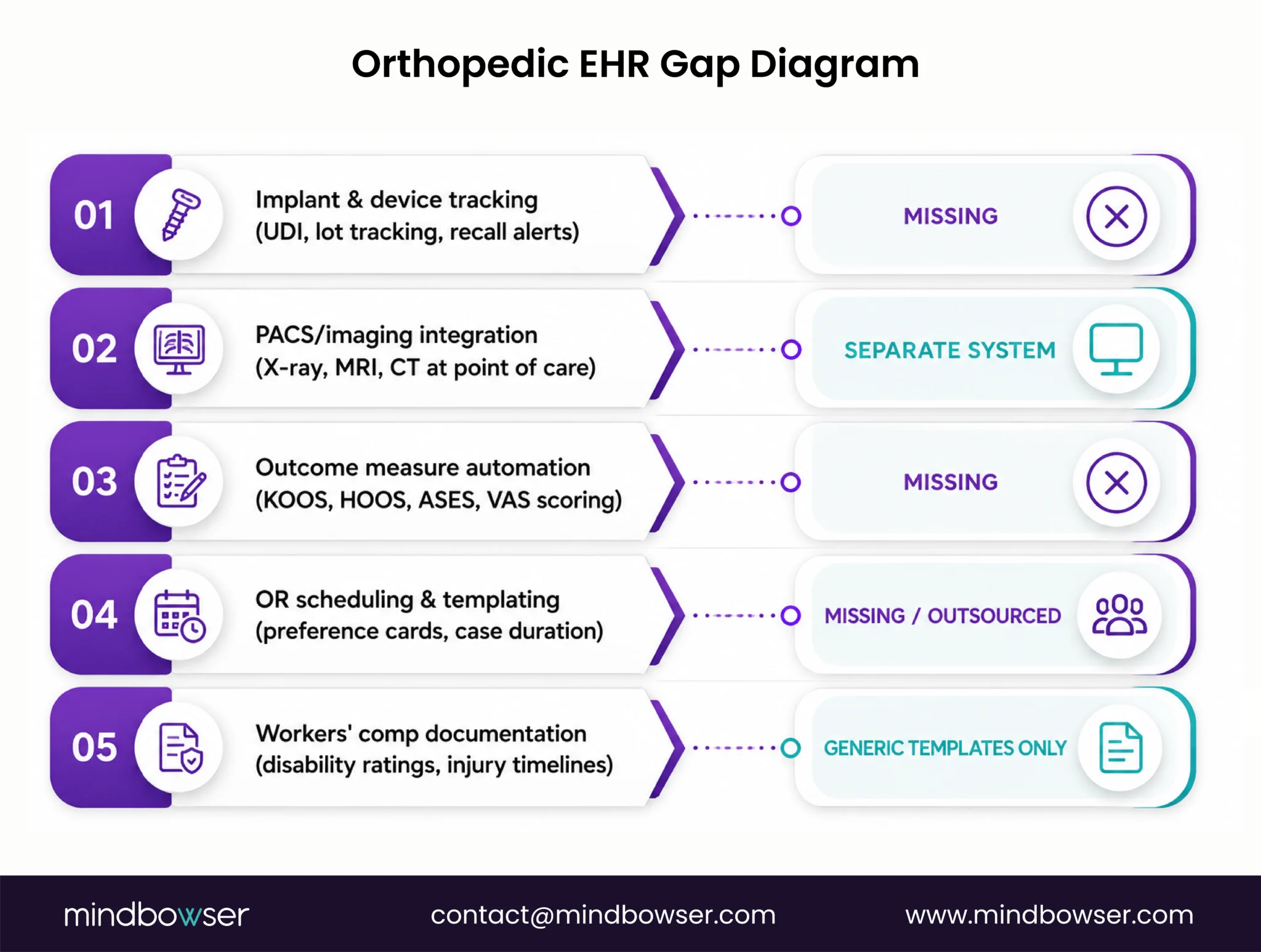
- Implant tracking: The FDA UDI mandate (21 CFR Part 830) requires device identifiers logged at the point of care, not in a spreadsheet after the fact. Most generic EHRs have no native implant log.
- Imaging: Orthopedics is an imaging-heavy specialty. X-rays, MRI, and CT need to open inside the encounter, not a separate tab, not a separate PACS login. Every extra click during a surgical consult is documentation time the surgeon doesn’t have.
- Workers’ comp: 10, 20% of orthopedic revenue comes from workers’ comp cases. These require specific narrative documentation (disability ratings, injury-to-recovery timelines, insurance form generation) that standard SOAP note templates don’t support.
- Documentation burden: Surgical specialties already spend more minutes per note than primary care. Ambiguous orthopedic templates force workarounds, dictation into generic fields, manual copy-paste into disability forms, and parallel tracking in Excel.
- Template gaps: The AAOS 2023 Orthopaedic Practice in the U.S. survey identified EHR-related workflow friction as one of the top three operational complaints among orthopedic surgeons in group practices, specifically citing lack of specialty-specific templates and poor imaging integration.
Orthopedic practices end up running an average of 3+ separate systems (clinical EHR + imaging + practice management) when the EHR can’t unify them. That’s the real cost, not just the software subscription, but the integration tax paid in staff time every single day.
II. What Does an Orthopedic EMR Actually Need to Include?
Before you look at a single vendor demo, six non-negotiables:
- Implant and device tracking FDA UDI compliance (21 CFR Part 830) requires logging device identifiers at the point of implantation. This needs to happen inside the encounter workflow, not in a bolt-on spreadsheet. If a vendor can’t show you exactly how UDI capture works at the point of care, move on.
- PACS/imaging integration X-rays, MRI, CT at the point of care. Inside the EHR encounter, with image annotation. Not a separate login, not a new browser tab. The standard to hold vendors to: can the surgeon pull up the pre-op imaging, annotate it, and close the note without switching systems?
- Outcome measure automation PROMIS, KOOS, HOOS, ASES, VAS, Oswestry. Forms need to go out automatically at the right intervals (pre-op, 6-week, 3-month, 1-year), and scores need to populate into the encounter record automatically. Manual entry defeats the clinical value.
- OR scheduling and surgical templating instrument sets, case duration estimates, and surgeon preference cards. Most generic EHRs outsource this entirely to a separate scheduling platform. For an orthopedic-primary practice, that’s a significant workflow gap.
- Workers’ comp documentation, disability ratings, injury-to-recovery timelines, and insurance form generation. These need to be generated from inside the note, not copied and pasted into a separate system.
- Referral management orthopedic practices receive 60, 80% of patients via referral. Inbound referral tracking with status visibility (received, scheduled, seen, report sent back) reduces the staff phone call volume that erodes clinic efficiency.
Any vendor that requires a workaround for two or more of these six items is a generic EHR with orthopedic marketing language applied to it.
ModMed (Modernizing Medicine) KLAS-rated 86.7/100 (KLAS Research 2024), built for surgical specialties from the ground up. Includes EHR + practice management + PACS + patient engagement in a unified platform. MSK-specific E&M coding modules, PACS-embedded image annotation, KOOS/HOOS automatic outcome score tracking. Best for high-volume surgical groups with 5+ providers. Limitation: pricing scales steeply at the enterprise level ($400, 600/provider/month range).
Nextech rated 85.2/100 (KLAS Research 2024), focused on surgical and procedural specialties including orthopedics, plastic surgery, and ophthalmology. Strong implant preference card management, OR case scheduling, and surgical supply tracking all in one system. Best for single or small group orthopedic practices that want specialty depth without enterprise complexity. Particularly strong for ASC-attached practices.
Greenway Health (Intergy) mid-market EHR with a decent template library. Good for practices transitioning from paper or a legacy system and want a cost-controlled option. Limitation: orthopedics-specific customization requires a Greenway services engagement; it doesn’t come out of the box.
athenahealth has a cloud-based, strong revenue cycle management and interoperability track record. Best fit when orthopedics is one of several departments inside a multi-specialty group. Limitation: orthopedic-specific workflow depth requires bolt-ons; it’s not a specialty-first product.
eClinicalWorks (eCW) is widely deployed, configurable, and good for mid-size practices already running eCW elsewhere in their organization. Limitation: orthopedic specialist templates require customization; not plug-and-play for surgical workflow.“`
DrChrono mobile-first, modern interface, approximately $299/provider/month. Best for solo or very small orthopedic practices (1, 3 providers) prioritizing ease of use and cost over deep specialty functionality. Limitation: implant tracking and PACS integration are materially limited compared to specialty-built options.
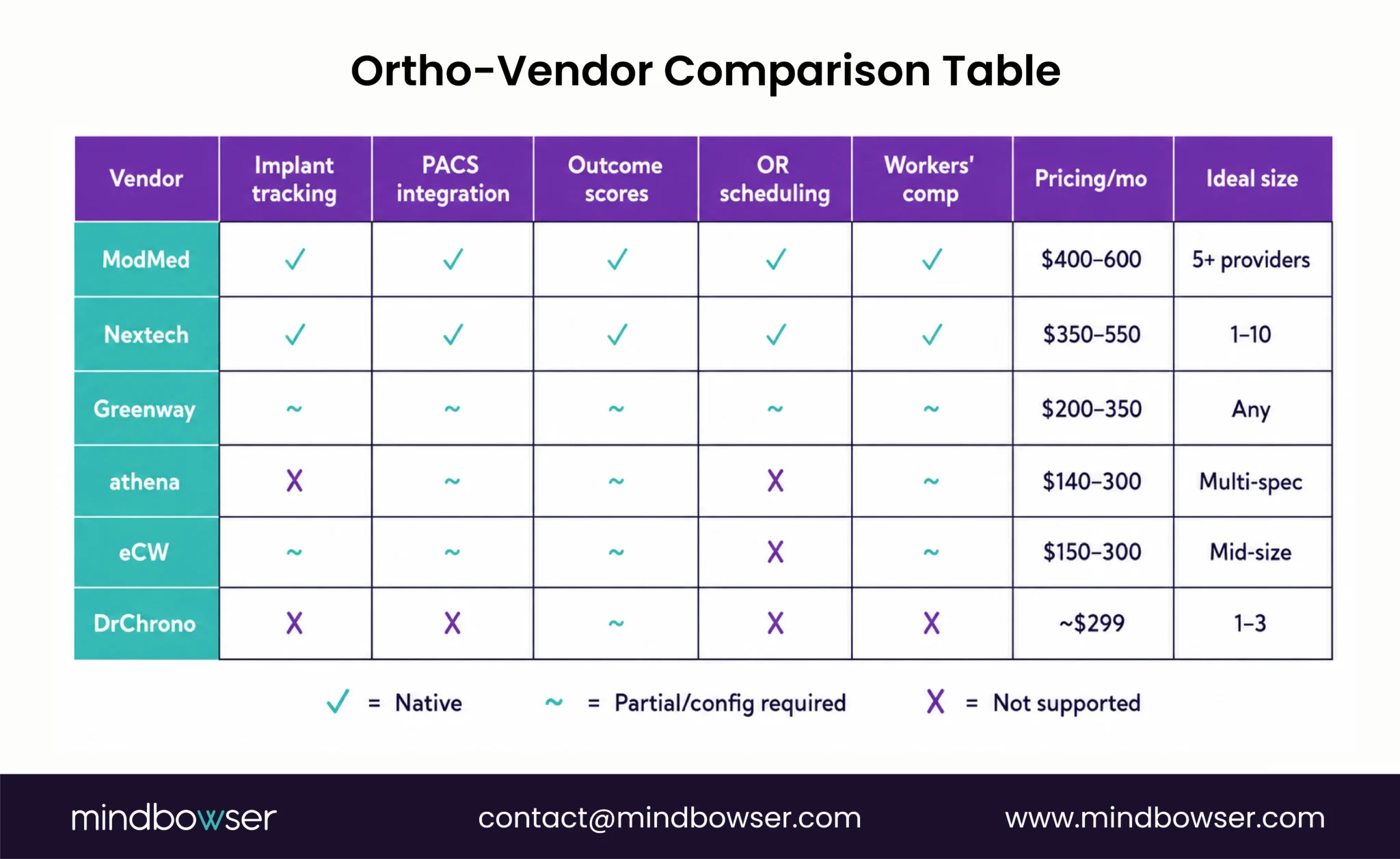
| Feature | ModMed | Nextech | Greenway | athena | eCW | DrChrono |
|---|---|---|---|---|---|---|
| Implant tracking | Yes | Yes | Partial | No | Partial | No |
| PACS integration | Yes | Yes | Partial | Partial | Partial | No |
| Outcome scores | Yes | Yes | Partial | Partial | Partial | Partial |
| OR scheduling | Yes | Yes | No | No | No | No |
| Workers’ comp | Yes | Yes | Partial | Partial | Partial | Partial |
| Pricing/mo | $400–600 | $350–550 | $200–350 | $140–300 | $150–300 | ~$299 |
| Ideal size | 5+ providers | 1–10 | Any | Multi-specialty | Mid-size | 1–3 |
Legend: • Yes = Native support • Partial = Requires configuration or add-ons • No = Not supported
Planning to Build a Custom Orthopedic EMR?
IV. ModMed vs. Nextech: The Two Specialty-Built Options Compared
If orthopedics is the primary (or only) specialty in your practice, not one department inside a multi-specialty group, these two are the ones that were actually designed for your workflows.
ModMed was built specialty-first, not retrofitted. The EMA (Electronic Medical Assistant) system includes MSK-specific E&M coding, PACS-embedded image annotation, and automatic KOOS/HOOS outcome score tracking. For high-volume joint replacement groups, ModMed’s documentation workflow is genuinely faster than most alternatives because the templates map to how orthopedic surgeons actually document, not to how a primary care EHR was adapted for surgical use.
New in 2024: Nuance DAX Copilot for orthopedics is now natively supported within ModMed. If ambient documentation (AI-generated surgical notes from voice) is on your evaluation list, ModMed is the cleaner integration path.
Nextech is strongest at the procedure management layer, implant preference cards, OR case scheduling, and surgical supply tracking, all in one system. Particularly strong for ASC-attached practices where the EHR needs to connect clinical documentation with surgical scheduling and supply chain. If your practice runs an ambulatory surgery center, Nextech’s OR workflow integration is a meaningful differentiator.
Head to head:
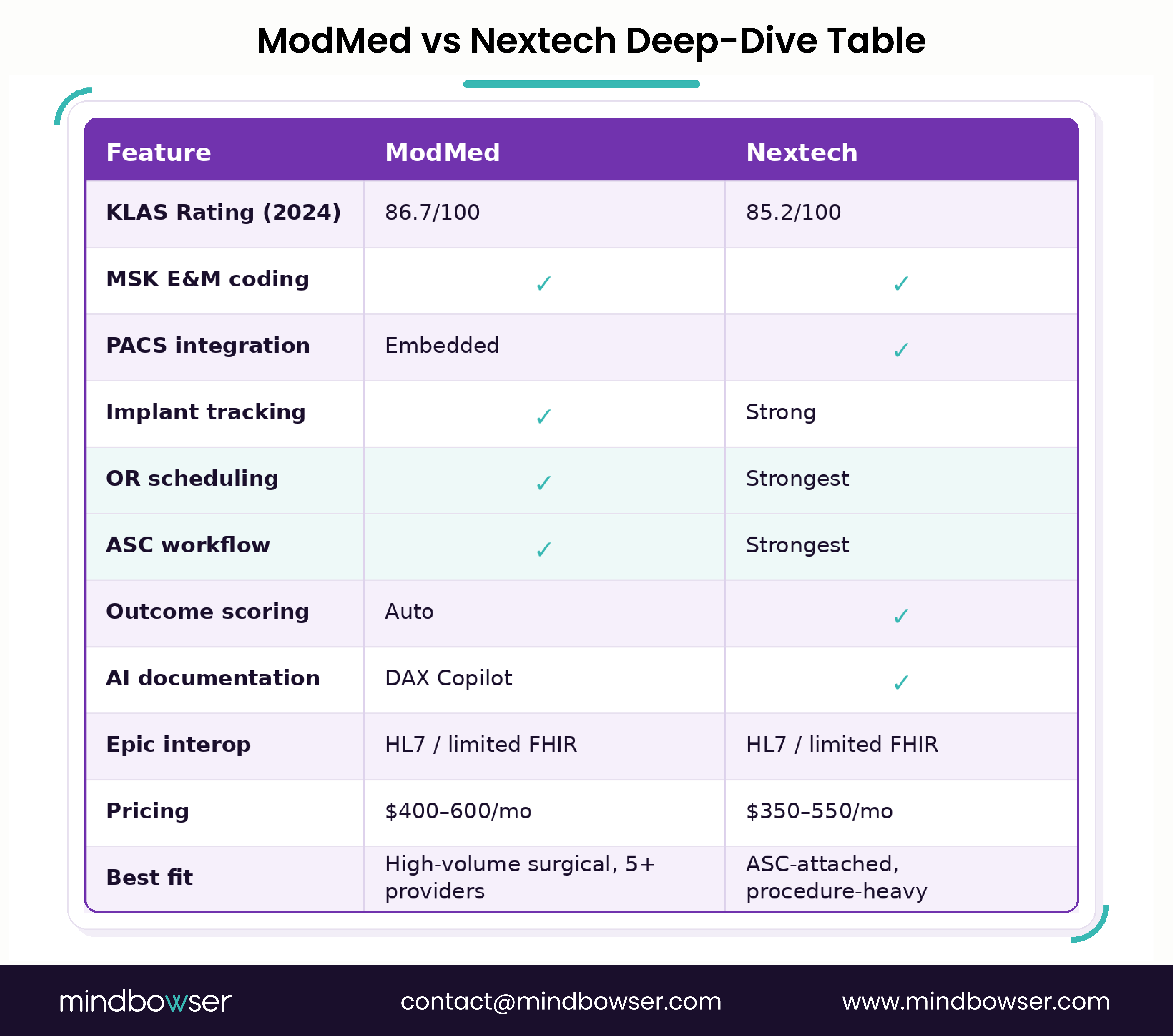
| Feature | ModMed | Nextech |
|---|---|---|
| KLAS Rating (2024) | 86.7/100 | 85.2/100 |
| MSK E&M coding | ✅ | ✅ |
| PACS integration | ✅ Embedded | ✅ |
| Implant tracking | ✅ | ✅ Strong |
| OR scheduling | ✅ | ✅ Strongest |
| ASC workflow | ✅ | ✅ Strongest |
| Outcome scoring | ✅ Auto | ✅ |
| AI documentation | ✅ DAX Copilot | Partial |
| Epic interop | HL7 / Limited FHIR | HL7 / Limited FHIR |
| Pricing | $400–600/mo | $350–550/mo |
| Best fit | High-volume surgical, 5+ providers | ASC-attached, procedure-heavy |
Neither is zero-friction with Epic. If your practice is inside a large health system that runs Epic enterprise-wide, standalone ModMed or Nextech will require middleware for bidirectional data sync. Factor the integration cost into your evaluation.
Evaluating your EHR options and not sure which fits your workflow?
Request an Assessment we’ll map your specific orthopedic workflows against what’s on the market.
V. When Does a Custom-Built Orthopedic EMR Make More Sense?
For most orthopedic practices, one of the six options above works. But there’s a category where off-the-shelf starts to break, and pushing through with a commercial vendor becomes more expensive than building.
Three scenarios where custom is the right conversation:
Multi-site groups need a unified data model. At 10+ locations, vendor EHRs don’t give you full data ownership or API access at the scale and flexibility a custom-built system does. You’re paying for seats, not for infrastructure you control. Custom build gives you a single orthopedic data model across all locations, patient history, outcome scores, and implant records without per-seat pricing that compounds as you grow.
Physician-founders building a commercializable specialty platform. This is a segment I see more of. Orthopedic surgeons who’ve been frustrated with the EHR market for 20 years have decided to build the product they wish existed. Off-the-shelf can’t serve as the foundation for a commercial platform you need full source code ownership, clean APIs, and a data model you designed.
Complex implant tracking and device manufacturer integrations. Standard EHRs handle UDI capture at a basic level. When you need real-time device manufacturer data (supply chain, lot tracking, recall alerts) flowing into the EHR at the point of care, that’s a custom integration layer. EHRConnect connects Epic, Cerner, Athenahealth, and device manufacturer data, compressing what would be a 6-month custom integration to 6 days. For orthopedic practices dealing with multiple implant suppliers and complex device documentation requirements, this is the accelerator that closes the FDA UDI gap at the point of care.
Two more worth knowing:
- AI Medical Summary cuts surgical note time by approximately 50% and improves accuracy by approximately 45% when woven into a custom EHR layer. This isn’t available as a modular add-on from standard vendors; it’s a custom integration play.
- Patient Referral Manager handles the inbound referral tracking layer that standard EHRs leave to spreadsheets, status visibility, staff phone call reduction, and referral loop closure. Orthopedics, with 60, 80% referral-sourced volume, benefits more than most.
Custom build cost range: $150K, $500K+, depending on scope and integration complexity. The ROI equation shifts when you’re eliminating 3+ separate systems and reducing documentation labor at scale. See our custom EHR development overview for what that scope typically looks like.
If you’re past the point where off-the-shelf scales, Start a Conversation 30 minutes to know whether a custom build is the right call for your group.
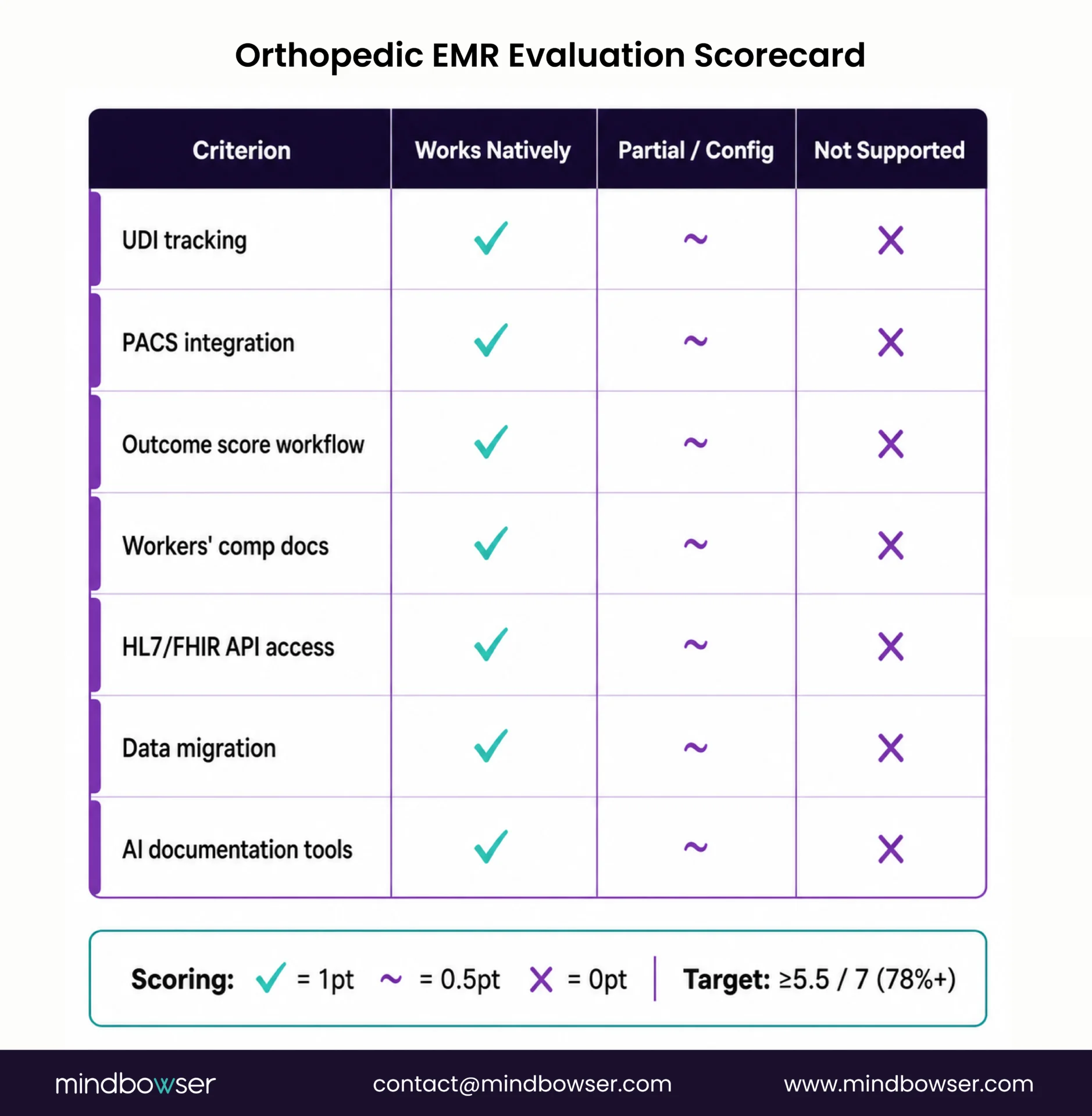
Seven things to test before you sign:
- UDI tracking: Ask the vendor to show you exactly how a device identifier is logged at the point of implantation during the encounter, not in a post-encounter form. If they pull up a separate window or say “you’d add that in the device management module,” that’s not point-of-care UDI. FDA 21 CFR Part 830 doesn’t give you a workaround.
- PACS integration: During the demo, ask them to open a radiology image from inside an active patient encounter. If they switch to a different tab, different login, or show you a separate PACS viewer, that’s not integrated imaging. That’s two systems.
- Outcome score workflow: Ask: “If I see a patient for a pre-op visit today, when does the KOOS form go out, and how does the score get into the note at the 6-week visit?” If the answer involves any staff reminder or manual entry, that’s not automated outcome tracking.
- Workers’ comp documentation: Ask them to generate a disability rating narrative from inside an EHR note for a mock workers’ comp case. If they can’t do it in the demo, your billing staff can’t do it in practice.“`
- HL7/FHIR APIs: Ask directly: “If we need to connect to a hospital system, lab, or imaging center outside your network, what’s the implementation timeline and what’s the cost?” This isn’t a trap question. It’s a budgeting question. KLAS 2024 implementation benchmarks show specialty EMR implementations for group practices average 5.2 months vs. vendor-stated timelines of 3 months. The API question tells you how much of that gap you’ll absorb in integration costs.
- Migration: Ask: “Can you extract structured data from our current system, or will we be re-entering patient history?” Data portability under the CMS Interoperability Rule (21st Century Cures Act) means vendors can’t block access to patient data, but bulk export can still be slow and expensive. Ask about format (HL7/CDA/FHIR), timeline, and cost at contract end. See our EHR data migration guide for what a clean migration looks like. Also relates directly to FHIR API testing make sure your new system’s APIs are testable and documentable before go-live.
- AI documentation: Ask whether ambient scribing (AI-generated notes from voice) is included, requires a separate subscription, or isn’t available. Nuance DAX Copilot is now natively integrated in ModMed; other platforms require a separate Nuance or Suki subscription. This is a real cost line, not a feature footnote documentation burden is the #1 EHR complaint across all specialties per KLAS 2024.
VII. Questions to Ask Any Orthopedic EMR Vendor Before Signing

Five things vendor sales teams will gloss over:
“What is your uptime SLA for imaging-heavy workflows?”
Standard SLAs at 99.9% still allow 8.7 hours of downtime per year. When OR scheduling, pre-op imaging review, and surgical documentation all live in the same system, that downtime hits at the worst possible time. Push for 99.95%+ and ask what the compensation mechanism is when they miss it.
“Can we have full API access to our patient data, or does extraction require your support team?”
The CMS Interoperability Rule requires API access to patient data, but “accessible” and “practical” are different things. Ask specifically: how long does a full structured data export take for a practice of our size? Is there a per-record or per-export cost? This is your exit clause and your data ownership reality check.
“What is the realistic implementation timeline for a practice our size, not the stated timeline?”
KLAS 2024 benchmarks: specialty EMR implementations for group practices average 5.2 months vs. the 3-month figure most vendors state. Ask for three live references from groups comparable in size and specialty depth, not a case study PDF, actual calls. The gap between stated and real implementation timelines tells you a lot about how the vendor manages expectations post-contract.
“What happens to our data if we switch vendors in three years?”
Data portability (you can export it) is not the same as data ownership (it’s in a format you can actually use). Confirm: structured data export format (HL7 CDA, FHIR, or CSV), timeline for delivery at contract end, and whether there’s a cost for it. Some vendors bill for this; it’s worth knowing before you sign.
“Do you have orthopedic-specific references we can speak to directly, not a case study PDF, an actual call?”
Vendor-curated references are the best-case scenario. A live reference call from a practice running the same specialty at comparable volume tells you far more about implementation reality than any published success story.
The right orthopedic EMR doesn’t feel like a workaround
The common denominator across every EHR complaint I hear from orthopedic practices is the same: the system doesn’t understand the clinical workflow, so the team builds workarounds. A second screen for PACS. A spreadsheet for implant tracking. A Word template for workers’ comp forms. A manual reminder system for outcome questionnaires.
Those workarounds are the cost of using a generic EHR in a specialty environment. They don’t show up in the vendor contract, but they show up in staff time, documentation errors, and surgeon frustration every single day.
The evaluation process matters. Watch a vendor demo with the seven-question checklist above, and you’ll see the workarounds before they become your problem. If ModMed or Nextech fits your practice size and workflow, either one represents a genuine upgrade over a generic EHR. If you’re running a complex multi-site group, building a specialty platform, or dealing with device manufacturer integrations that off-the-shelf solutions can’t handle, that’s a different conversation.
For the second category, here’s what a best-in-class EHR for private practice looks like at scale, and a comparison of headless EHR options if you’re evaluating modern open-source architectures as a foundation.
If you want a direct conversation about where your practice falls on that spectrum, we’re straightforward about it. Start here.
For 1, 3 providers, DrChrono, at approximately $299/provider/month, offers a modern interface and core functionality at the lowest entry cost. ModMed is the upgrade path when you outgrow it expect $400, 600/provider/month. Nextech sits between both in price and specialty depth. KLAS Research 2024 confirms both ModMed (86.7/100) and Nextech (85.2/100) as top-rated for orthopedic specialty workflow. If cost is the primary constraint and you can live without native implant tracking and deep PACS integration, DrChrono works for a small practice. If clinical workflow depth matters from day one, start with Nextech.
Yes, if you’re inside a health system that already runs Epic enterprise-wide and your orthopedics department is part of that network. Epic has an orthopedic-specific module (Bones) available to health system clients. For an independent orthopedic practice, Epic is cost-prohibitive, and over-engineered standalone implementations run 12, 18 months and $1M+ for a group practice. The only scenario where Epic makes sense for a standalone orthopedic practice is if you anticipate being acquired by a health system that runs Epic in the next 3, 5 years and want to reduce migration costs later.
UDI (Unique Device Identification) tracking means logging an FDA-assigned device identifier at the point of implantation at surgery, in the encounter record, not after the fact in a spreadsheet. Required under FDA 21 CFR Part 830. Non-compliance penalties can reach $15,000 per violation. Most generic EHRs don’t support this natively; orthopedic specialty EMRs (ModMed, Nextech) do. For practices with complex device manufacturer integrations, EHRConnect connects the EHR directly to device manufacturer data and compresses a 6-month custom integration to 6 days.
Cloud-based specialty options range from approximately $150 to $600/provider/month, depending on tier and bundled modules. Custom-built orthopedic EHR: $150K, $500K+ depending on scope and integration complexity. The custom build is a capital investment; the savings case is eliminating 3+ separate systems and reducing documentation labor over time. For a multi-site group running separate EHR + PACS + PM systems, the ROI math often closes faster than it looks on the surface. See custom EHR development for a realistic scope discussion.
ModMed (86.7/100, KLAS 2024) is stronger for high-volume surgical groups with complex imaging needs, joint replacement-heavy practices with 5+ surgeons. Nextech (85.2/100, KLAS 2024) is stronger for ASC-attached practices and procedure-heavy workflows with strong OR scheduling requirements. If you’re primarily a joint replacement group, lean on ModMed. Single-location sports med or spine practice, Nextech is the tighter fit. Both beat every generic EHR on this list for orthopedic-primary use.
Three scenarios: (1) Multi-site groups (10+ locations) requiring a unified data model with full data ownership and API access. (2) Physician-founders building a commercially viable specialty platform off-the-shelf can’t serve as the foundation for a commercial product; you need full source code ownership. (3) Complex device manufacturer integrations, UDI plus supply chain data flowing into the EHR at the point of care that standard EHRs can’t support natively. In all three cases, a custom build with EHRConnect compresses integration timelines from months to days and gives you the data architecture you actually need. The medical specialty EHR development guide covers what the build process looks like. ─── The common denominator across every EHR complaint I hear from orthopedic practices is the same: the system doesn’t understand the clinical workflow, so the team builds workarounds. A second screen for PACS. A spreadsheet for implant tracking. A Word template for workers’ comp forms. A manual reminder system for outcome questionnaires. Those workarounds are the cost of using a generic EHR in a specialty environment. They don’t show up in the vendor contract, but they show up in staff time, documentation errors, and surgeon frustration every single day. The evaluation process matters. Watch a vendor demo with the seven-question checklist above, and you’ll see the workarounds before they become your problem. If ModMed or Nextech fits your practice size and workflow, either one represents a genuine upgrade over a generic EHR. If you’re running a complex multi-site group, building a specialty platform, or dealing with device manufacturer integrations that off-the-shelf solutions can’t handle, that’s a different conversation. For the second category, here’s what a best-in-class EHR for private practice looks like at scale, and a comparison of headless EHR options if you’re evaluating modern open-source architectures as a foundation. If you want a direct conversation about where your practice falls on that spectrum, we’re straightforward about it. Start here.