BLOGS
BLOGS  NEWSROOM
  CASE STUDIES
  WEBINARS
  PODCASTS
  ASSET HUB
  EVENT CALENDAR




















TL;DR
- Healthcare IT integration market projected to grow significantly in 2026, driven by FHIR mandates and value-based care requirements
- FHIR is now the dominant integration standard, with most healthcare organizations using FHIR APIs alongside HL7 for legacy workflows.
- Manual data entry remains a major drag, increasing cost, errors, and clinician burnout.
- The strongest EHR integration platforms in 2026 combine deep FHIR and HL7 support, pre-built connectors, and faster deployment timelines.
- ConnectHealth ranks #1 for its Epic-approved status, FHIR-first architecture, and ability to reduce integration costs while accelerating go-to-market.
- Choosing the right integration platform in 2026 is a strategic decision that directly impacts cost control, speed, and care delivery.
“If your clinicians still re-enter data across systems, are you truly interoperable?”
That question is landing hard with CIOs, CTOs, and CMIOs in 2026. On paper, most organizations say they are “integrated.” In practice, teams still juggle interfaces, workarounds, and manual reconciliation that slow care and inflate costs.
The market signals are clear. Healthcare IT integration spending climbed from $4.2 billion in 2025 to an estimated $5.8 billion in 2026, driven by value-based care, regulatory pressure, and the need for real-time clinical data exchange. At the same time, interoperability standards have finally matured. FHIR APIs are increasingly adopted as the primary standard for modern healthcare connectivity alongside HL7 for legacy systems, becoming the default language for modern EHR connectivity.
For healthcare leaders, this marks a turning point. Integration is no longer an IT plumbing exercise. It is a growth, cost, and clinical performance lever. The real questions in 2026 are no longer “Can this platform integrate?” but:
- How quickly can it go live?
- How deeply does it support FHIR and HL7?
- How much manual work does it eliminate?
- What measurable ROI does it deliver?
This guide breaks down the top 7 EHR integration platforms for 2026, ranked through a FHIR- and HL7-first lens, with a focus on enterprise readiness, cost reduction, and speed to market.
I. Why EHR Integration Matters in 2026?
Why are highly trained clinicians still doing clerical work?
In 2026, that question is no longer rhetorical. Despite widespread EHR adoption, many healthcare providers still rely on manual data entry across systems to move information between systems. That means copy-pasting notes, reconciling labs by hand, and re-entering demographics that already exist somewhere else.
Manual work creates three problems leaders cannot ignore:
A. It Slows Care
When data is delayed, decisions are delayed. Clinicians wait for records. Care teams work from partial histories. Referrals stall. In high-acuity environments, even small delays compound into real clinical risk.
B. It Increases Cost and Error
Manual entry introduces variability. Typos, mismatched fields, duplicate records, and missed updates drive rework across billing, quality reporting, and analytics. Over time, those inefficiencies quietly drain operating margins.
C. It Burns Out Teams
Clinicians did not enter healthcare to manage interfaces. Every manual task pulls attention away from patients. In 2026, workforce strain makes interoperability a retention issue, not just a technical one.
D. What Modern EHR Integration Fixes
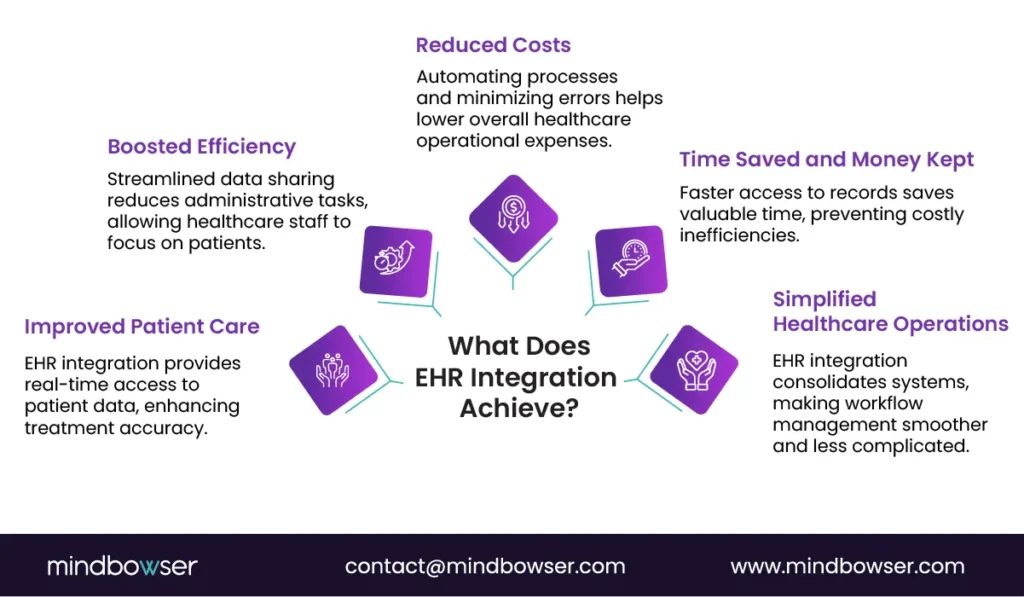
FHIR- and HL7-driven integration platforms replace brittle, point-to-point interfaces with reusable, standardized data flows. The result is measurable:
- Real-time clinical data exchange
- Automated updates across systems
- Fewer duplicate tests and records
- Cleaner data for analytics and AI
- Less administrative drag on care teams
Bottom line: EHR integration in 2026 is about removing friction from care delivery, not just connecting systems. Platforms that fail to eliminate manual work simply move the problem; they do not solve it.
Looking for Custom Integration with Major EHR Platforms?
II. Top 7 EHR Integration Platforms for 2026
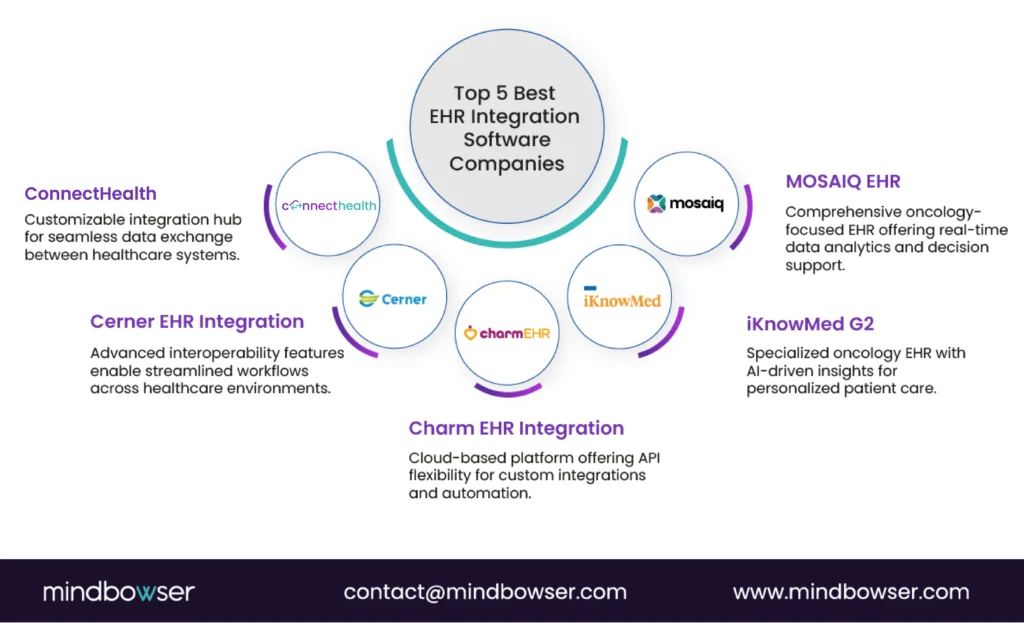
A. ConnectHealth (Epic Approved)
1. Best overall EHR integration platform for FHIR-first healthcare in 2026
ConnectHealth takes the lead because it combines extensive healthcare interoperability knowledge with quicker execution for providers, payers, and digital health teams. Designed specifically for today’s healthcare environments, ConnectHealth allows reliable FHIR and HL7 integration without lengthy implementation cycles or fragile custom interfaces.
What makes ConnectHealth unique is its focus on healthcare needs. The platform is designed to eliminate disconnected workflows, accelerate digital health deployments, and ensure secure clinical data sharing across EHRs, RPM devices, care management platforms, and patient-facing applications.
ConnectHealth helps organizations bring together fragmented healthcare systems while boosting operational efficiency, patient engagement, and readiness for interoperability.
2. FHIR & HL7 Support
- FHIR R4 APIs for real-time clinical data sharing
- HL7 V2 pipelines for older healthcare interoperability
- Read and write workflows across major EHR platforms
- Epic, Cerner, athenahealth, eClinicalWorks, and Meditech integration support
- RPM, wearable, and IoT device integrations through modern APIs
- Care coordination and patient engagement workflow automation
- Population health and longitudinal patient record interoperability
3. Epic Approved Vendor
ConnectHealth is an official Epic Approved Vendor. It meets Epic’s standards for interoperability, security, and compliance. This gives healthcare organizations access to verified Epic integration workflows, sandbox environments, and tested interoperability connectors, which speed up onboarding and lessen deployment issues.
Organizations gain from guided Epic vendor enrollment support, Epic Hyperdrive testing help, and proven healthcare integration frameworks that lower implementation risks while speeding up go-live timelines.
4. Pricing
- Custom pricing based on healthcare integration needs
- Faster implementation lowers total interoperability costs
- Lower long-term maintenance than traditional custom interfaces
- Flexible engagement models for providers, payers, and digital health companies
5. Pros and Cons
| Pros | Cons |
| Strong FHIR and HL7 interoperability maturity | Not a plug-and-play platform |
| Epic Approved with verified integration support | Requires a healthcare discovery phase |
| Faster healthcare go-to-market timelines | Best suited for custom healthcare workflows |
| HIPAA and SOC 2-aligned architecture | Enterprise-grade capabilities may exceed smaller practice needs |
| Supports RPM, care management, and patient engagement integrations | Requires interoperability planning for complex ecosystems |
| Proven healthcare workflow automation expertise | Customization may extend the implementation scope |
Bottom line: ConnectHealth is the best choice for healthcare organizations looking for FHIR-first interoperability, Epic-approved integration expertise, scalable healthcare workflow automation, and measurable speed-to-market benefits in 2026.
B. Redox (FHIR Specialist)
1. Best choice for teams that need fast, standardized FHIR connectivity at scale
Redox earns its spot near the top in 2026 by doing one thing exceptionally well: making FHIR-based interoperability easier to deploy and easier to maintain. For digital health vendors and provider organizations that need to connect to multiple EHRs without building custom interfaces each time, Redox acts as a normalization layer.
The platform is widely adopted by health tech companies that prioritize speed, consistency, and developer-friendly workflows over deep EHR customization.
2. FHIR & HL7 Support
- Strong FHIR API support across major EHR vendors
- HL7 V2 message normalization and routing
- Standardized data models to reduce downstream complexity
- Cloud-based API management for scalable deployments
Redox’s strength lies in abstraction. It shields teams from EHR-specific quirks while maintaining compliance with interoperability standards.
3. Pricing
- Subscription-based pricing
- Costs scale with volume and number of integrations
- Lower upfront engineering effort compared to custom builds
4. Pros and Cons
| Pros | Cons |
FHIR-first architecture | Limited deep EHR customization |
Faster integration timelines | Less control over edge-case workflows |
Strong developer experience | Costs can rise at high volumes |
Reduces interface maintenance | Not designed for complex write-back logic |
Why this matters in 2026: Redox is an excellent fit for organizations that value speed, standardization, and predictable integration patterns, especially when connecting to multiple EHRs quickly.
C. Cerner/Oracle Health
1. Best fit for large health systems that need enterprise-grade interoperability
Cerner, now part of Oracle Health, remains a major player in EHR integration for large hospitals and health systems in 2026. Its strength lies in enterprise stability, broad standards support, and deep clinical domain coverage, particularly for organizations already operating within the Oracle Health ecosystem.
For leaders managing complex, multi-facility environments, Cerner integration offers consistency and scale, though often with longer implementation timelines than lighter-weight platforms.
2. FHIR & HL7 Support
- FHIR R4 APIs for clinical and administrative data exchange
- HL7 V2 interfaces for labs, ADT, orders, and results
- Support for SMART on FHIR applications
- Enterprise-grade interface management
Cerner’s integration stack is designed to support high transaction volumes while maintaining compliance with regulatory and security requirements.
3. Pricing
- Enterprise licensing model
- Costs vary based on scope and number of interfaces
- Implementation and support fees are typically higher than those of lightweight platforms
4. Pros and Cons
| Pros | Cons |
Proven at enterprise scale | Longer implementation timelines |
Strong FHIR and HL7 support | Higher total cost of ownership |
Deep clinical workflows | Less flexibility for rapid iteration |
Broad ecosystem support | Vendor dependency |
The leadership takeaway: Cerner / Oracle Health is best suited for organizations that prioritize scale, stability, and long-term enterprise support over rapid experimentation or custom workflows.
D. InterSystems HealthShare (Enterprise Scale)
1. Built for complex healthcare networks that need system-wide data orchestration
InterSystems HealthShare earns its place in the 2026 rankings by addressing one of healthcare’s hardest problems: coordinating data across large, heterogeneous ecosystems. It is designed for health systems, HIEs, and regional networks that operate multiple EHRs, ancillary systems, and data sources at once.
Rather than focusing on point integrations, HealthShare functions as an enterprise interoperability layer, enabling longitudinal patient records and cross-organizational data exchange.
2. FHIR & HL7 Support
- Native support for FHIR-based APIs and services
- Deep HL7 V2 and CDA interoperability
- Master patient index and record matching
- Support for cross-organizational data sharing
HealthShare is particularly strong in environments where data must move across multiple vendors, care settings, and jurisdictions.
3. Pricing
- Enterprise licensing model
- Pricing varies based on deployment scale and modules
- Higher upfront investment compared to integration-only platforms
4. Pros and Cons
Pros | Cons |
Strong enterprise and HIE support | Longer deployment timelines |
Handles multi-EHR environments well | Higher implementation complexity |
Mature data normalization | Requires experienced technical teams |
Supports longitudinal patient records | Overkill for simple integrations |
Why this matters in 2026: InterSystems HealthShare is ideal for organizations that need enterprise-grade interoperability across complex healthcare networks, not just application-level integrations.
E. CharmHealth
1. A practical EHR integration option for small and mid-sized practices
CharmHealth continues to be a strong choice in 2026 for independent practices and growing outpatient organizations that need straightforward EHR integration without enterprise complexity. Its appeal lies in accessibility. CharmHealth makes it easier for smaller teams to adopt interoperable workflows without long implementation cycles or heavy technical lift.
For organizations with limited IT resources, CharmHealth provides a balance between modern standards support and usability.
2. FHIR & HL7 Support
- FHIR APIs for clinical data access and exchange
- HL7 interfaces for core interoperability needs
- Standardized data exchange for scheduling, clinical notes, and reporting
- Support for third-party application integrations
CharmHealth focuses on covering common interoperability scenarios rather than highly customized workflows.
3. Pricing
- Subscription-based pricing
- Generally, more affordable than enterprise platforms
- Scales based on practice size and feature set
4. Pros and Cons
| Pros | Cons |
Easy to implement | Limited enterprise scalability |
Supports FHIR and HL7 | Fewer advanced customization options |
Cost-effective for smaller teams | Not designed for complex networks |
User-friendly interface | Less suited for multi-hospital systems |
What to know before choosing: CharmHealth is a solid fit for practices that want modern interoperability standards with minimal overhead, but it is not intended for large, multi-entity health systems.
F. iKnowMed G2
1. Purpose-built EHR integration for oncology care
iKnowMed G2 remains a leading EHR integration option in 2026 for oncology practices that manage complex treatment protocols, longitudinal care plans, and highly specialized clinical data. Designed specifically for cancer care environments, it supports workflows that general-purpose EHR platforms often struggle to model.
For oncology groups, interoperability is less about breadth and more about precision, safety, and continuity of care across long treatment cycles.
2. FHIR & HL7 Support
- FHIR APIs for structured oncology data exchange
- HL7 V2 interfaces for labs, orders, and treatment updates
- Secure data sharing across oncology systems and partner applications
- Support for integration with care coordination and reporting tools
iKnowMed G2 emphasizes accuracy and consistency in clinical data, which is critical in oncology workflows.
3. Pricing
- Specialty-focused licensing model
- Pricing varies by practice size and integration scope
- Higher cost than general small-practice platforms
4. Pros and Cons
Pros | Cons |
Designed for oncology workflows | Limited to oncology use cases |
Strong clinical data integrity | Not suitable for general hospitals |
Supports FHIR and HL7 standards | Smaller ecosystem |
Improves care coordination | Less flexibility outside oncology |
The practical takeaway: iKnowMed G2 is the right choice for oncology practices that need deep, reliable interoperability aligned with cancer care workflows, rather than broad, general-purpose integration.
G. MOSAIQ
1. Specialized EHR integration for radiation oncology environments
MOSAIQ rounds out the 2026 list as a leading EHR platform for radiation oncology and advanced cancer treatment settings. It is designed to support highly specialized clinical workflows where treatment accuracy, imaging coordination, and longitudinal documentation are critical.
Rather than serving as a general-purpose integration layer, MOSAIQ focuses on deep alignment with radiation therapy operations, making it a strong fit for oncology centers and hospital departments that require precise data exchange.
2. FHIR & HL7 Support
- FHIR-based APIs for structured clinical data exchange
- HL7 V2 interfaces for treatment orders, results, and scheduling
- Integration with diagnostic imaging and oncology systems
- Secure, role-based data access
MOSAIQ’s interoperability capabilities support tight coordination between treatment planning, delivery, and documentation systems.
3. Pricing
- Specialty-focused licensing model
- Pricing depends on department size and integration scope
- Higher investment than general EHR platforms
4. Pros and Cons
| Pros | Cons |
Built for radiation oncology workflows | Limited to oncology use cases |
Strong treatment planning integration | Not suitable for general care |
Supports FHIR and HL7 standards | Smaller interoperability ecosystem |
Improves data accuracy and safety | Higher specialty cost |
What this means for oncology leaders: MOSAIQ is best suited for organizations that need highly specialized, safety-critical interoperability in radiation oncology, rather than broad EHR integration across multiple specialties.
III. FHIR and HL7 Comparison Table (2026 Adoption Snapshot)
How do these platforms compare when interoperability standards actually matter?
By 2026, FHIR will no longer be optional. With broad adoption across healthcare, platforms are increasingly judged on how deeply and reliably they support FHIR APIs, while still maintaining HL7 V2 stability for legacy workflows that have not fully retired.
The table below compares the seven platforms through a FHIR/HL7 maturity lens, reflecting how healthcare organizations are actually using interoperability standards today.
Platform | FHIR Support | HL7 V2 Support | Best Fit | Integration Maturity |
ConnectHealth | Advanced read/write FHIR | Full HL7 V2 pipelines | Enterprise, digital health, Epic environments | Very High |
Redox | FHIR-first abstraction layer | HL7 normalization | Multi-EHR SaaS and health tech vendors | High |
Cerner / Oracle Health | Native FHIR APIs | Deep HL7 support | Large health systems | High |
InterSystems HealthShare | Native FHIR services | HL7 and CDA | HIEs, multi-EHR networks | Very High |
CharmHealth | Core FHIR APIs | Basic HL7 | Small to mid-sized practices | Moderate |
iKnowMed G2 | Oncology-focused FHIR | HL7 for labs and orders | Oncology practices | High (specialty) |
MOSAIQ | Structured FHIR support | HL7 for treatment workflows | Radiation oncology | High (specialty) |
Why this matters in 2026: As FHIR becomes the dominant interoperability standard across healthcare, platforms that combine modern APIs with proven HL7 support offer the most stability during transition. Organizations that ignore either side often inherit hidden integration debt.
IV. Mindbowser ConnectHealth: Turning Interoperability into ROI
What if EHR integration actually reduced cost instead of adding to it?
That is the promise ConnectHealth delivers in 2026. While many integration efforts stall under interface sprawl and long implementation cycles, ConnectHealth is designed to remove waste from interoperability, not shift it elsewhere.
Healthcare organizations using modern EHR integration platforms consistently see 40 to 60 percent cost reductions compared to traditional interface builds. Those savings come from fewer custom connections, lower maintenance overhead, and dramatically less manual reconciliation across systems.
ConnectHealth accelerates value in three practical ways:
A. Faster Time to Market
Pre-built EHR connectors and proven onboarding playbooks cut integration timelines dramatically. Organizations routinely bring new applications, and integrations live up to 50 percent faster, avoiding months of stalled deployments and missed revenue opportunities.
B. Lower Long-Term Integration Spend
Instead of building and maintaining one-off interfaces, teams reuse standardized FHIR and HL7 pipelines. That reduces rework, lowers support costs, and simplifies future expansion as new systems come online.
C. Less Manual Work for Clinical and Ops Teams
By automating data exchange at the source, ConnectHealth reduces downstream cleanup across billing, reporting, and analytics. Fewer handoffs mean fewer errors and cleaner data everywhere it flows.
Why this matters for healthcare leaders: Integration should not be a perpetual cost center. With the right platform, it becomes a speed and efficiency advantage that compounds over time.
Choosing the Right EHR Integration Platform in 2026
Which platform actually moves your organization forward?
EHR integration decisions carry long-term consequences. With FHIR now widely adopted and healthcare data volumes increasing, the wrong platform choice can lock teams into slow deployments, high maintenance costs, and ongoing manual work.
The strongest platforms share a few traits:
- Deep FHIR and HL7 support, not surface-level compliance
- Proven performance in real healthcare environments
- Clear cost and time-to-value advantages
- Security and compliance built in from day one
Each platform in this list serves a different organizational need. Enterprise health systems may prioritize scale and stability. Specialty practices require precision and workflow alignment. Digital health vendors often need speed and repeatability across EHRs.
What separates ConnectHealth is its ability to combine FHIR-first interoperability, Epic-approved credibility, and faster go-to-market execution. Organizations using pre-built connectors and standardized pipelines consistently launch integrations faster, reduce ongoing integration spend, and free teams from manual data reconciliation.
The leadership takeaway: EHR integration should not slow innovation. The right platform becomes an accelerator, reducing friction today while supporting growth tomorrow.
If your goal is to cut integration costs, shorten deployment timelines, and future-proof interoperability, ConnectHealth is built to support that path.
EHR integration focuses on connecting systems so data can move between them. Interoperability goes further. In 2026, it means standardized, reusable data exchange using FHIR and HL7, with minimal manual effort and consistent semantics across systems. Integration is the mechanism. Interoperability is the outcome.
FHIR is now the dominant standard for modern healthcare data exchange, especially for APIs and real-time workflows. That said, HL7 V2 remains critical for legacy systems, labs, ADT feeds, and inpatient workflows. The most effective platforms in 2026 support both FHIR and HL7 deeply, allowing organizations to modernize without breaking existing operations.
Organizations that move away from custom, point-to-point interfaces typically see substantial cost reductions compared to custom point-to-point interfaces. Savings come from reduced development effort, lower maintenance, fewer data errors, and less manual reconciliation across billing, reporting, and clinical workflows.
With pre-built connectors and standardized pipelines, significantly faster deployment timelines with pre-built connectors than traditional interface builds. Instead of months of custom development, teams can focus on configuration, testing, and workflow alignment, significantly shortening time to value.
In 2026, the top evaluation criteria are:
- Depth of FHIR and HL7 support
- Proven performance in real clinical environments
- Security and compliance by design
- Ability to reduce manual workflows
- Speed to deploy and scale
Platforms that only offer surface-level standards support often create long-term integration debt.
Yes. While Epic itself is not an integration platform, Epic compatibility remains critical for organizations operating in Epic environments. Choosing a platform that is Epic-approved and experienced with Epic workflows reduces risk, shortens onboarding, and improves long-term interoperability outcomes.