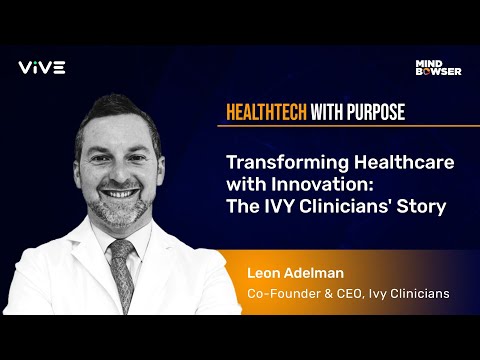

Recorded at ViVE 2023 in Nashville, this episode features Dr. Leon C. Adelman, an emergency physician and co-founder and CEO of Ivy Clinicians, speaking with Mindbowser’s Rushikesh Kulkarni. Leon ran emergency departments as a medical director before taking what he calls a real left turn into entrepreneurship, and still works one ER shift a week.
The idea came from both sides of the same problem. As a physician changing jobs, he couldn’t easily find out which medical group staffed which emergency department, let alone what each job was like. As a medical director in Clarksville, Tennessee, 45 minutes from Nashville, his county had three ER doctors while the city had plenty. Leon argues the physician problem is less a shortage than an imbalance between cities and rural or underserved areas. He explains why job boards fail physicians whose licensing and credentialing take up to a year, how Ivy mapped every US emergency department to the group that actually employs its clinicians and made it searchable like Zillow, why the platform scales specialty by specialty instead of by city, and why reviews have to start with objective data such as salaries.
Leon’s first frustration was as a job seeker. Every time he or a colleague changed jobs, the basic information was missing: which medical practice staffs which emergency department, how much it pays, how doctors, PAs, nurse practitioners and nurses work together. His second came as a medical director in Clarksville, Tennessee. It is only 45 minutes from Nashville, but because it sits one county away, Montgomery County had three ER doctors while Nashville seemed to have doctors on every corner. There was no place for physicians to signal they’d consider a move if the offer and conditions were right.
He watched his wife, an ER nurse, benefit from a wave of nurse staffing platforms such as Incredible Health, Nomad Health, ShiftMed, CareRev and Vivian, which by his count had over a billion dollars of current venture money behind them, while almost nothing existed for physicians, PAs and nurse practitioners. The same gap shows up in rural hospitals, many of which run on rotating physician coverage and very few specialists.
Rushikesh hears the same thing across the conference: the challenge isn’t technology, it’s finding capable people. Leon reframes it for physicians. There may be a real shortage as retirements rise, but today it’s an imbalance: a city like Nashville has plenty of doctors, PAs and nurse practitioners, and 45 miles in any direction there are plenty of people who need care and can’t get it. His purpose follows from that. Patients at chronically underfunded hospitals such as Nashville General deserve the same quality of care as patients at Vanderbilt, and a better marketplace for clinician labor is how he intends to get the right clinician to the right patient.
Leon’s hardest problem is fundraising for something with no precedent. Clinicians who have seen the rural staffing problem understand it immediately, but nobody had built a multi-sided platform that maps the entire landscape of a specialty, “kind of like Zillow did for houses.” That means forming hypotheses, trying them, and accepting that most won’t work: build, do customer discovery, launch what you have and learn fast. It’s the same loop behind building a minimum viable product to test whether an idea works before scaling it.
Scaling breaks the usual playbook too. Airbnb, OpenTable and Incredible Health each started in one city to match supply and demand locally, but emergency physicians apply across states, so Ivy scales specialty by specialty, starting with emergency medicine, hospital medicine and critical care, with the aim of covering all 32 specialties. Designing for that kind of supply and demand is the core challenge of two-sided marketplace development. Ryan Lee described a similar build for nurses on this show, a job marketplace focused on permanent nurse placements.
Physicians mostly find jobs by word of mouth, Leon says, because job boards don’t match their timeline. Hospital credentialing usually takes three to four months, a new state license adds four to six months, and credentialing often doesn’t start until the license is done, so it can take a year before someone can start. Residents begin interviewing about 18 months before they finish, while job boards post openings for today.
Ivy’s answer was data. By his account the team connected all of the roughly 5,600 US emergency departments to the medical practice that actually employs their physicians, PAs and nurse practitioners, which is usually not the name on the building, then layered on patient volume, residency programs and Medicare star ratings, and made it searchable by geography and preference. Clinicians apply directly to the in-house recruiter with their CV and credentialing information attached, with no middleman, and recruiters are surprised how easy the inbound leads are. Reviews come later, starting with a salary survey, because he doesn’t want another review site that turns into an insult platform.
Leon, welcome to Nashville, welcome to ViVE, and welcome to HealthTech with Purpose. How are you today?
I’m doing great, Rushikesh. Thanks for doing this, I really appreciate it. I’m really excited to be at this conference. There are so many great ideas and so many great products out there. Looking forward to having this conversation.
Awesome. And how did you like Nashville?
Oh, it’s the best. I actually used to live here. I love where I live, I’m in North Carolina right now, but Nashville’s amazing.
Awesome, awesome. So Leon, before we move to your product and your company, we’d like to know a little more about you, and then take it from there.
Perfect. So I’m an emergency physician. My background is in administering emergency departments and hospitals. I was the head of innovation for an emergency department, an assistant medical director, and then medical director for two large emergency departments. I noticed a gap in the market and went after the entrepreneurial dream. It took a real left turn from emergency medicine administration, but I still do one shift a week in the emergency department.
Okay, that’s good to know. Awesome. So how did the idea come about, and can you tell us a little more about Ivy Clinicians?
Yeah, great. The idea basically came from problems I faced, but also solutions my wife was seeing. What I mean by that is, on my side as a physician, every time I changed jobs, and every time the people around me changed jobs, there was this obvious missing piece of information: it was really difficult to figure out which medical practice staffed which emergency department. Just getting to the first step, like “I’m moving to Nashville, what are my job options in this area?”, was hard enough. And then you want to know what the differences between them are. Which ones are good places to work? How much do they pay? What is the relationship between the doctors, PAs, nurse practitioners and the nursing staff? There’s a lot that goes into whether a job is good or great, and getting even the basic information was very difficult.
Then I became a medical director, and I realized there’s a whole other side of the problem: hiring emergency physicians, especially in rural emergency medicine. Most physicians in the United States live in cities or in suburbs near a city, so there’s really a crisis of not having enough highly trained healthcare professionals in rural America. When I was a medical director, here in Clarksville, Tennessee… Clarksville is really not that rural; we were 45 minutes from Nashville. But because it’s one county away, we only had three ER doctors in Montgomery County, our county. Nashville has like a million doctors; you just trip over doctors walking around here. What we needed was some way of knowing who, if we gave them the right offer, paid them enough, treated them well and did all the right things, would be interested in working with us. There’s no place for them to put themselves on the market in a way that actually works out well. So there’s a two-sided problem.
What I mentioned about the opportunities my wife was seeing: my wife is an ER nurse, and there’s really a renaissance of health tech platforms helping nurses find better jobs right now. Whether it’s Incredible Health, Nomad Health, ShiftMed, CareRev, Vivian, you can go down the line. There’s over a billion dollars currently invested, not total valuation, but current VC money invested, in nursing staffing tech.
That’s right.
And almost none for physicians, PAs and nurse practitioners, the top of the market. So it was time to build it.
Wow, interesting, interesting. I was talking to a few people here, and one of the challenges they see going ahead, which was a very interesting aspect, was that the challenge is not tech but, to your point, a lack of capable people in the whole healthcare space. So I think that’s one of the things you’re trying to address from the other side of the table, right?
It’s interesting, though. On the physician side, there’s this idea that we have a shortage, and maybe in the future there will be, when there are more retirees in medicine, but also in the general community. Right now it’s really an imbalance, where in a city like Nashville there are plenty of doctors, plenty of PAs and nurse practitioners, plenty of everything. But draw a circle 45 miles in any direction, and all of a sudden you have lots of people who need healthcare, and it’s just very hard for them to get the healthcare they need.
Got it. Awesome. So while pursuing this journey, what were some of the challenges you faced?
Yeah, I think the hardest part is everything, actually. No, I’m totally going to jinx myself. It’s fundraising. Because the problem is hitting you in the face: if you go to any rural facility in this country, there’s this need for high-quality providers. Any emergency physician, or really any doctor, gets that, and so raising money from clinicians has been okay. What’s really hard is that nobody’s done this. Nobody’s created a platform like ours, a multi-sided platform for a specialty where we map out the entire landscape of that specialty, kind of like Zillow did for houses. Nobody’s done what we’re trying to do, and that means we have to come up with hypotheses and try them out. Some of what we try out works; most of it doesn’t. But there’s only one way to find out, which is to build it: do customer discovery, launch what you have based on that discovery, and learn. So the hard part is learning fast.
Yeah, yeah. So once you have solved this problem, would you add different job roles to the whole system? Is that the idea, or what’s the next big thing within this space?
Yeah, that’s a great question. Most multi-sided platforms scale by geography. Airbnb started in New York, OpenTable was limited to San Francisco, and Incredible Health, which does nursing, started in San Francisco. Usually you want a tight geography so you can match your supply and demand within it, win in one place, and then go from there. Because we’re dealing with a mobile workforce, we can’t really do that. One of my friends who’s at this conference, an ER doctor, has used our platform to apply for places in Hawaii, Utah and California, and that’s just how ER doctors are. So we’re going specialty by specialty, starting with emergency medicine, hospital medicine and critical care. There are 32 specialties in the house of medicine, and we do aim to get to all 32.
Nice, nice. Awesome. So in doing this, what are some of the areas where you feel you’re having an impact, and have you already started making an impact in this space? Your thoughts on that.
Yeah, so, great question. We’re a two-sided platform, so there’s a two-sided answer. The side I see most directly is the response of the clinicians. One of the things that happened during COVID, though it was already heading in that direction, is a lot of frustration. If you talk to doctors, there’s a lot of frustration out there, because electronic medical records are hard to use, and practice ownership is rarer now, so you’re an employee of some corporation that isn’t necessarily in line with your values. And I guess I missed the big one, which is that there are just not enough nurses. There are not enough nurses, and we can’t do anything without nurses. They’re the key to everything we do in the hospital.
So one piece of that puzzle is that if somebody feels their job isn’t living up to their expectations, it should be easy for them to move, especially somebody this highly trained. They excelled in college, then in medical school, then did a residency and often a fellowship. These are top-notch people, and they should not feel trapped in their job. If the job’s not working, it should be fairly easy to find something else that works for them and for their patients. So seeing providers who felt trapped go from feeling trapped to owning the next step in their career trajectory is really heartwarming for me.
Excellent. Awesome, awesome. I just want to understand both sides, since, as you said, it’s a two-sided problem. Say somebody wants to find a job: what are the steps? How do they come into the app or the portal, and what do they do? And on the other side, how does a provider organization use the whole system?
Yeah, so I’ll go through how it works today and then what we’re doing. Because of the way job boards are set up right now, most physicians get their jobs through word of mouth. The reason job boards don’t work for physicians is that our timeline is really long. Getting credentialed at a hospital usually takes three to four months. If you change states and need a new license in that state, that’s an additional four to six months, and the hospital doesn’t start your credentialing until you’ve finished the license. So it often takes a year just to get the paperwork to a point where you can start your job, and everybody knows that. So the job search happens way in advance. Residents usually start interviewing for jobs 18 months before they finish residency. And what are job boards doing? They’re posting jobs that are open today. If you’re looking for jobs 18 months out, that’s not the right thing.
So what we’ve built is a map of the entire landscape of emergency medicine. What I mean by that is there are 5,600 ERs in the country, and we’ve connected every one. We’re the only entity that has this data. We’ve connected every emergency department with its medical practice, the employer of its physicians, PAs and nurse practitioners, and it’s usually not the hospital. If you go to the big building downtown, it’s usually not the name on the building that’s employing those clinicians, and they don’t necessarily want you to know that, so finding them on Google is really hard. That’s where the problem we talked about a few minutes ago started.
Once we had that, we wanted to connect it to other data clinicians want when they’re looking for jobs: how many patients does that ER see, are there residents in that emergency department, what are the Medicare star ratings, is this a good hospital or not, that kind of thing. So we have a ton of data we’ve connected, and then we make it searchable like Zillow. You search by geography and filter by your preferences. Instead of bedrooms and bathrooms, it’s the number of patients, whether there are residents, all the stuff we talked about. Then on the platform we have the contact information for the in-house recruiter, so you apply directly through our platform to the in-house recruiter. There’s no middleman, nothing. It’s a direct connection.
On the employer side, because the clinicians, the physicians, PAs and nurse practitioners, go first, the in-house recruiter gets that email. We automatically attach the credentialing information and the CV to that email, so they have a full application in front of them, and they can either reply or not; it’s up to them. It is a totally legitimate application, like any other application, and we’ve seen really great responses from recruiters, because they’re not used to it being this easy. It’s not supposed to be that easy to get inbound leads from highly trained physicians.
Awesome. So during the whole process, are you also going to track the life cycle, probably reviews, et cetera? Because somebody who’s already used it might use it again to switch jobs. So what’s happening there?
Right. That’s a huge piece of the puzzle. Like I mentioned earlier, it’s hard to know which places are good workplaces. That is a challenge, and the whole review process is challenging. There is a review site for emergency medicine, but it turned into a place to poop on the employer, and that’s not what we do. They’re our customers, so we have to be very careful. We’re starting with objective information. We’re doing a salary survey so folks know how much they would get paid at a given place, and then we’ll probably do stars. We just want to make sure it’s not just an insult platform.
Yep, yep, yep. Awesome. So finally, since we’re on HealthTech with Purpose: what’s the main purpose, the goal you want to achieve? Where do you want to go in the coming years?
Yeah. The main purpose is patients, especially patients in rural hospitals and in underserved hospitals. There’s a hospital here in Nashville called Nashville General, and they are chronically underfunded. It’s hard for them to hire good staff because of the underfunding. Those patients have every right to receive just as high a quality of care as a patient at Vanderbilt or any other fancy hospital down the road. I strongly, strongly believe that. So if we build a better marketplace for physician, PA and nurse practitioner labor, we can better match the right physician, the right PA, the right nurse practitioner with the right patient, so that patient can receive the right care.
Nice, nice. Awesome. I hope you enjoyed the podcast. Saying hi to everybody who’s watching, and looking forward to seeing you [inaudible]. And I hope all those who will be watching have learned something, and I hope it helps.
Obviously. Thank you so much, and we are at IvyClinicians.io.
Awesome.
At the time of recording (published April 2023), Dr. Leon C. Adelman was co-founder and CEO of Ivy Clinicians, a job platform that maps emergency departments to the medical groups that employ their clinicians and connects physicians, PAs and nurse practitioners directly with in-house recruiters. An emergency physician who still worked one shift a week, he had been head of innovation for an emergency department, an assistant medical director, and medical director for two large emergency departments, including in Clarksville, Tennessee. He was based in North Carolina. He also writes the Emergency Medicine Workforce Newsletter.
Building a marketplace that has to win both sides of healthcare at once? Tell us who you’re matching and we’ll show you how we’d approach it.

In the HealthTech with Purpose podcast, Kristen Valdes, CEO of b.well Connected Health, discusses unifying healthcare experiences. She founded b.well to connect consumer data, using open standards for control and care coordination. Collaboration among stakeholders is crucial for transformation. Kristen also explores Generative AI and LLMs potential in healthcare data analysis, despite coding system challenges. Benefit from insights on improving patient care.
Discover Ora Medical’s innovative gait trainer for individuals with walking disabilities on the HealthTech with Purpose podcast. Enhancing the accessibility in physical rehabilitation.
Partner with us to design, build, and scale digital solutions that drive better outcomes.
Global Tech Teams LLC, 525 Washington Blvd, Industrious at Newport Tower, Jersey City, NJ 07310, United States.
Let’s discuss your goals, workflows, and next steps in a focused consultation call.
 Schedule a Call














 BLOGS
 NEWSROOM
 CASE STUDIES
 WEBINARS
 PODCASTS
 ASSET HUB
 EVENT CALENDAR