BLOGS
BLOGS  NEWSROOM
  CASE STUDIES
  WEBINARS
  PODCASTS
  ASSET HUB
  EVENT CALENDAR


















TL;DR
If you are a CMIO leading value-based care programs, how often does the patient voice actually show up in your dashboards and contracts? Patient-reported outcomes (PROs) and patient-reported outcome measures (PROMs) turn symptoms, function, and quality of life into structured data that can feed digital quality measures and PRO-PMs in CMS and NCQA programs (Patient-Reported Outcome Measures Overview – CMS – 2025; Person-Centered Outcome Measures – NCQA – 2024). Used well, PROMs become a quality and ROI engine, not just another survey.
If every clinical and claims feed went silent for a week, would you still know whether your patients were actually improving?
That is the central measurement gap PROMs were designed to close. Patient-reported outcomes capture how patients feel and function, as reported directly by patients without clinician interpretation. PROMs translate those reports into structured scores that can support quality teams, EHR workflows, and value-based care contracts.
PROMs are no longer optional. CMS outlines PRO, PROM, and PRO-PM pathways in the Measures Management System.
NCQA uses person-centered outcome measures to document what matters most to patients in its current pilots. When implemented well, PROMs shift your measurement strategy from documentation to lived experience. When implemented poorly, they create friction for both clinicians and patients.
This guide covers the fundamentals. You will see concrete PROM examples, the exact steps to translate PROMs into PRO-PMs and digital quality measures, an implementation checklist suited for Epic and Cerner teams, and how Mindbowser’s accelerators, such as EduCare AI, HealthConnect CoPilot, AI Medical Summary, and RPMCheck AI, remove operational friction.
I. What Are Patient Reported Outcomes and PROMs?
Most measurement systems rely on codes, labs, vitals, and discharge summaries. PROMs begin from a different vantage point: the patient’s own voice.
- A patient-reported outcome is any report of health status provided directly by the patient without clinician interpretation.
- A patient-reported outcome measure is a validated questionnaire that converts the report into a numerical score.
- A PRO PM is a performance measure constructed from aggregated PROM results.
Examples familiar to most CMIOs include pain scores after joint replacement, quality of life in
oncology, and functional status after heart failure admission.
II. Why PROMs Matter for CMIOs in Value-Based Care
For a CMIO responsible for value-based care programs, PROMs are not cosmetic. They provide
evidence of real improvement and reveal information not visible in claims or encounter feeds.
Key drivers:
- PROMs represent what matters most to patients. NCQA uses person-centred outcome measures to document goals and track progress at the plan and population level.
- Digital PROMs fill gaps between visits. BMJ research shows digital PROMs for long-term conditions support continuous symptom monitoring when integrated with EHR systems.
- PROMs can power future incentives. CMS positions PROMs as a pathway to digital quality measures and PRO PMs in the Measures Management System.
The NHS PROMs Programme provides a long-running example. Hip and knee PROMs have been collected at a national scale for years, enabling benchmarking across providers.
III. Common Types of PROMs and How to Use Them
PROMs fall into three practical categories for hospital and health plan programs.
- Generic PROMs
These measures, overall, address the function or quality of life and support population-level comparisons.
- Condition-specific PROMs
These focus on a specific disease area such as joint function, heart failure symptoms, or depression. The NHS hip and knee PROMs rely on this category.
- Experience and goal-based tools
NCQA’s person-centered outcome measures blend PROM-like items with goal attainment information to capture individualized progress.
A successful starting point is one generic and one condition-specific PROM per program.
IV. From PROM to PRO PM and Digital Quality Measure
PROMs become contract-relevant once they are translated into performance logic.
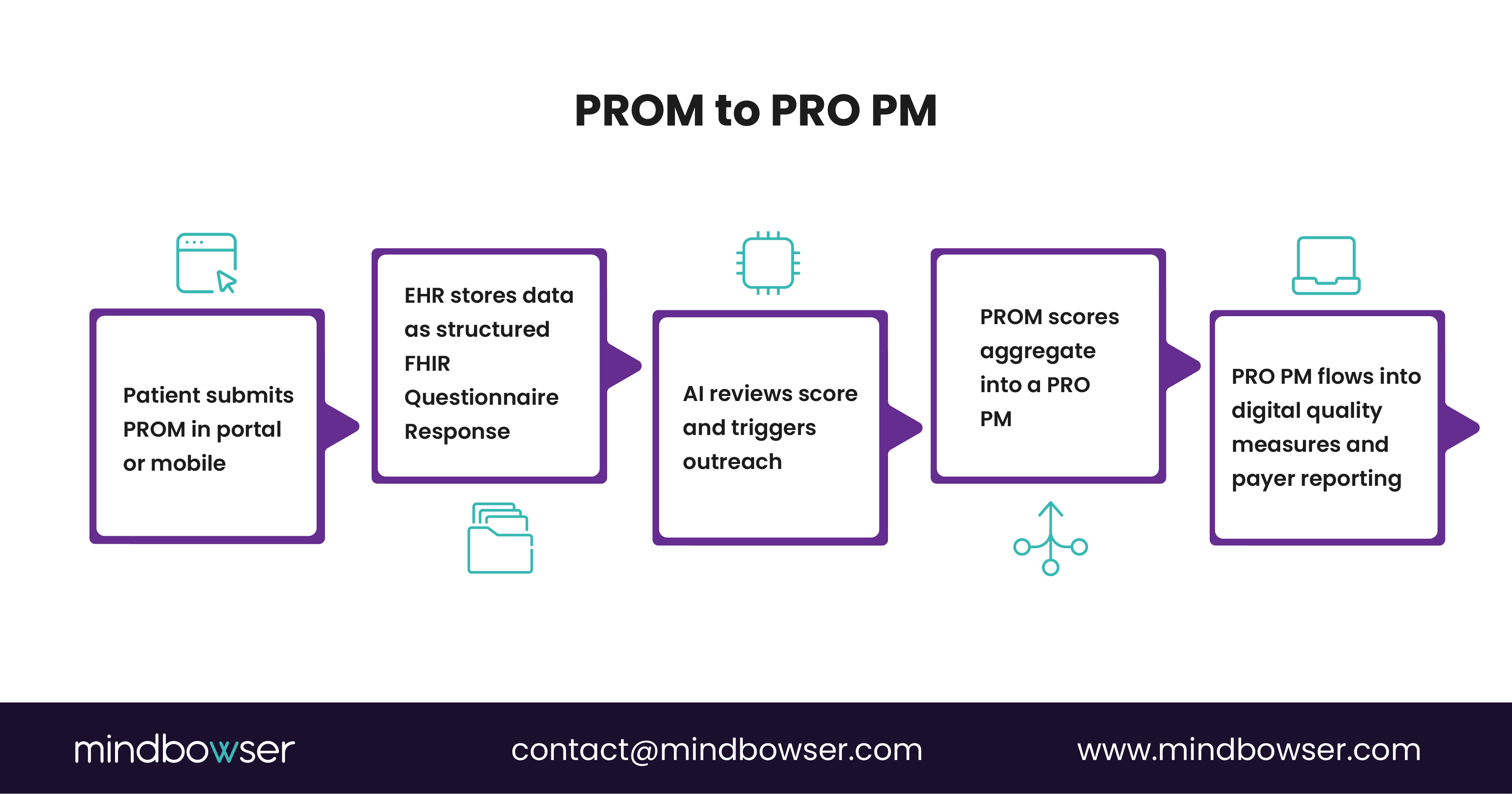
A simple sequence based on CMS guidance:
- Collect PROMs for a defined cohort using a validated instrument.
- Convert individual responses into numerical scores.
- Define improvement or deterioration thresholds.
- Aggregate these results into a PRO PM such as “percentage of patients with meaningful improvement in functional status at six months”.
- Translate the specification into a digital quality measure that aligns with FHIR-based data from the EHR.
NCQA’s person-centered outcome work provides a similar path for plans.
Close the measurement gap with PROMs and transform patient care.
V. The PROMs-Plus-Wearables Pattern: PROMs Plus Smartphone Signals
PROMs are snapshots. Continuous mobility signals create a richer narrative of outcomes.
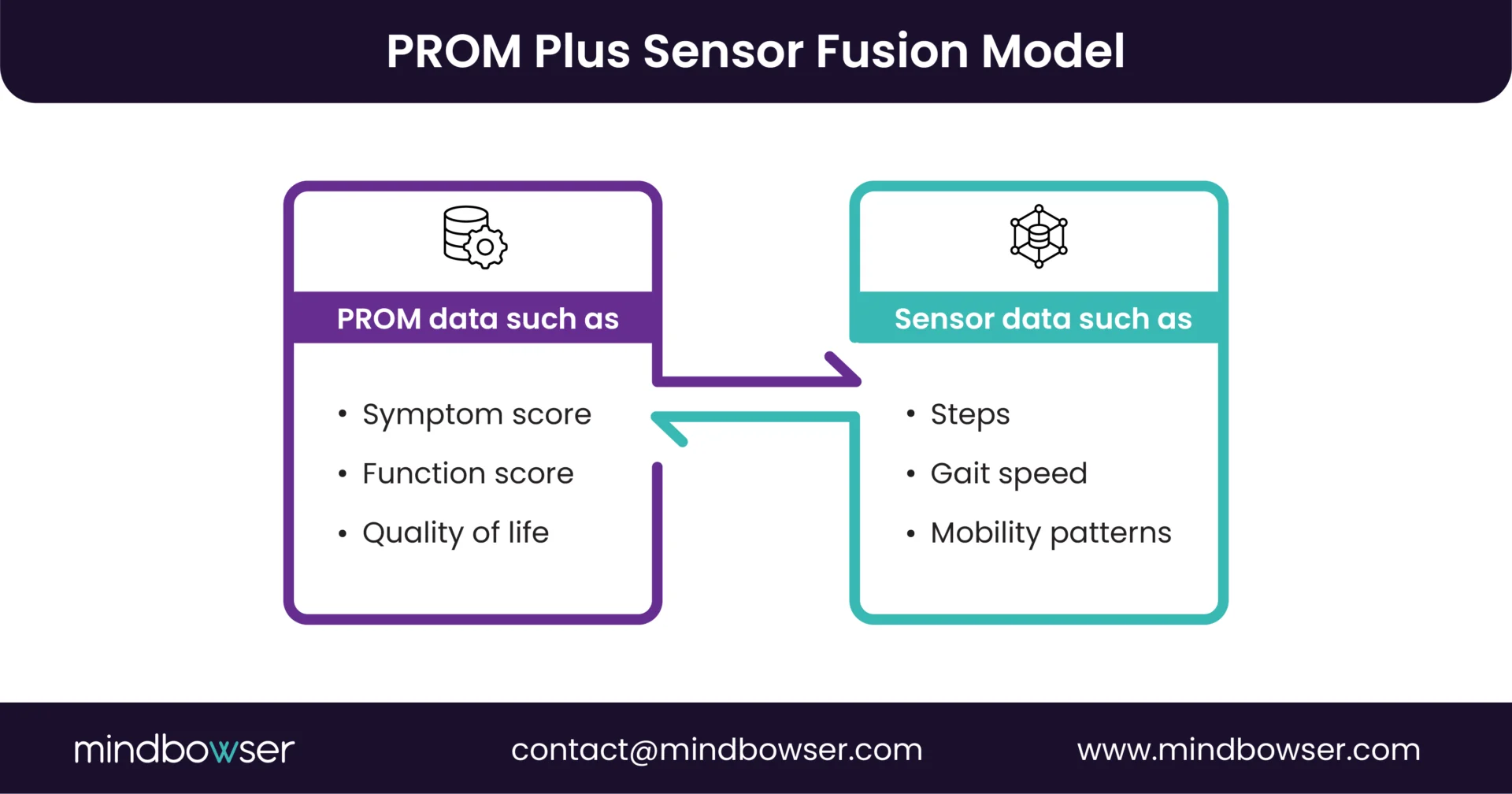
A clear example comes from a Phase 2b trial for aging frailty. Subjects receiving Lomecel B walked nearly fifty meters farther at one hundred eighty days and approximately forty-eight meters farther at two hundred seventy days, while placebo groups showed minimal improvement or decline.
One platform we worked with supplied a smartphone-based app that captured activity and movement data that paired with those outcomes.
This creates a repeatable pattern for health systems:
- PROMs describe how patients report feeling.
- Smartphone sensors reveal how they function between visits.
- Combined data supports risk scoring, case management triggers, and quality dashboards.
VI. Implementation Checklist: Making PROMs Work in Your EHR
Most PROM programs struggle because their workflows are unclear. Implementation research from ISOQOL and EHR dashboard studies repeatedly shows the same essential steps.
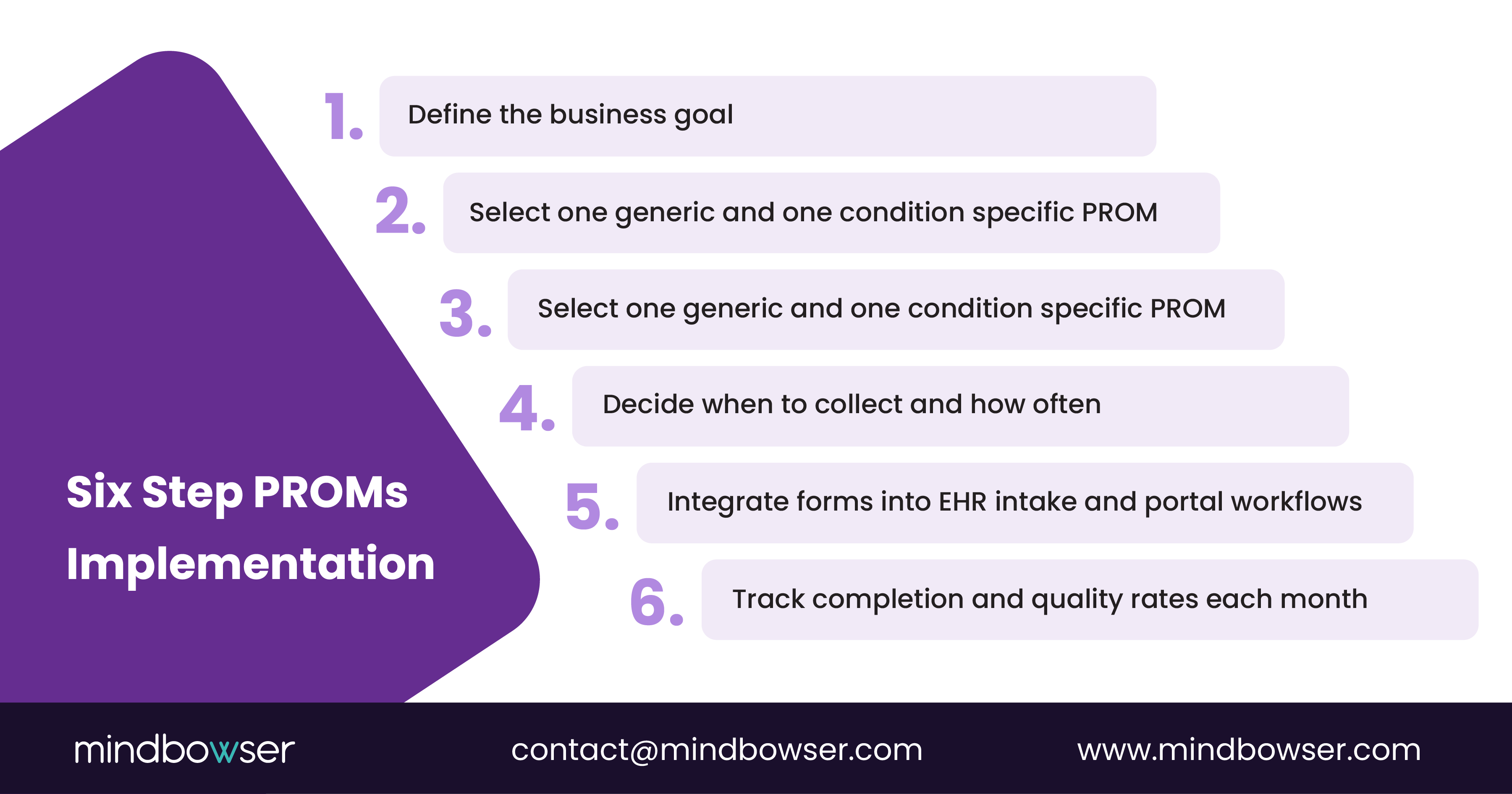
Use this checklist to build a durable PROMs program:
- Define the business goal
Link your PROM initiative to a specific contract incentive or quality aim.
- Choose one to two PROMs per program
Confirm licensing, languages, and accessibility requirements.
- Determine timing
Collect pre-visit, post-visit, and periodic scores for chronic conditions (ISOQOL, 2015).
- Integrate into the EHR and portal
PROM tasks should naturally appear during patient intake. Scores must be entered into structured fields, not PDFs.
- Design response workflows
Establish thresholds for action and team accountability.
- Monitor completion rates and quality
A study of more than 53,000 consultations found that targeted communication significantly increases PROM completion.
VII. Architecture Blueprint: How PROMs Flow Through Your Stack
A PROM is a structured event that moves across several layers.
- Capture
Portal, mobile, and in-clinic devices collect the PROM. Data is written as a FHIR QuestionnaireResponse.
- Data and integration
A FHIR store sits beside the core EHR. HealthConnect CoPilot synchronizes PROM data across systems.
- Intelligence
EduCare AI analyzes scores and triages patients.
AI Readmission Risk combines PROM data with utilization signals.
- Measurement
Aggregated PROMs become PRO PMs and digital quality measures.
This unified flow removes the need for standalone PROM silos.
VIII. What Good Looks Like in Year One
A realistic Year One PROMs profile:
- Two service lines, such as joint replacement and heart failure.
- PROM completion embedded in intake and follow-up
- PROM dashboards are visible inside the EHR rather than in a separate application.
- At least one defined PRO PM is tracked regularly.
How Mindbowser Supports PROMs Ready Products?
Mindbowser integrates PROMs into product strategy, EHR integration, AI enablement, and multi-source data fusion.
Key support areas:
- Product design and data modeling aligned with CMS and NCQA PROM and PRO PM logic.
- FHIR and HL7 integrations with assets such as HealthConnect CoPilot.
- AI automation through tools such as EduCare AI, AI Readmission Risk, and RPMCheck AI.
- Sensor plus PROM fusion modeled after that example.
The Signal That Proves Value-Based Care Actually Works
Claims and utilization show activity. PROMs show impact. The strongest value-based care programs use PROMs to demonstrate that patients function better, recover faster, and live healthier lives. This is the evidence pathway that regulators, payers, and accreditation bodies are moving toward.
If you start with one program, one generic, and one condition-specific PROM, you can create a clear measurement path that feeds PRO PMs, dQMs, Stars, and shared savings. This requires more than surveys. It requires workflow design, integration discipline, and AI-supported follow-up.
If your roadmap includes digital quality measures, value-based service lines, or new clinical products, PROMs must be part of the foundation rather than a patch added later.
Patient-reported outcomes are direct reports from patients about their symptoms, function, or quality of life without clinician interpretation. PROMs convert those reports into structured scores that can be added to clinical data, turned into PRO PMs, and eventually used for digital quality measures in value-based care programs.
PROMs measure health status and functional improvement from the patient’s viewpoint. CAHPS focuses on the care experience and communication. PROMs can be translated into performance measures through PRO PMs and can support digital quality measures in CMS and NCQA pathways.
Most CMIOs succeed when starting with one generic PROM and one condition-specific PROM in one or two service lines. ISOQOL implementation guidance shows that success depends more on workflow integration than on the number of instruments. This keeps the program manageable during early adoption.
Common timing patterns include pre-visit, post-visit, and periodic intervals for chronic conditions. ISOQOL guidance recommends aligning PROM timing with clinical pathways rather than rigid calendar dates. This approach increases relevance for clinicians and improves response rates.
Studies show that patients respond more positively when surveys are short, clearly explained, and tied to visible action in their care plan. A PLOS ONE review found that meaningful feedback loops increase trust and participation. Clear communication is the strongest predictor of engagement.
Yes. PROMs support better monitoring of symptoms and function between visits. A BMJ research study found that digital PROMs enable continuous oversight for long-term conditions. NCQA’s person-centered outcome measures are already being tested as performance indicators that can influence Stars and related quality programs.
AI tools process PROM scores, summarize trends, and automate follow-up. For example, EduCare AI generates patient-facing education and triage prompts. AI Readmission Risk combines PROMs with utilization patterns to forecast risk. These tools reduce manual review time and help CMIOs operationalize PROMs inside Epic and Cerner environments.
A PRO PM is a performance measure built from aggregated PROM scores. CMS outlines the workflow: collect PROMs, score responses, define improvement thresholds, and convert the logic into a measure with a clear numerator and denominator. The same logic can be converted into a digital quality measure for automated reporting.
PROMs should be captured through the patient portal or intake workflows and stored as structured fields, ideally as FHIR QuestionnaireResponse resources. HealthConnect CoPilot can synchronize PROM data between Epic or Cerner and any downstream system. This eliminates the need for separate PROM tools and maintains alignment with digital quality measure specifications.
Yes. This approach strengthens outcome measurement. In a Phase 2b study on aging frailty, subjects who received Lomecel B walked nearly 50 meters farther at 180 days, while smartphone-based activity data from Kinesiometrics provided continuous functional insights. PROM plus sensor data is ideal for advanced VBC programs.