













 BLOGS
BLOGS  NEWSROOM
  CASE STUDIES
  WEBINARS
  PODCASTS
  ASSET HUB
  EVENT CALENDAR




















III. Key Features of Epic Kaleidoscope
When evaluating an Epic module, we look for three key factors: interoperability depth, clinical usability, and ROI impact. Epic Kaleidoscope scores high across all three. It’s not just an add-on for ophthalmology; it’s a tightly integrated feature set that drives efficiency from intake to follow-up. Below is a detailed look at the key functional layers that make it work.
A. Clinical Documentation Tools
Documentation is where most ophthalmology practices lose time. Kaleidoscope simplifies this with structured templates that capture the full range of ophthalmic data points, including visual acuity, intraocular pressure, refraction values, and slit-lamp findings. The templates are pre-configured for precision, yet flexible enough to accommodate customization based on physician preferences.
From an engineering standpoint, what makes this module different is how it handles structured data. Each entry is coded and mapped to Epic’s core data model, which means physicians are not typing into free-text boxes that later require manual coding. This supports clean data flow into reporting, billing, and analytics systems.
For clinical staff, the gain is immediate. Charting time drops, errors decrease, and the information stays consistent across visits. When combined with voice dictation and SmartTools, clinicians can complete documentation more efficiently without compromising detail. This precision also ensures alignment with ophthalmology-specific quality metrics such as diabetic eye exams or post-surgical outcomes.
B. Imaging and Diagnostic Integration
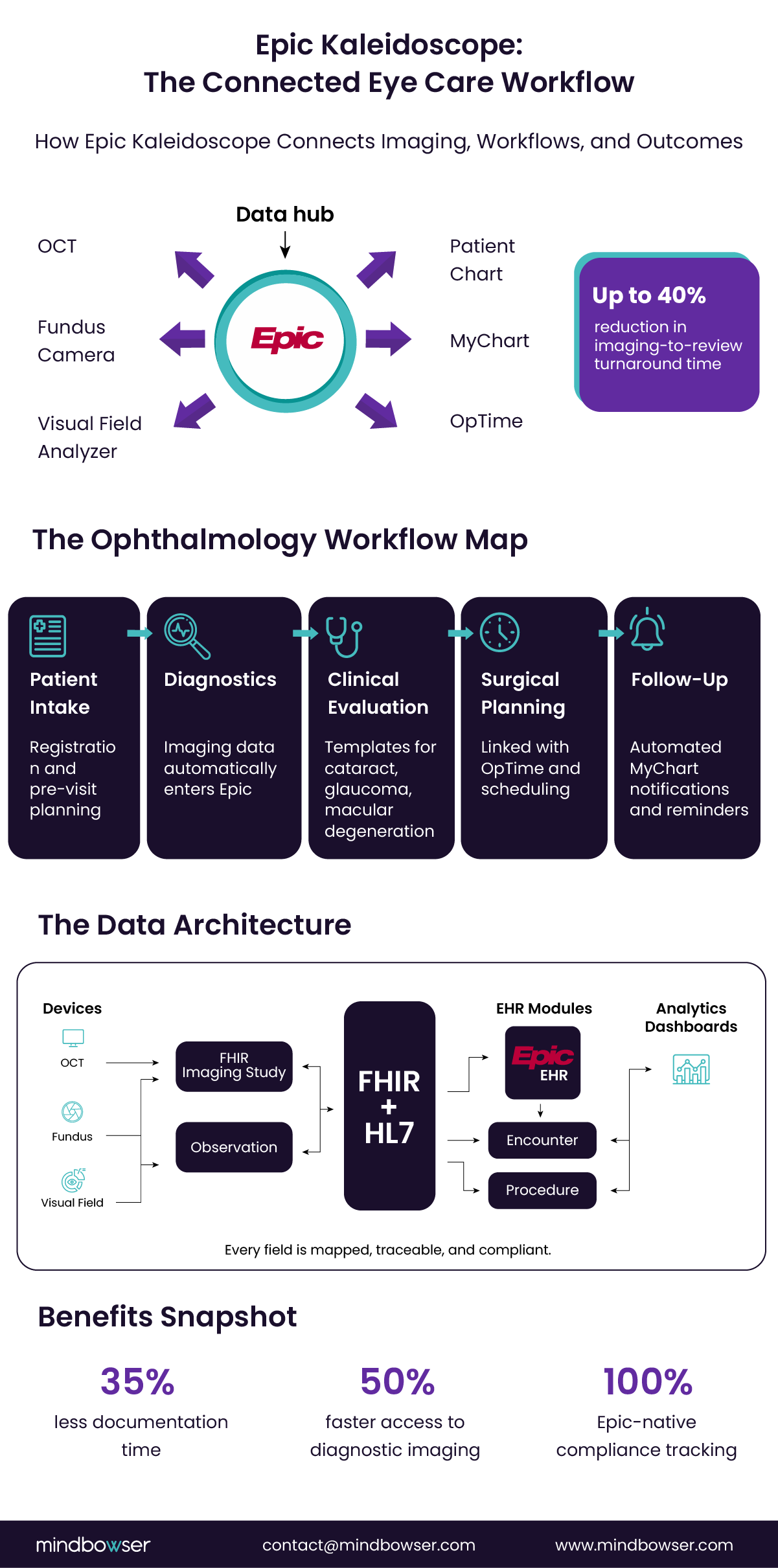
Ophthalmology depends on imaging accuracy, and Kaleidoscope’s integration strength lies in its direct device connectivity. It connects seamlessly with OCT machines, fundus cameras, and visual field analyzers, allowing diagnostic data to flow directly into the patient record.
In a typical clinic setup, this eliminates multiple manual steps. The images appear instantly in the chart, tagged to the correct encounter, and can be reviewed alongside prior scans. The system supports high-resolution image viewing, side-by-side comparisons, and automated linking to diagnostic interpretations.
From an IT standpoint, the integration uses DICOM and HL7 standards to maintain compliance and interoperability. This ensures that, regardless of the vendor of the imaging device, the data remains accessible and consistent within Epic. For health systems, this reduces the dependency on third-party imaging repositories and simplifies maintenance across locations.
C. Workflow Support
Kaleidoscope is not only about data; it is also about process control. The module includes tools for pre-visit planning, structured patient history capture, and ophthalmology-specific scheduling. Each workflow aligns with how real-world eye care practices operate.
Scheduling templates automatically map procedures, such as cataract surgery or glaucoma follow-up, to the correct time slots, supporting efficient resource allocation. During surgical planning, Kaleidoscope integrates directly with Epic OpTime, enabling pre-op checklists, lens calculations, and post-op instructions to remain within a single workflow.
The advantage for administrative and clinical staff is predictability. When every visit type, procedure, and imaging test follows a predefined workflow, it eliminates bottlenecks. The system also provides dashboards for tracking performance metrics, appointment throughput, and follow-up adherence.
D. Patient Engagement
Epic Kaleidoscope extends the patient experience through MyChart. Patients can view their imaging results, educational content, and appointment reminders directly from their portal. The visual nature of ophthalmology makes this particularly effective. Patients can view side-by-side progress images and better understand their treatment plan.
For practices, this results in higher compliance and fewer missed appointments. Automated reminders reduce no-show rates, and integrated educational resources enhance patient understanding of chronic conditions such as glaucoma or macular degeneration.
From an engineering perspective, MyChart is not just a communication channel. It is a connected layer that captures feedback, follow-up responses, and patient-reported outcomes, integrating them back into the EHR. This creates a closed-loop system where engagement feeds data, and data drives personalized care.
IV. Benefits for Providers and Practices
When we integrate a new Epic module, our goal is simple: reduce cognitive load for clinicians while giving administrators measurable ROI. Epic Kaleidoscope delivers both. Its impact becomes evident once ophthalmology workflows transition from disconnected systems into a single, Epic-driven environment.
A. Clinical and Operational Gains
The first and most immediate gain is documentation accuracy. Ophthalmology requires structured and precise data to track disease progression. With Kaleidoscope, every data point — from intraocular pressure readings to lens measurements — is stored in a standardized format. This minimizes transcription errors and improves the reliability of diagnostic trends over time.
Clinicians also report a noticeable reduction in charting fatigue. Structured templates, auto-populated fields, and voice-enabled inputs cut down documentation time per visit. For multi-provider practices, this can mean hours saved each week, translating into more time for patient care.
Operationally, Kaleidoscope simplifies the work of technicians and front-desk teams. Automated pre-visit planning ensures that required imaging or diagnostic tests are queued before the physician encounter. The scheduling and procedure management tools reduce double-bookings and missed follow-ups. These improvements create a smoother patient flow and higher throughput without requiring additional staff.
From an IT and compliance standpoint, the integration across Epic modules eliminates data silos, ensuring seamless data flow. Imaging, surgical plans, and billing details share the same data layer, which supports more accurate reporting, fewer billing rejections, and stronger audit trails. It is a cleaner, safer system to maintain.
B. Strategic and Financial ROI
Every CIO and CFO asks the same question at implementation kickoff: how does this translate into value? The answer lies in aligning data, workflows, and outcomes. Epic Kaleidoscope helps organizations move closer to value-based care models by enabling accurate reporting of quality metrics such as diabetic eye exams and follow-up adherence.
Financially, the native integration reduces reliance on third-party imaging systems and middleware. Licensing, support, and data transfer costs drop significantly when everything runs within Epic’s infrastructure. Hospitals that migrate ophthalmology data to Kaleidoscope often see a faster break-even point because they retire older, siloed imaging solutions.
From a strategic viewpoint, the module positions the organization for future innovation. Once ophthalmology data is fully digitized and structured, it can feed analytics platforms, AI tools, and predictive models. These capabilities help identify high-risk patients earlier, measure performance across providers, and support research initiatives in visual health.
At Mindbowser, we often quantify ROI in three dimensions: time saved, errors reduced, and revenue preserved. Epic Kaleidoscope impacts all three. It enhances clinical efficiency, supports compliance, and lays the groundwork for scalable, data-driven care.
We Improved Predictive Accuracy in Childbirth with Advanced EHR Integration
V. Epic Kaleidoscope in Action: Clinical Workflow Integration
A. The Patient Journey
When we map out an ophthalmology workflow, it typically involves interactions with six different systems before Epic Kaleidoscope is implemented. Imaging, scheduling, surgical planning, and patient communication each run on separate platforms. Once Kaleidoscope goes live, these workflows converge.
A patient’s journey begins at check-in. Administrative staff use Epic’s scheduling tools to confirm appointments and pre-visit requirements. Diagnostic tests are ordered automatically based on the type of visit. As the patient moves to imaging, devices such as OCT or fundus cameras send data directly to the Epic chart. The clinician no longer needs to search through shared folders or manually import files.
During the consultation, physicians can pull up prior imaging studies, visualize disease progression, and record findings using predefined templates. If a surgical procedure is required, they can transition directly into surgical planning without leaving the interface. Kaleidoscope integrates with OpTime, enabling the seamless flow of pre-op assessments, lens calculations, and consent documentation into the surgical record.
After surgery, follow-up scheduling and patient reminders are automated through MyChart. Patients receive secure updates, care instructions, and details about upcoming appointments. Every touchpoint, from intake to recovery, remains within Epic’s single ecosystem. This is how Kaleidoscope transforms ophthalmology from a fragmented process into a continuous care loop.
B. Team Collaboration
Epic Kaleidoscope was designed for multi-role collaboration. Ophthalmologists, technicians, nurses, and billing staff each access role-based dashboards tailored to their responsibilities. Technicians can capture measurements and imaging results in real-time, while physicians review the data immediately during the examination. Administrative teams can track procedure volumes, diagnostic trends, and compliance indicators across departments.
From a systems engineering perspective, this coordination is possible because of Epic’s shared data model. Every action, image, and note ties back to a single patient record. This ensures data integrity and eliminates duplicate entries across modules.
In one of our hospital projects, implementing Kaleidoscope reduced turnaround time between imaging and physician review by nearly 40 percent. Surgeons reported fewer scheduling conflicts and more predictable OR readiness. For leadership teams, these improvements resulted in improved patient satisfaction scores and measurable operational ROI.
Epic Kaleidoscope creates visibility where most ophthalmology systems create friction. It aligns clinical workflows, enhances communication, and builds a real-time data pipeline across teams. For providers and executives alike, that integration means fewer delays, better outcomes, and a system that truly supports coordinated eye care.
VI. Common Challenges and How to Overcome Them
No system deployment in healthcare is ever friction-free. Epic Kaleidoscope brings significant efficiency gains, but success depends on how well teams prepare for implementation and training. Based on my experience leading integrations across multiple specialty systems, I have identified the most common barriers and how hospitals can effectively navigate them.
A. Implementation and Adoption
The first challenge is change management. Ophthalmology teams are used to older, standalone imaging platforms. Transitioning to an integrated Epic environment requires alignment across clinicians, technicians, and IT teams. Training is not just about learning new screens; it is about changing how data flows and who controls it.
The most effective way to drive adoption is to involve ophthalmologists early in the build phase. Epic allows for custom templates and order sets. When providers help shape those templates, they are more likely to use them consistently. At Mindbowser, we typically create role-based training modules that focus on real-world use cases rather than generic overviews. This helps users connect the software to their daily workflow faster.
System readiness is equally important. Ensuring that all imaging devices, workstations, and network configurations are Epic-certified prevents delays during the go-live process. A technical validation round before deployment can save weeks of troubleshooting later.
B. Data Migration and Interoperability
Data migration is where many ophthalmology EHR transitions stall. Legacy systems often store imaging and exam data in proprietary formats that are not easily mapped to Epic’s data model. The solution lies in planning early for standardization.
Before migration, teams should classify which data elements are essential for continuity of care and which can remain archived. For structured data, Epic’s import utilities can bring in demographics, prior visit summaries, and test results. Imaging data, however, requires DICOM-compliant export and validation.
Epic Kaleidoscope supports HL7 and FHIR protocols, which simplifies integration with external labs and diagnostic systems. When engineered properly, these connections eliminate the need for manual file transfers and reduce data-entry duplication. Hospitals that build these integrations with a compliance-first mindset achieve both accuracy and auditability.
C. Balancing Customization and Standardization
Every ophthalmology department has its own workflow preferences. The temptation to over-customize the Epic environment can create long-term maintenance issues. Having too many unique templates or order sets makes it difficult to train new staff and increases the burden during software upgrades.
The best approach is controlled customization. Define which workflows must remain consistent across the enterprise and where flexibility adds real value. For example, having a single standard cataract surgery workflow across all locations ensures uniform documentation and billing accuracy, while allowing for local variations in equipment preferences or technician inputs.
Epic’s governance tools can help maintain that balance. Setting up a small steering group of clinicians and IT leads ensures that customization requests undergo a thorough review process. This maintains alignment between clinical efficiency and system integrity.
VII. Future of Ophthalmology with Epic Kaleidoscope
Ophthalmology is entering a phase where precision medicine, AI analytics, and interoperability are no longer optional. Epic Kaleidoscope sits right at that intersection. From my experience, the future of this module will be defined by how well it leverages structured data, connected ecosystems, and intelligent insights to support clinicians in real time.
A. Emerging Technology
The next generation of Kaleidoscope deployments will expand far beyond charting and imaging. Epic is actively integrating AI-assisted diagnostics into its modules, and ophthalmology will benefit from this shift early on. Conditions like diabetic retinopathy, glaucoma, and macular degeneration are ideal use cases for AI-enabled screening and predictive modeling. When trained on clean, structured data captured by Kaleidoscope, these algorithms can flag early disease indicators and suggest care pathways before visual impairment progresses.
Epic’s foundation for AI is already visible through its analytics dashboards and Cosmos dataset. As more ophthalmology data flows into this ecosystem, organizations will be able to benchmark outcomes, analyze treatment efficacy, and build predictive models that inform clinical and operational decisions. For hospitals and digital health companies, this represents a clear ROI pathway — using existing Epic data to improve both patient outcomes and resource allocation.
Another key area of advancement is teleophthalmology. With Kaleidoscope integrated into MyChart and EpicCare Link, remote consultations can include image sharing, annotations, and collaborative review between specialists. This model is particularly valuable for rural hospitals and satellite clinics that want to extend ophthalmology services without building full in-house imaging capacity.
B. Interoperability and Population Health
True population health in ophthalmology depends on connected data. Epic Kaleidoscope is built on FHIR and HL7 standards, which means that ophthalmic data can flow securely to registries, public health agencies, and partner organizations without manual export. This connectivity will become increasingly essential as federal initiatives, such as TEFCA and interoperability mandates, mature.
From a systems engineering standpoint, the model’s strength lies in its reusability. Once data flows are standardized through FHIR, the same pipeline can feed analytics dashboards, research databases, or payer quality programs. Hospitals can monitor diabetic eye exam rates, track post-surgical outcomes, and identify at-risk populations through automated reporting.
In the long term, Kaleidoscope will not just manage ophthalmic encounters but serve as a data backbone for population-level vision health insights. It will allow health systems to link visual outcomes to chronic disease management programs, improving early intervention for patients with diabetes, hypertension, or age-related conditions.
The vision for Epic Kaleidoscope’s future extends beyond documentation. It is a connected care platform designed to evolve with the digital health ecosystem. As AI, interoperability, and value-based care continue to converge, the organizations that have already mastered their data within Kaleidoscope will be the ones ready to lead the next chapter of ophthalmology innovation.
VIII. How Mindbowser Can Help
When hospitals decide to implement Epic Kaleidoscope, the challenge is rarely the software itself. The real test lies in stitching the module into existing workflows, devices, and compliance frameworks. That is where we come in. At Mindbowser, our engineering and product teams have helped health systems and digital health startups bring specialty modules, such as Kaleidoscope, online faster, with fewer workflow disruptions and a measurable ROI.
A. Integration
We specialize in Epic module integrations that maintain both clinical precision and IT stability. Using HealthConnect CoPilot, our interoperability accelerator, we help hospitals set up FHIR and HL7 interfaces between ophthalmic imaging systems, diagnostic devices, and Epic Kaleidoscope. This reduces manual data entry and ensures that every clinical image, note, and order moves securely through the Epic ecosystem.
We begin with an architecture audit, map device interfaces, and design integration flows that align with each hospital’s data governance model. By automating these steps through our internal tools, we typically shorten Epic integration timelines by 30 to 40 percent compared to traditional vendor-led processes.
B. Compliance-First Development
Every Epic deployment touches PHI and regulated data. Our builds are designed to follow HIPAA, SOC 2, and ONC standards. We establish audit trails, access control matrices, and encryption layers that meet or exceed compliance expectations.
During migrations, our data engineering team utilizes structured migration utilities to securely transfer ophthalmology data from legacy systems into Epic. Every field is validated to ensure consistency with Epic’s data schema, which eliminates downstream reconciliation issues.
For leadership teams, this compliance-first strategy translates into peace of mind. It means faster sign-offs from security officers, smoother audits, and minimal post-launch corrections.
C. AI and Workflow Automation
Epic Kaleidoscope’s future lies in analytics and automation, and that is one of our strongest capabilities. With AI Medical Summary and CarePlan AI, we help hospitals layer predictive and diagnostic intelligence over their Epic data. These accelerators summarize ophthalmology encounters, flag abnormalities, and auto-generate care plans that feed back into the EHR.
For large practices, this automation cuts administrative work and reduces time to treatment. For smaller clinics, it brings AI-driven insights that would otherwise require a full data science team. In both cases, our goal is to help clinical teams make faster, data-backed decisions without leaving the Epic interface.
D. Partner Pathways
Our partnership model is structured for outcomes. We begin with a Discovery-to-Deployment roadmap that aligns compliance, clinical, and technical goals. Each engagement includes ROI modeling, training playbooks, and analytics dashboards to track adoption metrics.
We also offer post-launch optimization, where our engineering team monitors data quality, system performance, and workflow utilization. This continuous improvement cycle ensures that Epic Kaleidoscope evolves with each organization’s operational needs.
Hospitals and digital health leaders partner with Mindbowser because we understand both the technical and clinical sides of Epic. We build systems that are compliant, scalable, and ready for the next generation of connected care.

Conclusion
Implementing Epic Kaleidoscope is not just an IT upgrade; it’s a comprehensive transformation. It is a clinical and operational transformation that integrates diagnostics, workflows, and patient engagement within a single EHR ecosystem. For ophthalmology practices, this integration brings measurable improvements in accuracy, turnaround time, and overall care coordination.
Based on my experience, the organizations that achieve the highest ROI are those that approach Kaleidoscope strategically. They start with a discovery-led assessment, align their data model with Epic’s standards, and invest in training that mirrors real clinical scenarios. Once those foundations are in place, the system runs smoothly, with fewer support tickets and faster adoption across departments.
Epic Kaleidoscope will continue to evolve. With interoperability frameworks like FHIR and TEFCA maturing, and AI tools becoming more reliable, the module will serve as a foundation for next-generation ophthalmology care. Hospitals that capitalize on this momentum now will be ahead of the curve in both regulatory preparedness and patient outcomes.
At Mindbowser, we help teams get there faster. Our approach combines engineering precision, compliance-first design, and real-world implementation expertise. Whether it’s integrating imaging devices, building FHIR pipelines, or deploying AI workflows, our focus stays on measurable outcomes—better workflows, cleaner data, and a faster path to ROI.
If your organization is planning to modernize ophthalmology workflows with Epic Kaleidoscope, our team can help you design and implement a roadmap built for success.