Automated insurance verification
Most eligibility verification software stops at returning a response. Patient verification automation that runs before the visit: coverage checked, benefits parsed and written back into the system your front desk already uses — not into a portal they have to open in another tab. The work is turning that response into something a scheduler can act on.
The trigger. Tomorrow's schedule, a new booking, or a walk-in at the counter — all three start the same check, which is what stops walk-ins being a separate manual process.
Start here
Eligibility verification in medical billing looks like three different jobs depending on where the failure lands on you. Pick the one that sounds like your week.
The clinical cost
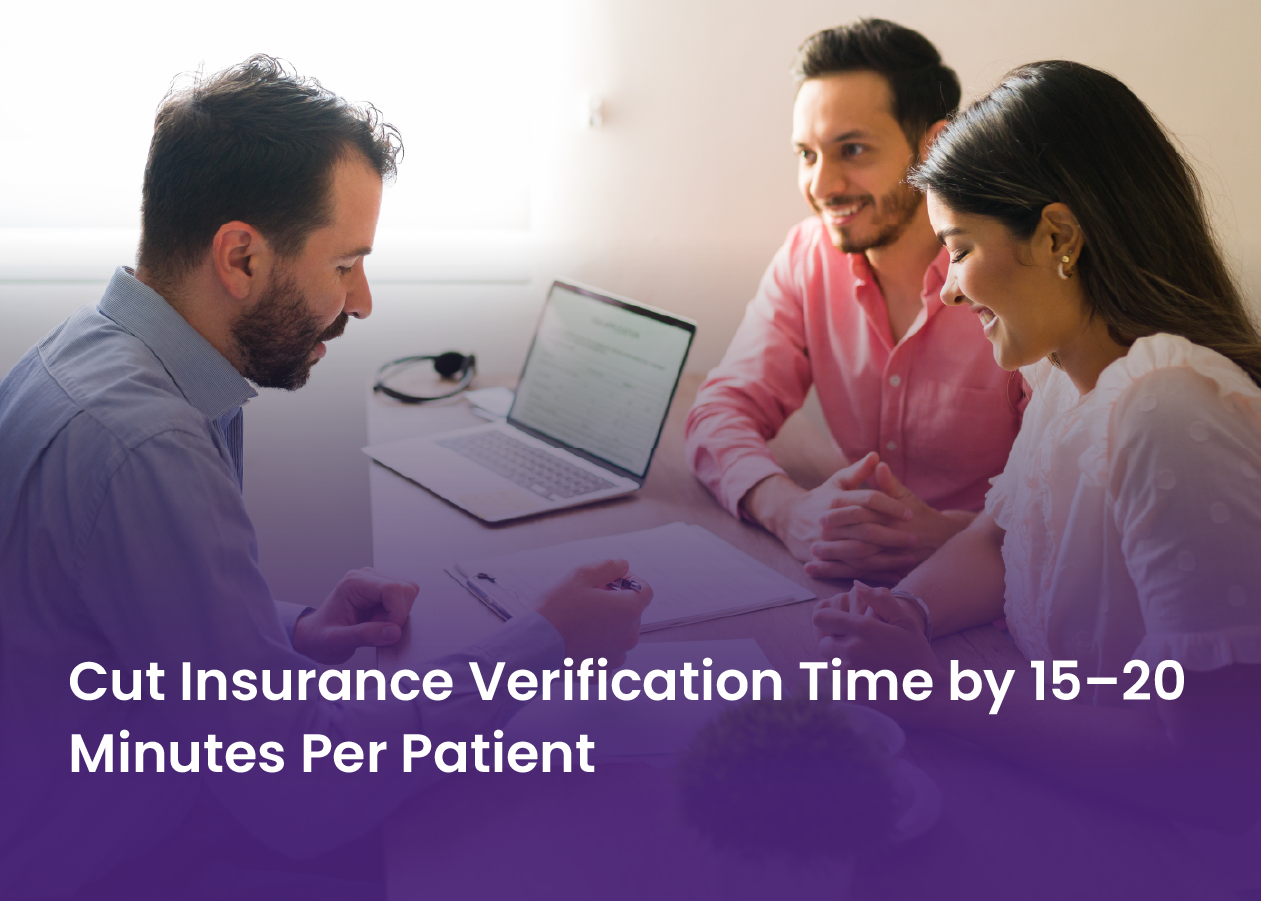
Payer site, then a check, then retyping into your own software — repeated per patient, scaling directly with appointment volume. This is exactly the shape of the delivered dental work in the proof section: 15 to 20 minutes back per patient, and a 60% drop in data-entry errors, because the errors were transcription rather than judgment.
The six stages
The transaction itself is standardized and largely solved. What is not solved is everything around it: knowing which patients to check and when, reading a response that every payer formats differently, deciding what a partial answer means, and getting the result back into the record without anyone retyping it. Select a stage.
Ready vs tailored
Insurance verification automation is sold as one thing and is really two: a transaction that is largely solved, and a mapping problem that is not. Real-time eligibility runs on a node that exists and is connected to a clearinghouse today. What gets built is everything specific to your payers, your practice management system and your front desk's rules.
Four ready, three built, one yours. We would rather give you that than a readiness percentage, because a percentage hides which part you are paying for.
What changes
The payer's site, the check, and retyping into your own software collapse into one automated pass. In a delivered dental integration this saved 15 to 20 minutes per patient.
Most eligibility mistakes are transcription, not judgment. The same delivered integration cut data-entry and verification errors by 60%.
Tomorrow's schedule is checked overnight, so staff arrive to the handful that need a person rather than a list that needs working through.
A lapsed plan found the day before is a phone call. Found at the claim, it is a denial and a write-off, and by then the service has happened.
The same check runs on demand at the counter, in seconds, rather than becoming a manual exception handled differently every time.
Every eligibility and benefits response stored and auditable, so a later dispute is a lookup rather than an argument about what anyone remembers.
What gets built
Tomorrow's schedule checked overnight, plus today's walk-ins checked on demand, sorted so the exceptions are at the top. Select a patient — the flagged episodes are purple.
An illustration of a screen we would build to your protocols, not a product you license. Every figure is invented sample data.
Getting live
Four steps, and who owns each. No durations printed for the reason at the bottom of this page — your payer mix and your practice management system decide the answer, and we have not seen them yet. Select a step.
Clearinghouse connection for the eligibility transaction, and a read and write path into your practice management system. The transaction side is usually the fast part.
One vertical worth naming
Dental practices carry this problem more acutely than most, because verification volume scales with appointment volume and appointment volume is high. It is also where our most complete delivered eligibility work sits, so it is worth being exact about what we have and have not connected.
Open Dental is a documented, delivered connection. We have built and shipped an integration that pulls patient, insurance, condition, procedure and appointment data, runs real-time and scheduled eligibility checks through a clearinghouse, and maps the payer's response back into Open Dental's own data structures.
Denticon, Dentrix and Dentrix Ascend we have not connected to. That is not a no — the eligibility transaction is identical whichever system you run, so what changes is the write path back into your software, and that is a discovery sprint rather than a rebuild.
The failure path
A green check is not the same as getting paid. These are the four gaps between the two. Choose a scenario.
What the system must decide
The most common false pass. The plan is live and the patient is covered — just not for what you are about to do, or not at this facility, or not without a referral on file. The fix is attaching the service type to the inquiry and reading the service-level benefit rather than the coverage flag.
How the check actually runs
The route decides how much is already built, so it is worth settling before anyone quotes you. Select a route.
The default and the one we build on. A 270 goes out, a 271 comes back, and the connection covers many payers through one integration rather than one each. Both real-time and batch are supported, which is what makes checking a full schedule overnight practical.
Proof
All client names withheld as a matter of standing policy — the metric, the systems and the workflow are all here, only the name is not. Open one for the problem, what was built, and the systems it touched.
Front-desk staff were verifying insurance for every scheduled and walk-in appointment by hand: collecting details, entering them into payer websites, validating, then copying the verified information back into the practice management system. Three systems per patient, and the time cost scaled directly with appointment volume.
An integration between the practice management system and a clearinghouse API covering three things: a secure portal giving staff unified access to patient, insurance, condition, procedure, appointment and eligibility data; real-time eligibility verification returning coverage dates, copays, deductibles and out-of-pocket maximums; and both manual and scheduled automated triggers, so staff check on demand for walk-ins while the system checks scheduled appointments ahead of the visit. Custom mapping translates each payer's response into the practice management system's own structures, and every eligibility and benefits record is stored for audit.
Practice management system API · clearinghouse API · X12 EDI and JSON · custom per-payer mapping · HIPAA-compliant storage
Delivery status: delivered and in production, from the published case study. Results: 15–20 minutes saved per patient on eligibility verification, ~40% reduction in administrative burden, and 60% fewer data-entry and eligibility-verification errors. Three technical realities shaped the build and are worth repeating: payers responded in X12 with different structures each, some payers offered limited real-time support, and the data had to map cleanly into the practice management system without staff leaving their normal workflow. Source: case-study library.
Eligibility answers were arriving too late to change anything, because the check happened at the desk on the day rather than ahead of the appointment.
A real-time eligibility verification capability connected to a clearinghouse and callable at the point of scheduling, so the answer exists before the patient is in the building.
Clearinghouse connection · X12 270/271 · real-time and scheduled triggers
Status: this is a built and connected capability, not a proposal. It is listed separately from the row above because it is the reusable piece rather than a customer project — it is what makes that row repeatable rather than bespoke. Source: internal connection catalog.
Dental groups have asked for the same eligibility automation on practice management systems we have not integrated.
Open Dental is a documented, delivered connection. Denticon, Dentrix and Dentrix Ascend we have not connected to — those start with a discovery sprint on the write path rather than a delivery estimate. The eligibility transaction itself is the same either way.
Open Dental — delivered · Denticon, Dentrix, Dentrix Ascend — absent
Status: not a capability. This row exists because a proof section that only lists wins is not proof, it is a brochure. Source: internal connection catalog and workflow inventory.
For platform teams
Patient-access platforms, scheduling products and practice management vendors keep arriving at the same place: their customers want coverage confirmed inside the product, and every customer bills a different payer mix through a different clearinghouse.
You keep the interface and the customer. We build the transaction layer, the per-payer response mapping and the write path, and hand structured results back through your API. The rules about what counts as verified stay with your customer, because that is a front-office policy rather than a feature. Your cost scales with the number of payers your customers bill, not the number of customers you sign — anyone pricing this per customer has the wrong unit.
The fastest route to a real scope is not a demo. Three questions about how verification runs today — the answers tell us how much of this is transaction work and how much is policy work.
We can also build this kind of software for you end to end, if you would rather own it outright.
Questions
Insurance eligibility verification is confirming, before a service happens, that a patient's coverage is active and that it covers what you are about to do. Eligibility and benefits verification is the fuller version of the same job: not only is the plan active, but what are the copay, the deductible, the out-of-pocket maximum and the plan limits that apply to this visit. The reason it matters is timing — a lapsed plan found the day before is a phone call, and the same plan found at adjudication is a denial after the service has already been delivered.
The phone call is replaced by an electronic transaction that most payers are required to support. In practice, tomorrow's schedule is checked overnight and your staff arrive to a short list of exceptions instead of a full day of calls. Being straight about the limit: where a payer returns thin benefit detail, or the answer is ambiguous for the specific service, somebody still picks up the phone — the calls that remain are the ones that genuinely needed a human.
They are the standardized pair that carries an eligibility check. The 270 is the inquiry you send; the 271 is the payer's response, carrying coverage status, plan dates, copays, deductibles, out-of-pocket maximums and plan limitations. Both are HIPAA-mandated for covered entities at version 005010X279A1. Worth knowing where that stops: workers' comp, auto and liability medical payers are generally not HIPAA covered entities and are not obliged to support 270/271 at all — if they are a meaningful share of your mix, those stay manual.
No. Eligibility asks whether coverage exists — is the plan active, what does it cover, what will the patient owe. That is the 270/271 pair, and it is largely automatable. Prior authorization asks whether the payer will approve this specific service — that is a different transaction, the 278, a different workflow, and a much harder automation problem. A patient can be fully eligible and still be denied for lack of authorization.
There is a federal floor most vendor pages skip: the CAQH CORE operating rules require a 271 to return patient financial responsibility for a defined set of high-volume service types, alongside real-time response and defined error reporting. So the floor is mandated and everything above it is not — outside those defined service types, what comes back varies by the payer's own systems and data quality. That is why per-payer response mapping is real work rather than a configuration screen.
It depends which one. On the dental side, Open Dental is a delivered, documented connection — the eligibility work described in the proof section runs against it in production. Denticon, Dentrix and Dentrix Ascend are not connections we hold, and we have said so in writing rather than implying otherwise. The eligibility transaction is the same everywhere, so the only variable is the write path into your system.
Yes, and for a platform that is usually the right shape. We build the transaction layer, the per-payer mapping and the write path underneath your interface and return structured results through your API. The one thing worth planning for: your cost scales with the number of payers your customers bill, not the number of customers you sign.
Mostly automation. What gets marketed as insurance verification AI is usually this pipeline with a model doing two specific jobs: reading a payer response that does not follow a predictable shape, and deciding whether a thin answer is good enough to pass. The eligibility transaction itself involves no intelligence at all. The question worth asking any vendor is not how good the model is — it is which payers they have actually mapped, and what happens on the ones they have not.
Custom, and on this workflow more of it is already standing than on most. The real-time check, the scheduled and on-demand triggers, patient-side capture and batch verification all run on connections we already hold. What gets built for you is the per-payer response parsing, the mapping into your system's fields, and the exception queue your staff work. What stays yours is the rule about what counts as verified.
Partner with us to design, build, and scale digital solutions that drive better outcomes.
Global Tech Teams LLC, 525 Washington Blvd, Industrious at Newport Tower, Jersey City, NJ 07310, United States.
Let’s discuss your goals, workflows, and next steps in a focused consultation call.
 Schedule a Call














 BLOGS
 NEWSROOM
 CASE STUDIES
 WEBINARS
 PODCASTS
 ASSET HUB
 EVENT CALENDAR