
Karl Ulfers, co-founder and CEO of DUOS, joins host Ayush Jain to explain how technology can make the aging experience less fragmented for older adults and their caregivers. After helping create Optum Health and leading Rally Health, Karl started DUOS in November 2020, shaped by watching his own grandparents struggle to stay in control of their lives. DUOS helps older adults with five need states (food, transportation, staying in their home, medical appointments and medications) by matching them to benefits they often don’t know they have, drawn from Medicare Advantage plans, state, federal and VA programs.
Karl shares what test and learn taught his team about building software for older adults: a typical member is 74, most interactions are digital, and a single login change more than doubled digital use. He explains how a large language model beat six months of search engine work at matching needs to programs, why DUOS won’t use AI to deny coverage, and why the data you train on matters as much as the model. He closes on the trends he sees: more older adults, fewer financial resources, and a final mile of care orchestration that technology can automate.
Karl describes the need states DUOS focuses on: food, transportation, staying safely in the home (heating and cooling, bathroom rails, fall prevention), and getting to medical appointments and medications. Underneath all of them sits one barrier: most older adults DUOS works with don’t have the money to pay for the services that would help. So DUOS aggregated the benefit and coverage structures of what Karl describes as well over 4,000 Medicare Advantage plans through an integration with CMS, plus state, federal and VA programs. By his account, 88% of the time the older adults they start working with have no idea what their benefits are, and some go months or years making trade-offs between food and medication.
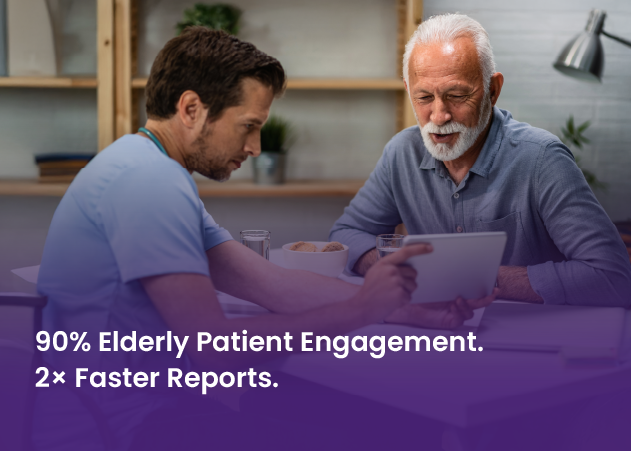
The common assumption, including among payer partners, is that older adults won’t engage with technology. Karl says the opposite: the average DUOS member is 74 and earns $28,000 a year or less, and 60% of interactions are digital, over the website or text message. DUOS started closer to 20% and grew the number through test and learn. The biggest single jump came from replacing username and password logins with a magic link sent to the member’s email address, which Karl says more than doubled digital utilization overnight. It’s the kind of simplified onboarding that decides whether elderly patients and those unfamiliar with digital tools stick with a health app at all.
DUOS first marketed around social isolation, which over 40% of its members report, about twice what Karl would expect. It wasn’t compelling to them. Aging independence worked better. Then the team realized the real barrier to independence was paying for services, so the primary job became helping members get financial resources. That job now runs through the landing page, activation and each step of the product, and it’s the test the team applies to every prioritization call.
DUOS had spent six months building a search engine with a complex ontology to match older adults to programs. When ChatGPT arrived, Karl asked his CTO to test a large language model on the same problem, and within two weeks it was doing a better job at understanding needs and matching them. Karl’s example: a member typed a badly misspelled message about being afraid of falling in the bathroom, and the model understood the fall risk and connected them to a bathroom modification benefit on their health plan.
He is just as clear on where DUOS won’t use it: making negative decisions, such as whether someone should have coverage. His second caution is about the learning layer. If a model is trained on biased data or data that doesn’t reflect the people you serve, its inferences won’t serve them either, which is the core argument for AI guardrails and governance in healthcare. Munjal Shah of Hippocratic AI made a similar case on this show for safety-focused language models that support patients without diagnosing.
Karl frames DUOS as B2B2C: the buyer sits at a health plan, the user is the plan’s member. In a program with Humana for veterans, DUOS combined Medicare Advantage, state and federal, and VA program data so a veteran didn’t have to untangle overlapping programs. Instead of dumping every benefit on a member, the product orchestrates a journey, for example the food benefit on a flex card first, then SNAP and EBT. Looking ahead, he expects more older adults, less money, and a final mile of scheduling rides, food and services where much of today’s wasted labor can be automated.
Hello everyone, welcome to another episode of HealthTech with Purpose. Today we have Karl Ulfers, co-founder and CEO of DUOS, joining us on our show. Karl shares insights into the journey of DUOS and how they leverage technology to increase accessibility and access for older adults in navigating the complex healthcare system. Tune in for an inspiring discussion on the intersection of technology, healthcare and social impact. Hi Karl, how are you today?
I’m doing great. It’s a wonderful morning here in Minneapolis.
Great. I was looking forward to this conversation. But before we get into the details, I want you to start by telling us a bit about your background: how it was for you growing up, where you grew up, where you went to college, where you learned your lessons. Let’s start from there.
Yeah, sure. I grew up here in Minnesota. I first lived in Minneapolis, and then from elementary school on I grew up in a suburb of Minneapolis and St. Paul called Eagan. It was a really fast-growing suburb. I think when we moved there it was about 7,000 people, and when I graduated high school it was about 70,000 people, all in a period of about 13 years. Growing up, I played a lot of sports: football, hockey, baseball. And I was also one of the rare kids who was in the choir. Our school is known for its theater and choir programs.
From there I went to St. John’s University in Minnesota and got an economics degree. It was a tremendous place to learn and grow. From there I went and worked for a software and consulting firm based out of Lake Oswego, Oregon, just outside of Portland, and that’s where I really fell in love with the health tech space. While I was in college I was actually an institutional equity trader intern, and I spent a couple of years doing that. I did it long enough to realize that working on the big institutional money side of the world was not what got me fired up and excited. Working within the healthcare and health tech space, a space where you can really feel like the work you’re doing is helping the world be a little bit better place, was really exciting and motivating.
That company was a great place to start. It had some roots in Andersen Consulting, if you remember that firm from way back when, and you’re probably familiar that UnitedHealth Group had some roots in Andersen Consulting too. So I was actually part of the small team that helped create Optum Health way back when, in [inaudible], and did that for a number of years before moving to another small company called Audax, which I joined right after their Series B. That ultimately became Rally Health, and that’s where I went from being the chief product officer to CEO of the company, taking over for the founder, a guy by the name of Grant Verstandig, who has been incredibly impactful with his career and his entrepreneurism. And that led me to DUOS, which is where we started this company. That’s the quick flyby on my background and my experiences.
Okay, great. You would be the best person to describe DUOS. What do you do at DUOS? If you can explain it in the most layman terms, the value that you create and the benefits you have brought to the world, please tell us more about that.
Yeah. I was passionate about starting DUOS for two reasons. One is that my entire professional career, as I just described, has been focused on that intersection between technology, healthcare, and helping individuals navigate the system a little bit better. And over the course of helping lead Rally, my grandparents, who are actually both still alive, they’re 90 and 95 years old, I got to see firsthand how fragmented the healthcare system was for them. And not just the healthcare system, but the entire aging experience they had. It was very complex and very challenging. Like a lot of older adults, they wanted to continue to maintain control, but they also knew they needed more support, and it was so complex that it was frankly very hard for them to accomplish both of those objectives.
So I was really excited about starting DUOS because I felt that the experience I had in leveraging technology to take a really fragmented healthcare system and simplify it for people could be applied to the older adult space. And the reality is that there are over 60 million older adults, people over 65, and over 40 million caregivers. If you take a step back, that’s over a third of our country being impacted, as the country continues to age, by frankly just a not great system for helping them navigate and get their day-to-day needs met. That was really the impetus, and what I was so excited about in starting DUOS. Does that make sense as an explanation of what got us started?
What I would like to know more about is: what was the missing piece that you created with DUOS? The competitive advantage, I would say, that was missing before DUOS came into existence.
Yeah, for sure. It always starts, for us, with what we really want to get done for older adults. We are very passionate that we want older adults not just to maximize the number of years they live, but to maximize the life they get from those years. And the competitive thing we’ve really focused on, to help those individuals maximize their day-to-day lives so they can maximize their overall life, is helping them with the things that are typically pretty fragmented and hard to find.
They are as follows. Food: it’s really hard for a lot of older adults, and there’s a lot of food insecurity. Transportation: as is well known, a lot of older adults have a hard time driving, so transportation starts to become a real barrier. Staying in their home, which the vast majority of older adults want to do, becomes really challenging, from simple things like making sure they’ve got the heating and cooling they need, to fall-proofing their homes with things like bathroom rails. The fall prevention tactics that need to be deployed just become really overwhelming for those individuals. And finally, helping them get the medical appointments and the medications they need to receive the quality of healthcare they deserve also becomes really challenging.
If you think about those need states, the reality is that underneath them there’s a big challenge most of the older adults we work with face, which is that they don’t have the financial resources to pay for the services that would help them in each of those areas. So what we’ve done is aggregate every single Medicare Advantage plan in the country, their benefits and their coverage structure. It’s well over 4,000 Medicare Advantage plans and benefit structures that we’ve pulled into our system, and we’ve done that through an integration with CMS (the Centers for Medicare & Medicaid Services). In addition, we’ve pulled together every state, every federal and every VA (Department of Veterans Affairs) program in the country as well.
What that has given us is this vast set of resources that can help pay for the services these older adults need. I’ll be honest with you: 88% of the time, when we start working with these older adults, they have no idea what their benefits are, no idea what these government programs are, and no idea how to tap into the resources that can give them the finances to get the services that help them live the quality of life they deserve. That’s the key asset we’ve built, and it gives us really nice differentiation as we work with our partners, which are Medicare Advantage plans, and engage with their populations.
Right. And I could see on your website the stories that have brought real happiness to the people who have been your users: older people with smaller things that may look very small to a young person like ourselves, but could be very important for them, and they aren’t able to find the way. I think if you’re able to solve it at that moment, that makes all the difference.
Yeah. And just to really emphasize that point about “at that moment”: the reality we find time and time again is that these older adults will forgo these services for months and years, and they’ll make really horrible trade-offs, like trying to decide between the food they buy and the medications they can receive, because they don’t know how to get access to these benefits and services.
So, to your point, one of the really cool things about our culture that I love at DUOS is that every single week we send out to the whole company a member story: a person whose life we directly improved through our technology, and often through the support we offer around that technology. Those stories are what really, frankly, fuel us through the challenging times of being a startup, because these are people who have often gone months, if not years, without being able to get that service, and in that moment we’re able to connect them and get them the services they need. It makes a huge impact on their lives.
Yeah. Another thing, out of curiosity: how much of the whole service to older citizens is technology for you, and how much is human driven? At DUOS, how do you see it?
One of the things we’re really excited about is how we’ve been able to leverage technology to engage with these populations. There are a lot of misnomers, frankly, that older adults won’t engage with technology, and we find that’s not the case.
Let me start by talking about the average person we work with. The average person is 74 years old and makes $28,000 or less a year in income. It’s well documented that the older adult population does not have the savings they ideally would have, so we’re dealing with people who are really financially constrained. We do tend to see more females than males, which is pretty standard within the older adult population. But what we’ve really found is that 60% of the time our interactions are digital, and digital can mean using our site or using text message, but it’s a digital interaction from their actual phone.
That’s a really important insight for us, because a lot of people, and frankly a lot of our payer partners, assume a far lower rate of digital utilization in this population. One of the reasons we’ve been able to get that level of engagement, and by the way we think we can get it up to 85%, is that we’ve spent a lot of time understanding the differences in how you engage with an older adult from a technological standpoint versus, say, you and me. It’s been a really interesting learning for us.
Right. But was that something you realized over time building the product, or were you very clear on day one that older people do use technology?
Yeah, I always like to say that you’re going to be more wrong than right when you first build a company and a technology. We actually started with a very heavy telephonic, one-to-one operational model. We got a lot of learnings from that, and that’s how we figured out there was a strong desire for more digital. We were also able to deeply understand the needs, the big five I mentioned earlier. We’ve got a very strong culture of test and learn, because there’s a certain amount of strategy and research you can do up front, and then there’s a certain amount where you just need to watch the data and see how people are interacting.
One of the coolest things, I would tell you, is that when we first launched our digital capabilities, about 20% of interactions were happening digitally. Then progressively, as we learned, tweaked the technology and made improvements, we’ve seen that steadily increase to the 60%, and like I said, we think we can get it to about 85%.
Let me give you a real example of a change we made. It’s pretty standard in any digital experience to have a username and password, or a login with Google, or any one of the different authentication services. What we found with older adults is that it worked fine, but it was still confusing. It was still another thing for them to remember. So what we deployed that drove a really big increase for us was a magic link, where they simply put in their email, it sends an email to their inbox, and they click on a secure link that takes them directly into their experience. That little tweak literally more than doubled our digital utilization for these older adults, because they all know their email address.
We like to joke that one of the greatest things that happened during the pandemic was that a lot of older adults got on Facebook, and what do you need for Facebook? You need an email. So everybody knows their email. That little change, which was technologically pretty sophisticated because of how you have to do it within the healthcare space, made a massive increase: like I said, it more than doubled our use of digital by this older adult population overnight.
Nice. And when building technology especially for older adults, what have been some of your other learnings, like the one you just shared? If you could expand on it as system thinking: when you have an ideal customer profile of a 74-year-old, for example, what kind of decision making have you seen go into choosing between features, or choosing between communication media, and so on?
Absolutely. I think one of the most important things, as you think about system thinking and building engagement loops for older adults, or for any user population, is to make sure you land on the right “what’s in it for me” factor, and then how you pull that all the way through the experience. This is again an area where we really tested and learned to get to the right “what’s in it for me” for the ideal customer profile. Let me tell you about that journey. We launched the company in November of 2020, and we started by thinking that, because there’s a lot of social isolation among older adults, if we really focused our marketing and our product on helping them not feel so socially isolated…
This episode of the HealthTech with Purpose podcast is brought to you by Mindbowser, a product engineering and digital transformation company focused on health. At Mindbowser, we enable health companies to build the future of health with accessible, equitable [inaudible] patient care. We strongly believe that technology can empower a healthier world, and that’s why we are partnering with healthcare experts like you to make it happen.
Hi guys, thanks for listening to HealthTech with Purpose. Make sure to subscribe to us on Spotify, Apple, and YouTube for more expert insights on industry innovation and transformation. And remember: share the knowledge.
…that would be a good way to get older adults into the experience. What we found is that, yes, we found high rates of social isolation within our population. Over 40% of our members would identify as being somewhat socially isolated, which is about twice what you would expect. However, that was actually not that compelling to them.
The next learning we had was that these older adults really want to maintain control. They want to be able to continue to live the life they’ve had for the previous decades. So we started to market to older adults around aging independence. We found that worked. It got us a little more activation and helped us build a better product. But then we realized the biggest barrier these older adults have to living independently is that they don’t have the financial resources to pay for the services that will help them maintain independence and control.
That’s the part of the journey we’re on right now, and we feel very confident about it from a product and a user standpoint: the primary job we have for these users is to help them get the financial resources that will pay for the services they need. And to your point, that rips through the entirety of the product from a product loop standpoint. Our landing page and our messaging when we’re activating people highlight our ability to help get them the financial resources they need. As we activate them and ask about their needs, we’re constantly reminding them that we’re going to help them get access to benefits and programs that will pay for these services. And even from a feature set perspective, within the experience itself, as we connect these programs, each step along the way we highlight the amount of financial support they can tap into once they start using these benefits for the services they need.
So I love that you asked that question, because that journey has been incredibly important for us. And you asked another question within your question, which is how it affects prioritization. We’re constantly challenging ourselves to say: we could do this, but is it actually helping that older adult get access to the services and the healthcare they need, and feel like they’ll be able to get it when previously they haven’t? We’re constantly pushing ourselves in that regard.
Nice. In fact, I’m glad you touched on choosing between features, or choosing between privacy and convenience, and so on. I also saw that you use a lot of AI today as a company, from what I could read. So tell us more about your version of AI. How does DUOS go about using AI? What are the ways you have already used it, and what are some of the ways you have deliberately avoided using it? Tell us more about that aspect.
Yeah. AI has been a really wonderful component of what we’ve done, and frankly a big lift for our engagement model with older adults. The headline is that the two big themes we focus on from an AI perspective at DUOS are how we leverage AI to increase accessibility, and how we leverage AI to increase access, in everything we do as a company.
Let me tell you that we actually started out not using AI. When we were thinking about the problem of how to match an older adult to benefits, programs and services, we started by building a search engine with a pretty complex ontology associated with it. Then, right about a year ago, OpenAI and ChatGPT all of a sudden started making a lot of noise in the world. So I said to my CTO, Art Petrossian, “Hey, we should look at their large language model and just see how it would do on the problem space we’re focused on.” He came back to me two weeks later. He’d had one of his top engineers work on it, and what we found was that the large language model was doing a better job than the search engine we had developed over six months at understanding older adults’ needs and matching them to the right programs for those needs.
That really allowed us to realize there’s a lot more we could be doing with it. It’s not everything we do; there’s a lot of other technology we build around it, but it does play a really important role. When I talk about those two themes of accessibility and access, I’ll give you two very simple use cases. The reality of the older adult population we deal with is that it’s very diverse, both in terms of languages and in the level of English spoken, whether that’s spoken or chatted to us in our digital experience or over text. It’s a very wide array, and frankly, often very limited.
So beyond the fact that these models can understand lots of different languages, which is super powerful in and of itself, they can handle even fragmented English incredibly well. One of the stories I always like to tell: we had a user who literally typed in “I am fall afraid,” with “afraid” spelled wrong, “of fallen in my bathroom,” with very few words actually input correctly. The model was able to figure out that this person was afraid of falling and was a fall risk, and it was able not just to connect us to them, but to get them connected to a bathroom modification benefit they had on their health plan. That’s what I mean when I say accessibility. It really opens up the aperture of how you can scale and help more people.
Okay. You covered the different ways AI has been helping. Just to touch on any deliberate choices to avoid aspects of AI, things you kept on the back burner, especially from the viewpoint of ethical AI, or privacy and security, and so on.
Yeah, look. Again, we stay focused on these two key themes of accessibility and access, because we feel those are the most powerful ways to use it. And to say what’s unsaid when I say that: what we don’t think it’s great for, at the moment and on its own, is denial of things. Using AI strictly as a way to make negative decisions, like determining whether somebody should have coverage for something, we think is not the best use yet, and maybe ever.
So what we really try to do is focus on accessibility, and then on the access side, the way we focus on it from a positive standpoint is that we’ve built our own machine learning model that sits on our side. It takes every interaction we have, so when the large language model figures out the intent of what that individual is doing, we’re training it on the experiences of the people we work with within our company, to find the best benefit, the best program and so on.
And I would say that’s the other thing you have to be so careful about with AI. You have to remember that AI at its core is two different problem sets. There’s a learning problem set, and then there’s an inference problem set that sits on that learning. What you train the learning engine component of AI with is so important. I think this is where you can get into a really challenging spot: if you’re not using data from the people you’re serving, or you’re using data that’s inherently biased in one way or another, the learning itself will then generate inferences that are not what’s best for the people you’re servicing. That’s the other thing I always explain to people as they think about how to use AI: be really careful about how you think about that learning layer.
Right, right. Thank you for saying that, because that’s so important. Another thing I would like to touch on: for the audience you’re catering to, engagement and personalization are super important, and technology is a great enabler of that. How has DUOS been able to use technology to make healthcare engaging and personalized for members? You’re dealing with an audience that may need to be convinced this is useful to them and not noise. They tend to be choosy, from what I understand from my own parents.
Yeah, yeah. Look, what I would tell you is that this is where it’s so important to take a step back and think about how you’re leveraging the technology and the way you’re going to market with it. At DUOS, we are a B2B2C (business to business to consumer) business, and the way we think about leveraging technology to drive activation is so critical relative to the way we work with the partners we’re servicing. Even though the person who buys our service and technology sits at a health plan, the users are the people the health plan serves.
The reason I say this is that this is where we think the power of digital technology, payer data sets, and these broader government program and benefit data sets come together to create a simple experience for the older adults we have the privilege to serve. Let me give you a couple of real market examples that illustrate how that technology comes together.
You might have seen that we recently did a launch with Humana. We got a bunch of press with Humana and their veteran populations. I highlight it because it’s a perfect example: we already had Medicare Advantage benefit data, we already had a lot of state and federal program data, and then we brought in all this veteran program information. The reason that’s so important: think about yourself as a veteran on one of these Humana Honor Medicare Advantage plans. Not only are you trying to figure out how to navigate your VA benefits, you’re also trying to figure out how to navigate your Medicare Advantage benefits. And oh, by the way, if there are other programs out there from the state or the federal government, your head is basically exploding, because lots of these programs overlap with one another. And that’s if you even know about them.
So what we’ve done is build that data supply across all those different programs. But the end user doesn’t care about that. They care about: “Hey, I have a need. What can you do to help me with that need?” The way we’ve built the technology, it takes all that complexity of programs and benefits, and when we figure out that an individual needs, say, to get connected to food resources, rather than dumping a whole set of benefits and government programs and VA benefits on them, we use the technology to orchestrate a journey. First, for example, it helps them get connected to the food benefit they have as part of their flex card. Next, it helps them get connected to SNAP (Supplemental Nutrition Assistance Program) and EBT (electronic benefit transfer) benefits so they have that on an ongoing basis.
That simplification of the complexity down to a unique user interaction is how we leverage the technology to meet that member’s need. And as you probably know, once you meet somebody’s need, the chance they’ll come back and be loyal to your technology and the service you’re providing is exponentially higher than if you just have some really slick technology. So we try to stay very purpose driven in how we use all this data and technology to lead us into our experience.
The other thing I’ll say, because food insecurity is such a big challenge in the populations we serve: one of the partnerships we’ve thought about from a technology standpoint is a marketing campaign we have called Connections for a Cause. That’s on our B2B marketing side, but we’ve used it to generate over 8,200 meals delivered through U.S. Hunger, because of that marketing and the dollars we’ve raised for people that U.S. Hunger and we ourselves serve. It’s another good example where technology comes in as a supportive factor for a need state we see such a high prevalence of in the populations we serve.
Makes sense, totally makes sense. That’s fantastic. The next thing I’d like to talk about is the future. What do you see as the future for DUOS, and also for the older adult population? What are the newer trends, opportunities or possibilities coming up in care for older adults, and how, especially with technology, can we be a participant in that?
Yeah, let’s start with the big trends, which I think are hopefully well known. We’re going to have more older adults in the country than we’ve ever had before. As that happens, there’s going to be more strain on the existing aging system than there has ever been, both for older adults and for the family caregivers, like myself and my family, who are trying to support them. Coupled with that, we’re going to be living in a world where not only do older adults have fewer financial resources than before, but the federal government, which has been a key resource for older adults through Social Security and Medicare funding, inclusive of Medicare Advantage, is more financially constrained than it’s ever been.
I set that backdrop of more people and fewer financial resources to say that technology has got to play an absolutely enormous role in bringing greater scale and greater impact to those populations than has ever existed before. And the good news is that this older adult population, as we’ve seen ourselves, and as you can really see in the baby boomers coming into it, is more technologically savvy than it has ever been.
So as we think about the future for DUOS, I’ll keep it really simple with a couple of key patterns. One is that we’re going to continue to look for innovative ways, whether that’s voice, devices in the home, or just enhancing the technology we already have, to open up the aperture of how people can engage with us. You hear a lot about VR. I think that’s still a little further out for this older adult population, but there are lots of ways we can be innovative and open up the ways people can engage with us, and we’re going to continue to stay very curious and really test what works best with those older adults.
Then on the back end: think about the way you get a ride, maybe not every day but on a frequent basis, from an Uber or Lyft. Think about the way you can order food for your family, or the way you can schedule things. We think all of the technology advancement that has come about in basically every other category of a consumer’s day-to-day life has got to come into this aging space, both in the healthcare sector and in the social needs we support individuals on. So the other area we’ll continue to be very focused on is how to make that final mile connection as seamless as possible for the people we’re servicing. Today in the industry there’s so much wasted labor and expense in that orchestration, and so much of it can be automated with really focused use of technology, frankly just by taking what’s already been done in other parts of the economy and bringing it into what should be really easy for the older adults we serve. So I’ll use those two bookends as where we’re really excited about the future, where we’re focused, and where we’ll continue to improve things.
Great, great. Awesome learning from you about the possibilities, Karl. All along it’s been a great master class on care for the older adult population. Thank you so much for sharing your thoughts. It’s been a pleasure hosting you.
Yeah, absolutely. Thank you for having me on, and I look forward to talking again in the future.
Thank you for joining us on the HealthTech with Purpose podcast. Before you leave, make sure to like and subscribe on Spotify, Apple and YouTube. And if you would like to see someone on this podcast, do refer them to us; my contact details are in the description. Before I leave, I wish you: stay healthy, stay curious, and keep building.
At the time of recording (published May 2024), Karl Ulfers was co-founder and CEO of DUOS, a Minneapolis-based company that helps older adults find and use benefits and programs for food, transportation, staying in their homes and medical care, working with Medicare Advantage plans as partners. He grew up in Eagan, Minnesota, and earned an economics degree from St. John’s University in Minnesota. He began his health tech career at a software and consulting firm near Portland, Oregon, was part of the small team that helped create Optum Health within UnitedHealth Group, and later joined Audax, which became Rally Health, where he served as chief product officer and then CEO before founding DUOS in 2020. LinkedIn: https://www.linkedin.com/in/karl-ulfers-9736452/
Building a product that older adults, or the health plans that serve them, will actually use? Tell us what you’re working on and we’ll show you how we’d approach it.

Join us in this Healthtech with Purpose Podcast episode at Health 2.0 Vegas! Discover how UK-based startup Encode Health disrupts healthcare inventory management using AI, optimizing the supply chain while respecting data privacy. CEO Cos Fantis discusses integration challenges and collaborative team dynamics.
Join Jessica Brazil, healthcare leader, on HealthTech with Purpose Podcast. Explore mental health advocacy, female leadership, and self-care for impactful growth. Don’t miss her inspiring journey!
Partner with us to design, build, and scale digital solutions that drive better outcomes.
Global Tech Teams LLC, 525 Washington Blvd, Industrious at Newport Tower, Jersey City, NJ 07310, United States.
Let’s discuss your goals, workflows, and next steps in a focused consultation call.
 Schedule a Call













 BLOGS
 NEWSROOM
 CASE STUDIES
 WEBINARS
 PODCASTS
 ASSET HUB
 EVENT CALENDAR