

 BLOGS
BLOGS  NEWSROOM
  CASE STUDIES
  WEBINARS
  PODCASTS
  ASSET HUB
  EVENT CALENDAR


















TL;DR
Epic Cosmos is reshaping how health systems use data. With 300M+ de-identified patient records across thousands of hospitals, it enables real-time research, benchmarking, and predictive insights. It powers Epic Research and Epic Curiosity, bringing AI directly into clinical workflows. Strong governance ensures privacy and trust. The real edge? Insights don’t sit in dashboards; they drive action at the point of care.
What if your EHR didn’t just store data but actively improved clinical decisions every day?
Health systems are sitting on massive volumes of patient data, yet most of it remains underutilized, trapped in silos, delayed in reports, and disconnected from real-time care decisions. The gap is no longer about access. It’s about activation.
Epic Cosmos changes that by turning fragmented EHR data into a continuously learning system, one that powers research, enables AI, and drives action directly within clinical workflows.
I. What is Epic Cosmos? (And Why CIOs Are Paying Attention Now)
Healthcare data isn’t scarce. It’s trapped.
Every CIO knows the pattern. Data lives in silos. Analytics lives in dashboards. Decisions lag behind reality. The result? Missed opportunities, delayed interventions, and rising operational costs.
Epic Cosmos changes that equation.
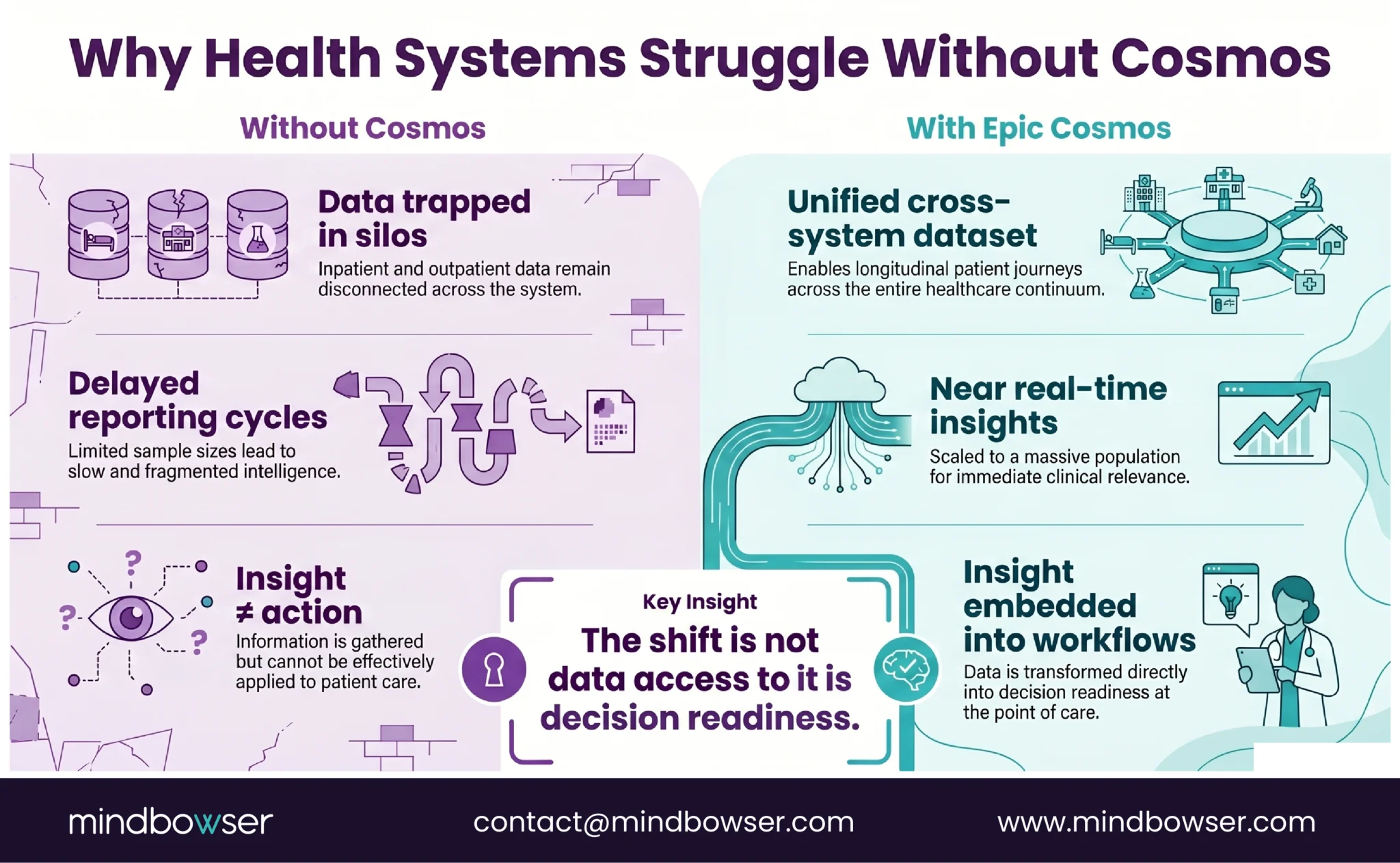
At its core, Epic Cosmos is a massive, continuously updated dataset built from de-identified patient records across participating Epic health systems. But calling it a dataset misses the point. Cosmos is designed as a learning health system infrastructurewhere data flows, learns, and feeds back into care delivery.
What if your EHR didn’t just store data but actively improved clinical decisions every day?
That’s the shift.
Cosmos aggregates longitudinal data across inpatient and outpatient settings to create a unified patient journey. This means clinicians and leaders can move beyond snapshots and start working with real-world, time-based insights.
Here’s where CIOs lean in:
- Scale: Hundreds of millions of patient records
- Continuity: Longitudinal data across care settings
- Actionability: Insights integrated into Epic workflows
This isn’t just about better reporting. It’s about faster clinical decisions, smarter operations, and measurable outcomes.
A quick scenario:
A CMIO reviews sepsis trends. Instead of waiting weeks for analysis, Cosmos enables near-real-time cohort insights, triggering protocol changes within days, not quarters.
That’s the difference. Speed. Precision. Impact.
Epic Cosmos turns static EHR data into a living intelligence layer, and that’s why health system leaders are paying attention now.
II. How Epic Cosmos Turns EHR Data into a Learning Health System
A. Unified Dataset Across 1,500+ Hospitals and 300M+ Patients
Scale alone doesn’t create intelligence. Connection does.
Unlike fragmented registries or siloed systems, Cosmos connects patient data across organizations. This creates a shared foundation in which patterns emerge more quickly, and insights become statistically reliable, even for rare conditions.
Ever tried identifying trends with limited sample sizes? It’s guesswork at best.
With Cosmos, that guesswork fades. Health systems can analyse outcomes across millions of comparable cases, not thousands.
The impact shows up in three ways:
- Better cohort definition for research and care pathways
- More reliable benchmarking across institutions
- Stronger evidence for clinical decisions
This works. Period.
B. Longitudinal, Multi-Setting Data (Inpatient + Outpatient)
Healthcare doesn’t happen in one place. Why should your data?
Most analytics platforms struggle with fragmented patient journeys. Inpatient data sits in one system. Outpatient in another. Post-acute? Often missing.
Epic Cosmos stitches this together.
It captures longitudinal patient journeys across care settings, inpatient, outpatient, ambulatory, and beyond. This gives clinicians and leaders a time-based view of care rather than isolated encounters.
What happens before admission? After discharge? Which interventions actually changed outcomes?
Now, those questions have answers.
The result:
- Improved care coordination
- Better outcome tracking over time
- More precise intervention planning
C. Creates a Continuous Learning Loop Across Health Systems
Here’s the real shift: data doesn’t just inform, it evolves.
Epic Cosmos enables a continuous learning loop:
- Data → Insight → Clinical action → New data → Refined insight
This loop runs across participating health systems, not just within a single organisation. That means every new data point strengthens the collective intelligence.
Imagine every patient interaction making your system smarter the next day.
That’s not theoretical. It’s already happening.
For CIOs and CMIOs, this changes the operating model:
- Research is no longer periodic; it’s ongoing
- Protocols evolve faster based on real-world evidence
- Clinical variation becomes measurable and correctable
A short anecdote:
A population health leader identifies variation in diabetes management across sites. Using Epic Cosmos, they standardise protocols and track improvements in near real time, reducing variation within months.
Epic Cosmos transforms EHR data into a self-improving system in which every interaction feeds the next, better decision.
III. What Makes Cosmos Different from Traditional Data Warehouses?
A. Not Passive Storage → Active Intelligence Layer
Most data warehouses answer questions. Cosmos changes decisions.
Traditional healthcare data platforms are built for storage and retrospective analysis. Data gets extracted, transformed, loaded… and then analysed weeks later.
By then, the moment is gone.
Epic Cosmos flips that model. It acts as an active intelligence layer, continuously fed by live clinical workflows inside Epic. This means insights are not delayed; they are available when decisions are made.
What’s the value of insight if it arrives after discharge?
That’s the gap Cosmos closes.
Instead of static reports, clinicians and leaders get:
- Near real-time cohort analysis
- Dynamic benchmarking
- Immediate visibility into emerging trends
Cosmos doesn’t store history. It shapes what happens next.
B. Standardized Clinical Vocabularies (SNOMED, LOINC, RxNorm)
Data is only useful if it speaks the same language.
One of the biggest failures of traditional data warehouses is inconsistency. Different systems document the same condition in different ways. The result? Endless data cleaning and unreliable comparisons.
Epic Cosmos solves this at the source.
It uses standardized clinical vocabularies such as SNOMED, LOINC, and RxNorm to harmonize data across organizations. This ensures that a diagnosis, lab value, or medication means the same thing, no matter where it was recorded.
Ever tried comparing outcomes across hospitals with mismatched data definitions? It slows everything down.
With Cosmos:
- Data normalization is built-in
- Cross-system comparisons become reliable
- Analytics cycles shrink significantly
This reduces the hidden cost of analytics: manual reconciliation.
C. Continuously Updated from Live Clinical Workflows
Fresh data changes the quality of decisions.
Traditional warehouses rely on batch updates daily, weekly, and sometimes monthly. That lag creates blind spots, especially in fast-moving clinical scenarios.
Epic Cosmos is different.
It is continuously updated from live clinical workflows, meaning the dataset evolves as care is delivered. This enables a level of responsiveness that static systems simply can’t match.
If a new treatment protocol starts showing better outcomes today, when do you want to know, next month or now?
For operational leaders, this matters in real terms:
- Faster response to emerging health trends
- Real-time monitoring of interventions
- Improved agility in care delivery
A quick example:
During a seasonal surge, a hospital tracks admission trends and adjusts staffing models within days, not weeks, based on Cosmos-driven insights.
Epic Cosmos replaces delayed analytics with continuous intelligence, turning data into a real-time strategic asset.
IV. The Strategic Advantages of Epic Cosmos (Why It Matters for Health Systems)
A. Unmatched Scale for Real-World Evidence
In healthcare, scale determines truth.
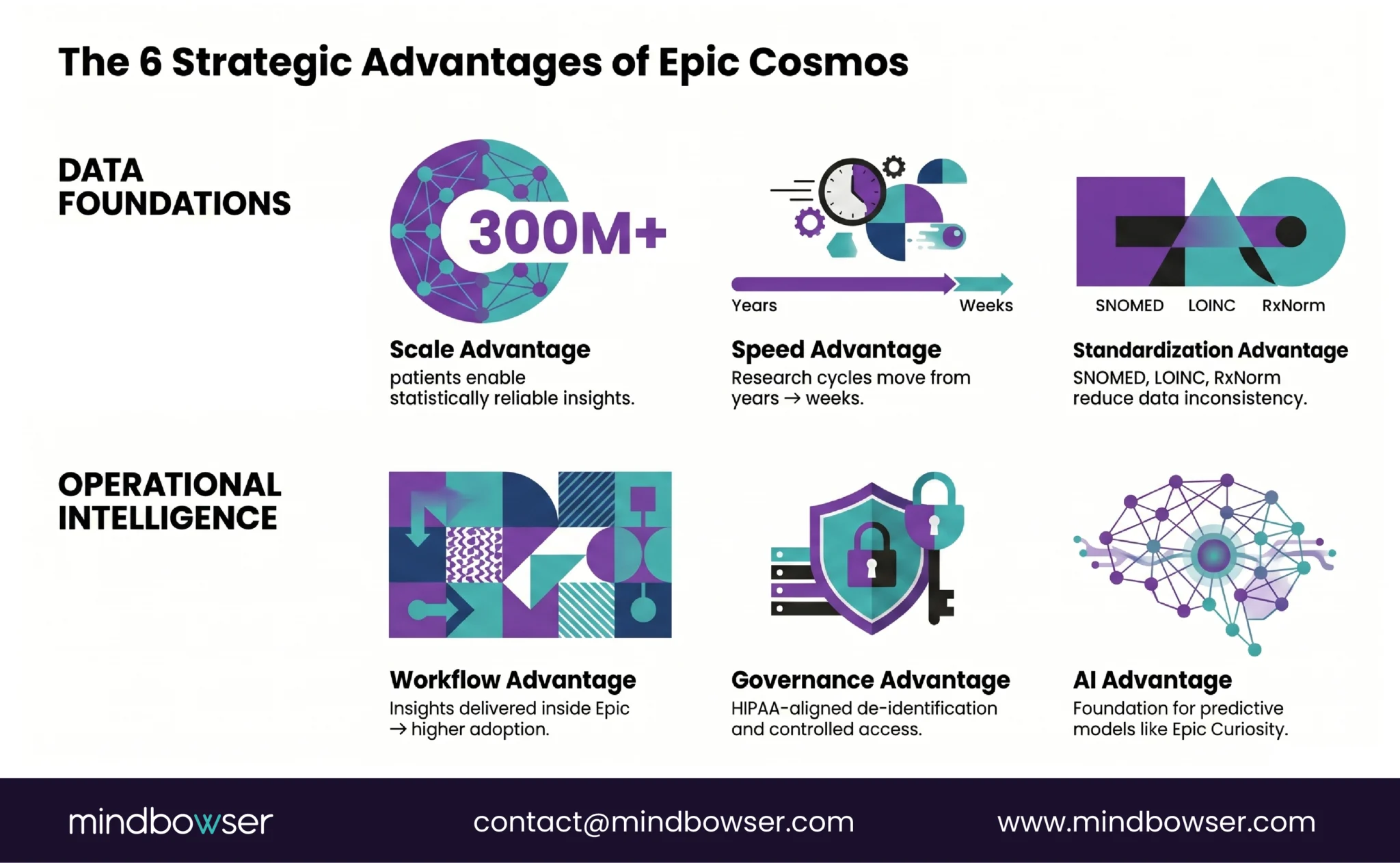
Epic Cosmos brings together the largest longitudinal clinical dataset globally, enabling health systems to move beyond the limitations of small-sample assumptions. With hundreds of millions of patient records, even rare conditions can be analyzed with statistical confidence.
How do you validate treatment effectiveness when patient populations are small?
Traditionally, you couldn’t, at least not reliably.
Cosmos changes that:
- Enables statistically significant insights for rare diseases
- Reduces dependence on fragmented registries
- Strengthens real-world evidence generation
Bigger data isn’t just more data; it’s better decisions.
B. Faster Clinical & Operational Decision-Making
Speed is now a clinical advantage.
Healthcare used to run on delayed insights. Research cycles took years. Operational changes lagged behind real-world conditions.
Epic Cosmos compresses that timeline.
By enabling near real-time cohort analysis, health systems can test hypotheses and act faster. What once took quarters can now happen in weeks or even days.
What happens when your clinical team can validate a protocol change within a week?
Momentum.
The result:
- Rapid response to emerging health trends
- Faster protocol adjustments
- Improved operational agility
This is where competitive advantage starts to show.
C. Built-In Standardization Across Systems
Consistency drives clarity.
One of the biggest barriers to cross-system analysis is the inconsistency of different documentation styles, coding practices, and workflows.
Epic Cosmos addresses this with a harmonized data model across participating organizations. The benefit is immediate: less time cleaning data, more time using it.
How much analyst time is wasted reconciling mismatched datasets?
Often, more than leaders realize.
With Cosmos:
- Data cleaning effort drops significantly
- Comparisons across systems become meaningful
- Insights are faster and more reliable
For CIOs, this translates into lower analytics overhead and higher ROI.
D. Embedded in Clinical Workflows (Not a Separate Tool)
Adoption decides impact.
Many analytics platforms fail not because they lack insight, but because clinicians never use them.
Epic Cosmos avoids this trap by being embedded directly within the Epic interface. Insights show up where decisions happen, not in a separate dashboard.
If clinicians have to leave their workflow, will they actually use the data?
Rarely.
Cosmos enables:
- Point-of-care decision support
- Higher clinician adoption
- Faster translation of insight into action
This is where Cosmos moves from insight to impact.
E. Strong Governance & Compliance Framework
Trust is non-negotiable.
Handling data at this scale demands rigorous governance. Epic Cosmos is built with HIPAA-aligned de-identification and a multi-stakeholder governance model.
This ensures that data is used ethically, securely, and transparently.
Can you scale data without compromising privacy?
Cosmos proves you can.
Key safeguards include:
- De-identification protocols
- Controlled data access
- Defined usage policies
For health system leaders, this reduces risk while enabling innovation.
F. Enables System-Wide Benchmarking
You can’t improve what you can’t compare.
Epic Cosmos enables health systems to benchmark performance against peers, a capability that was historically difficult due to inconsistent data.
Now, organizations can compare:
- Length of stay (LOS)
- Clinical outcomes
- Resource utilization
Are your outcomes truly competitive or just internally acceptable?
That question now has a clear answer.
Benchmarking drives:
- Performance gap identification
- Targeted improvement initiatives
- Accountability across teams
G. Foundation for AI (Epic Curiosity)
No AI works without good data.
Epic Cosmos provides the training ground for AI models, including Epic Curiosity. Its scale and diversity reflect real-world clinical variability, critical for building reliable predictive systems.
Why do many AI models fail in healthcare? Poor training data.
Cosmos addresses that at the root.
It enables:
- More accurate predictive models
- Better generalization across populations
- Continuous learning as new data flows in
This sets the stage for the next evolution of AI-driven clinical intelligence embedded into everyday care.
Epic Cosmos is not just a data asset; it’s a strategic engine for research, operations, and AI-driven healthcare transformation.
Build a Custom EHR with Epic EHR Capabilities
V. Inside the Scale: Why Epic Cosmos is a Research Powerhouse?
A. The Numbers That Change the Game
At this scale, patterns stop hiding.
Epic Cosmos operates on a dataset that fundamentally shifts what’s possible in clinical research:
- 300M+ patients
- Thousands of hospitals and clinics
- Billions of clinical encounters
These aren’t just impressive numbers. They redefine statistical confidence.
What happens when your sample size is no longer the constraint?
You move from approximation to precision.
Traditional research often struggles with limited cohorts, especially in rare diseases or niche populations. Cosmos removes that limitation by providing broad, diverse, and longitudinal data across geographies and care settings.
According to the NIH, small sample sizes are one of the leading causes of inconclusive clinical research. Cosmos directly addresses this by enabling large-scale observational studies with real-world diversity.
The result:
- Higher confidence in findings
- Better representation of patient variability
- Reduced bias compared to controlled trials alone
This is where data volume translates into clinical credibility.
B. From Data to Discovery: How Cosmos Accelerates Clinical Research
Research used to be slow. Now it’s iterative.
Epic Cosmos compresses the research lifecycle by enabling rapid hypothesis testing and validation. Instead of waiting months to gather and clean datasets, researchers can access structured, de-identified data almost immediately.
What if validating a clinical hypothesis took days instead of quarters?
That’s the shift Cosmos enables.
Key capabilities include:
- Rapid hypothesis validation using real-world cohorts
- Observational research at scale across diverse populations
- Clinical trial optimization through better patient matching
A practical scenario:
A research team explores the effectiveness of a new treatment protocol. Using Cosmos, they identify comparable patient cohorts across multiple systems and validate outcomes within weeks, accelerating publication timelines and clinical adoption.
The impact extends beyond speed:
- Lower research costs
- Faster innovation cycles
- Closer alignment between research and care delivery
Epic Cosmos turns research from a periodic activity into a continuous, data-driven engine for clinical discovery.
VI. Epic Research + Cosmos: Real-World Evidence at Scale
A. What is Epic Research?
Research is no longer confined to academic centres.
Epic Research is an open research initiative powered by Epic Cosmos, designed to generate and publish real-world clinical insights using large-scale, de-identified data.
It bridges a long-standing gap.
Traditionally, research lived in silosacademic institutions, pharma-sponsored trials, or isolated registries. The process was slow, expensive, and often disconnected from everyday clinical practice.
Why does it take years for research insights to reach frontline care?
Because the data and the workflows were never connected.
Epic Research changes that by embedding research capabilities directly into the ecosystem where care happens.
The result:
- Continuous generation of clinical insights
- Access to real-world patient populations
- Faster dissemination of findings
This is research that moves at the speed of care.
B. How Epic Cosmos Powers Epic Research
Data is the engine. Cosmos is the fuel system.
Epic Cosmos provides the structured, de-identified dataset that enables Epic Research. Without it, scaling research across health systems would remain impractical.
Here’s how it works:
- De-identified structured datasets ensure privacy while enabling analysis
- Standardized data models allow cross-system comparisons
- Longitudinal patient records enable outcome tracking over time
What changes when you can analyze millions of patient journeys instead of thousands?
Clarity.
Researchers can:
- Track disease trends across populations
- Compare treatment effectiveness in real-world settings
- Identify outcome variations across demographics and regions
According to the FDA, real-world evidence is increasingly used to support clinical and regulatory decisions. Cosmos gives health systems direct participation in that shift.
C. Why This Matters for Health Systems
This isn’t just research, it’s an operational advantage.
Epic Research enables health systems to move from passive data contributors to active insight generators. That shift has direct clinical and financial implications.
What if your organization could validate care protocols using real-world evidence without external studies?
That’s now possible.
The benefits are tangible:
- Evidence-backed care protocols that improve outcomes
- Faster innovation cycles driven by internal insights
- Reduced research costs by leveraging existing data
A practical example:
A health system evaluates two treatment pathways for heart failure. Using Cosmos-powered research, they identify the more effective approach across similar patient populationsthen standardize it system-wide.
This shortens the gap between discovery and implementation.
Epic Research, powered by Cosmos, turns every participating health system into a contributor and beneficiary of real-world clinical intelligence.
VII. Governance, Compliance, and Trust: The Backbone of Epic Cosmos
A. How Data Governance Works in Epic Cosmos
At this scale, governance is not optional; it’s foundational.
Epic Cosmos operates under a multi-stakeholder governance model, ensuring that data usage aligns with clinical, ethical, and organizational priorities.
This isn’t a single-owner system. Participating health systems actively shape how data is used, shared, and analyzed.
Who decides what data can be used and for what purpose?
In Cosmos, that decision is structured, transparent, and controlled.
Key governance principles include:
- Defined data usage policies across all participants
- Oversight committees representing multiple stakeholders
- Clear accountability for research and analytics activities
This structure builds trust across organizations that may otherwise hesitate to contribute data at scale.
A practical lens:
A health system considers contributing data to Cosmos. Governance clarity ensures they understand exactly how their data will be used, reducing legal and operational friction.
Governance in Cosmos isn’t a barrier; it’s what makes large-scale collaboration possible.
B. Privacy & Security Model
Data utility means nothing without privacy protection.
Epic Cosmos is built on HIPAA-aligned de-identification protocols, ensuring that patient identity is protected while still enabling meaningful analysis.
This balance is critical.
How do you unlock insights from millions of records without exposing patient identities?
Through rigorous data handling mechanisms:
- De-identification of patient data before inclusion
- Data masking and suppression for sensitive attributes
- Continuous monitoring for privacy compliance
According to the U.S. Department of Health & Human Services, de-identification is a core requirement for the secondary use of healthcare data. Cosmos operationalizes this at scale.
The outcome:
- Safe data sharing across organizations
- Reduced regulatory risk
- Confidence in analytics and research outputs
C. Controlled Access Framework
Not everyone sees everything, and that’s by design.
Epic Cosmos enforces a tiered access model, ensuring that only approved users can access the data and do so only within defined boundaries.
This prevents misuse while enabling legitimate research and operational insights.
What happens if access is too open? Risk. Too restricted? Lost value.
Cosmos strikes the balance.
Access controls include:
- Restricted access to approved users
- Role-based permissions
- Audit trails for data usage
This ensures that every query, analysis, and output is traceable and compliant.
A quick scenario:
A researcher requests access to a dataset for outcome analysis. Approval workflows validate the request, assign appropriate access levels, and track usageensuring compliance at every step.
Epic Cosmos builds trust through controlled, transparent access, enabling innovation without compromising security.
VIII. Epic Curiosity: AI Built on Cosmos Data
A. What is Epic Curiosity?
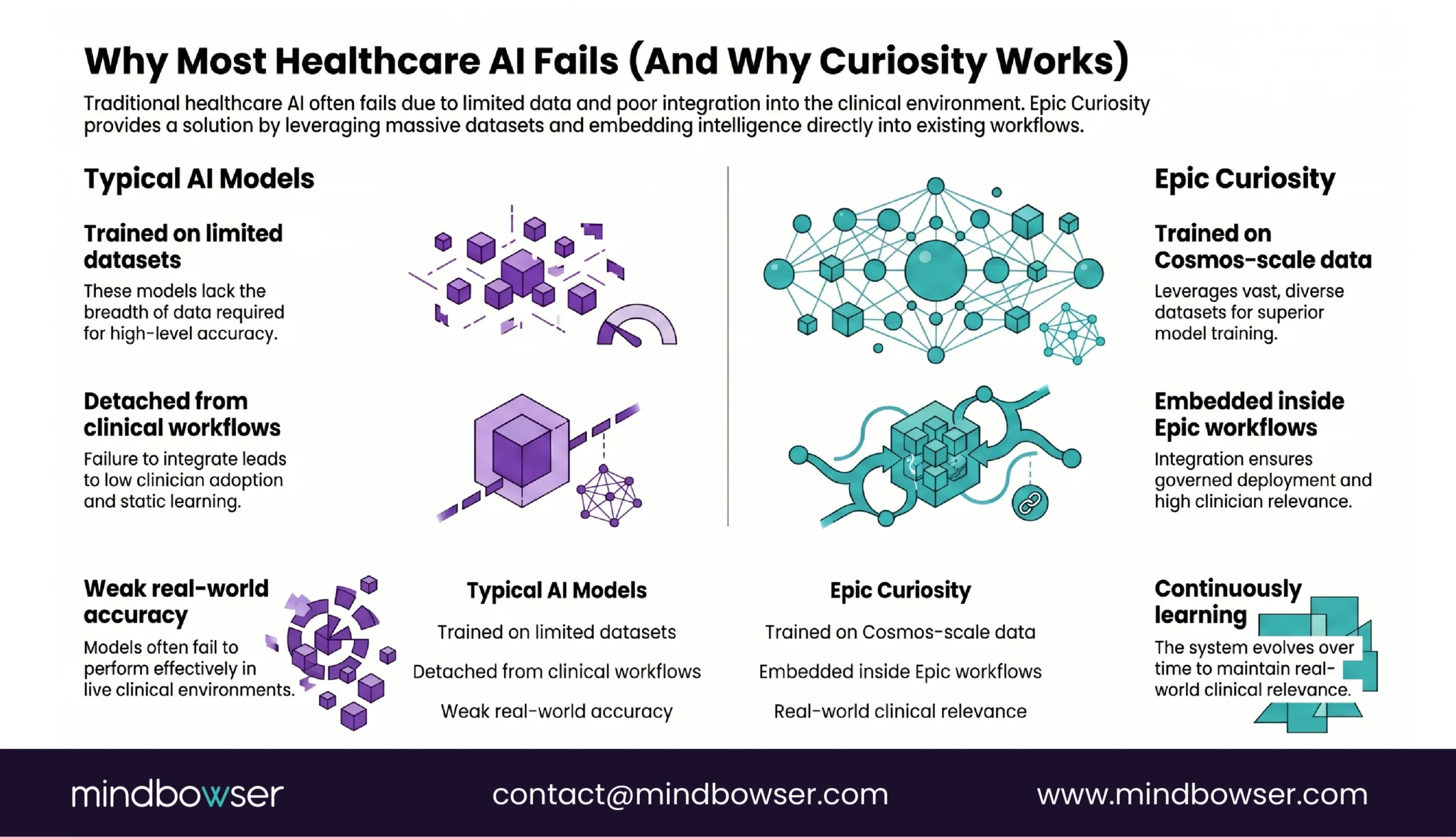
AI in healthcare often fails for one reason: weak data foundations.
Epic Curiosity is Epic’s answer to that problem. It is an AI-driven intelligence layer built directly on top of Epic Cosmos, trained on large-scale, real-world clinical data.
This is not experimental AI sitting outside workflows. It is embedded intelligence designed for clinical and operational use.
What changes when AI learns from hundreds of millions of real patient journeys?
Accuracy. Relevance. Trust.
Unlike isolated AI tools trained on limited datasets, Curiosity benefits from:
- Massive, diverse training data
- Real-world clinical variability
- Continuous learning from new data
This creates models that reflect how care actually happens, not how it’s supposed to happen in controlled environments.
Epic Curiosity turns Cosmos data into usable, trustworthy AI.
B. How Epic Curiosity Works
It learns the way clinicians think over time.
Epic Curiosity analyses longitudinal patient journeys captured within Cosmos. It identifies patterns across diagnoses, treatments, outcomes, and timelines to generate predictive insights.
This is where AI moves from theory to action.
Can you predict which patient is at risk before deterioration begins?
Curiosity is built to answer that.
Core capabilities include:
- Learning from historical patient pathways
- Identifying risk signals across populations
- Predicting outcomes based on real-world patterns
C. Where Curiosity Delivers ROI
AI only matters if it changes outcomes and finances.
Epic Curiosity delivers value across both clinical and operational domains by enabling earlier, smarter decisions.
Where does predictive intelligence actually move the needle?
Three high-impact areas:
- Risk stratification → Identify high-risk patients earlier
- Early intervention → Prevent complications and readmissions
- Care optimization → Align treatments with predicted outcomes
A real-world scenario:
A care team uses Curiosity to flag patients at high risk of readmission. Interventions are triggered earlier, reducing avoidable readmissions and improving reimbursement under value-based models.
This is where AI ties directly to ROI.
D. Why Curiosity is Different from Standalone AI Models
Most AI tools sit outside the system. Curiosity lives inside it.
Standalone AI platforms often struggle with adoption, data integration, and governance. They require separate workflows, additional interfaces, and constant data syncing.
Epic Curiosity avoids these barriers.
It is:
- Native to the Epic ecosystem
- Continuously learning from live data
- Governed within existing compliance frameworks
If clinicians don’t trust or use AI, does it create value?
No.
By embedding AI into familiar workflows, Curiosity drives:
- Higher clinician adoption
- Faster decision-making
- More consistent outcomes
The contrast is clear:
- External AI → integration challenges → low adoption
- Curiosity → embedded intelligence → real usage
Epic Curiosity succeeds because it is not an add-on; it is a natural extension of the clinical environment powered by Cosmos.
IX. Real-World Use Cases of Epic Cosmos
A. Clinical Use Cases
Data becomes powerful when it changes patient outcomes.
Epic Cosmos enables clinicians to move beyond intuition and into evidence-backed decision-making at scale.
What if you could compare treatment effectiveness across millions of similar patients before choosing a care path?
That’s now possible.
Key clinical applications include:
- Rare disease identification by analyzing patterns across vast populations
- Treatment effectiveness comparison using real-world outcomes
- Population health segmentation to identify high-risk cohorts
A practical scenario:
A specialist evaluates two treatment options for a rare condition. Cosmos reveals outcome trends across thousands of comparable cases, guiding a more confident clinical decision.
According to the WHO, data-driven care models can improve patient outcomes by up to 30% when applied consistently. Cosmos brings that consistency into everyday workflows.
B. Operational Use Cases
Clinical excellence fails without operational alignment.
Epic Cosmos equips health systems with real-time operational intelligence, enabling leaders to make faster, data-informed decisions.
Where are inefficiencies hiding in your system today?
Cosmos helps answer that with clarity.
Core operational use cases include:
- Length of stay (LOS) benchmarking across peer institutions
- Capacity planning based on real-time demand trends
- Value-based care optimization through outcome tracking and cost alignment
A real-world example:
A hospital identifies extended LOS for specific procedures. Using Cosmos benchmarking, they pinpoint drivers of variation and implement targeted interventions, reducing LOS within a quarter.
This directly impacts margins and patient throughput.
C. Research Use Cases
Research is no longer a separate function; it’s embedded.
Epic Cosmos enables health systems to participate in continuous, large-scale research without building separate infrastructure.
What if every patient interaction contributed to the next clinical breakthrough?
That’s the model.
Key research applications include:
- Clinical trial matching using real-world patient cohorts
- Drug safety monitoring across large populations
- Public health analytics for trend identification and response
According to the FDA, real-world data is increasingly used for post-market surveillance and safety monitoring. Cosmos accelerates this by providing immediate access to relevant datasets.
A quick scenario:
A research team monitors adverse drug reactions across millions of records, identifying safety signals earlier than traditional reporting systems.
Epic Cosmos turns clinical, operational, and research use cases into a unified, data-driven ecosystem where insight leads directly to action.
X. Limitations & Challenges of Epic Cosmos
A. Data Standardization Challenges
Even the best systems inherit real-world complexity.
While Epic Cosmos uses standardized vocabularies such as SNOMED and LOINC, data variability still exists at the source. Clinical documentation is not uniform across providers, departments, or organizations.
What happens when two clinicians describe the same condition differently?
Variation creeps in.
Key challenges include:
- Inconsistent documentation practices across institutions
- Free-text clinical notes that are harder to structure and analyze
- Differences in workflow-driven data entry
This creates edge cases where normalization is not perfect. While Cosmos significantly reduces data cleaning effort, it does not eliminate it.
A practical example:
A condition documented in structured fields in one hospital may appear in free-text notes in another, requiring additional processing for accurate comparison.
Standardization is strong but not absolute.
B. Access & Usability Constraints
Powerful data is only useful if people can access and use it effectively.
Epic Cosmos operates under a controlled-access model, which is essential for compliance but introduces limitations.
Who gets accessand how quickly?
Not everyone, and not instantly.
Constraints include:
- Restricted access to approved users
- Approval workflows for data usage
- Learning curve for new users navigating the platform
For many organizations, this means:
- Delays in getting started with analysis
- Dependence on trained personnel
- Need for internal enablement and training
A scenario:
A clinical leader wants to explore a new hypothesis but must go through access approvals and rely on analysts, slowing initial momentum.
This is a tradeoff between security and agility.
C. Ecosystem Dependency
Cosmos is powerful, but it’s not universal.
Epic Cosmos is primarily built for and within the Epic ecosystem. While this enables deep integration and performance, it also creates dependency.
What if your organization operates across multiple EHR systems?
That’s where complexity increases.
Key limitations:
- Stronger value within Epic-based networks
- Limited native interoperability outside Epic
- Integration effort required for non-Epic systems
For multi-EHR health systems, this can lead to:
- Data silos outside the Cosmos environment
- Additional integration layers
- Incomplete visibility across the enterprise
A quick contrast:
- Epic-only system → seamless Cosmos value
- Multi-EHR system → partial visibility without integration
Epic Cosmos delivers maximum value within its ecosystem, but requires additional strategy to extend that value beyond it.
XI. How Mindbowser Builds Custom EHR with Epic Integration Capabilities
A. The Gap: Why Cosmos Alone Isn’t Enough
Insight without action is just observation.
Epic Cosmos delivers powerful intelligencebut it does not automatically transform workflows. That gap is where many health systems stall.
You have the insight. Now what?
Clinicians still need:
- Decisions embedded into workflows
- Alerts aligned with care pathways
- Actions triggered at the right moment
Without this layer, Cosmos risks becoming another analytics asset that informs but doesn’t execute.
A common scenario:
A health system identifies high readmission risk cohorts using Cosmos. But without workflow integration, care teams struggle to act consistently, limiting impact.
This is the missing link: operationalizing intelligence.
Cosmos tells you what to do. Systems must still enable doing it.
B. Mindbowser’s Approach
This is where custom engineering creates real value.
Mindbowser bridges the gap between insight and execution by building custom EHR-integrated solutions that extend Epic Cosmos capabilities.
The focus is simple: turn data into action inside clinical workflows.
Core capabilities include:
- FHIR and HL7 integrations with Epic to unify data across systems
- Custom workflow orchestration aligned with clinical operations
- Real-time dashboards that surface actionable insights
What if every Cosmos insight triggered a defined clinical workflow automatically?
That’s the shift.
Instead of static analysis, organizations get:
- Insight → Workflow trigger → Clinical action → Outcome tracking
- This closes the loop that Cosmos starts.
C. Accelerators That Extend Cosmos Value
Speed matters. Pre-built accelerators reduce time to impact.
Mindbowser offers targeted accelerators that plug into Epic environments and amplify Cosmos-driven intelligence:
- AI Medical Summary → Faster clinical documentation and review
- CarePlan AI → Personalized, data-driven care pathways
- AI Readmission Risk → Early identification of high-risk patients
- HealthConnect CoPilot → Intelligent workflow assistance for care teams
These are not generic tools. They are designed to work within existing clinical ecosystems, reducing adoption friction.
How long does it take to go from insight to measurable improvement?
With accelerators, it is significantly faster.
D. Example Use Case (Insert Case Study)
Here’s how it comes together in practice.
A mid-sized health system identifies rising readmission rates using Epic Cosmos.
Step 1: Cosmos highlights high-risk patient cohorts
Step 2: Mindbowser integrates AI Readmission Risk into Epic workflows
Step 3: Care teams receive real-time alerts during discharge planning
Step 4: CarePlan AI recommends personalized interventions
Step 5: Outcomes are tracked and refined continuously
The result:
- Reduced readmission rates
- Improved care coordination
- Stronger performance under value-based models
This is the difference between knowing and acting.
Mindbowser turns Epic Cosmos insights into workflow-driven outcomes that directly improve care delivery and financial performance.
XII. Epic Cosmos vs Traditional Data Platforms (Quick Comparison)
A. Why Epic Cosmos Wins
Not all data platforms are built for action.
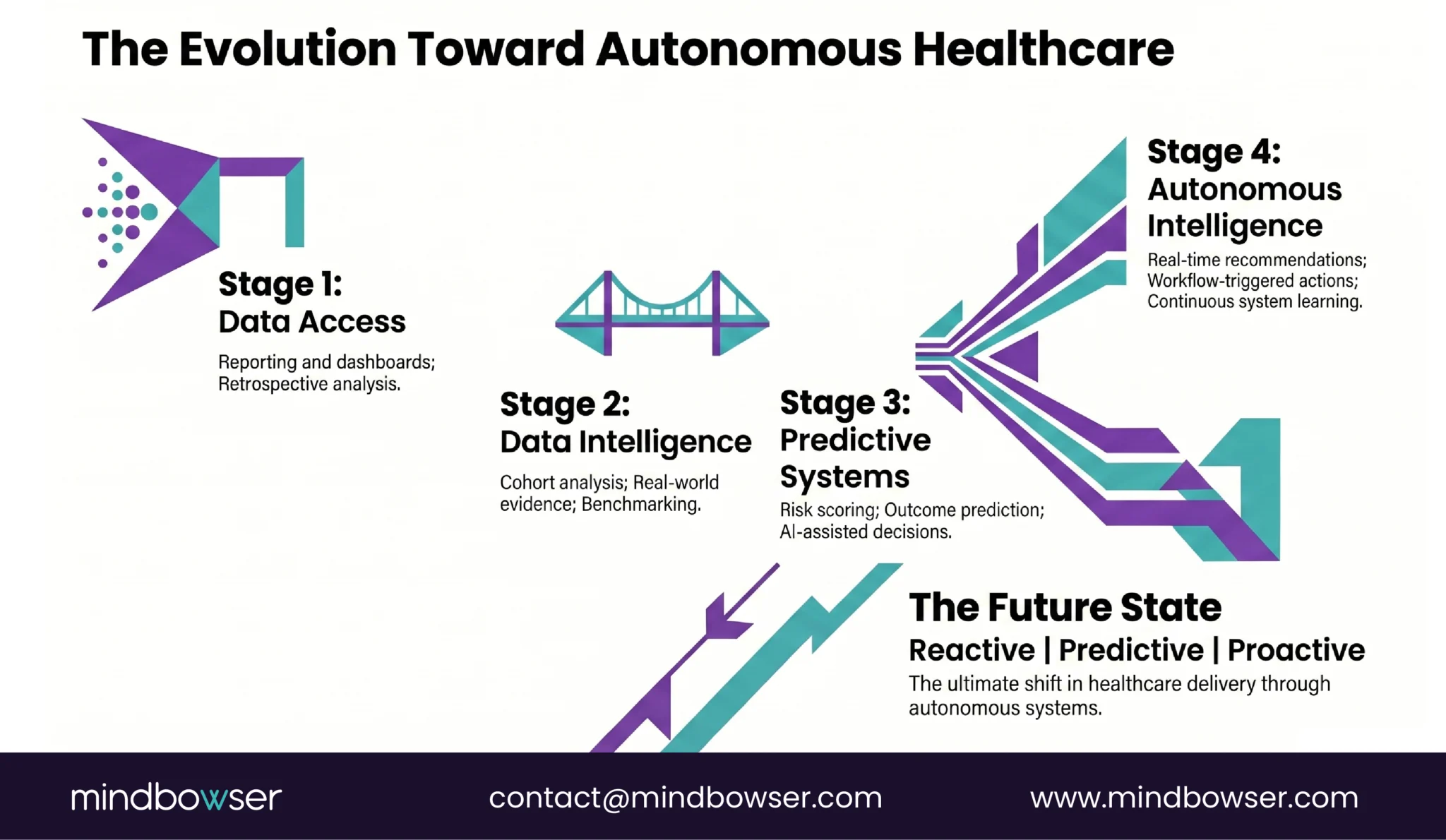
Traditional healthcare data platforms were designed for storage, reporting, and retrospective analysis. Epic Cosmos, on the other hand, is built for real-time intelligence embedded into care delivery.
What separates a reporting tool from a decision engine?
Three factors define that gap:
- Scale → Cosmos operates on hundreds of millions of patient records, enabling deeper and more reliable insights
- Standardization → Built-in harmonization reduces data inconsistencies across systems
- Embedded intelligence → Insights appear inside clinical workflows, not external dashboards
Here’s the practical difference:
- Traditional platform → Data → Dashboard → Delayed action
- Cosmos → Data → Insight → Immediate clinical action
Cosmos wins because it shortens the distance between insight and action.
B. Where Custom Solutions Still Matter?
Even a powerful platform has boundaries.
Epic Cosmos delivers strong native capabilities, but it is not a complete solution for every enterprise need.
What happens when your workflows, systems, or strategy extend beyond Epic?
That’s where custom solutions come in.
Key areas where customization remains critical:
- Workflow customization → Tailoring insights to specific clinical and operational processes
- Interoperability beyond Epic → Integrating data from non-Epic systems
- Advanced AI layering → Building specialized models for unique use cases
A quick contrast:
- Epic Cosmos → standardized intelligence
- Custom layer → contextual execution
For CIOs, the strategy becomes clear:
- Use Epic Cosmos for data scale and baseline intelligence
- Use custom solutions for differentiation and workflow alignment
Is your organization using data or competing with it?
That question defines the next phase of digital health maturity.
Epic Cosmos provides the foundation, but custom engineering drives competitive advantage.
Why Epic Cosmos is a Strategic Asset?
Epic Cosmos is not just a dataset; it’s the foundation for modern healthcare intelligence. It combines scale, standardization, and real-time insight to power research, AI, and faster clinical decisions. But the real advantage is not access, it’s execution. Health systems that embed Cosmos insights into everyday workflows will outperform those that only analyze them. In the end, data doesn’t improve outcomes; decisions do, and Cosmos is built to make those decisions faster, smarter, and more consistent.
Epic Cosmos is a large-scale, de-identified healthcare dataset built from patient records across thousands of hospitals using Epic. It enables real-time research, benchmarking, and clinical insights. Its key value lies in turning raw EHR data into actionable intelligence.
Unlike traditional data warehouses that focus on storage and retrospective analysis, Epic Cosmos acts as an active intelligence layer. It continuously updates from live clinical workflows and delivers insights directly within the EHR. This allows faster, more actionable decision-making.
Yes, Epic Cosmos uses HIPAA-aligned de-identification protocols to protect patient privacy. Data is anonymized before inclusion, and strict governance controls regulate access and use. This ensures both compliance and trust across participating health systems.
Epic Curiosity is an AI layer built on top of Cosmos data that generates predictive insights. It learns from large-scale, real-world patient data to support risk prediction and care optimization. Because it is embedded in Epic, it integrates directly into clinical workflows.
Epic Cosmos primarily delivers value within Epic-based environments. However, non-Epic systems can still benefit through integrations and custom interoperability layers. Many organizations use external solutions to extend Cosmos insights beyond Epic.