BLOGS
BLOGS  NEWSROOM
  CASE STUDIES
  WEBINARS
  PODCASTS
  ASSET HUB
  EVENT CALENDAR






















TL;DR
Enterprise automation is shifting from isolated tools to AI agents that orchestrate workflows across systems, decisions, and outcomes. The best AI agents for enterprise task automation don’t just execute tasks; they integrate deeply, operate under governance, and scale across departments to drive measurable ROI. For leaders, success depends on choosing the right platforms, designing for integration and control, and following a structured roadmap from pilot to enterprise-wide execution.
What happens when automation exists across your enterprise, but work still moves slowly?
Most organizations have invested in tools, bots, and workflows, yet execution remains fragmented across systems and teams. The real challenge isn’t automation, it’s orchestrating tasks, decisions, and data across disconnected environments.
This is where AI agents are redefining enterprise task automation by moving from rule-based scripts to intelligent, multi-step execution. For CIOs and operational leaders, the shift is clear: automation alone doesn’t scale coordinated, AI-driven execution; coordinated, AI-driven execution does.
I. What Enterprise Task Automation Means Today
What happens when automation exists but operations still slow down?
That’s the paradox many enterprise leaders face today. Systems are digitized. Workflows are “automated.” Yet execution still depends on humans stitching tasks across tools, teams, and timelines.
Enterprise task automation today is no longer about isolated scripts or bots. It’s about orchestrating work across systems, decisions, and outcomes.
Automation doesn’t reduce complexity. Poor automation multiplies it.
Let’s break down where things stand and why AI agents are shifting the model.
A. Why Enterprises Still Rely on Manual Workflows
If automation tools exist, why are teams still buried in manual work?
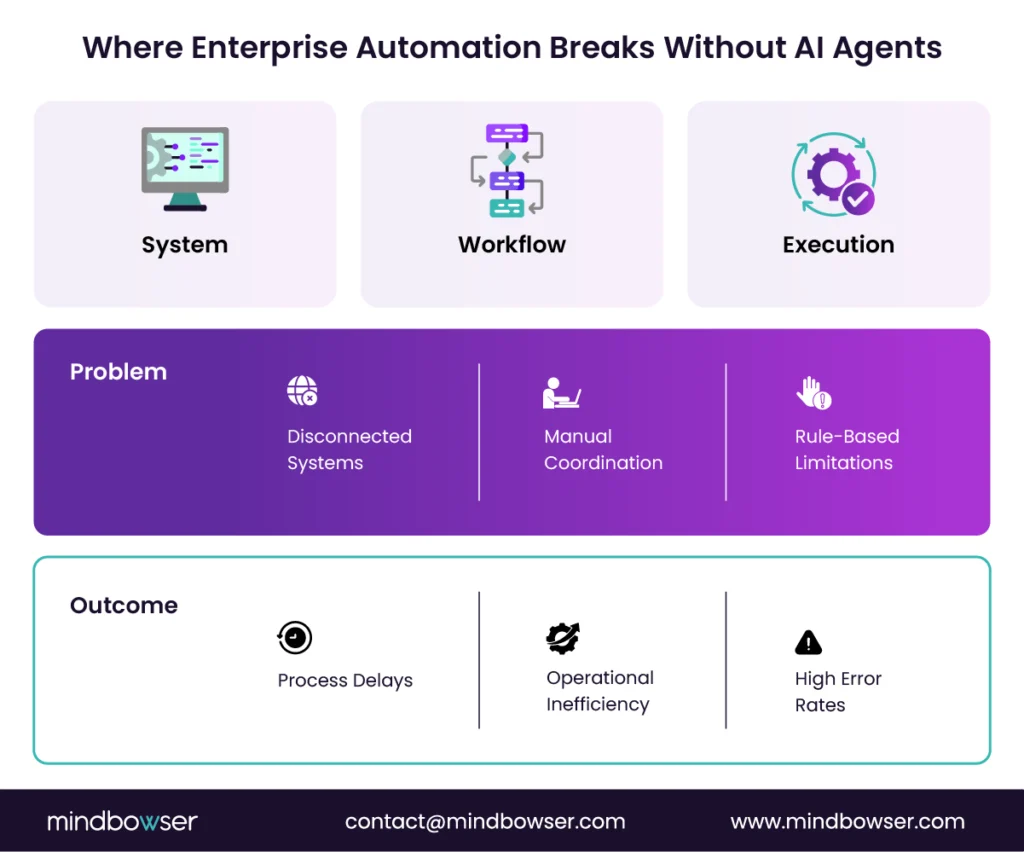
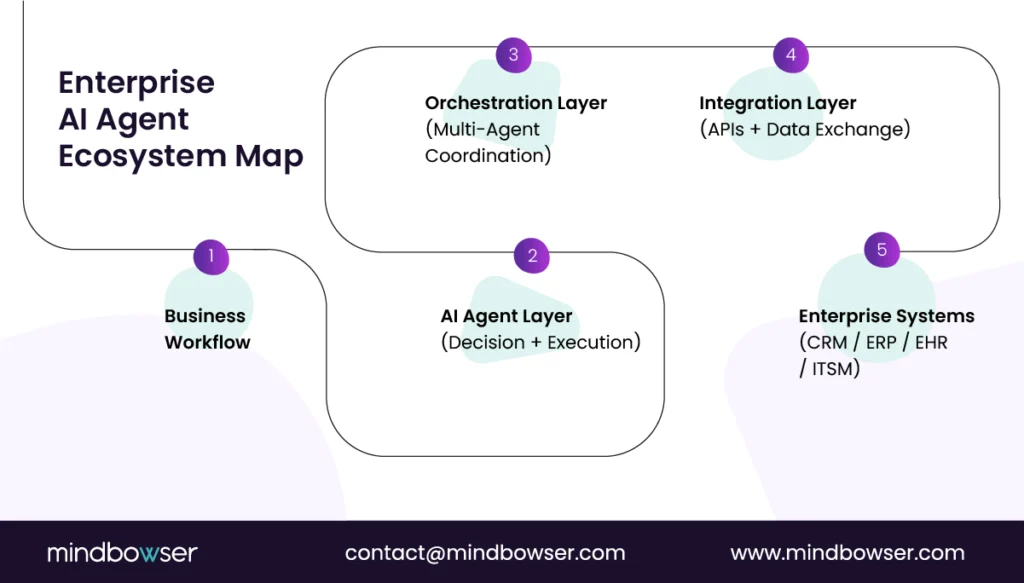
Because enterprise workflows don’t live in one system, they span CRM, ERP, EHR, ticketing, finance tools, and communication platforms, often without shared context.
1. Operational tasks spread across multiple systems
A single workflow, onboarding a new customer or patient, can touch five to ten systems. Data entry, validation, approvals, notifications. Each step depends on the last.
Humans become the glue.
They copy data. They trigger actions. They resolve mismatches.
Slow. Expensive. Error-prone.
2. Process bottlenecks caused by disconnected tools
What happens when one system updates, but the others don’t?
Work stalls. Teams wait. SLAs slip.
3. High operational cost of repetitive work
Repetitive tasks don’t just waste time; they consume budget.
That’s one full day per week. Lost to navigation, not execution.
Enterprises aren’t lacking automation tools. They’re lacking intelligent coordination across them.
Related read: Enterprise AI Agents: Architecture, Use Cases, ROI
B. How AI Agents are Changing Enterprise Automation
What if workflows didn’t need constant human intervention to move forward?
This is where AI agents step in, not as tools, but as operators of workflows.
1. Rule-based vs AI-driven automation
Traditional automation follows predefined rules. If X happens, do Y.
But enterprise workflows aren’t always predictable. Exceptions, edge cases, context shifts, they break rigid systems.
AI agents introduce decision-making into automation.
They interpret inputs. They adapt flows. They resolve ambiguity.
That’s the shift. From scripts to reasoning.
2. Multi-step execution across systems
AI agents don’t just complete tasks. They coordinate sequences of actions across systems.
Example:
A denied insurance claim → AI agent reviews policy → checks patient data → updates records → resubmits claim → notifies billing team.
No swivel chair. No manual intervention.
This works. Period.
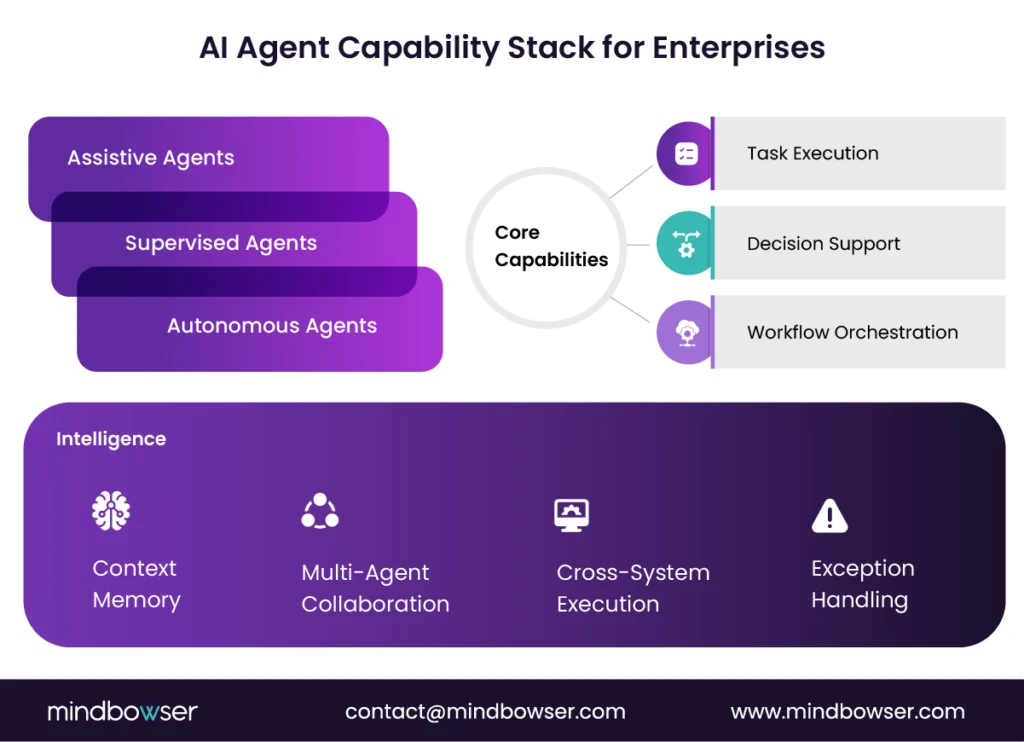
3. Autonomy spectrum: assistive, supervised, autonomous
Not all AI agents operate the same way.
- Assistive agents support humans with recommendations.
- Supervised agents executing tasks with human checkpoints
- Autonomous agents run workflows end-to-end within defined boundaries
The real question isn’t “Should we automate?”
It’s “How much control are we ready to delegate?”
AI agents don’t replace automation; they make it adaptive, connected, and outcome-driven.
C. Enterprise Workflows Where AI Agents Deliver the Most Value
Where does this actually move the needle?
Not everywhere. But in the right workflows, the impact is immediate and measurable.
1. Customer support operations
AI agents triage tickets, resolve common issues, escalate intelligently, and update systems in real time.
Faster resolution. Lower cost per ticket. Better experience.
2. Revenue cycle and finance
From invoice processing to claims management, finance workflows are rule-heavy but exception-prone.
AI agents handle validation, reconciliation, and follow-ups, reducing cycle times and leakage.
Think fewer denials. Faster collections.
3. IT service management
Incident detection, ticket routing, root cause analysis, and resolution workflows.
AI agents don’t just log tickets; they resolve them across systems.
What if your IT backlog cleared itself overnight?
4. Healthcare workflows (care coordination, patient access, scheduling)
This is where complexity peaks.
Multiple stakeholders. Regulatory constraints. Time-sensitive decisions.
AI agents coordinate appointments, verify insurance, manage referrals, and ensure continuity of care.
And they do it while maintaining compliance boundaries.
The best AI agents for enterprise task automation deliver value in high-volume, cross-system, decision-heavy workflows.
II. How Enterprises Should Evaluate AI Agents for Automation
Choosing an AI agent isn’t a tooling decision. It’s an operating model decision.
The market is crowded. Every platform claims intelligence. Every demo looks smooth.
But in enterprise environments, the question is sharper:
Will this agent execute reliably across systems, under governance, at scale?
Most automation initiatives fail not because of technology, but because of poor evaluation upfront.
So what should CIOs and CTOs actually evaluate?
A. Architecture and Execution Capabilities
Can the AI agent actually run your workflows or just assist them?
This is the first filter. And the most misunderstood.
1. Multi-agent orchestration
Enterprise workflows aren’t linear. They involve multiple roles, systems, and decision points.
Strong AI agents support orchestration, not just execution.
That means multiple agents can collaborate:
- One agent gathers data
- Another validates it
- A third triggers downstream actions
All within a controlled workflow.
Think less “bot” and more “digital workforce.”
2. API-based execution
If an AI agent cannot act across systems, it cannot deliver enterprise value.
APIs are the backbone of execution.
Agents must:
- Read and write data across systems
- Trigger workflows in CRM, ERP, EHR
- Handle exceptions without breaking flow
No API depth? Expect manual fallback.
3. Context and memory
What happens when a workflow spans hours or days?
Basic automation forgets. AI agents remember.
They maintain context across interactions, allowing:
- Smarter decision-making
- Fewer repeated steps
- Continuity across systems and teams
Context is the difference between automation and intelligence.
Evaluate whether the agent can orchestrate, execute, and adapt, not just respond.
B. Governance, Security, and Compliance Requirements
How do you scale automation without increasing risk?
This is where many pilots fail during enterprise rollout.
AI agents act. And action introduces risk.
1. Access controls
Agents must operate within strict identity and access boundaries.
- Role-based permissions
- System-level restrictions
- Data access governance
Especially critical in regulated industries like healthcare and finance.
2. Auditability
Every action taken by an AI agent must be traceable.
- What decision was made?
- Why was it made?
- What data was used?
Audit trails aren’t optional; they’re operational safeguards.
3. Risk management
What happens when an agent makes the wrong decision?
Enterprises need:
- Human-in-the-loop controls
- Escalation mechanisms
- Policy-based guardrails
Without governance, automation doesn’t scale; it creates exposure.
Related read: AI Agents for Healthcare Compliance: Audit-Ready Automation
C. Integration with Enterprise Technology Ecosystems
Will this agent fit into your ecosystem, or will it force you to rebuild around it?
This is where strategy meets reality.
1. CRM, ERP, productivity platforms
AI agents must integrate deeply with:
- Salesforce, Dynamics, SAP
- Microsoft 365, Google Workspace
- Finance and operations systems
Shallow integrations create shallow value.
2. EHR in healthcare
For healthcare enterprises, integration complexity increases.
EHR systems like Epic or Cerner require:
- Secure data exchange
- Workflow alignment
- Compliance adherence (HIPAA, SOC 2)
This is not plug-and-play. It’s precision engineering.
3. Cross-department scalability
Can one successful use case scale across the enterprise?
That’s the real test.
AI agents should support:
- Reusable workflows
- Cross-functional automation
- Standardized orchestration patterns
Otherwise, you’re building isolated wins rather than enterprise capability.
The best AI agents for enterprise task automation integrate deeply, securely, and repeatably across your ecosystem.
D. Total Cost of Ownership
What does this actually cost beyond the license?
Many automation programs fail here. Not because of upfront cost but because of hidden complexity.
1. Licensing
Pricing models vary:
- Per user
- Per workflow
- Per execution
Costs scale quickly as adoption grows.
2. Integration complexity
The real cost often sits in:
- System integration
- Workflow design
- Data mapping
If integration takes months, ROI gets delayed.
3. Maintenance and governance
AI agents require ongoing oversight:
- Model updates
- Workflow tuning
- Compliance monitoring
Automation is not a one-time investment. It’s an operational capability.
Evaluate total cost through the lens of time-to-value, scalability, and governance overhead, not just licensing fees.
Looking to Automate Complex Healthcare Workflows with Secure, Compliant AI Agents?
III. Best AI Agents for Enterprise Task Automation
Which platforms actually deliver enterprise-grade automation, not just demos?
This is where strategy becomes selection.
The best AI agents for enterprise task automation aren’t defined by brand recognition alone. They are defined by how well they execute across systems, operate under governance, and scale across departments.
Tools don’t create enterprise value. Execution layers do.
Below is a practical breakdown of leading platforms and their respective roles.
A. Microsoft Copilot Studio
What if your existing Microsoft ecosystem became your automation engine?
Microsoft Copilot Studio positions itself as an AI orchestration layer embedded within enterprise productivity tools.
1. Internal workflow automation
Copilot agents operate across:
- Microsoft 365 (Teams, Outlook, SharePoint)
- Dynamics 365 (CRM, ERP)
- Power Platform
This allows enterprises to automate internal workflows like:
- Employee onboarding
- Document processing
- Internal service requests
The advantage? Minimal disruption to existing workflows.
2. Enterprise use cases
Copilot shines in:
- Knowledge worker productivity
- Internal operations automation
- Cross-team collaboration workflows
But here’s the trade-off:
It works best inside the Microsoft ecosystem. Outside integrations require additional engineering.
Ideal for enterprises already standardized on Microsoft, looking to extend automation quickly.
B. Salesforce Agentforce
Can AI agents drive revenue workflows, not just support them?
Salesforce Agentforce is built for CRM-centric automation, where customer data drives decisions.
1. CRM automation
Agentforce integrates directly with Salesforce data models, enabling:
- Lead qualification
- Opportunity management
- Customer insights generation
The strength lies in data proximity.
2. Service and sales workflows
AI agents handle:
- Case routing and resolution
- Sales follow-ups
- Customer engagement workflows
The catch?
Deep value depends on the maturity of your CRM data.
Best suited for enterprises where customer lifecycle automation is the primary driver of ROI.
C. ServiceNow AI agents
What if your operations backbone could resolve issues before they escalate?
ServiceNow’s AI agents are built for enterprise operations, especially IT and service management.
1. IT operations automation
Agents can:
- Detect anomalies
- Trigger workflows
- Automate remediation
This significantly reduces mean time to resolution (MTTR).
2. Incident management
From ticket creation to resolution, AI agents:
- Classify incidents
- Route intelligently
- Execute predefined fixes
A strong fit for organizations prioritizing operational resilience and IT efficiency.
D. UiPath Agentic Automation
Is your RPA strategy ready for intelligence?
UiPath is evolving from traditional RPA to agentic automation, combining bots with AI-driven decision-making.
1. RPA modernization
UiPath extends existing automation by:
- Adding AI decision layers
- Handling unstructured data
- Managing exceptions dynamically
This bridges the gap between rule-based automation and intelligent workflows.
2. Complex workflows
Best suited for:
- Finance operations
- Supply chain processes
- High-volume transactional workflows
Think beyond scripts toward adaptive execution.
Ideal for enterprises with existing RPA investments looking to upgrade to AI-driven orchestration.
E. IBM Watsonx Orchestrate
What about workflows that depend on knowledge, not just transactions?
IBM Watsonx Orchestrate focuses on knowledge-intensive processes.
1. Knowledge workflows
Agents assist with:
- Research synthesis
- Document analysis
- Decision support
This is critical in domains like legal, procurement, and HR.
2. HR and procurement
Use cases include:
- Employee query resolution
- Vendor management
- Contract analysis
Best for enterprises where decision-making workflows drive operational cost.
F. Emerging AI Agent Automation Platforms
What if you need flexibility beyond large vendor ecosystems?
A new wave of platforms is emerging focused on integration-first, system-agnostic automation.
1. Integration-first platforms
These platforms prioritize:
- API-first architecture
- Rapid workflow design
- Cross-platform orchestration
They’re built for enterprises with heterogeneous tech stacks.
2. Cross-system automation
Unlike ecosystem-bound tools, these agents:
- Operate across multiple vendors
- Enable custom workflows
- Support domain-specific logic
This is where custom builds often outperform off-the-shelf tools.
Emerging platforms and custom-built agents offer the flexibility needed for complex, cross-enterprise workflows.
IV. Implementation Roadmap for Enterprise AI Agents
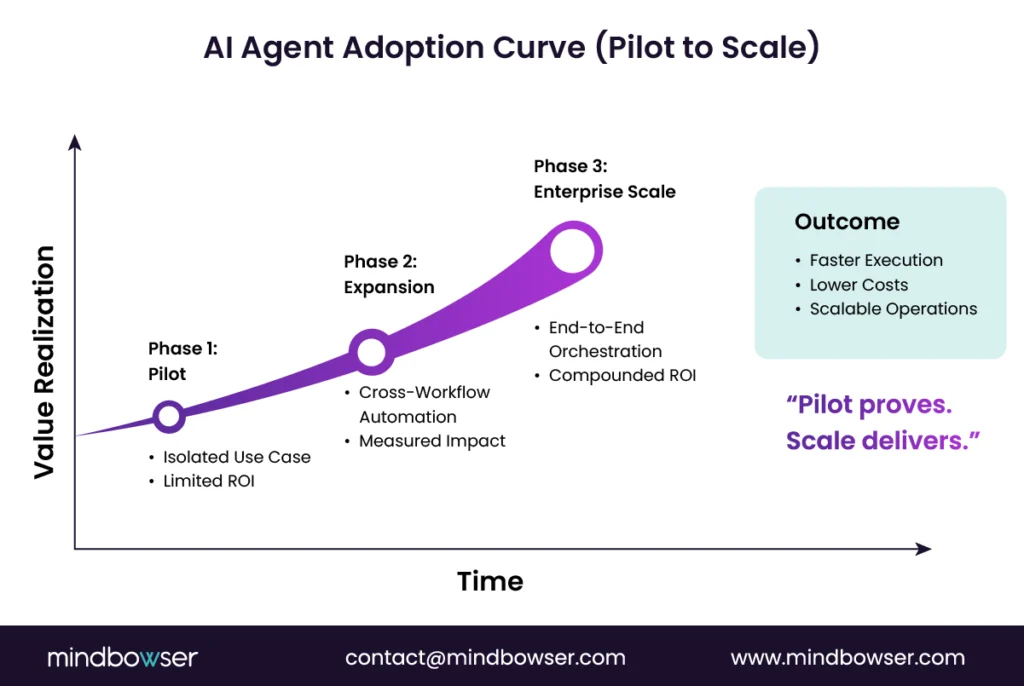
Why do most automation initiatives stall after a successful pilot?
Because execution breaks where strategy ends.
Enterprises often demonstrate value in one workflow but fail to scale across departments, not due to a lack of tools but to a lack of structured rollout discipline.
Pilots prove the possibility. Roadmaps create enterprise impact.
According to McKinsey, only 30% of digital transformation initiatives achieve their intended outcomes, largely due to poor scaling strategies and unclear governance.
Here’s how to avoid that trap.
A. Identify the Right Automation Opportunities
Not every workflow should be automated. Some shouldn’t be touched at all.
The key is selecting workflows where AI agents can deliver immediate, measurable impact.
1. High-volume tasks
Start where repetition is high.
- Large ticket volumes
- Frequent transactions
- Repetitive approvals
These are low-risk, high-return opportunities.
More volume = faster ROI.
2. Clear workflows
If the process is unclear, automation will amplify the confusion.
Look for workflows that have:
- Defined steps
- Known inputs and outputs
- Established business rules
Clarity first. Automation second.
3. Efficiency gains
Ask a simple question:
Will this measurably reduce time, cost, or errors?
If the answer isn’t clear, it’s not the right starting point.
Start with workflows that are predictable, repeatable, and measurable.
B. Establish Governance Before Scaling
What happens when AI agents act without boundaries?
Risk scales faster than value.
Governance must be designed before expansion, not after failure.
1. Define boundaries
Every AI agent needs:
- Scope of action
- Decision limits
- Escalation triggers
This defines where automation ends, and human control begins.
2. Monitoring processes
You can’t scale what you can’t see.
Enterprises need:
- Real-time monitoring
- Performance tracking
- Exception visibility
“Visibility drives trust. Trust enables scale.”
3. Accountability
Who owns the outcome when an AI agent executes a workflow?
Define:
- Business owners
- Technical owners
- Compliance oversight
This is where many initiatives fail; unclear ownership leads to stalled adoption.
Governance is not a blocker. It’s the enabler of safe scale.
C. Scale Automation Across Departments
How do you move from isolated success to enterprise capability?
By treating automation as a repeatable operating model, not a one-off project.
1. Pilot workflows
Start small but scale design.
- Choose one department
- Solve one workflow
- Measure outcomes
Then document everything.
2. Measure improvements
Track:
- Time saved
- Cost reduction
- Error rates
- Throughput improvements
If you can’t measure it, you can’t justify expansion.
3. Expand across the enterprise
Once validated, extend:
- Across similar workflows
- Across departments
- Across business units
Reuse patterns. Standardize orchestration. Build momentum.
This works. Period.
Scaling AI agents requires structured replication, not reinvention.
V. How Mindbowser Can Help
What if your automation strategy didn’t stop at tools but translated into measurable enterprise outcomes?
This is where most organizations struggle. They select platforms. They run pilots. But connecting AI agents to real operational impact requires more than implementation; it requires architecture, integration, and governance working together.
That’s the gap Mindbowser is built to close.
We don’t deploy tools. We design enterprise automation systems that execute reliably under real-world conditions.
A. Enterprise Automation Strategy
Before building anything, do you know where automation will actually deliver ROI?
Mindbowser starts with clarity, not code.
1. Use-case discovery
We identify workflows that:
- Are high-volume and cross-system
- Have measurable inefficiencies
- Can benefit from AI-driven orchestration
This avoids the common trap of automating low-impact processes.
2. AI architecture design
Every enterprise is different. So is every automation layer.
We design:
- Multi-agent orchestration frameworks
- Context-aware execution models
- System interaction layers aligned to your stack
No generic templates. Only fit-for-purpose architecture.
3. ROI Modeling
What will this deliver in 6, 12, and 18 months?
We map:
- Cost savings
- Productivity gains
- Throughput improvements
So leadership can make decisions with confidence, not assumptions.
Strategy defines whether AI agents become experiments or enterprise capabilities.
B. Integration with Enterprise Technology Ecosystems
Can your AI agents actually operate across your systems or just sit on top of them?
Execution depends on integration depth.
1. CRM, ERP, EHR integrations
Mindbowser integrates AI agents across:
- Salesforce, Dynamics, SAP
- Finance and operations systems
- Healthcare EHRs like Epic and Cerner
All are designed with secure data exchange and workflow continuity.
2. Scalable architectures
We build for scale from day one:
- API-first design
- Modular workflow components
- Reusable orchestration layers
So new use cases don’t require rebuilding from scratch.
3. Governance readiness
Security and compliance are not add-ons.
They are built into:
- Access controls
- Audit trails
- Policy-driven execution
Aligned with HIPAA and SOC 2 expectations by design.
Integration is where automation succeeds or fails. We make sure it succeeds.
C. Implementation Accelerators
How do you reduce time-to-value without increasing risk?
Speed matters. But controlled speed matters more.
1. Automation frameworks
Pre-built frameworks for:
- Workflow orchestration
- AI agent lifecycle management
- Exception handling
This reduces development time significantly.
2. Integration accelerators
Reusable connectors and patterns for:
- Enterprise systems
- Data pipelines
- Workflow triggers
Faster execution. Lower integration overhead.
3. Scalability strategies
We don’t stop at deployment.
We help you:
- Expand across departments
- Standardize automation patterns
- Build internal capability
“Automation that scales is designed, not discovered.”
With the right accelerators, enterprises can move from pilot to production up to 40% faster without compromising control.
The Operational Shift: Why AI Agents are Now a Leadership Priority
What happens when execution becomes your competitive advantage or your bottleneck?
AI agents are no longer experimental tools; they are becoming the execution layer of modern enterprises, reducing overhead, accelerating workflows, and enabling scale across systems that were never designed to work together. As operations grow more complex and distributed, leaders who embed AI-driven orchestration into their core workflows will move faster, operate leaner, and respond with precision. In contrast, others remain constrained by manual coordination and fragmented automation. The best AI agents for enterprise task automation are not optional upgrades; they are foundational to how enterprises will run, compete, and scale in the future.
The best AI agents for enterprise task automation include platforms like Microsoft Copilot Studio, Salesforce Agentforce, ServiceNow AI agents, UiPath, and IBM WatsonX Orchestrate. Each excels in different areas such as CRM workflows, IT operations, or cross-system automation. The right choice depends on your enterprise architecture, integration needs, and governance requirements.
Traditional automation tools follow predefined rules and often break when workflows change or exceptions occur. AI agents introduce decision-making, allowing them to adapt, interpret context, and execute multi-step workflows across systems. This makes them more suitable for complex, real-world enterprise operations.
AI agents deliver the most value in high-volume, cross-system workflows such as customer support, finance operations, IT service management, and healthcare coordination. These processes involve repetitive tasks, decision points, and multiple systems. Automating them leads to faster execution, lower costs, and improved accuracy.
Enterprises should implement role-based access controls, audit trails, and policy-driven governance before scaling AI agents. Human-in-the-loop mechanisms and clear escalation paths help manage risk in sensitive workflows. Compliance frameworks like HIPAA and SOC 2 should be embedded into the system design from the start.
CIOs should assess execution capabilities, integration depth, governance readiness, and total cost of ownership. It’s critical to ensure that AI agents can operate across existing systems while maintaining security and auditability. Clear ROI metrics and scalability plans should also be defined before deployment.