


From Apple Watch to Epic: How Wearable Data Maps to FHIR Observations
EHR/EMR

From Apple Watch to Epic: How Wearable Data Maps to FHIR Observations

Table of Content

TL;DR

Wearable devices like the Apple Watch, Fitbit, and Oura have revolutionized health data collection by providing continuous patient-generated health data (PGHD). However, to be useful in clinical settings, this data must be standardized and mapped into FHIR Observations. FHIR, or Fast Healthcare Interoperability Resources, is the health data exchange standard that ensures data interoperability between wearables and Electronic Health Records (EHRs) like Epic. This blog explores how wearable data becomes FHIR Observations, the benefits for clinicians, and how Mindbowser’s WearConnect accelerates the integration process, ensuring faster, more compliant EHR synchronization with wearables.

The rapid adoption of wearable devices has transformed the way we track and monitor health metrics. Devices like the Apple Watch, Fitbit, and Oura generate a wealth of patient-generated health data (PGHD), offering healthcare providers a new avenue for continuous monitoring and early intervention. However, raw data from these devices is often disconnected from the systems clinicians rely on, such as Electronic Health Records (EHRs). To truly impact clinical decision-making, this data must be transformed into a standardized format that can be integrated seamlessly into the existing healthcare ecosystem.

This is where FHIR (Fast Healthcare Interoperability Resources) comes in. FHIR provides a common language for healthcare data, allowing wearable data to be mapped into FHIR Observations, which EHRs like Epic can interpret and display in a meaningful way. For healthcare organizations and digital health developers looking to implement remote monitoring programs, the challenge lies in ensuring these wearables integrate smoothly with clinical systems without creating bottlenecks or data silos.

In this blog, we will explore how wearable data becomes FHIR Observations, the benefits for clinicians, and how Mindbowser’s WearConnect accelerates integration, enabling healthtech teams to connect wearables to EHRs efficiently and securely. This step-by-step process ensures that wearable data is transformed into a clinical asset that drives real-time decision-making and improves patient care.

I. The Data Flood: Why Wearables Are Changing Clinical Workflows

A. The Explosion of Patient-Generated Health Data

Wearable devices are producing a staggering amount of patient-generated health data (PGHD). Devices such as the Apple Watch, Fitbit, and Oura have become essential tools for capturing continuous health metrics. These wearables track a range of vitals including heart rate, sleep patterns, blood oxygen levels, and step counts. According to recent reports, wearables have seen rapid adoption, with over 200 million devices expected to be in use globally by 2025.

This wealth of data presents an unprecedented opportunity for clinicians to gain deeper insights into a patient’s health outside the traditional office visit. Wearables provide continuous monitoring that can identify potential issues before they become critical. This real-time data enables early intervention, improves chronic disease management, and allows for more personalized care plans.

B. The Promise: Real-Time Monitoring and Patient Engagement

Wearables offer healthcare providers the ability to monitor patients in real-time, creating a more dynamic healthcare model. Devices that continuously monitor vital signs can offer a clearer picture of a patient’s condition, revealing patterns and trends that are often invisible during periodic clinical visits. This continuous monitoring allows for early detection of abnormalities, such as irregular heart rates or low oxygen levels, which can trigger timely interventions.

For patients, wearables offer a greater sense of ownership over their health. Real-time feedback on vital statistics not only improves patient engagement but also encourages adherence to treatment plans. Studies have shown that wearables can significantly enhance patient adherence to medication regimens and lifestyle changes, which ultimately leads to better health outcomes.

C. The Problem: Fragmented Device APIs and Unstructured Data

While wearables provide valuable data, the key challenge lies in how this data is handled. Most wearable devices operate with proprietary APIs and data formats that are incompatible with EHR systems. Data flows into disparate platforms, making it difficult for clinicians to access and interpret the data within their established workflows.

The lack of standardization in the way wearable data is presented creates significant integration bottlenecks. For example, heart rate data might come from one device in beats per minute (bpm), while another device may present it in pulses per second (pps). The absence of a uniform standard means that valuable health data cannot be easily consolidated into EHRs like Epic or Cerner, where clinicians rely on data being structured in a specific way to make informed decisions.

D. Why Mapping Wearable Data into FHIR Observations Is the Missing Link

The solution to this fragmentation lies in FHIR (Fast Healthcare Interoperability Resources). FHIR provides a standard framework for healthcare data, ensuring interoperability between systems and devices. By mapping wearable data into FHIR Observations, healthcare providers can access and interpret this data in a format that aligns with their existing clinical workflows. FHIR Observations allow heart rate, blood pressure, spO2, and other wearable data to be structured in a way that EHR systems can understand and use.

Without proper mapping to FHIR, wearable data remains isolated and underutilized. But with FHIR’s structured approach, wearable data becomes actionable—clinicians can view it alongside traditional clinical data, analyze it in real-time, and use it to make informed decisions. As the healthcare ecosystem moves toward a more connected, patient-centric model, FHIR offers the interoperability needed to unlock the full potential of wearable devices.

We Improved Predictive Accuracy in Childbirth with Advanced EHR Integration

II. The FHIR Standard: The Common Language for Health Data

A. What FHIR Is and Why It’s Important

FHIR (Fast Healthcare Interoperability Resources) is a standardized framework developed to simplify and improve the exchange of healthcare information across different systems. Unlike earlier health data standards like HL7 v2, FHIR leverages modern web technologies to create a flexible and interoperable platform for healthcare data exchange. It allows data to be transmitted quickly and securely between systems, reducing the complexities typically associated with healthcare IT integration.

For wearable devices, FHIR is crucial because it provides a common language that enables the seamless exchange of data between disparate devices and Electronic Health Records (EHRs). With FHIR, healthcare providers can easily integrate patient-generated data into their existing workflows, ensuring that data from devices like Apple Watch, Fitbit, and Oura can be interpreted and used effectively in clinical environments.

B. The Observation Resource: Standardizing Wearable Data

One of FHIR’s most important components is the Observation resource. This resource standardizes how health data such as heart rate, blood pressure, and oxygen saturation is represented and shared. The Observation resource is specifically designed to handle a wide range of clinical measurements, making it an ideal tool for wearable data integration.

For instance, a heart rate measurement captured by an Apple Watch can be mapped into a FHIR Observation using LOINC (Logical Observation Identifiers Names and Codes), a standardized system for identifying health measurements. The data is categorized by type, unit of measurement, and the context in which it was captured. This ensures that the data can be easily read and understood by both human clinicians and machine algorithms.

By using the FHIR Observation resource, healthcare systems can eliminate data discrepancies, ensuring that wearable data is consistently formatted and structured for clinical use. This standardization also enables seamless data exchange across different systems and devices, which is essential for providing comprehensive and timely care.

C. How FHIR Facilitates Interoperability with EHRs

FHIR’s ability to enable interoperability between different health systems is one of its key advantages. For wearables, this means that data can be extracted, standardized, and transferred to EHRs like Epic, Cerner, and Allscripts without needing complex, custom integrations for each device or system.

In practical terms, when wearable data is mapped to FHIR Observations, it becomes interoperable with a wide range of healthcare technologies. This not only allows healthcare providers to view data from different wearable devices within their EHR but also helps integrate it with other clinical data, such as lab results, medications, and previous patient histories.

With FHIR-enabled wearables, a healthcare provider can see a patient’s real-time vitals from their wearable device, alongside their clinical data from lab tests or previous hospital visits. This consolidated data helps clinicians make more informed, data-driven decisions, improving patient outcomes and enhancing care coordination. In an increasingly digital healthcare ecosystem, FHIR is the common denominator that allows different technologies and devices to work together efficiently.

Image of FHIR Observations- Mapping Wearable Data to Clinical Insights
Fig 1: FHIR Observations Mapping

III. From Watch to Record: The Data Flow Pipeline

A. The Step-by-Step Data Journey

The journey of wearable data from device to Electronic Health Record (EHR) is a complex process, but when mapped to FHIR Observations, it becomes straightforward and seamless. Here’s how it works:

  1. Data Capture: The wearable device collects real-time health data, such as heart rate, blood pressure, or blood oxygen levels. This data is stored within the device’s app ecosystem, like Apple HealthKit or Google Fit.
  2. Aggregation: Data from multiple devices can be aggregated in one central platform. For instance, an aggregator API collects data from Apple HealthKit, Google Fit, and other wearables to create a unified source of health information. This aggregation step ensures that data from various devices is collected in one place, ready for processing.
  3. FHIR Mapping Layer: The aggregated data is then sent through a FHIR mapping layer, where it is transformed into standardized FHIR Observations. This is a critical step in converting device-specific formats into a clinical format that EHR systems like Epic can interpret.
  4. EHR Integration: Finally, the FHIR-compliant data is sent to the EHR, where it appears as a FHIR Observation in the patient’s record, ready for clinicians to access and act upon.

This data flow pipeline ensures that wearable data moves from device to clinical action in a matter of minutes, creating a seamless experience for healthcare providers.

B. Real-World Example: Apple Watch Heart Rate Data in Epic

To make this process clearer, let’s take a real-world example: Apple Watch heart rate data. The heart rate data captured by the Apple Watch is sent to the Apple HealthKit platform, where it is stored. An aggregator API pulls this data, aggregates it with other health information, and then maps it to the appropriate FHIR Observation standard.

This heart rate data is then transferred to an Epic EHR system where it appears in the patient’s chart as a FHIR Observation under the vital signs section. Clinicians can see real-time heart rate trends, compare them with historical data, and make decisions accordingly. This allows for proactive care, such as adjusting treatment plans if abnormal heart rate trends are identified.

This is a simple example of how data from wearables can seamlessly integrate into clinical workflows, ensuring healthcare providers have immediate access to patient-generated data alongside traditional clinical data.

C. Secure Data Sharing: OAuth + SMART-on-FHIR

For any data exchange, security is paramount, especially when it comes to health data. Wearable data is sensitive, and patient privacy must be protected at every stage of the process. To ensure secure data sharing between devices, aggregators, and EHRs, OAuth and SMART-on-FHIR protocols are commonly used.

  • OAuth is an open standard for access delegation that allows users to authorize apps to access their health data without exposing their login credentials. It ensures that patient consent is obtained before any data is shared.
  • SMART-on-FHIR extends FHIR by allowing apps to securely interact with EHRs via a standardized interface. It allows wearable data to be integrated into EHRs without compromising patient privacy, ensuring that data is only accessed by authorized users.

Together, these protocols help create a secure, patient-consented, and seamless connection between wearable devices and clinical systems like Epic, ensuring that data privacy and security are maintained throughout the data exchange process.
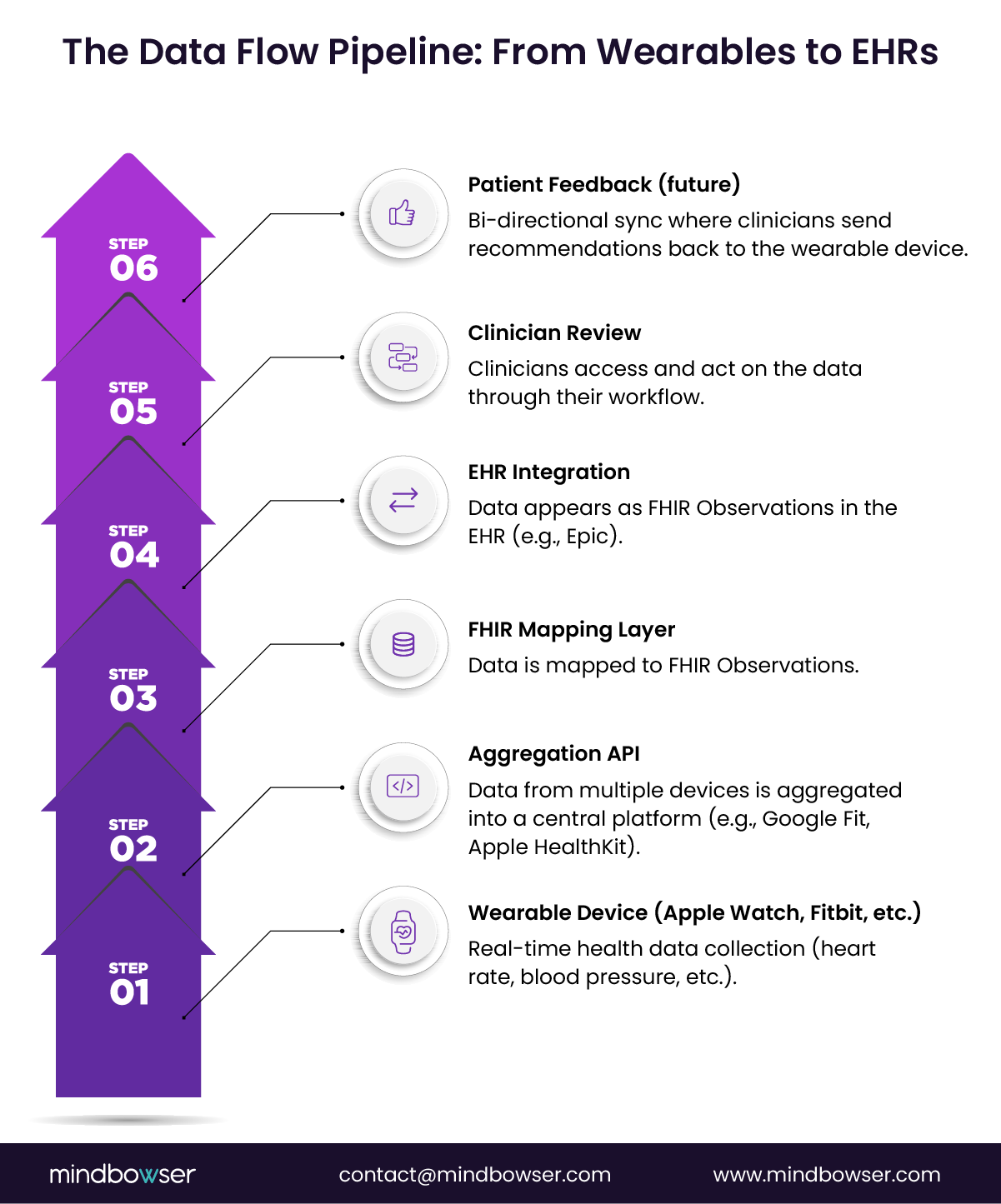
Image of The Data Flow Pipeline- From Wearables to EHRs
Fig 2: From EHRs to Wearables – Data Flow Pipeline

IV. The Hidden Work: Normalization, Units, and Context

A. Mapping Device-Specific Metrics to Standard Codes

Wearables generate a variety of health data, but this data is often in device-specific formats that are not immediately compatible with clinical systems. For example, the heart rate from an Apple Watch may be labeled as “pulse_rate”, while Fitbit may use a different naming convention. To ensure that all wearable data can be interpreted consistently within an EHR like Epic, it needs to be mapped to standardized codes.

The LOINC (Logical Observation Identifiers Names and Codes) and SNOMED CT (Systematized Nomenclature of Medicine) coding systems are used to assign standardized codes to health measurements. These codes ensure that metrics such as heart rate, blood pressure, and oxygen saturation are categorized in a way that aligns with clinical standards.

For instance, heart rate (bpm) from a wearable device would be mapped to the appropriate LOINC code for heart rate in beats per minute (bpm). This mapping ensures that when the data is integrated into an EHR, it can be displayed in a format that clinicians understand and can use in their decision-making.

B. Managing Timestamps, Units, and Provenance

When dealing with wearable data, it’s not just about converting metrics into standardized codes. The context of the data must also be preserved. This includes timestamps, units of measurement, and device provenance.

  • Timestamps: Wearables continuously track health data, so ensuring accurate timestamps for each data point is essential for clinical decision-making. For instance, heart rate data from a wearable may be recorded at multiple points during the day. If this data is not properly timestamped, it could confuse clinicians, making it difficult to interpret the data accurately within the context of the patient’s condition.
  • Units of Measurement: Different devices may report the same metric in different units. For example, one device might report glucose levels in milligrams per deciliter (mg/dL), while another may use millimoles per liter (mmol/L). Proper unit conversion and standardization is vital for accurate comparisons between data points.
  • Device Provenance: It’s important to track which wearable device the data originated from. Different devices may have varying levels of accuracy, so knowing the source of the data helps clinicians assess its reliability. Mapping device provenance ensures that this critical context is preserved, allowing clinicians to account for any discrepancies that might arise from different devices.

C. Ensuring Data Validity for Clinical-Grade Accuracy

For wearable data to be used in clinical decision-making, it must meet the standards required for clinical-grade accuracy. This means that the data must be precise, consistent, and valid, with any potential errors flagged or corrected before it reaches the clinician.

Wearable devices, while innovative, are still subject to certain limitations in terms of accuracy. For example, a fitness tracker might record steps or calories burned, but these readings can sometimes be inaccurate due to the device’s limitations or how it’s worn. To ensure that this data is reliable for patient care, it must go through a validation process to check for discrepancies and errors before being mapped into the FHIR format.

Ensuring this level of data validation requires a deep understanding of both clinical standards and wearable technology. The goal is to ensure that when data from a wearable device is presented to a clinician, it is reliable, actionable, and free from inconsistencies that could undermine clinical decision-making.

D. Lessons from Childbirth Management and Real-Time Monitoring Projects

Real-world applications, such as childbirth management systems and real-time patient monitoring, offer valuable insights into the challenges of mapping wearable data into clinical systems. In these cases, wearable data is critical for monitoring maternal health, detecting complications, and enabling remote patient monitoring.

For instance, a wearable device might continuously monitor fetal heart rate and maternal contractions during labor. To ensure that this data can be used effectively by healthcare providers, it must be mapped to the appropriate FHIR Observation resource. This involves not only standardizing the data but also ensuring that the context—such as time intervals and device accuracy—is properly accounted for.

By studying these real-world examples, healthcare organizations can better understand how to handle continuous monitoring data from wearables and translate it into a format that clinicians can trust.

V. What Clinicians Actually See (and Why It Matters)

A. How Wearable Observations Appear in Epic

Once wearable data has been mapped to FHIR Observations and integrated into an EHR like Epic, it is presented to clinicians as part of the patient’s electronic health record. This data is typically displayed within the Vitals Dashboard, which is a central part of the clinician’s workflow.

For example, a clinician can see the heart rate data from an Apple Watch displayed alongside traditional clinical data, such as blood pressure and temperature, all in a standardized format. This allows clinicians to make informed decisions quickly, based on a comprehensive view of the patient’s health. Wearable data, now integrated into the patient’s record, becomes an essential tool for real-time clinical decision-making.

These FHIR Observations are displayed clearly with important data points such as:

  • Heart rate trends
  • SpO2 (blood oxygen levels)
  • Sleep patterns
  • Physical activity data

The integration of wearable data in this way allows clinicians to easily assess how a patient’s health is evolving over time, without switching between multiple systems or devices. It’s all available in one place, making healthcare workflows more efficient and helping clinicians provide better, more personalized care.

B. How Normalized Data Powers RPM and Chronic Disease Management

The integration of wearable data into clinical workflows is particularly impactful in the context of remote patient monitoring (RPM) and chronic disease management.

In RPM programs, wearables like the Apple Watch can monitor vitals such as heart rate, blood pressure, and oxygen levels remotely. This data is transmitted to the clinician in real time, where it appears as FHIR Observations within the EHR. If any abnormalities are detected, the clinician can take immediate action, such as adjusting treatment plans or scheduling follow-up appointments.

For patients with chronic conditions such as diabetes, heart disease, or asthma, continuous monitoring via wearables can provide a wealth of actionable data. For example, the glucose level tracked by a wearable glucose monitor can be mapped to a FHIR Observation and displayed within the patient’s record, helping clinicians make timely adjustments to treatment plans. These capabilities significantly enhance the effectiveness of chronic disease management programs, reducing the need for in-person visits and improving patient outcomes.

By turning wearable data into actionable insights, clinicians can intervene earlier, adjust medications, and monitor progress continuously, all within the clinical workflow.

C. Why FHIR Observations Make Data Actionable

The true power of wearable data lies in its ability to be actionable. Without a standardized format like FHIR, wearable data would remain disconnected, difficult to interpret, and ultimately underused in clinical decision-making.

FHIR Observations ensure that wearable data is presented in a structured format that clinicians can act on. For example, real-time alerts can be set for abnormal vitals such as high blood pressure or irregular heart rate. These alerts can trigger interventions, whether through adjusting medications, scheduling further tests, or simply providing lifestyle recommendations to the patient.

    Facing a similar challenge or have a unique use case in mind?

    VI. The Compliance and Security Backbone

    A. Managing PHI in Wearable Data Streams

    When it comes to healthcare, protecting protected health information (PHI) is paramount. Data from wearables is no different — it is still considered PHI when it is linked to an individual. Therefore, the transmission and storage of wearable data must comply with HIPAA (Health Insurance Portability and Accountability Act) regulations to ensure that patient privacy and security are maintained.

    Wearable data streams, such as heart rate or glucose levels, often contain sensitive patient information. For this reason, strict guidelines must be followed when handling, storing, and transmitting this data. Any wearable data sent to an EHR like Epic must be encrypted both during transit and at rest. This ensures that data is protected from unauthorized access and prevents potential breaches.

    Additionally, any system used to handle wearable data must implement strong authentication and authorization protocols. This is where OAuth and SMART-on-FHIR come into play. They allow for secure data exchange, ensuring that only authorized users (clinicians, health systems, etc.) can access and view patient data. OAuth ensures that only patients who have consented can share their data, while SMART-on-FHIR provides a secure way to connect apps to EHRs.

    B. Simplifying Compliance with Built-In Security Features

    One of the biggest hurdles in integrating wearables with clinical systems is ensuring compliance with healthcare regulations such as HIPAA. This process can be time-consuming and complex, particularly when managing data across multiple devices, each with its own security protocols.

    By using FHIR, the process of ensuring compliance becomes more manageable. FHIR-enabled systems are designed with security in mind, providing built-in features like data encryption, user authentication, and audit logs. These features help streamline the compliance process, reducing the burden on healthcare organizations and simplifying the integration of wearable data with clinical systems.

    With FHIR Observations, health data can be safely transmitted to EHRs in a secure, encrypted format, ensuring that compliance with HIPAA is maintained throughout the data exchange process. This not only protects patient data but also helps healthcare organizations avoid costly fines and legal repercussions associated with data breaches.

    C. The Importance of Audit-Ready Logging for Healthcare-Grade Integrations

    In addition to security, audit trails are an essential component of healthcare-grade integrations. Since PHI is involved, it is critical to have a complete and traceable record of all data transactions. An audit trail logs every instance of data access, modification, and transmission, making it easier to track how and when patient data was used.

    For example, when wearable data is transferred from a device to an aggregator API and then into an EHR, every step of the process should be logged for traceability. This ensures that healthcare organizations can provide detailed reports in the event of an audit, proving that data privacy and security protocols were followed correctly.

    Audit-ready logging is essential for maintaining compliance with regulations like HIPAA and for ensuring the transparency and integrity of the data exchange process. It provides an added layer of accountability and helps healthcare organizations demonstrate their commitment to patient privacy.

    VII. How Mindbowser Helps Healthtech Teams Connect Wearables to EHRs

    A. WearConnect: Accelerating Integration with 100+ Wearables

    Mindbowser’s WearConnect accelerator simplifies the integration of wearable devices with Electronic Health Records (EHRs) like Epic EHR, Cerner, and Allscripts. With support for over 100 wearable devices such as Apple HealthKit, Health Connect by Google, Fitbit, and Garmin, WearConnect offers a plug-and-play solution for healthtech teams looking to integrate wearables into their systems.

    This solution eliminates the need for custom integrations for each device, reducing the development time and complexity that typically accompany these projects. By leveraging WearConnect, organizations can accelerate the deployment of remote patient monitoring (RPM) programs and other digital health initiatives, ensuring that wearable data is readily available in clinical workflows.

    B. Prebuilt FHIR Mapping and Validation

    One of the major challenges in integrating wearables with EHRs is ensuring that the data is mapped to the correct FHIR Observations. WearConnect offers prebuilt FHIR mapping and validation to ensure that wearable data is accurately transformed into a clinical-grade format.

    This mapping process standardizes device-specific metrics, such as heart rate, sleep data, and blood pressure, and maps them to standardized FHIR Observation codes. This ensures that the wearable data can be correctly interpreted by clinicians within their existing workflows, eliminating the risk of data misinterpretation or errors.

    By using WearConnect, healthtech teams can avoid the labor-intensive process of manually mapping each device’s data to the appropriate FHIR codes, reducing both development time and the potential for errors. This enables organizations to focus on more critical aspects of patient care while ensuring data integrity.

    C. Proven Outcomes: Faster Integration and Reduced Development Effort

    Mindbowser’s solutions, including WearConnect, have been proven to deliver significant results for healthcare organizations. Teams using WearConnect experience:

    1. 60% Faster Integration Timelines: With prebuilt connectors for over 100 wearables, integration timelines are drastically reduced. This means faster time-to-market for RPM programs and digital health applications.
    2. 80% Reduction in Development Effort: Preconfigured FHIR mappings and secure data exchange protocols eliminate the need for custom integrations, saving teams substantial development resources and effort.

    These outcomes ensure that healthcare organizations can quickly scale their remote patient monitoring initiatives without getting bogged down by complex technical challenges or prolonged development cycles.

    D. HIPAA Compliance and Secure Data Handling

    When dealing with wearable data, maintaining HIPAA compliance is non-negotiable. WearConnect ensures that all data exchanges are secure and meet HIPAA standards.

    • Encryption: All data transferred from wearable devices to EHRs is encrypted during transit and at rest, ensuring that sensitive patient data is protected.
    • PHI Anonymization: WearConnect’s built-in PHI anonymization protocols ensure that sensitive patient information is anonymized during data transfers, offering an additional layer of privacy protection.
    • OAuth and SMART-on-FHIR: These industry-standard authentication protocols ensure that only authorized users can access the wearable data, preventing unauthorized access.

    By leveraging WearConnect, organizations can be confident that their wearable data integrations are not only secure but also fully compliant with the highest standards in healthcare security.

    E. Expertise Across EHRs, FHIR, and Certification Frameworks

    Mindbowser’s deep expertise in FHIR, SMART-on-FHIR apps, and EHR certification frameworks allows healthtech teams to integrate wearables into clinical workflows smoothly. With years of experience working with various EHRs and developing FHIR-compliant applications, Mindbowser provides a comprehensive service that guides teams through the complexities of the integration process.

    Whether it’s navigating the intricacies of FHIR Observations, ensuring compatibility with existing EHR systems, or meeting certification requirements, Mindbowser has the expertise to ensure that your integration is successful and sustainable.

    VIII. The Future of FHIR + Wearables

    A. Bi-Directional Sync: Monitoring to Intervention

    The future of wearable data integration will include bi-directional sync, allowing clinicians not only to monitor patients but also to send feedback and care plan adjustments directly to wearable devices. For instance, if a patient’s heart rate is elevated, a clinician can recommend relaxation techniques, which are sent directly to the device. This creates a dynamic, interactive care model, empowering patients to engage actively in their treatment while improving outcomes.

    B. AI and Predictive Health Insights

    Combining FHIR Observations with AI will enable predictive health insights, helping clinicians detect patterns in patient data and predict potential health issues, such as heart attacks or strokes. By predicting these events before they occur, healthcare providers can intervene earlier, improving patient outcomes and reducing emergency interventions.

    C. Why “FHIR-First” Design Is the Future of Connected Care

    A FHIR-first approach is essential for the future of connected care. As healthcare becomes more interconnected, FHIR will serve as the foundation for interoperability, allowing seamless data exchange between wearables, EHRs, and other health technologies. This ensures scalability and adaptability, preparing healthcare systems for the future of data-driven, patient-centered care.

    coma

    Conclusion

    Wearable devices have unlocked a new era of continuous health monitoring, but for this data to be useful in clinical settings, it must be transformed into FHIR Observations. By standardizing and mapping wearable data to FHIR, it becomes actionable, easily integrated into EHRs like Epic EHR, and valuable for clinicians in real-time decision-making.

    As healthcare evolves towards more personalized, data-driven care, the importance of a FHIR-first approach cannot be overstated. Organizations that prioritize interoperability, compliance, and security in their integration strategies will be best positioned to lead this transformation. The future of healthcare is one where wearable data is not just collected, but actively used to improve patient outcomes and enhance care coordination.

    By investing in structured, secure, and interoperable data pipelines today, with the support of partners like Mindbowser, healthcare organizations can harness the full potential of wearable data, turning raw information into actionable clinical insights.

    What are FHIR Observations and why are they important for wearables?

    FHIR Observations are standardized data formats used to represent clinical measurements such as heart rate, blood pressure, and glucose levels. They are essential for integrating wearable data into Electronic Health Records (EHRs) like Epic, as they allow data from devices such as the Apple Watch or Fitbit to be easily interpreted and used by clinicians. By transforming wearable data into FHIR Observations, healthcare organizations ensure that data is consistent, accurate, and actionable.

    How does Mindbowser accelerate wearable-to-EHR integrations?

    Mindbowser’s WearConnect accelerator simplifies the integration process by offering prebuilt connectors for over 100 wearable devices. This reduces the time and complexity of integrating devices into clinical workflows. WearConnect ensures that data from wearables is mapped to FHIR Observations, allowing healthcare teams to quickly integrate patient-generated data into EHRs like Epic and Cerner, accelerating remote patient monitoring (RPM) programs.

    Can wearables improve patient engagement and care outcomes?

    Yes, wearables play a crucial role in improving patient engagement by providing real-time feedback on health metrics. Continuous monitoring helps patients become more active participants in their care, increasing adherence to treatment plans. By delivering actionable insights, wearables enable early intervention and better chronic disease management, ultimately improving health outcomes.

    How does FHIR ensure the interoperability of wearable data across EHRs?

    FHIR is a standardized framework that allows data from various sources, including wearables, to be easily exchanged and understood across different healthcare systems. When wearable data is mapped to FHIR Observations, it can be integrated into any compatible EHR system like Epic or Cerner. This ensures that healthcare providers can access and use the data seamlessly, regardless of the device it came from or the system it was initially collected in.

    Your Questions Answered

    FHIR Observations are standardized data formats used to represent clinical measurements such as heart rate, blood pressure, and glucose levels. They are essential for integrating wearable data into Electronic Health Records (EHRs) like Epic, as they allow data from devices such as the Apple Watch or Fitbit to be easily interpreted and used by clinicians. By transforming wearable data into FHIR Observations, healthcare organizations ensure that data is consistent, accurate, and actionable.

    Mindbowser’s WearConnect accelerator simplifies the integration process by offering prebuilt connectors for over 100 wearable devices. This reduces the time and complexity of integrating devices into clinical workflows. WearConnect ensures that data from wearables is mapped to FHIR Observations, allowing healthcare teams to quickly integrate patient-generated data into EHRs like Epic and Cerner, accelerating remote patient monitoring (RPM) programs.

    Yes, wearables play a crucial role in improving patient engagement by providing real-time feedback on health metrics. Continuous monitoring helps patients become more active participants in their care, increasing adherence to treatment plans. By delivering actionable insights, wearables enable early intervention and better chronic disease management, ultimately improving health outcomes.

    FHIR is a standardized framework that allows data from various sources, including wearables, to be easily exchanged and understood across different healthcare systems. When wearable data is mapped to FHIR Observations, it can be integrated into any compatible EHR system like Epic or Cerner. This ensures that healthcare providers can access and use the data seamlessly, regardless of the device it came from or the system it was initially collected in.

    Pravin Uttarwar

    Pravin Uttarwar

    CTO, Mindbowser

    Connect Now

    Pravin is an MIT alumnus and healthcare technology leader with over 15+ years of experience in building FHIR-compliant systems, AI-driven platforms, and complex EHR integrations. 

    As Co-founder and CTO at Mindbowser, he has led 100+ healthcare product builds, helping hospitals and digital health startups modernize care delivery and interoperability. A serial entrepreneur and community builder, Pravin is passionate about advancing digital health innovation.

    Share This Blog

    Read More Similar Blogs

    Let’s Transform
    Healthcare,
    Together.

    Partner with us to design, build, and scale digital solutions that drive better outcomes.

    Location

    5900 Balcones Dr, Ste 100-7286, Austin, TX 78731, United States

    Contact form