

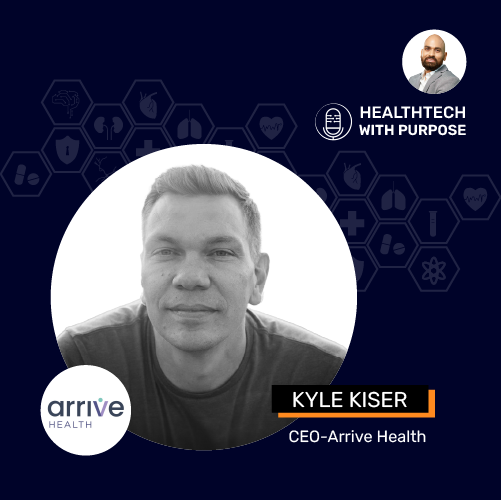
Ayush Jain: Hello, everyone. Welcome to another episode of HealthTech with Purpose podcast. Our today’s guest is Kyle Kiser from Arrive Health. Hi Kyle, how are you?
Kyle Kiser: Doing Great! Glad to be here.
Ayush Jain: Same here pleasure is all ours. Thank you so much for joining in, and we are equally excited to know more about your work and about you. In the next 30 or so minutes. So Kyle, why not we start with Arrive Health? Can you tell us more about Arrive Health and what you guys are doing at Arrive Health and so on
Kyle Kiser: Yeah, happy to. So we’re a data network that connects to the point of care. What we mean by the point of care is we are. We are integrating directly into the e-prescribing workflows of providers as they’re selecting medications on behalf of patients.
So the goal there is to guide to more affordable options for patients, and that might be a better relationship with their insurance plan. That might be
considering a cash pay option that might be suggesting a medication that does not require prior off instead of one that does require prior off. But we we are kind of demystifying that very complicated space of the patient’s insurance, and how that affects prescribing.
Ayush Jain: Okay? And does, it has to deal with more outpatient? Or is it inpatient or both?
Kyle Kiser: Outpatient. Yeah.
Ayush Jain: Okay, okay. So quick question that, you know again, there are many companies that are trying to, I would say, you know, like decipher or simplify the patient journey. Can you go deeper a bit in how Arrive Health is creating value? And you know, what is the moot that Arrive Health creates, and your customers are usually practices, or the patients like B2C themselves.
Kyle Kiser: Sure. So to your first question, moment in time that we influence is really unique and important, because it is before the medication’s ever been prescribed. It’s before the decision is left the healthcare facility. So it’s inside the EMR before the medication is signed would guide that prescribing decision as a part of the decision, support capabilities built by any of our, and help drive the right decision the first time.
So, you know if you think about our prescribing processes now, it’s it’s a complicated multi-step process. And in our healthcare system today.
And we are at the very beginning the outset of that process, so we have the opportunity to resolve it before you know, before the order is signed, before the orders are routed before the prior authorizations being considered, all those things could be resolved at the very outset. So that’s that’s the most important part of what we’re doing and we’ve done that in some interesting ways.
So we are, you know, we’re taking on this problem by building direct relationships with their help plans and the PBMs that are actually adjudicating that price. So what that allows us to do is have very accurate representations of the patient’s out-of-pocket costs inside of those ordering workflows, because the goal is if we can get the right decision happening the first time, we can then smooth a lot of processes downstream that are much more complicated and burdensome to providers and payers and patients themselves.
Kyle Kiser: To your second question business model. It’s a multi-sided network. So we work with a lot of different constituents. We work with health plans and PBMs. Those are our customers. In some cases we work with large provider organizations to help decision support around pharmacy selection. Those are our customers. We work directly with cash pay programs and on behalf of patients. It’s finding cash pay options.
So in a multi-sided network, we kind of have a lot of constituents who we would consider customers, I think. In addition to that, the provider user
is also an extraordinarily important element of what we do with the value we provide because we have to be solving problems that are important to those providers and doing it in ways that that’s value, add or otherwise, the relationships on on the other ends of the network become less valuable. So we think of them all as a customer, in a way, because we have to be solving our problems.
Ayush Jain: So how did Arrive Health happen like, you know, what was the inspiration or that the moment of epiphany that happened? What got you guys as a founding team together. Tell us more about that part.
Kyle Kiser: Yes, it’s a guy named Kevin O’Brien, still a doctor in Denver. Part of the the outset of this business was that Kevin was approached by his mom, who had a out of pocket spend. That was significant, and she wanted some help with. And Kevin looked at her meds and found ways for her to save on her medication, and, you know, took Brandon Med. Split it into its generic parts, found a therapeutic equivalent for this one. Maybe even a pill split or a different form solved her problem, and that inspired him to start doing this in his own clinic. So the original effort around this company was really Kevin just doing this inside of the clinic that he was working, not because he was. you know, in a value-based care arrangement, not because he was making more money to do it, just because he saw that patience can’t manage their conditions if we can’t get them on medications that they can afford.
And that’s really the initial inspiration. So we, from that
sort of founding point of view, have now built this business, really, with a lot of the same focus. We still spend a lot of time thinking about, how do we solve problems for providers? And we’ve worked really closely as strategic partners, investors with providers. Because that’s where the trust is most
vivid inside of the healthcare journey for a patient right? When you, when you have a question about your medications your instinctive outreach almost every time is to the provider. It’s cause that’s where that decision originated.
And more often than not patients have a lot of trust in their providers for better or worse. They don’t really care to talk to their health plan or the PBM, Right. You wake up in the morning, you seek out a conversation with your provider. You tolerate a conversation with your help plan.
And so that’s really how we’ve oriented the businesses we’ve really thought about. How do we bring the right information at the right time into that relationship between patient and provider, because that’s the most leverage to solve the problem.
So today, we still think about it that way, we’ve got relationships with places like Providence UPMC and University Colorado Health System. Where we we develop product, we would take new ideas. We collaborate with them on making things better because they really understand that rubber meets the road moment between patient-provider quite well. And and it’s it’s been an important part of our story since the very beginning.
Ayush Jain: And what’s the way the interaction with the patients happen? So it’s a mobile application. It’s a web platform, is it, Like part of the integration of the providers platform? So like, how has been the way of customer? You know, using Arrive Health.
Kyle Kiser: We integrate directly with the electronic health record systems that the providers use. So we’re an API that connects into their systems that powers what’s called real-time benefit. So now CMS requires a real-time benefit tool for party plans. And we are one of those. So we’re providing real-time, patient, specific moment of time, specific pricing into those e-prescribing workflows. So we’re a data network in the background, the user experience and user interface is all driven by the EMR. And we’re we’re powering that element of the EMR.
Ayush Jain: Okay, great, great. So you know, moving forward Kyle, would like to know more about you know how the whole industry, you know, has been moving forward, especially with the advent of AI, and is AI on your roadmap. And is it disrupting the patient care space that you are operating in, and how.
Kyle Kiser: Yeah, no, we. We are spending a lot of time thinking about how
AI is going to be a value add to our network. We over the last year built prior off capabilities. Those are also directly integrated into the electronic health record systems.
And AI is gonna be a really important part of that story. And we really think of it as a guidance system, opportunity. So how do we? How do we collect the right information from our network of constituents and bring that to the fingertips of the provider in a way that helps them make a better decision faster. And instead of what happens today which is, you know, a lot of basically yes or no questions about whether or not their decision is appropriate. And so that’s the way we want to reorient things is, let’s bring the interested provider.
Let’s help guide that decision from the outset and get the right patients to the right meds the first time, rather than the relatively burdensome system today, which is, you know, to go through the processes with multiple constituents that all have some relatively manual way of dealing with it. We see a huge opportunity to automate that from the very beginning of the process.
Ayush Jain: Right? So are there any use cases you already have in action currently? You know, as part of Arrive Health, or you are like you know, building out those use cases that you just mentioned.
Kyle Kiser: Yeah. The ones I’ve just mentioned are on in stream right now. So these are things we’re actively working on and gonna release. It’s a pretty focused place.
Ayush Jain: Okay, great, great and you know, since Kyle, you have spent so much you know of your life into the patient care space. So it would be very interesting to know more from you like, how do you see this whole patient care space evolving in terms of you know, what are some of the great solutions that you admire? If you could just give examples or tell about them, and then you know what are still those big gaps that exist in the market or evolving needs that still need to be catered by, if someone is operating or plans to be in the patient care, space.
Kyle Kiser: Sure. Yeah. And I think the most important thing that’s happening is empowering patients with their own data. And you know, I think that the applications of that concept are gonna spider out across the industry in a bunch of ways that are super important and valuable from our perspective. We think about it as the the right for patients to understand their own options right? And when we adopted E-prescribing the first time around. It was the first time in my understanding of our economy
where we adopted technology and consumer choice was constrained.
We went from taking a paper script. If you felt so inclined any pharmacy wanted, and figuring out how much it cost, and getting a good deal to it, being routed directly from the EMR system, directly to a pharmacy. And so someone else was making a purchasing decision on your behalf.
Neither of you knew what it cost until you’re asked to pay for it at some third party at some later date. And it we say that those terms it just doesn’t make any sense. And so I think that part of what is in front of us because of 21st century cures and because of the price transparency rules because of things like real-time benefit because of data liquidity in general, are the opportunities to really empower consumers with those types of decisions to reintroduce consumer choice that both at the point of care and throughout the patient experience.
It’s one of those things that just has to be at the forefront of where we’re going as an industry. And because, you know, in a world where deductibles were in the hundreds of dollars, and copays were in fives and tens of dollars.
It’s not that it wasn’t super important. It still mattered a little, but it didn’t matter that much. Well, today deductibles are in the thousands of dollars, and that’s the norm, not the exception, patient out-of-pocket expenses, for medications and all other things are, are, you know hundreds and thousands of dollars, and in some cases even north of that.
And we really can’t separate the concept of consumer choice. And
it’s and insurance benefits anymore. Those have to be increasingly integrated concepts. We gotta be able to help patients make better decisions sometimes that’s gonna include the benefits. And sometimes it’s not. And it’s to me that all of the unlock for all of that is really consumers. Now having the ability to demand their data is that you know, information. Blocking is now legal. There’s a chance for patients to really get services
and capabilities in their hands and at their fingertips. They can help them make better decisions.
And that’s gonna have a huge and important impact on the industry overall. But most importantly as a healthcare consumer, you know the consequences of you not being able to forge your medication pretty high, you know. Having to choose between managing your condition through medications or putting food on the table is literally the choice a lot of Americans are having to make. And to me, the data, liquidity, and patients being empowered with this information at the right time to make a better decision is the most important thing that we can be thinking about.
Ayush Jain: And glad that you said that. So what I would like to know? More about, Kyle would be like what’s your favorite story of impact? You know, like you mentioned, you touched upon some high-level things that you guys are doing. But what’s your favorite go to story you know, of Arrive Health and creating an impact? And you know, like what it was and how it happened.
Kyle Kiser: Yeah, we have. We’ve got kind of a super user at Presbyterian, New Mexico. And he told us this story, and he had a patient in front of him that was facing Albuterol prescription, Albuterol’s a generic, and you know, in most cases. When you, when you’re prescribing a generic, you think it’s a relatively low-cost Med, you think it’s going to be a pretty simple process.
And what he had in front of him was a couple of $100 out-of-pocket expense for a Mom, who was trying to take care of her kid. And he was able to use our tool to say, Well, it’s not this drug form, it’s not this one. So maybe it’s the disk instead of the inhaler. You know. He solved the problem and the truth of it. It was there was a $0 option for that patient and he was able to understand where that was. Use the tool easily to solve the mother’s problem.
And do that in an instant. Do it at point of care, and do it not with her having to go to the pharmacy and figure it out, not with her having to
be told no, or a claims denial at some point in the process. It just happened. And that’s exactly what we’re striving for. We you know you think about the if you really put yourself in in your parent mindset. I’ve got 2 young kids. They think about that that day right? If you’re having to, more than likely not be at work. You’re already stressed. Because of that. You’ve got a sick kid in front of you. You know. The way it would work without us is you’re standing at the pharmacy counter with a kid that’s suffering probably coughing on you. And the poor pharmacist has to tell you no, or has to tell you a price that you can’t afford. You have to walk out of there with nothing.
Instead of that we were able to solve a problem the first time save her that stress and frustration that would occurred and get her kid on medication. That’s going to make them heal. That’s gonna make them healthier, and that scenario is the is exactly what we’re striving for at every at every point. We did a little bit of data work last year and wrote a paper on this that almost half of the time there was a $0 option available when a medication was prescribed that was $50. And that’s just an information availability problem. Right? That’s not. It’s not that the formulary was designed in a way that’s cruel to patients. And it’s not that patients or providers don’t want to make the right decision for patients. It’s that we’re not in an effective way putting the information in front of providers and help them make better decision. And that’s ultimately what we’re about. That’s that’s the problem we’re going to solve. And we’re going to continue to solve.
Ayush Jain: Right, and I have a question around that. So what’s the incentive for the provider to be good, or say by that definition, not be good? So is it just the choice between being honest, and go for profit versus go for profit or you know there are some patterns that you’ve seen, you know, with more embracement of Arrive Health tools and lesser in some spaces. So are there any typical tipping points between that like, between people or institutions, embracing Arrive Health and those that are not Arrive Health or similar systems, I would say.
Kyle Kiser: Sure. Yeah, no, I think the 2 first question this is definitely not about providers not wanting to make the right decisions for patients or having some profit motive that prevents them from doing so. It’s think about a typical clinical day. If you’re seeing 30 or 40 patients at a typical clinical day in the US. There’s, you know, in your market probably a dozen or more different help plans with different plan designs.
Right. So you take those 40 patients with some unknown mix of those, more than a dozen health plans and those health plans all have different preferences around the way they’ve negotiated to lower prices for their policyholders. And so the Albuterol’s example right that it might be in a inhaler for one, it might be a disk for another, it might be nebulous for the other as some, you know, generic example, and that is true for almost every drug category. There’s some complexity, at least drug categories where there’s competition is that the health plan has tried to negotiate a good deal for their members and that creates a right answer, and that right answer may not be the same answer for the next help plan, or the next playoff plan, or the next help place.
So it’s a machine problem to solve. Right? This is just not something that anybody, even the best and most providers can solve. Right? It’s just we, this is a very ideal problem for us to create this network to solve.
So it’s absolutely not like a you know perverse motivation on behalf of anybody in the supply chain. Honestly, it’s everybody’s trying to do the right thing based on their constituents and the incentives in front of them. We’re just trying to organize that information in a way that helps the right decision happen the first time.
Ayush Jain: Makes sense makes sense, True. Very interesting. So Kyle, maybe, I’d like to touch, a bit more on about your background. So you know, I was reading that you started your career pretty much as a salesperson. And you know, you’ve grown through the ranks your career pretty much, you know, growing with companies and growing the companies so tell us more about you know from being a salesperson to becoming a CEO would have been your best lessons that have made your life or your journey successful, that you could pass on.
Kyle Kiser: Sure. Yeah, to be the best salespeople are problem solvers, Is
taking a really intentional effort to understand the problems that are in front of whoever it is. You’d like to sell something to understanding what they’re up against, what they’re trying to accomplish, what they’re trying to solve and then coming alongside it to do that. And if your solution is an important application in that process great, and if it’s not, tell them.
And it’s, you know, being a problem solver and having an eye ethic and really earning trust in a way that is authentic and is empathetic of what it is that they’re going through and trying to accomplish in my experience is what really successful salespeople look like. That’s been true in our organization. And I think that’s true in a lot of organizations. So to me those are skills that apply no matter job function, right? They’re just applied in slightly different ways. And so in this seat it’s it’s not that different. It’s just trying to understand what people are trying to accomplish.
But preventing them from accomplishing that. And then how can I apply whatever leverage I have based on my background experience or position to help them do it. I mean, it’s that’s the almost a one-to-one overlap from a
personal skill standpoint, from my perspective.
Ayush Jain: Right right? No, I agree. I agree. I mean, though you made it very simple, as you said, but I think that’s a very important and you know, like immaculate skill that is required of any salesperson, be a good listener, and be able to comprehend the problems that sometimes your customer also may not be seeing, and then, you know, be able to connect the dots for them, because you’ve been listening well and be able to connect it with outside information that you could be knowing possibly.
Kyle Kiser: Yeah, I think you’re right. The other thing that’s coming to mind is as you share. That is that the other, another important skill of of someone in a sales role is getting all the right people in the room. And so as you’re marching through a sales process you’re gonna require some technical expertise to solve that problem, probably some, maybe clinical expertise in our in our world, you know, data expertise in our world and getting that right collection of people into that sales conversation in a way that is value add really important skill set.
Similar application in my new chair. It’s having the right folks on the leadership team having the right folks and in the company and empowering them to go do what they do well and kind of stay another way, right? And not necessarily trying to dictate every behavior in the organization, but hiring really talented, smart people that are operating at the top of their license, and let them do. It is something I see is very similar in both of those scenarios, too.
Ayush Jain: Right right true that. So the last question that I’d like to know of from you, Kyle would be, you know I read the survey from you guys like 5 reasons to prioritize prescription price transparency so you know, I would like you to compare some of the findings from that survey.
Kyle Kiser: I mean, I think you know, we talked about a lot of this from the beginning, right? There’s there’s a lot of downstream waste that happens because we aren’t getting the decision right. The first time. So you know, goal one is, how do we empower providers with high-quality information that
that’s reliable, that works nearly every time and is a value add in that provider’s workflow. So that’s one big element that I think applies in a bunch of different ways to that document secondary to that is increasingly, we’re thinking about, how do we leverage our network and our capabilities to not just get the decision right the first time? But how do we help that patient get on met as quickly as possible? That so that means working with the care team. So resolving prior authorizations and creating the same kind of connectivity on it for a different purpose to help patients actually get on the medication.
And then finally, it’s having the ability to follow that all the way through adherence and ensuring that we’re getting the right med the first time we’re getting helping the patient actually get the Med. And we’re making sure that they actually take the Med, because ultimately that continuum is the only way that we get the value out of that decision. And the only way we help patient health. And so to me, that’s why it’s important end to end is is that all those things have to happen in concert and have to have it in a successful way for this value to be is as significant as it can be. So to me, that’s that’s what we spend our life on.
Ayush Jain: Right right? And I think it saves it creates value by saving the waste for everybody. That’s how I see it, like, you know, like there are just like you said. You know, there are these options and information available, but if you’re not accessing it, it’s just getting wasted. So it’s all about keeping value from you know what already lies, but it probably skips the eye so, or skips the time or the attention.
Kyle Kiser: Exactly right. That’s right.
Ayush Jain: Well, thank you so much, Kyle, it’s been a pleasure speaking on this podcast today. And we wish you good luck with the vision that you have. And hopefully, Arrive Health helps more and more patients be able to make the right decisions and be able to get a value from their healthcare. Thank you.
Kyle Kiser: Thank you for the invitation, enjoy the conversation.
Hello everyone, in this episode of Health Tech with Purpose, we had an in-depth conversation with Kyle Kiser, CEO of Arrive Health! In this engaging session, Kyle shares insights about Arrive Health’s mission and its amazing work in the healthcare sector.
Arrive Health is a data network that integrates directly into e-prescribing workflows, helping providers guide patients to more affordable medication options. Discover how their innovative approach demystifies the complex space of patient insurance and influences prescribing decisions at the point of care.
Key Points Covered:
✅The role of Arrive Health at the point of care
✅How Arrive Health simplifies the prescribing process
✅Impact of accurate real-time patient-specific pricing
✅Importance of provider and patient relationships
✅Integration with electronic health record systems (EMR)
✅The influence of AI and automation in patient care
✅Real-life success stories and patient impact
✅Empowering patients with data and price transparency
✅Kyle Kiser’s journey from sales to CEO and key lessons learned
✅The future of patient care and the evolving industry needs
Kyle discusses the company’s unique value proposition, focusing on real-time benefit tools and partnerships with health plans, PBMs, and provider organizations. Learn how Arrive Health’s integration with electronic health record systems empowers providers with accurate patient-specific pricing, ultimately improving the prescribing process.
We also explore the impact of AI on the healthcare industry, particularly in automating and streamlining prior authorizations and enhancing decision support for providers. Kyle shares compelling stories of how Arrive Health has made a tangible difference, including a heartwarming example of a mom saving on her child’s medication thanks to their tool.
Don’t miss this insightful conversation about the evolution of patient care, the challenges, and the exciting innovations driving the industry forward.
Welcome to our DEI podcast! Today, we’re joined by Parul Batra, Technical Program Lead at Neuro42. She shares her journey from e-commerce to healthcare, highlighting resilience and the importance of self-belief in tech. Tune in for insights on professional growth and empowerment!
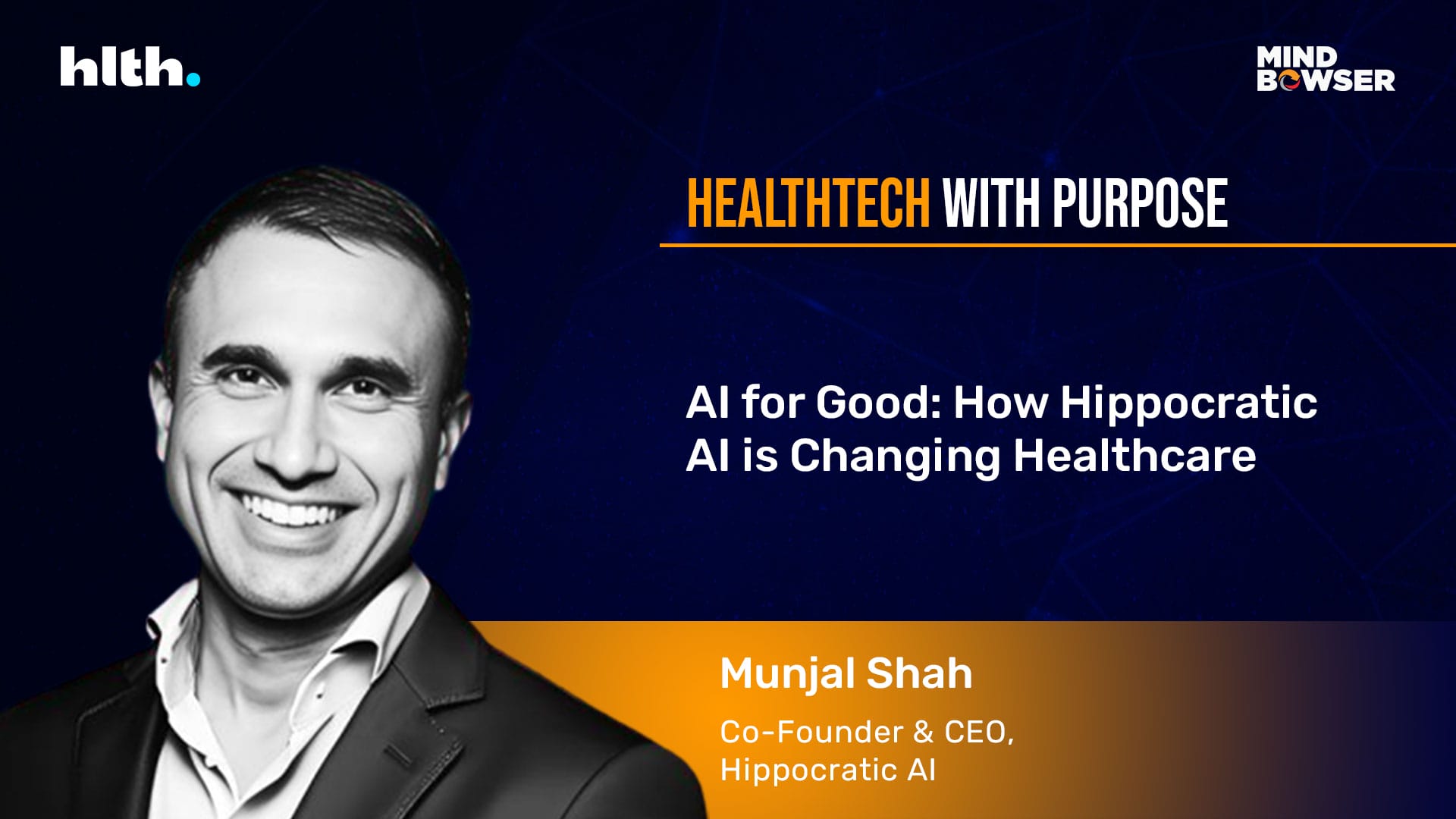
Join us for an enlightening episode of HealthTech with Purpose as we delve into a conversation with Munjal Shah, the visionary Co-founder & CEO of Hippocratic AI, a pioneering company that’s transforming the healthcare industry with its safety-focused Large Language Model (LLM).
In the podcast with Rushikesh Kulkarni, CGO at Mindbowser, Co-founder & CEO Ryan Lee discussed about HireMe Healthcare a job marketplace that specializes in connecting nurse professionals with job opportunities. Lee also shared the curation process for nurses on the app, and the challenges the company faced while building the platform.
Partner with us to design, build, and scale digital solutions that drive better outcomes.
Global Tech Teams LLC, 525 Washington Blvd, Industrious at Newport Tower, Jersey City, NJ 07310, United States.
Let’s discuss your goals, workflows, and next steps in a focused consultation call.
 Schedule a Call














 BLOGS
BLOGS  NEWSROOM
  CASE STUDIES
  WEBINARS
  PODCASTS
  ASSET HUB
  EVENT CALENDAR