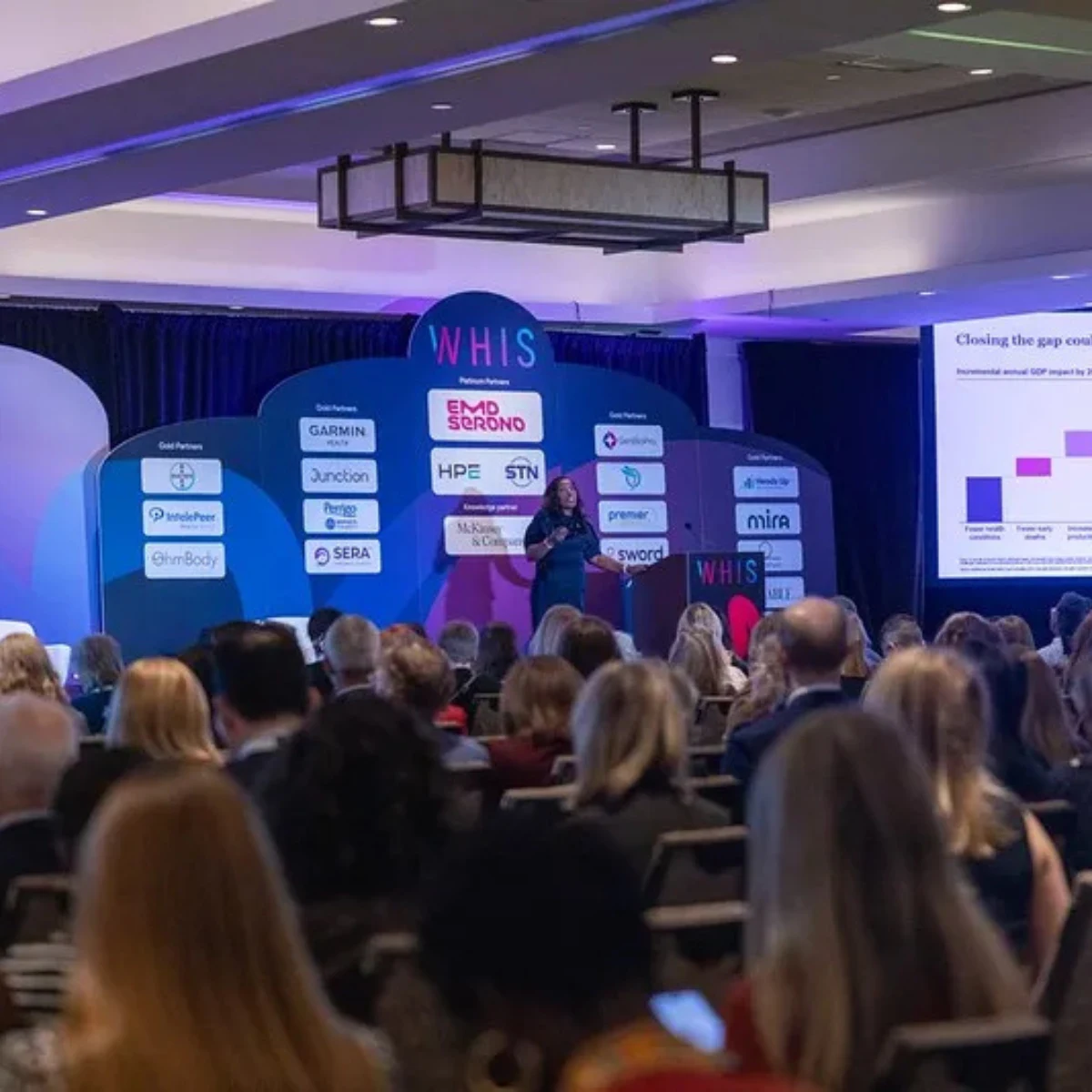

David Evendon-Challis, Chief Scientific Officer and Head of R&D for Bayer Consumer Health, talks with Mindbowser CEO Ayush Jain in an episode recorded in partnership with Frontiers Health. He traces a nonlinear career through Kimberly-Clark, agency work and Reckitt Benckiser before joining Bayer in Basel, and explains why he thinks self-care has never mattered more to strained health systems.
For David, precision health is about digital making health data actionable. He describes moving Bayer from a product-centric view to the whole journey a person takes, from the first prompt to act through research, expert advice and treatment, and argues that everything should start with a big unmet need. He is candid about the obstacles: missing in-house capabilities, the difficulty of partnerships between large companies and startups, and business models built on selling medicine. He shares partnership examples with Huma on a heart risk assessment for Bayer Aspirin and with Ada Health on online assessments, and gives startups direct advice on approaching a company like Bayer. He closes on sustainability as a team sport and a personal purpose built on making connections.
David frames precision health as the role of digital in giving people better control over their health: “better data means better healthcare.” Digital has changed daily life everywhere, he says, but more slowly in healthcare and especially in self-care. Wearables and online assessments exist, but they are often too complicated, too expensive and, above all, not actionable. That gap between data and a decision is the same one AI in precision medicine tries to close in clinical settings.
Bayer’s response is to be less product-centric and more human-centric. A person starts with a problem, looks for information (often with “Dr Google”), may speak to an expert, decides what to do and then acts. The question is what role Bayer should play across that whole journey, not only the bottle of pills at the end, which means rethinking the development process end to end. That is the logic behind end-to-end product development in healthcare, where the product is designed around the full journey rather than one step of it.
David’s filter for digital health is unmet need: products that don’t work well enough on their own, or areas where people don’t know what to do and when. Without that, “you’re providing a solution to a problem that doesn’t really exist.” He gives two examples. Irritable bowel syndrome (IBS) and gut health: his father suffered for years and, near the end of his life, rarely left the house for fear of what might trigger symptoms. And intimate health, where Bayer’s Canesten brand can educate, bust myths and break taboos. Nathan Price of Thorne HealthTech took the same idea further on this show with precision prevention, stopping disease before it starts.
Asked what stands in the way, David lists the health system, regulation and the difficulty of behavior change, then names the problem closest to home: a consumer health company doesn’t have the capabilities to build everything itself. Spending 10 years developing its own digital therapeutics is not an option, so the answer is partnering. Partnerships between large companies and startups are hard in their own right: finding the right partners and technologies, getting a cultural fit, and making a deal where both sides can make money, in a field where much of digital health is free and the company is used to selling bottles of medicine. He calls it a business model, partnership, consumer and regulatory challenge at once, and his answer is to take steps with like-minded companies rather than decide it’s impossible. Teams building in this space face the same questions covered in custom digital therapeutics software development, from regulation to engagement.
David’s working principle is that “experimentation is better than perfection.” With Huma, Bayer Aspirin offers a US heart risk assessment that gives people a sense of their cardiovascular risk without a doctor’s office visit; he says people who completed it understood their risk better and committed to act, often by visiting a healthcare practitioner. The brand brings consumer understanding that can make a clunky technology work better. With Ada Health, shortly after Bayer invested, the teams ran pilots embedding Ada’s online assessment in, as he recalls, three markets and four brands.
His advice to startups: be clear about what you offer, what you want and who you are; research where the company is strong and growing, rather than pitching a tiny single-market brand; and aim for a human conversation, not a vendor pitch. Partnerships that get formal too quickly often fizzle out, which is why Bayer’s program is built around human connection rather than an automated intake process.
David calls sustainability “a team sport” that can’t sit in a remote corporate function. It works when experts, passionate people and those accountable for change (R&D, marketing, sales) work together. At Bayer he focuses on moving self-care packaging to environmentally responsible materials, which is slower in healthcare because of technical and regulatory constraints; PVC in blister packs has been a challenge for as long as he has worked in the industry. On access, Bayer’s goal is to bring better healthcare to 100 million people in medically or economically underserved communities, through pack sizes and channels as well as new innovation. Every product developer and packaging engineer on his team is trained on sustainability, and a tool is used at each development stage to check how sustainable and inclusive a product is.
Hello everyone, welcome to another podcast of HealthTech with Purpose. Today we have a special guest coming all the way from Switzerland: David Evendon-Challis, who is the Executive Board Member and Chief Scientific Officer, Head of R&D, Consumer Health, at Bayer. Hello David, how are you?
Hi there, thank you for having me. Good here, thank you.
Great, glad to be connected with you, David, because I know some of the work you have been doing has a very high impact on the world we live in, which we are going to talk more about during this podcast. But before we get to the work, today I would like to know a bit more about your background and the things you have done that led to the role you are in today. Would you like to describe some of your work history and your background?
Sure. Where to begin? I studied biology in the UK, a long time ago now, and decided that I didn’t want to go into research, so I moved into industry. I joined Kimberly-Clark, and that was the start of my 20-odd years within health and hygiene. I’ve always had a bit of a nonlinear route through my career. I started off in regulatory, I was an auditor for a little while, and I moved into public affairs and sustainability. That was a fantastic experience, because working in this kind of industry you often only see one piece of it, and being able to see everything from the policy side of things through to manufacturing the products and what’s going on in the factories was a super experience for me.
I spent a couple of years agency side, doing similar kinds of things but from the other side, working with different companies on things like sustainability, health and innovation. Then I moved to Reckitt Benckiser and spent about eight years there. I started off responsible for sustainability and then picked up innovation along the way, so it was a nice mixture of setting the company strategy on sustainability, how to be a company that is responsible and grows in a responsible way, integrating sustainability into innovation, and then actually bringing that to the products themselves. Some of my passions are around building brands into new areas, and creating new brands as well. So another fantastic experience. And then about four years ago I moved to sunny Basel in Switzerland and joined Bayer, and that’s my current role, looking after R&D within Bayer Consumer Health.
Great, thank you so much for a comprehensive introduction, David, to set things up. Let’s go deeper into the work you do at Bayer. What is your day-to-day work like? What are the things that excite you the most, and what are you currently working on?
It’s an exciting time to work in consumer health. I think there’s such a big opportunity. I work across all of our different brands and our different geographies, and innovation has a role to play in all of them, so it’s a pretty diverse role. When you think about it, self-care has never been more important, with the burden on health systems. There was actually a report that came out just this week from the European self-care association, which I haven’t finished reading yet, but one of the key findings was that expanding self-care could save more than 54 billion euros for the European healthcare system per year, and you see similar kinds of stats elsewhere.
So I’m really passionate about self-care, and about how we can essentially allow people to take better control of their health. That cuts across all the self-care areas we work in, from allergy, cough and cold, pain and heart health to supplements, dermatology and digestive health. Across all of those areas: what can we do not just to grow our brands and grow our business, but to actually provide better products and services to people, and to move into new areas? It’s an exciting area to work in. It’s not always easy. There’s quite a fragmented regulatory environment around the world, so it’s always a challenge to do these things at scale, but there’s such a need in all of these areas, and we’re working across each of those benefit areas, or categories, however you want to call them, to bring new innovations to the market.
Great. I’d like to dig deeper into this aspect of your work, which is very exciting: precision medicine, what I would call a very customized solution for every person, rather than everybody taking the same medicine. Can we go one level deeper: what it is, how it works, what the roadmap is and what the challenges are?
Yeah. Ultimately this is all another part of how you give people better control over their health, and precision health for me is about the role of digital in enabling that. Better data means better healthcare. We know that digital has changed how all of us live day to day; it’s changed everything in our lives. But I think it’s been a bit slower within healthcare, especially within self-care. Some of us have a bunch of wearables, whether they’re incorporated into other things or not, and there are online assessments and tests and stuff like that, but I think it’s just too complicated sometimes, it’s too expensive, and for me one of the big problems you face is that it’s not really actionable.
So what we’re trying to do is take a different approach, which is less product-centric and much more human-centric, just thinking about the way people actually want to manage their health. It starts with “I have a problem.” There’s a prompt to action, and then you start to find out information about it. You might engage with some experts, you might do your online research with Dr Google, and then you decide what you actually want to do about it and take some action. For us, this is about piecing together that whole journey and asking what’s the right role for us, not just a product, a bottle of pills that might arrive at the end of that process. That’s the general setup here.
As part of that, we’re rethinking the whole development process, so it is truly an end-to-end experience rather than just one piece of it. That requires a lot of partnerships, because we’re obviously not experts in all of that, and it involves bringing lots of different new technologies into this area, some of which aren’t new to the world but are new to healthcare, or new to self-care, things like digital therapeutics (DTx), which all have a role within this. I think it’s very cool, because it’s now moving from that one piece of the puzzle to taking a step back and saying there are bigger problems here, we’ve got a role to play, and maybe we have a role beyond what we thought it was in the past. You can apply that to almost any area of health, and we’re working on a number of different areas within that.
When it comes to digital health, there are so many different ways you could approach it, but for me we need to focus on the areas where there is a big unmet need. Whether that’s because the products don’t really work so well, so you need something else and a physical product on its own isn’t going to be enough, or maybe there isn’t great education and people aren’t really sure what they should be doing, and at what point, to give themselves the best care. The unmet need part of this is incredibly important, because otherwise you’re providing a solution to a problem that doesn’t really exist.
I think we still have a huge number of such areas. Take irritable bowel syndrome (IBS), for example, and gut health. This is something my dad suffered with for years, to the point that close to his death he didn’t really leave the house, because he was so worried about what was going to happen and what was going to trigger him. He didn’t really know what was going on with it. Just think of what you could do by giving people that knowledge, that power, that control over their health, to regain a bit of their independence in that situation and start to live a bit more confidently. Those are the kinds of areas that I think are absolutely ripe for disruption, because people just don’t know what to do.
The other side of things, which is also really interesting, is where things might be taboo. We have a brand called Canesten, which works in intimate health, and that’s a huge taboo topic. With that kind of brand you can bring in education, you can bust myths, you can try to break some of the taboos around the topic. So there are loads of different angles in, but ultimately it’s got to start with: what’s a big unmet need?
Yeah, I think that definitely sounds exciting, and in fact seems like a perennial solution for the unmet needs people have. But one thing that comes to mind that I’d like to discuss with you today is the challenges in applying it, because I think it really shakes up the old structure. We have big institutions built on the foundation and habit of mass producing things. All the R&D, all the things that are done, are possibly based on mass production of any kind of vaccine or any kind of cure, for example. So that’s one thing that comes to my mind. I’d like to know: is that a problem, and what are the other problems or challenges you see in reaching the future we are imagining? So that’s a big question.
There’s a ton of problems you could talk about: the healthcare system, the regulatory environment and things like that. You can talk about the problems we face in getting people to understand that prevention is really important, not just waiting for an issue, because behavior change is tough for all of us. I think we all know what we probably should be doing, and we’re probably not all doing it at the same time.
But when it comes to a business like ours working in this kind of area, some of the problems are that we don’t have the capabilities or the skill sets to actually do this. So what do you do? Are we going to spend 10 years developing our own new digital therapeutics and things like that? No. So the answer is partnerships, piecing together the different experts in this, and I don’t like the word ecosystem, but I’ll use it in this instance, the different parts of that ecosystem, and stitching those together. That comes with its own problems, because partnerships are tough, particularly partnerships between large companies and startups.
You might have a vision for what the future might look like, but identifying the different partners, all the different technologies and skill sets, is one thing. Being able to bring those together and create something that makes sense, where there’s a good cultural fit between the organizations, but where there’s also essentially a deal to be made, where you can actually make money from it, that is tough. A lot of the time, when it comes to digital health, not everything is paid for. Lots of things are free, so you need to work that in, and for a company that is used to selling bottles of medicine, that is a big challenge. So it’s a business model challenge, a partnership challenge, a consumer challenge and a regulatory challenge as well. There are lots of firsts in this kind of area. But you could sit there and think this is impossible, or you could start to take some steps and find some like-minded companies, and that’s what we’re trying to do.
Yeah. In fact, one of the things I noticed is that you have been working diligently on partnerships and bringing partners into the ecosystem. Tell us more about some of the exciting partnerships you have been part of and how those journeys have been. And especially if there is someone who wants to be part of the ecosystem, I’d like you to also elaborate on how they can participate, if there’s a way.
Sure. We partner across the board. I think we know that experimentation is better than perfection in this area, and in most areas, to be honest. So there are lots of different types of partnerships. We’re working with a company called Huma, an amazing company doing some awesome things, and we’re working with them on cardiovascular health, providing better information to people, starting off in the US and hopefully soon broader, to help people understand their heart health risk. You don’t need to go to a doctor’s office and have a bunch of tests to get a decent amount of information about your risk level when it comes to your heart health, and that might then prompt some action.
So working with that company, they have a great tool. We have brands like Bayer Aspirin, and we have been working in cardiovascular health for a long, long time as a company. You put those two things together, the power and awareness of that brand with a great technology, and you can start to do some experiments: how is this going to work, and what kind of action does it actually prompt? We know from the work we’ve done there, and that one was in the US with Huma, that the people who went through this process have a better understanding of their cardiovascular risk and are actually committing to take action, which in many cases involves a visit to their healthcare practitioner.
The other thing I find interesting in the role of partnerships is that brands know consumers, and they have awareness. So one of the things we bring is this: there might be a great technology, but it might be a little bit clunky, and if you can bring the brand’s understanding of the consumer, how people like to receive information and what triggers them to action, those two things can come together quite nicely and get better action and better results than something that wasn’t necessarily designed with that user experience in mind. So that’s one of them, a fantastic experiment that’s been running for a little while now.
We’ll also do it with self-care chatbots and telehealth partnerships. We’ve been partnering with a couple of organizations on digital therapeutics as well, which is a different end of the digital health spectrum, as well as things like online assessments, where we have a partnership with Ada Health. So for me it’s about lots of different types of partnerships where you can actually start doing things. With Ada, for example, fairly shortly after we made an investment in the company and said we were going to work together, we put out a bunch of pilots with our brands, I think in three different markets and four different brands, embedding that digital tool within our brand ecosystem to see how it actually works and what should happen. So it’s that kind of series of experiments, and there’s lots more to come on that one.
When it comes to partnering with a company like Bayer, the most important thing for me is that there’s a good fit between the different organizations. You’ve got to be able to work together; you need to be able to make a human connection. We always start by talking about technologies and things like that, but there needs to be a way that you can start to talk to each other and figure out what you’re all about and what you’re looking for, and vice versa, rather than a pitching or vendor-type arrangement. That’s one thing.
My advice for people thinking about working with Bayer, or companies similar to ours, would be: be really, really clear on what you’re offering, but also what you want and who you are. Those are the things we sometimes miss with partnerships. Do your research on the organization. Where are they strong, where are they weak, where do they have great brands? There’s no point pitching to work with Bayer, or with others, if it’s for a tiny brand that is just in one market and doesn’t have any scale potential, for example. Have a look at where they’re strong and where they’re growing, and start to find those kinds of connections. And then really it’s just a conversation that starts things off.
In my years of working in partnerships, there’s been a lot of wasted time with back and forth. Things get very formal too quickly, and then oftentimes they just fizzle out. So I think going in as direct as you can be, with who you are, what you’re looking for and what your idea might be, is best. Obviously not giving away all of your company secrets and stuff like that, but being as open as possible is the best place to start. With our partnerships program we’ve definitely taken much more of a human-centric approach, rather than an automated system kind of thing, because I’ve been part of those in the past and they are pretty clunky, a bit impersonal, and they can take forever. We’re a large company; sometimes we can be a bit slow, as much as we would love to move fast. But when you’ve got that human connection, things can move a lot faster and a lot smoother.
Makes sense, makes sense. And I think you said it right: one, human connection, and second, the objective of the partnership has to be very clear. Of course, easier said than done, but the parties should know why they’re getting into it and what they’re expecting out of it; otherwise it becomes confusing. Great.
Another thing that stood out, David, from your background and the work you have done was the sustainability focus, and I was very excited, because I have personally always been invested in sustainability as much as possible in my work too. Share more about your sustainability focus, especially around developing consumer-centric products today.
Well, I’m also passionate about sustainability, and I’ve spent a bunch of my career working only on sustainability. What I like is that we’re all trying our best, and it’s a team sport. I think that’s the first thing I’ve learned: it can’t just be done by a remote corporate function. It has to be truly embedded into the business. Where you actually get traction is where you bring together people with a lot of knowledge and expertise, often on the sustainability side, with people who are passionate about it, who can come from anywhere, and also people who are accountable for the change. That will involve people within R&D, marketing and your sales teams, putting those kinds of groups together, and that’s very much been our approach.
At Bayer we have a focus on the environment, and I’m particularly interested in the packaging element of that: moving self-care packaging to be environmentally responsible and sustainable. The industry has probably moved a little bit slower than some others, so there’s a lot of work to be done there. That’s super interesting, because there are a lot of technical issues you have to face when you change packaging to new materials, and within a healthcare environment it’s much harder and slower than in some other industries and areas I’ve worked in. So that’s one.
The other one is around access. We’ve got a goal to give better healthcare to 100 million people who are in either medically or economically underserved communities. That gives us a focus to innovate differently and provide different products and services to underserved communities. What does that actually mean in practice? Because it all sounds good, and it’s very much a corporate commitment. There are a bunch of different things. There are things we can do within our existing portfolio. We have products, but are they in the wrong pack sizes, are they not available in the right channels? There’s a bunch of things you can do to make what you already have accessible to more people. That’s one.
Another side is actually innovating for sustainability. Rather than it being a separate project, this is incorporated into everything my team does within R&D. At each stage of product development, our product developers and our packaging engineers are all trained on sustainability, and we have a tool that we use at each of those phases to assess whether this product is as sustainable as it could be, whether it’s reaching the most people, and whether it’s as inclusive as it can be, because things like inclusivity fall into that larger space as well. That way we make sure that, over time, our product portfolio becomes more sustainable.
So it’s a mixture: what can you do today to make things a bit better, how can you move things through your innovation pipeline to become a more sustainable portfolio as a company, and making sure you’ve got those big corporate goals that provide an anchor. That’s our approach. It means you can do things for today, but you’re also planning for the next five to 10 years with your innovation pipeline, because as much as we would always love to move really fast, it’s not always possible. We’ve had a challenge within healthcare with PVC packaging in blisters, for example. That’s been a challenge since I started working in this industry. It takes a long time to crack, and let’s see who’s first to crack it.
Great, great. I think somebody who has the mission and the motive will be the one who cracks it. We’ll see. Great, David. My last question for the evening: because this is the HealthTech with Purpose podcast, I would like to learn more about your purpose for the things you do, and how you are driving that purpose.
My purpose. My purpose is around expanding my own and other people’s worlds to make things better. That sounds super fluffy, and it probably is, but for me this is what I love to do, and what I think I’m here to do: make connections between different ideas and different people, expand the world a little bit, so that we can make more progress, be that in healthcare, digital, development, whatever it might be. I apply it to everything I do. It’s all about making things a little bit bigger and making better connections between things, and that’s what I apply in my job and also outside of it.
It took me a long time to think about what my purpose is. What am I here to do? Is my purpose my job? Well, what happens when my job changes? I think a lot of us go through that kind of thing. I only settled it last year, so it took me a good 20 years of working to figure this out. But the thread through all of it is that what I’m here to do is make things a bit bigger, so you can make better connections and make things better. The thing you’re doing it with could be anything.
I apply that to my job today. Rather than just delivering the commitments we have and the products we’ve committed to, my job becomes thinking about the impact we want to make with our stakeholders, making that world a little bit bigger: not just thinking about our customers and consumers, but also the healthcare pyramid, the healthcare professionals, our investors. So expanding things out, and then, in addition to delivering today, asking how we reimagine how we serve all of those needs. It can apply at a very high level, and it goes down into the day-to-day as well: mobilizing the organization, having that great idea, connecting different like-minded people so you can start to catalyze some of that change, and then coaching people through it. With that kind of purpose, my style needs to be coaching: asking questions, helping to make some light connections, so that it’s not me and my brain doing something, it’s the impact I can have on others. Not everyone who works in healthcare has that purpose, so mine is a bit different, but it guides what I do and in particular how I do it. And as you can tell, because we could talk for hours about this, it brings me a lot of energy when I think about things that way. So, in a nutshell, it’s that.
Oh no, I definitely like the sound of it. All I can say from my own experience is that the purpose has to be that big vision goal, and then that allows us to do the small things, the small wins, every day. So it has to be big enough that you are striving towards it over years and accomplishing a lot along the way. I like the purpose you mentioned. Thank you. It’s been a real pleasure hosting you, and thank you so much for sharing your insights and your time.
Thank you. All righty.
At the time of recording (published December 2023), David Evendon-Challis was Chief Scientific Officer and Head of R&D for Bayer Consumer Health, based in Basel, Switzerland, and a member of the division’s executive leadership. He studied biology in the UK and spent more than 20 years in health and hygiene, starting at Kimberly-Clark in regulatory, auditing, public affairs and sustainability roles, then working agency side on sustainability, health and innovation, and spending about eight years at Reckitt Benckiser, where he moved from sustainability into innovation. He joined Bayer about four years before this recording. He remains Chief Scientific Officer of Bayer Consumer Health.
Turning a consumer health brand into a digital experience people actually act on? Tell us the journey you want to own, and we’ll show you how we’d build it.

Join us on this episode of ‘HealthTech with Purpose’ as we delve into the challenging world of medical device startups with Scott Nelson, Co-Founder, President, and CEO of FastWave Medical. Scott shares insights from his extensive experience in the med-tech space, discussing the unique challenges of building from scratch to becoming a medical maverick in the medical device startup arena.
Uncover the transformative power of AI in healthcare on the HealthTech with Purpose Podcast. Tamas Petrovics from XUND discusses their innovative platform, personalized care delivery, productivity hacks, and future goals.
Partner with us to design, build, and scale digital solutions that drive better outcomes.
Global Tech Teams LLC, 525 Washington Blvd, Industrious at Newport Tower, Jersey City, NJ 07310, United States.
Let’s discuss your goals, workflows, and next steps in a focused consultation call.
 Schedule a Call












 BLOGS
 NEWSROOM
 CASE STUDIES
 WEBINARS
 PODCASTS
 ASSET HUB
 EVENT CALENDAR