BLOGS
BLOGS  NEWSROOM
  CASE STUDIES
  WEBINARS
  PODCASTS
  ASSET HUB
  EVENT CALENDAR























Generative AI in healthcare transforms organizations by automating processes and delivering personalized patient care. This technology is making its mark across healthcare applications, including diagnostics, treatment planning, and patient engagement, showcasing its ability to improve efficiency and precision.
Despite its promise, adopting Generative AI in healthcare requires thoughtful financial planning. Costs associated with infrastructure, model training, and deployment can be substantial.
According to Deloitte’s AI Readiness Report, companies spend a significant portion of their budget on data preparation, directly influencing AI models’ effectiveness. Understanding these factors is key to making informed decisions about integration and ensuring successful implementation.
This guide simplifies the complexities, providing a roadmap for assessing Generative AI systems’ financial and operational impact in healthcare.
Let’s get to know how Generative AI in healthcare works.

Free Whitepaper on Super Smart AI: Game Changer for Healthcare
Key Insights You Will Gain Through This Whitepaper :
▪️AI in Diagnostics and Treatment
▪️Operational Efficiency
▪️Patient Engagement
▪️Data Management and Security
▪️Our Expertise and Strategies
➡️ How Does Generative AI in Healthcare Work?
Generative AI in healthcare works through a series of phases, each requiring specialized resources and expertise:
🟢 Analyzing (EHRs)
Generative AI in healthcare processes vast amounts of data from EHRs to identify patterns and trends. This helps healthcare providers make informed decisions, improve diagnostics, and optimize patient care. Automating data analysis reduces the administrative burden on staff, allowing them to focus more on patient interactions.
🟢 Supporting Clinical Decision-Making
It assists clinicians by generating treatment recommendations based on patient data, medical literature, and past cases. Generative AI in healthcare analyzes symptoms, tests, and history to propose options that align with current medical guidelines. This support helps reduce diagnostic errors and ensures consistent care, particularly in complex or rare cases, enhancing patient outcomes.
🟢 Improving Medical Imaging Interpretation
AI models analyze medical images like X-rays, MRIs, and CT scans to detect abnormalities. Generative AI can create simulations or enhance image clarity for better diagnostics. It accelerates the review process, supports early disease detection, and reduces radiologists’ workload, ensuring timely and accurate interpretations for improved patient outcomes.
Another benefit of implementing AI involves using medical imaging, such as X-rays and MRIs. Generative AI models help scientists find new disease markers, leading to better treatments and shorter clinical trials. The result is a 10% higher success rate for trials, 20% lower costs and time and quicker approval by up to two years, amplifying the value of medical projects.
🟢Streamlining Administrative Tasks
Generative AI in healthcare simplifies administrative tasks such as scheduling, billing, and documentation. It automates data entry and report generation, saving time and reducing errors. This efficiency helps healthcare providers focus on delivering quality care while ensuring that operational processes run smoothly and accurately.
🟢 Personalizing Patient Communication
Through chatbot automation or virtual assistants that answer patient questions, Generative AI in healthcare makes personalized communication possible. These tools provide accurate, timely information about conditions, medications, or appointment details. It increases patient happiness and engagement by customizing replies to meet specific requirements, resulting in a more responsive healthcare setting.
Redefine Healthcare Innovation with Our Generative AI Offering
🟢 Accelerating Drug Discovery
AI models generate potential drug candidates by analyzing biological data and predicting molecular interactions. The innovation speeds up the development of treatments for diseases by reducing the time and cost of research. In healthcare, GenAI can bring life-saving medications to market faster than traditional methods.
🟢 Enhancing Training and Education
It creates realistic simulations for medical training, helping healthcare professionals practice procedures or diagnose complex cases. Generative AI in healthcare provides personalized learning experiences, adapts to the user’s needs, and improves knowledge retention. This technology ensures that practitioners are better equipped to handle diverse medical scenarios.
🟢 Developing Predictive Models
AI analyzes healthcare data to predict patient outcomes, hospital readmissions, or the spread of diseases. Generative AI in healthcare creates scenarios to test various interventions, helping providers plan resources effectively. Providers with the help of AI models, can improve care quality and help healthcare systems anticipate challenges before they escalate.
➡️ Types of Generative AI Models in Healthcare
Generative AI in healthcare is transforming various aspects of medical care, from diagnostics to treatment planning. The primary types of Generative AI models used in healthcare include:
- Natural Language Processing (NLP) Models: These models process and generate human-like text, helping with tasks like patient record analysis, medical transcription, and clinical documentation.
- Generative Adversarial Networks (GANs): GANs create realistic medical images, enhance training datasets, and help with tasks like tumor detection and medical imaging analysis.
- Variational Autoencoders (VAEs): VAEs generate synthetic data for training machine learning models, particularly in cases where real-world data is limited, such as rare diseases or new drug development.
- Recurrent Neural Networks (RNNs): These models are used for time-series data analysis, like predicting patient outcomes or creating personalized treatment plans based on historical data.
Case Study
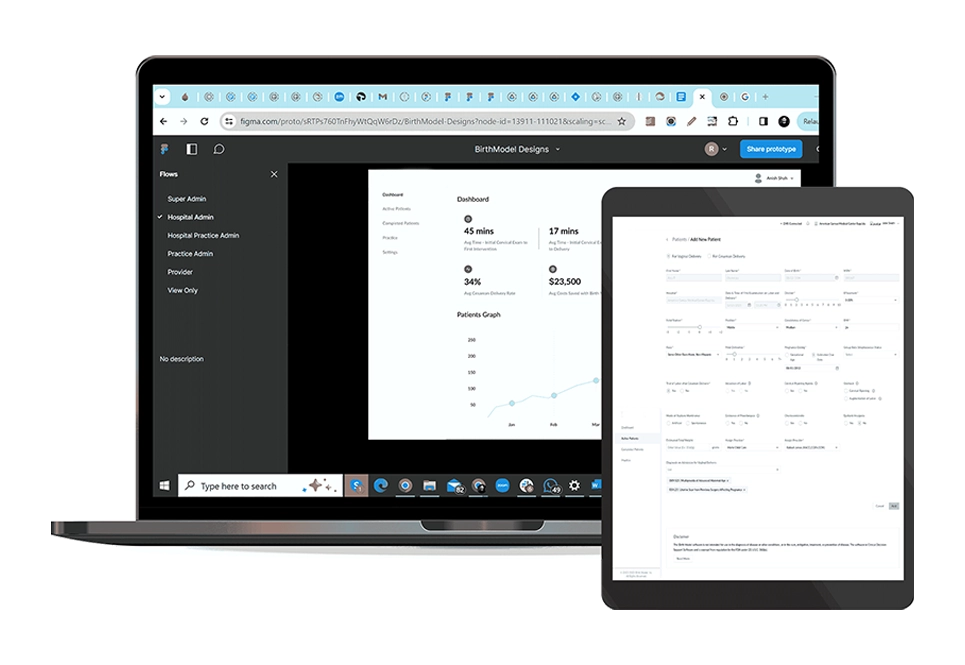
AI-Powered Transformation in Childbirth Management
“Our client, a childbirth management platform, used AI to improve the accuracy of predicting delivery times. By analyzing patient data with machine learning, the platform aids doctors in making better decisions and providing timely care. To address challenges like EHR integration, data security, and model reliability, we implemented a SMART-on-FHIR app for real-time updates and EPIC integration for seamless data management. AI-driven automation also streamlined post-delivery exams and data recording, reducing manual effort while maintaining HL7 standards for secure data exchange.”
How Mindbowser Can Help You With Generative AI in Healthcare Cost and Pricing
Building a Generative AI application in healthcare involves several stages, each with specific costs and considerations. The process includes gathering high-quality healthcare data, training models, and ensuring proper deployment to achieve effective outcomes. While the investment may be substantial, Generative AI can significantly improve healthcare operations through process automation, advanced problem-solving, and increased efficiency.
Mindbowser offers expertise in helping organizations manage the costs of implementing Generative AI in healthcare. With comprehensive support throughout the development process, we ensure better cost control, scalability, and efficient execution. Our experienced team helps customize and maintain AI models, allowing healthcare providers to make informed decisions and utilize Generative AI to address challenges and drive growth.