













 BLOGS
BLOGS  NEWSROOM
  CASE STUDIES
  WEBINARS
  PODCASTS
  ASSET HUB
  EVENT CALENDAR

















TL;DR
- FHIR is built for clinical data exchange it is how EHRs talk to each other in real time.
- OMOP is built for research it is the standardized schema used by 400+ organizations for analytics, population health, and drug safety studies.
- The gap between them is real: FHIR data is document-oriented and research-hostile; OMOP requires structured relational tables.
- Automated FHIR-to-OMOP pipelines close that gap, cutting what used to take 9–12 months to 3–4 weeks.
Healthcare systems generate massive amounts of data daily, but the data formats vary from one organization to another. The FHIR standards allow the clinical data exchange in provider/clinical settings. However, when it comes to large-scale data required by researchers and analysts, FHIR won’t be helpful due to variation in data formats. On the other hand, OMOP (Observational Medical outcomes partnership CDM (Common Data Model) is an open community data standard, designed to standardize the content and structure of observational data to enable efficient analysis that can produce reliable evidence to get relevant clinical outcomes.
In Healthcare organizations, the data is collected at different levels for different purposes, such as Patient registration, Insurance Eligibility and Verification, Patient care, Provider Claims, and Clinical Research. This data might be stored in different formats in multiple systems using different terminologies such as HL7, FHIR, or EDI messages. Even though there is an increase in the trend to use the Standard terminologies, the implementation and representation can be done in a variety of ways from one organization to another.
I. What are OMOP and the OMOP Common Data Model?
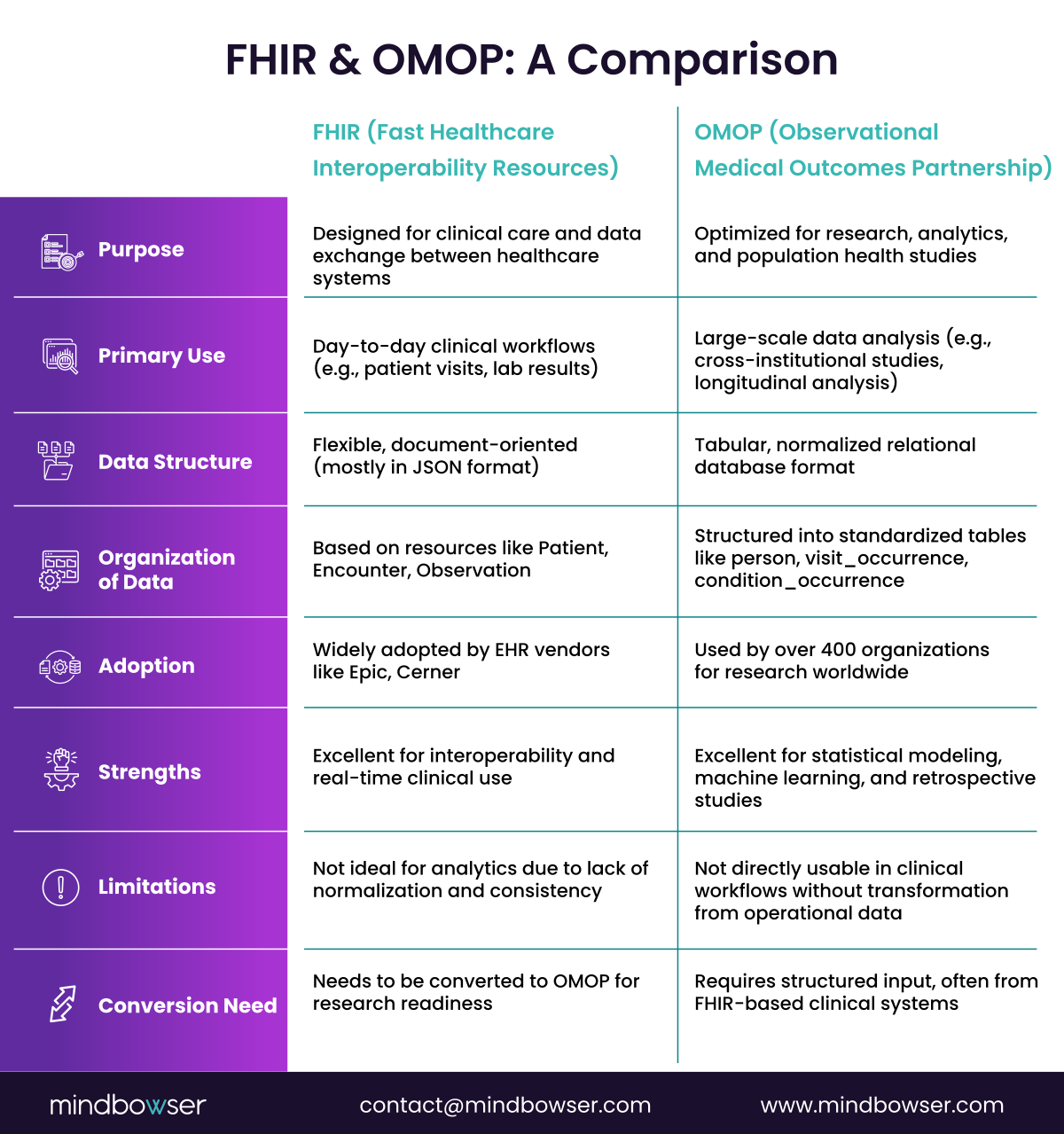
OMOP (Observational Medical Outcomes Partnership) is a standardized data model used in research, clinical trials, and population health studies to make patient data from different sources directly comparable. The OMOP Common Data Model (CDM) defines a set of standard tables: person, visit_occurrence, condition_occurrence, drug_exposure, measurement, observation and maps every clinical concept to standard vocabularies: SNOMED, LOINC, RxNorm.
Where FHIR defines how clinical data is exchanged between systems, the OMOP data model defines how that data is organized for analysis. They solve different problems, which is why converting FHIR resources to OMOP is a required step before FHIR-sourced data can feed OMOP-based analytics tools like ATLAS or multi-site research databases in the OHDSI network.
The OHDSI network currently spans 100+ data partners with 600M+ patient records. The FHIR-to-OMOP conversion pipeline exists to bridge the exchange format and the research format without losing clinical fidelity.
II. FHIR: The Clinical Care Standard
Fast Healthcare Interoperability Resources (FHIR) has emerged as the gold standard for healthcare data exchange. Epic, Cerner, and other major EHR vendors have adopted FHIR R4 as their primary API standard, enabling direct data sharing between healthcare systems. FHIR’s resource-based approach organizes clinical data into intuitive concepts like Patient, Encounter, and Observation, making it perfect for clinical workflows.
However, FHIR’s strength in clinical operations becomes a limitation in research contexts. The flexible, document-oriented structure that serves clinicians well doesn’t translate easily to the tabular, normalized format that researchers need for statistical analysis and machine learning applications. This is where FHIR to OMOP conversion becomes essential.
III. OMOP: The Research Powerhouse
The OMOP common data model allows us to analyse the differently structured observational databases. The primary idea behind this approach is to transform the data from these databases into a common data format as well as a common representation (terminologies, vocabularies, coding schemes) and then perform the systematic analysis using the standard analytic routines that have been written based on the common data.
FHIR to OMOP transformation enables consistent table structures that support:
- Cross-institutional research studies
- Longitudinal patient analysis
- Population health insights
- Drug safety surveillance
- Clinical quality measurement
IV. Why Do We Need CDM?
The observational databases differ in the purpose for which they are built and their design. The EMR/EHR is aimed at handling the patient intake, administrative workflow, insurance reimbursement process, etc. Each piece of data that has been collected at the clinical level is used for different purposes, and eventually, that results in different formats with different terminologies used for describing the clinical data, which varies from source to source.
The Common Data Model can consume different types of data from different sources and allows users to generate evidence data from a variety of sources. Also, it would also support collaborative research across data sources both in the US and outside the United States. In addition to the existing feature to make the data manageable for data owners, it would also make it useful for the data users.
Talk to Our FHIR-to-OMOP Team About Your Research Data Pipeline
V. Why Use OMOP CDM?
Once the clinical data have been converted to the OMOP CDM format, the data can be analysed using the standard analytical tools to generate the evidence. OHDSI (Observational Health Data Sciences and Informatics) is currently developing the open source tools for data quantity and characterization, comparative effectiveness, quality of care, and patient-level predictive modeling.
FHIR has been rapidly improving the data standardization in the U.S.A, and it has been a widely used format across different EHR and EMR systems. Whenever the data is required for research and analytical purposes, the organization connects with electronic health records to get the clinical records with masked patient personal information. The SMART on FHIR framework allows these organizations to download the clinical data from different health systems. The organization first needs to create and register the Bulk Export application with EHR, and also define the specific scope of data needed from the system. Once the application is approved and integrated with EHR, the Bulk export will get the required data from the health systems as per the defined scope.
When SMART applications perform the bulk export process, the EHR system generates JSON files for each FHIR resource as requested in the scope of the application. Once the files are ready, the EHR sends a status to the SMART application with files location on the server. The SMART application downloads the ndjson files and stores them in the application’s database.
VI. Converting FHIR data to OMOP
Now, the process of converting this data from ndjson to OMOP data tables contains several steps as described in the following figure.
1) Convert the ndjson file to jq files – First, the ndjson file needs to be converted into a single jq file for each FHIR Resources as the bulk export file results in a FHIR bundle resource that contains multiple patient data.
2) Generate tab-separated fragments – Once the bundle resource is converted into a single jq file, the second step is to convert the data into row fragments with tab separation, which will align the single patient data in a row with each element separated by tab in a tsv file.
3) Map Data to OMOP Table – The third and final step is to convert the tsv file data into a single row and map the data to the OMOP tables accordingly. This process would require awk for performing the fragment reduction from multiple rows in tsv file to a single row with specific data.
OMOP data tables enable researchers and analysts to generate output improving patient care quality across healthcare organizations and pharmaceutical companies.
For engineering mechanics: fragment generation, parallel processing, conflict resolution at 2,000+ records/second, see our fragment processing deep dive. For running this pipeline on Databricks (Bronze/Silver/Gold medallion architecture), see FHIR-to-OMOP on databricks.
VII. The Integration Challenge
The challenge lies in converting FHIR’s flexible JSON documents into OMOP’s structured relational tables. Traditional approaches to FHIR to OMOP conversion have relied on custom ETL (Extract, Transform, Load) processes that are:
- Time-intensive: 9–12 months to develop
- Maintenance-heavy: Constant updates for new data fields
- Error-prone: Manual mapping introduces inconsistencies
- Expensive: $500K–2M typical implementation costs
VIII. Enter Domain-Based Intelligent Routing
How Domain-Based Routing Works: medical terminology standards to automate the FHIR to OMOP conversion process. Instead of hard-coding mappings, this method uses the inherent domain classification within medical codes to intelligently route data to appropriate OMOP tables.
The domain-based routing described here is how Mindbowser’s FHIR-to-OMOP pipeline works in production. The upstream half, pulling FHIR bulk exports out of Epic, Cerner, and 20+ other EHRs and normalizing the resources before they hit the OMOP mapping, is handled by ConnectHealth, our healthcare integration platform, with Helix AI generating the mapping logic instead of a team hand-coding it. The OMOP side then routes each resource to the right table automatically.
A genomics research platform running a 5-year bulk FHIR pipeline used this approach to bring its OMOP transformation time from 11 months of custom ETL to a 3-week implementation with no loss of clinical fidelity.
A. How It Works:
- Extract medical codes from FHIR resources (SNOMED, LOINC, RxNorm)
- Lookup concept metadata in OMOP vocabularies
- Use domain classification to determine the target OMOP table
- Generate multiple records from a single FHIR resource as needed
For example, a single FHIR Encounter containing codes for a visit, diagnosis, and procedure automatically creates records in three separate OMOP tables: visit_occurrence, condition_occurrence, and procedure_occurrence.
B. Business Impact
Organizations implementing automated FHIR to OMOP conversion report:
- Up to 90% reduction in manual ETL effort (based on Mindbowser implementation benchmarks)
- 3–4-week implementation vs. 9–12-month custom builds
- Research-ready data available within hours of pipeline completion
- Significant first-year ROI, see our full FHIR-to-OMOP cost analysis for the business case breakdown
IX. The Future of Healthcare Analytics
As healthcare continues its digital transformation, the ability to rapidly convert operational data into research-ready formats becomes a competitive advantage. FHIR to OMOP automation helps organizations lead in:
- Evidence-based care delivery
- Population health management
- Clinical research acceleration
- Value-based care optimization
The convergence of FHIR and OMOP, enabled by intelligent automation, represents the future of healthcare analytics where clinical care and research excellence work hand in hand to improve patient outcomes.
Conclusion
FHIR and OMOP were never meant to compete. They were designed to solve fundamentally different problems. FHIR excels at real-time clinical interoperability, while OMOP unlocks large-scale, longitudinal analytics and evidence generation. The real challenge for healthcare organizations has been bridging the two without incurring massive cost, time delays, or data integrity risk.
As research, population health, and value-based care increasingly depend on high-quality observational data, manual and brittle ETL pipelines are no longer sustainable. Domain-based intelligent routing changes the equation. By leveraging standardized clinical vocabularies and automating how FHIR data is classified and mapped into OMOP, organizations can move from months of engineering effort to weeks of implementation, and from static datasets to continuously research-ready data.
The future of healthcare analytics will belong to systems that can operationalize clinical data and translate it into evidence at speed and scale. Automated FHIR-to-OMOP transformation is not just a technical optimization. It is a strategic capability that enables faster research, better insights, and ultimately, better patient outcomes.
Healthcare providers store vast amounts of clinical data in EHRs using formats like FHIR, which are great for patient care but not ideal for research. Researchers require structured, normalized data—typically in the OMOP format—for effective analysis and study.
FHIR (Fast Healthcare Interoperability Resources) is a standard for exchanging healthcare data electronically. It’s widely adopted by EHR vendors like Epic and Cerner and structures data around concepts like Patient, Encounter, and Observation, making it well-suited for clinical workflows.
FHIR is document-based and highly flexible, which benefits clinical use but complicates analytical tasks. Researchers need structured, tabular formats—something FHIR doesn’t inherently provide.
OMOP (Observational Medical Outcomes Partnership) is a Common Data Model designed to support healthcare research by transforming diverse clinical data into a standardized, analytics-friendly format. Unlike FHIR, which is optimized for clinical workflows, OMOP structures data into relational tables that enable powerful statistical analysis and machine learning. This makes it ideal for conducting cross-institutional research, tracking patients over time, analyzing population health trends, monitoring drug safety, and measuring clinical quality. With adoption by over 400 organizations worldwide, OMOP facilitates large-scale, collaborative studies that drive evidence-based healthcare improvements.