
 BLOGS
BLOGS  NEWSROOM
  CASE STUDIES
  WEBINARS
  PODCASTS
  ASSET HUB
  EVENT CALENDAR





















There is an increasing drive in organizations around the world to improve operational efficiencies and to reduce costs. Most companies aim to accomplish this drive through technological innovations. The demand for IT is ever increasing. The success or failure of any software company depends on their ability to complete the plans on time. It is also essential to complete these projects within the budget and to the specification. Since the IT needs of an organization are constantly changing, developing in-house capabilities for these projects can be risky. However, a company must keep up with advancements in the IT industry.
Any business falling behind the IT innovation curve can have disastrous outcomes. Companies also cannot afford to be content with their IT setup, as it can lead to them using outdated systems. As a result, the business could get crippled. Nowadays, many companies are seeking assistance in non-profile areas. One of the most beneficial delivery methods to complete IT projects is Staff Augmentation. This article aims to help you understand the concept of staff augmentation and its benefits.
What Is Staff Augmentation And Why Is It Important?
One of the most significant trends in the IT industry is the dramatic increase in the use of contingent workers globally. This practice first began when administrators across organizational borders were asked to fill in roles temporarily due to vacations and illnesses. Today, contingent work manifests itself in many working models. The most common model of the same is staff augmentation.
Staff augmentation is the process of hiring outside personnel temporarily to augment the capacity of your organization. It allows a company to add staff to their teams based on the skills required to support their initiatives. The hiring company provides all the necessary resources. This difference between this approach and simple hiring is that it only uses resources temporarily.
Here are a few types of staff augmentation techniques:
1. Commodity
This is done when an organization needs reliable workers to perform a task, but they do not require any skillset. Such staff augmentations include factory or warehouse work, and manual labor. It is usually required in retail and events industries.
2. Skill-Based
When organizations require specific skills, but the level of expertise is not that crucial. Such skills include typing, spreadsheet use. This kind of augmentation is needed in data processing, clerical work, and transcription.
3. Highly-Skilled
Some organizations require more advanced skills that are only attainable by significant training and experience. In this type of staff augmentation, the level of expertise is essential. It is used in fields such as software engineering, contract law and brand design.
The Process Of Staff Augmentation
Staff augmentation is leveraged by companies in a wide range of situations. This process is used to increase labor and fulfill the spike in everyday work. It is also used to hire specialized skills for a defined period. Staff augmentation can build entirely flexible labor and thus help in gaining a competitive advantage.
1. Identify Your Needs
2. Interview And Hire Staff
Based on your requirements, find candidates, and interview them. It is also essential to review the most relevant candidate.
3. Workforce Integration
Integrate the new employees into your team. Augmentation will significantly enhance your team’s efficiency.
4. Request Support
In most cases, you will have hired your augmented staff from a staffing organization. If so, you can request support from them to help you build a productive relationship with your augmented team.
Free Ebook On Different Outsourcing Models Explained
Staff Augmentation
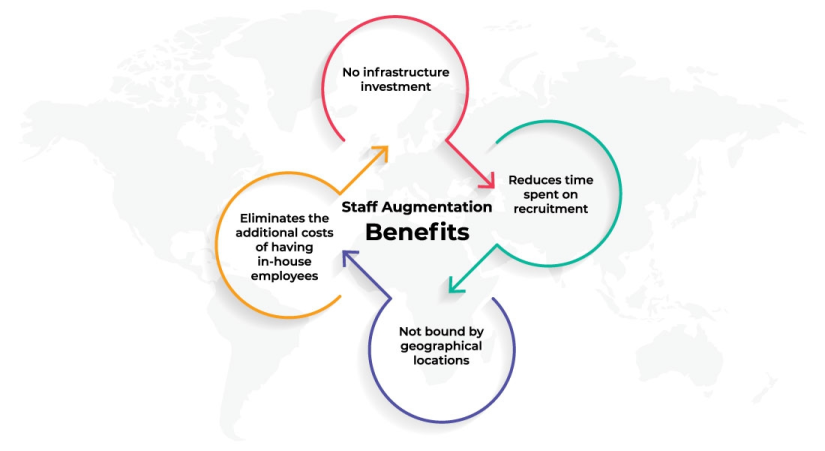
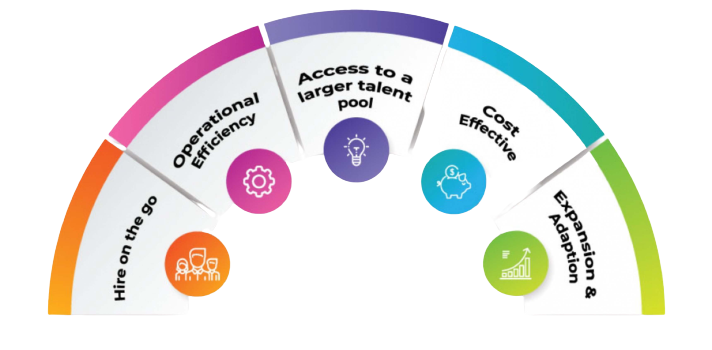
Here Are The Advantages Of Staff Augmentation
- More Control Over Staff
- Effective Integration With Internal Processes
- Leverage Existing Resources
- Expert Specialization
- Scalable Staffing Needs
- Reduced Skill Development Costs
- Reduced Liabilities
- Meet Deadlines
- Internal Acceptance
Choosing The Right Model
The most predominant outsourcing models are staff augmentation and managed services. While all models can provide you with a skilled workforce to assist your development team, there are some distinctions between these approaches. These are the key differences between managed services and staff augmentation:
MANAGED SERVICES
Transfer in project autonomy from the parent company to the service provider.
High accountability to the parent company.
Long term relationship between the service provider and the parent company.
Provides consultation about scaling operations.
Ideal for companies with specific goal-oriented outcome needs.
STAFF AUGMENTATION
Parent company retains a high degree of managerial control
It allows the parent company high flexibility.
Short term relationship between service seeker and service provider.
It offers high scalability of the workforce.
Ideal for companies looking to increase productivity while maintaining cost-effectiveness.
Read About How A Clinical Trial Platform Built Their Team With Mindbowser
While managed services concern a definitive deliverable, staff augmentation involves a job description, augmented staff is paid on a time and material basis. A managed service contractor would be paid upon completion of the project and the team works offsite. The biggest drawback of the managed services model is that the client has no control over the workflow. The lack of managerial control can lead to difficulty in communicating due to various barriers. As a result, the business can suffer losses due to quality issues. Hence, vendor reliability is a significant risk. Additionally, experienced vendor’s services can be quite expensive. On the other hand, with staff augmentation, the team works in-house. Therefore, the client maintains managerial control.
When considering staff augmentation, it is vital to determine your organizational goals. Based on your needs, you can find a mix of organizations to fulfill your requirements. Staff augmentation is a flexible staffing solution that lets you bring in external technical expertise when needed. Augmented staff can quickly integrate with your team and increase workforce productivity. They can stay for the entire duration of a project or only certain stages of it. If you want to increase your team’s efficiency while maintaining control, staff augmentation might be the best option for you.