In today’s mobile-driven world, location-based services have become integral to enhancing user experiences across various applications. React Native, with its ability to develop robust cross-platform applications, empowers developers to harness device location effectively. Let’s explore how a well-structured utility file can streamline location-related tasks, from obtaining permissions to fetching geolocation data and processing it for meaningful insights.
The first step in utilizing device location involves requesting and managing permissions. The utility functions requestLocationPermissionAndroid and requestLocationPermissionIos demonstrate platform-specific approaches to handling location permissions on Android and iOS, respectively.
This function, requestLocationPermissionAndroid, is an asynchronous utility for requesting location permissions on Android devices. It prompts the user for access to fine location services using a customizable permission dialog. The function checks if the permission request was granted, or denied, or if the user selected “never ask again” (indicating the permission is permanently blocked).
Based on the result, it returns an object containing the success status, error status, and whether the permission is blocked. If an error occurs during the permission request process, it catches the error and returns a failure response.

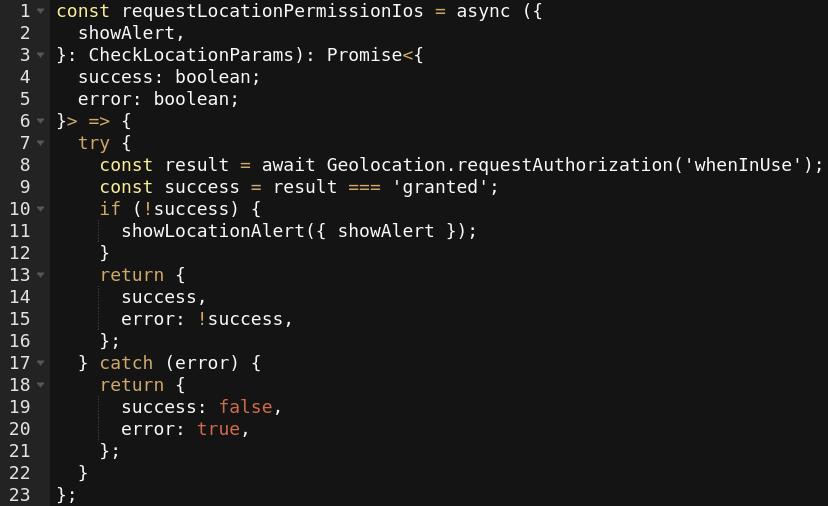
The requestLocationPermissionIos function is an asynchronous function that requests location permissions on iOS devices. It uses the Geolocation.requestAuthorization method to ask for permission to access location data when the app is in use. The function determines whether the permission was granted and, if not, triggers an alert to inform the user.
The function returns an object indicating whether the permission request was successful and whether an error occurred. If any exception occurs during the process, it catches the error and returns a failure response.
Once permissions are granted, fetching the device’s current position becomes crucial. The fetchLocation function demonstrates how to retrieve the current geo-position using react-native-geolocation-service.

Beyond obtaining coordinates, applications often require converting these coordinates into meaningful addresses. The utility functions getGeoCoderValues and getAddressFromCoords demonstrate how to integrate react-native-geocoding for geocoding tasks.

This function takes a geocoder response, extracts relevant address components (city, state, country) from it, and returns them in an object. It handles cases where no results are found or if there are errors during processing, ensuring robustness and error logging.

The getAddressFromCoords function is an asynchronous utility that extracts and returns the city, state, and country from a geocoding response. It checks if the response contains results, and if so, it processes the address components of the first result to identify and extract the relevant geographical information based on specific component types (locality for city, administrative_area_level_1 for state, and country for country).
If no results are found or an error occurs, the function returns an object with empty strings for each field, ensuring the application can gracefully handle cases where address information is unavailable.


Integrating robust location utilities into React Native applications empowers developers to create sophisticated, location-aware features. From enhancing user engagement with personalized content to optimizing operational efficiencies through geolocation-based services, the ability to harness device location is indeed a game-changer in mobile development.
By adopting these best practices and leveraging the provided utility functions, developers like Shrinath Himane can ensure their applications deliver seamless and impactful experiences in today’s competitive app landscape.
Join us for “Your 24/7 Clinical Knowledge Partner – The AI Companion” Webinar on Thursday, 30th July 2025 at 11:00 AM EDT
Register Now

We worked with Mindbowser on a design sprint, and their team did an awesome job. They really helped us shape the look and feel of our web app and gave us a clean, thoughtful design that our build team could...

The team at Mindbowser was highly professional, patient, and collaborative throughout our engagement. They struck the right balance between offering guidance and taking direction, which made the development process smooth. Although our project wasn’t related to healthcare, we clearly benefited...

Founder, Texas Ranch Security
Mindbowser played a crucial role in helping us bring everything together into a unified, cohesive product. Their commitment to industry-standard coding practices made an enormous difference, allowing developers to seamlessly transition in and out of the project without any confusion....

CEO, MarketsAI
I'm thrilled to be partnering with Mindbowser on our journey with TravelRite. The collaboration has been exceptional, and I’m truly grateful for the dedication and expertise the team has brought to the development process. Their commitment to our mission is...

Founder & CEO, TravelRite
The Mindbowser team's professionalism consistently impressed me. Their commitment to quality shone through in every aspect of the project. They truly went the extra mile, ensuring they understood our needs perfectly and were always willing to invest the time to...

CTO, New Day Therapeutics
I collaborated with Mindbowser for several years on a complex SaaS platform project. They took over a partially completed project and successfully transformed it into a fully functional and robust platform. Throughout the entire process, the quality of their work...

President, E.B. Carlson
Mindbowser and team are professional, talented and very responsive. They got us through a challenging situation with our IOT product successfully. They will be our go to dev team going forward.

Founder, Cascada
Amazing team to work with. Very responsive and very skilled in both front and backend engineering. Looking forward to our next project together.
Co-Founder, Emerge
The team is great to work with. Very professional, on task, and efficient.

Founder, PeriopMD
I can not express enough how pleased we are with the whole team. From the first call and meeting, they took our vision and ran with it. Communication was easy and everyone was flexible to our schedule. I’m excited to...

Founder, Seeke
We had very close go live timeline and Mindbowser team got us live a month before.

CEO, BuyNow WorldWide
Mindbowser brought in a team of skilled developers who were easy to work with and deeply committed to the project. If you're looking for reliable, high-quality development support, I’d absolutely recommend them.

Founder, Teach Reach
Mindbowser built both iOS and Android apps for Mindworks, that have stood the test of time. 5 years later they still function quite beautifully. Their team always met their objectives and I'm very happy with the end result. Thank you!

Founder, Mindworks
Mindbowser has delivered a much better quality product than our previous tech vendors. Our product is stable and passed Well Architected Framework Review from AWS.

CEO, PurpleAnt
I am happy to share that we got USD 10k in cloud credits courtesy of our friends at Mindbowser. Thank you Pravin and Ayush, this means a lot to us.

CTO, Shortlist
Mindbowser is one of the reasons that our app is successful. These guys have been a great team.

Founder & CEO, MangoMirror
Kudos for all your hard work and diligence on the Telehealth platform project. You made it possible.

CEO, ThriveHealth
Mindbowser helped us build an awesome iOS app to bring balance to people’s lives.

CEO, SMILINGMIND
They were a very responsive team! Extremely easy to communicate and work with!

Founder & CEO, TotTech
We’ve had very little-to-no hiccups at all—it’s been a really pleasurable experience.

Co-Founder, TEAM8s
Mindbowser was very helpful with explaining the development process and started quickly on the project.

Executive Director of Product Development, Innovation Lab
The greatest benefit we got from Mindbowser is the expertise. Their team has developed apps in all different industries with all types of social proofs.

Co-Founder, Vesica
Mindbowser is professional, efficient and thorough.

Consultant, XPRIZE
Very committed, they create beautiful apps and are very benevolent. They have brilliant Ideas.

Founder, S.T.A.R.S of Wellness
Mindbowser was great; they listened to us a lot and helped us hone in on the actual idea of the app. They had put together fantastic wireframes for us.

Co-Founder, Flat Earth
Mindbowser was incredibly responsive and understood exactly what I needed. They matched me with the perfect team member who not only grasped my vision but executed it flawlessly. The entire experience felt collaborative, efficient, and truly aligned with my goals.

Founder, Child Life On Call
The team from Mindbowser stayed on task, asked the right questions, and completed the required tasks in a timely fashion! Strong work team!

CEO, SDOH2Health LLC
Mindbowser was easy to work with and hit the ground running, immediately feeling like part of our team.

CEO, Stealth Startup
Mindbowser was an excellent partner in developing my fitness app. They were patient, attentive, & understood my business needs. The end product exceeded my expectations. Thrilled to share it globally.

Owner, Phalanx
Mindbowser's expertise in tech, process & mobile development made them our choice for our app. The team was dedicated to the process & delivered high-quality features on time. They also gave valuable industry advice. Highly recommend them for app development...

Co-Founder, Fox&Fork