













 BLOGS
 NEWSROOM
 CASE STUDIES
 WEBINARS
 PODCASTS
 ASSET HUB
 EVENT CALENDAR

























TL;DR
- Verification has two halves: eligibility (is the plan active on the visit date) and the benefits breakdown (what the plan pays for this patient’s planned codes, after history and limits).
- Run a full breakdown for new patients, plan changes and new treatment plans 2-3 business days before the visit. Everyone else gets an eligibility re-check. Everyone gets a re-check on the day.
- The costly misses are frequency and tooth-level history, replacement clauses, waiting periods, the missing-tooth clause, downgrades, network status and the order of benefits when there are two plans.
- A verified benefit is the payer’s statement on the day you asked. Payment is decided when the claim is processed, so tell the patient it’s an estimate, and use predetermination for major work.
- Track two numbers to know it’s working: denials caused by eligibility, and the gap between your estimate and what the patient owed.
The first thing I map on a verification build is the front-desk loop. Someone collects the insurance details, looks them up on a payer portal or over the phone, checks what’s covered, then types it all back into the practice management system (PMS). Then they do it again for the next patient.
Confirming the plan is active is the quick part. The surprise balances, the denied claims and the awkward conversations at checkout come from the benefits breakdown: the frequency history, the waiting period, the clause nobody asked about. That’s where most of this guide spends its time: how to verify dental insurance step by step, including the benefits breakdown, with a printable checklist at the end of that section.
What Does Dental Insurance Verification Actually Confirm?
Dental insurance verification confirms two things before a visit. First, eligibility: the patient’s plan is active on the date of service, under the subscriber and member ID you have on file. Second, the benefits breakdown: what that plan will pay for the specific procedures planned, once deductibles, maximums, frequency limits and plan clauses are applied.
Most offices get the first half right. It’s a yes or a no, and a portal or an electronic check answers it in seconds. But the second half decides the estimate. A plan can be active and still pay nothing for a cleaning the patient had at another office four months ago.
And the electronic route still doesn’t reach every plan. The 2025 CAQH Index puts dental plans’ adoption of fully electronic eligibility and benefit verification at 80%, down from 82% in the 2024 edition. It reports that dental adoption “slowed or fell” across every transaction except claim payment, in a year it describes as recovery from the Change Healthcare cyberattack.
The same report puts dental’s national spend on administrative transactions at $6.6 billion, with a further $1.9 billion that full automation could still save. Much of the gap is portal and phone work like the steps below.
The Dental Insurance Verification Process, Step by Step
Here are the seven steps in the order they happen. Steps 4 and 5 prevent the most surprise balances. Step 6 protects the office when a payer changes its mind later.
- Sort the schedule, then pick the window. A full breakdown is needed for new patients, anyone whose plan has changed, and anyone with a new treatment plan. Run those 2-3 business days before the appointment, which leaves a day for callbacks. Returning patients on the same plan with no new treatment need an eligibility re-check only. Same-day adds get checked when they book.
- Collect the details. From the patient: subscriber name and date of birth, relationship to the subscriber, member ID, group number, employer, any second plan, and a Medicaid ID if they have one. Ask for a photo of both sides of every card. Ask Medicare patients whether their plan includes dental, and for that dental plan’s own card (more on that below). From the office: have the billing provider’s NPI (National Provider Identifier) and the practice’s tax ID ready, because payer phone lines and portals ask for them before they’ll discuss a patient. If the patient has a discount or in-office membership plan, there’s no payer to verify with: apply that plan’s fee schedule and skip to step 7.
- Check eligibility. There are three routes: the payer’s portal, the payer’s phone line, or an electronic inquiry sent through a clearinghouse (how dental clearinghouses compare). The electronic route is the X12 270/271 transaction, HIPAA’s standard for eligibility inquiries, dental included. Your system sends a 270 request, and the payer answers with a 271.
- Pull the benefits breakdown for the planned codes. Ask about each code on the treatment plan; a plan-level summary won’t settle the estimate. The questions are in the next section. Past explanations of benefits (EOBs) are useful for history in step 5, and the current breakdown has to come from the payer.
- Check service history against frequency limits. For every code you plan to bill, get the last date the plan paid it, and for crowns, bridges and fillings, which tooth and surface. Exam, cleaning and x-ray codes are the usual suspects (D0120, D1110, D0274, D0210 on most schedules). A frequency limit means nothing without the last date of service.
- Write it down where the next person will look. Record the date and time you checked, the method, the representative’s name and the call reference number, or save a portal screenshot. The ADA’s eligibility verification guidance recommends recording the date, time and representative, because it’s the office’s evidence if a payer later says the patient wasn’t covered. Put the benefits into the PMS fields that drive the estimate, where the next person will see them.
- Estimate and tell the patient before the visit. Give them their expected portion, say it’s an estimate, and name the items that depend on a clause (a downgrade, a frequency limit). Re-check eligibility on the day of the visit.
The Benefits Breakdown Checklist: What to Ask, in Call Order
This section decides the estimate, and the order of questions decides whether a second call is needed. Payer representatives answer the question asked, in the scope it’s asked. “What’s covered for basic?” gets a percentage. Questions about the codes on the treatment plan get the answer the estimate needs.
Work through them in this order, on the phone or in the portal:
- Network and fee schedule. Is the office in network for this plan, and which fee schedule applies? For a DHMO plan, is the patient assigned to this office? Out of network, does the payer pay the office or the subscriber?
- Plan year. Calendar year or benefit year? When does it renew? (Everything below resets on that date.)
- Deductible. How much, how much is met, and does it apply to preventive care?
- Annual maximum. The amount, and how much is left.
- Coverage percentage for each planned code’s category (preventive, basic, major), and which category this plan puts endodontics, periodontics and extractions in, since plans differ.
- Frequency limits and history, per code. How often is it covered, when was it last paid, and is that limit shared with any other code?
- Replacement clause and tooth-level history. How many years before the plan pays to replace a crown, bridge or denture, and when was this tooth (and surface, for fillings) last treated?
- Waiting periods. Is there one for basic or major work, and has it been met? The clock usually runs from the coverage effective date, unless the plan waives it for prior coverage.
- Age limits. Fluoride, sealants and orthodontics often stop at an age. Ask, too, when dependents come off the plan: dental plans set their own cutoff.
- Missing-tooth clause. Does the plan exclude replacing a tooth that was missing before coverage started?
- Alternate benefit. Will the plan pay a cheaper procedure’s rate instead (for example, a posterior composite paid at the amalgam rate)?
- Orthodontics. The lifetime maximum and how much has been used (including under a previous plan with the same payer), the age limit, and whether treatment already in progress is covered.
- Predetermination. Is one required for any planned code? (Predeterminations and claim narratives get their own guide.)
- The close. “May I have your name and a reference number for this call?” Confirm the payer ID and claims address while you’re there.
Stop when an answer comes back as “it depends”, when a limit arrives as free text that can’t be tied to a code, or when the representative can’t say whether a limit is shared. Those answers turn into denials. So hand them to one named owner (usually the insurance coordinator or billing lead) the same day, with the call reference. If coverage comes back inactive, call the patient before the visit and offer a self-pay estimate or a reschedule. Nobody should find out at the chair.
A verified benefit is the payer’s statement on the day you asked. But payment is decided when the claim is processed, against eligibility, history and maximums at that point, so the patient hears it as an estimate. For major work (crowns, bridges, implants, larger perio cases), a predetermination is the closest thing to a commitment in advance: the payer reviews the planned treatment before you start, and its answer still depends on the patient being eligible on the day of treatment.
Turn Insurance Verification Into an Automated Workflow
Second Plans, Medicaid, and Medicare Advantage: The Checks Behind Wrong-Plan Denials
Two plans mean one more decision before anyone can estimate: which plan pays first. The claim has to go to the primary plan first. Sent to the secondary, it comes back denied.
For most insured plans, the order of benefits follows rules states take from the NAIC Coordination of Benefits Model Regulation (model 120). The ones the front desk meets every week:
- The patient’s own plan comes before a plan that covers them as a dependent. If the patient is the employee on one plan and a spouse’s dependent on another, their own plan is primary.
- The birthday rule for children of parents who live together. The plan of the parent whose birthday (month and day, not year) falls earlier in the year pays first. If both parents share a birthday, the plan that has covered the parent longer goes first.
- Separated or divorced parents. A court decree that makes one parent responsible for the child’s coverage decides the order. With no decree, the model’s order is: the custodial parent’s plan, then the custodial parent’s spouse’s plan, then the non-custodial parent’s plan, then the non-custodial parent’s spouse’s plan.
- Active coverage before retiree or continuation coverage. When the rules above don’t settle it, a plan covering someone as an active employee pays before a plan covering them as a retired or laid-off employee, and before COBRA or state continuation coverage.
Dental plans are inside these rules too: the NAIC’s 2013 revision of the model made clear that dental coverage counts as a “plan” for coordination of benefits. But two exceptions catch people out. Self-funded employer plans sit outside state insurance law (the Supreme Court said so in FMC Corp. v. Holliday, 1990), so their order comes from the plan document, which has to be asked about.
And Medicaid generally pays last: federal Medicaid law requires states to treat group health plans, self-insured plans and other insurers as liable first. On the call, ask the secondary plan whether it applies a non-duplication clause, because some secondary plans pay little or nothing once the primary has paid its share.
Medicaid needs its own check as well. Confirming coverage is step one; the real question is which plan holds the dental benefit on the date of service. States run Medicaid dental in different ways. As the North Carolina Medical Journal set out in November 2024, a state may contract with a managed care organization that covers both medical and dental benefits (carve-in), separate dental out to a dental-focused plan (carve-out), or pay dentists directly on a fee-for-service basis.
So after the state eligibility response, confirm which plan the patient is assigned to, check that the office is in that plan’s network, and follow that plan’s rules. And members can move between plans, so re-check managed-care patients at every visit.
Medicare Advantage has a similar trap. Original Medicare doesn’t cover routine dental care, but most Medicare Advantage plans add a dental benefit, and many run it through a dental vendor rather than the medical plan’s own network. As Milliman described in 2021, plans have built dental networks “either via direct contracts or by using subcontracted dental vendors.”
So the patient’s medical card is the starting point. Ask for the dental plan’s card, or the dental administrator’s name and phone number, and verify it there.
Where Manual Verification Breaks
Even a careful team hits these six leaks. Most of them are built into how dental benefits are delivered today.
- The electronic response comes back thin. A 271 carries an active plan and a coverage percentage easily. A frequency limit shared across several codes is harder. X12’s own interpretation (RFI 2773) says that in the HIPAA version of the 271, “we do not have a way to provide a response that would be better parsable,” so payers often put the codes in a free-text message segment. The data is there. A person has to read it.
- Every portal is different. Each payer’s portal lays out benefits its own way, so every lookup starts with finding where this payer puts the answer.
- Coverage ends after you checked. The ADA’s guidance warns that employers report terminations late and payers can terminate coverage retroactively, then recoup what they paid. The note from step 6 is what protects the office.
- The plan changed since the last visit. A new job means a new plan, and the old member ID still sits in the PMS.
- Re-keying errors. Every value copied from a portal into the PMS is a chance to type it wrong. Wrong values make wrong estimates. This is the leak I design hardest against when we build verification software, because it’s the one training can’t fully remove.
- The wrong plan pays first. A missed second plan, a misapplied birthday rule, a Medicare Advantage dental benefit checked against the medical plan, or a Medicaid patient checked against the wrong managed-care plan.
Leak 1 is the one I’d explain to anyone who says “we already have electronic eligibility.” It’s why the phone calls keep happening: the dental 271 can’t carry everything the estimate needs, so someone still reads the rest.
What’s changing next (as of October 2026). The CAQH CORE Eligibility & Benefits Data Content Rule vEB.2.1, approved in June 2025 and voluntary to adopt, asks dental responses to detail frequency limitations, waiting periods, age restrictions and maximum and remaining benefits. Until your payers adopt it, keep the phone and the portal in the process.
What Automating Verification Changes, and What Stays a Person’s Job
Software can run most of the loop. The judgement calls stay with your team:
| Step | Done by hand | Done by software | Still a person’s job |
|---|---|---|---|
| Collect details | Card photo, typed into the PMS | Pre-visit intake; card data checked against the PMS | Resolving a mismatch with the patient |
| Check eligibility | Portal or phone, one patient at a time | Batch 270s for tomorrow’s schedule, real-time for same-day adds | Patients the payer can’t find |
| Pull the breakdown | Read the portal, work through the call order | Read the 271; fill gaps from portals, benefit documents or payer calls | Free-text limits, “it depends” answers |
| Service history | Look up last-paid dates by code and tooth | Compare history to frequency and replacement limits | Disputed history |
| Document | Notes, screenshots | Benefits written into the PMS fields, with a timestamped record | Spot-checking the exceptions queue |
| COB, Medicaid, Medicare Advantage | Ask, then decide | Flag second plans and plan assignments | Deciding the order when it’s unclear |
| Estimate | Calculated by hand | Calculated from the written-back fields | The conversation with the patient |
If your PMS or clearinghouse already sends 270s, the questions that matter are where the answer lands and what happens to the fields a 271 can’t carry. And a 271 shown on a separate screen still has to be read and typed into the PMS by someone.
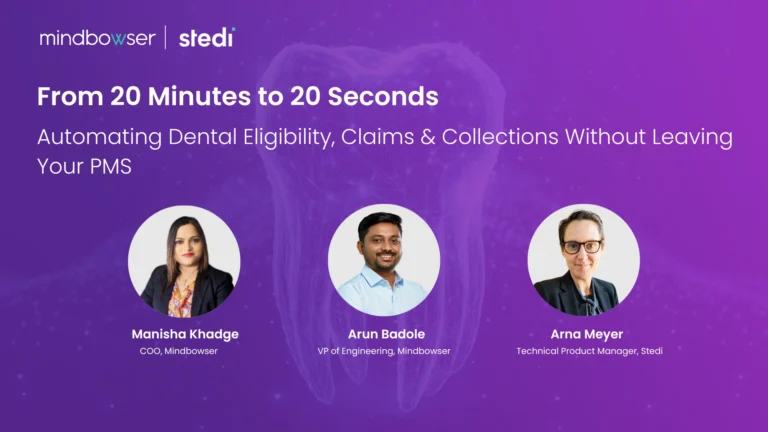
We build dental insurance verification automation that writes the verified benefits into your PMS fields and puts the gaps in one queue for a person. I walk through that write-back live, in a real Open Dental environment, in our dental eligibility automation webinar.
How to Tell Your Verification Process Is Working
A dental insurance verification process is working when two key numbers improve: the share of denials caused by eligibility or coverage issues and the gap between estimated patient costs and the actual amount owed after claim processing.
Review denial reasons monthly to identify issues such as inactive coverage, incorrect plans, exceeded frequency limits, replacement restrictions, and unmet waiting periods. A shrinking gap between estimated and actual patient costs shows that the verification steps are working.
Start with the printable dental insurance verification checklist. If verification still takes a morning each day, Mindbowser can help review your workflow.
For further guidance, explore dental claim narratives, Open Dental integration, and ConnectHealth’s real-time X12 270/271 eligibility checks through Stedi, deployed within your own cloud environment.