













 BLOGS
 NEWSROOM
 CASE STUDIES
 WEBINARS
 PODCASTS
 ASSET HUB
 EVENT CALENDAR




























TL;DR
- The general telemedicine prescribing flexibility expires December 31, 2026, no matter what happens with the pending special registration rule. Buprenorphine telemedicine prescribing is separately permanent, but capped at a six-month audio-only window per patient.
- The special registration rule that would replace the temporary extension is sitting at OIRA as of today, with a review window that could close before or after the deadline.
- Your platform’s e-prescribing workflow needs pathway-aware logic, inline PDMP checks, DEA/1311.115-compliant two-factor signature controls, and schedule-specific refill rules regardless of which way the pending rule goes.
The DEA’s telemedicine prescribing rules aren’t one rule. They’re three separate tracks moving at three different speeds, and only one of them has a hard deadline most platforms haven’t actually built for.
We’ve spent the last few months pulled into conversations with telehealth founders and compliance leads who read the same six law-firm alerts we did and came away with the same question: is this actually settled, or do I still need to do something before January? Short answer: you need to do something before January. The long answer depends on which of the three tracks your prescribing workflow touches.
What this piece covers, in order: where the rules stand as of today (October 20, 2026), why “DEA telemedicine prescribing rules” is three separate regulatory tracks and not one evolving story, what the current rule requires inside your e-prescribing workflow right now, what to check in your platform before December 31, what happens under either outcome of the pending special-registration rule, and who the rule actually binds (hint: not your patients).
Where the DEA Telemedicine Prescribing Rules Actually Stand Right Now

The current telemedicine flexibility for prescribing controlled substances runs through December 31, 2026. That’s the fourth temporary extension DEA and HHS have issued since the COVID-19 public health emergency waivers first suspended the Ryan Haight Act’s in-person exam requirement, and it’s set in Federal Register document 2025-24123 (effective January 1, 2026 through December 31, 2026).
Here’s the part most of the law-firm coverage glosses over. On August 25, 2026, DEA sent its long-promised special registration rule, the permanent replacement for these temporary extensions, to the White House’s Office of Information and Regulatory Affairs for review. OIRA review has no fixed minimum, but the statutory maximum is 90 days plus one possible 30-day extension. Count from August 25 and that window runs to late November, with room to stretch into December. As of today, there’s no Federal Register entry. The rule hasn’t published.
So we’re sitting in an odd gap: the deadline is fixed, the replacement isn’t public yet, and the timing is close enough that it could land before the deadline, or not.
Timeline: DEA telemedicine controlled substance prescribing rules, 2008-2026. Six markers: 2008 Ryan Haight Act baseline (in-person exam required); March 2020 COVID-19 PHE waiver suspends it; 2023-2024 first and second temporary extensions; January 17, 2025 DEA/SAMHSA finalize the permanent buprenorphine telemedicine rule (6-month audio-only cap), effective February 16, 2025; 2025-2026 third and fourth extensions, current extension (2025-24123) running January 1 to December 31, 2026; August 25, 2026 DEA submits the special registration rule to OIRA.
Three Pathways, Not One Rule
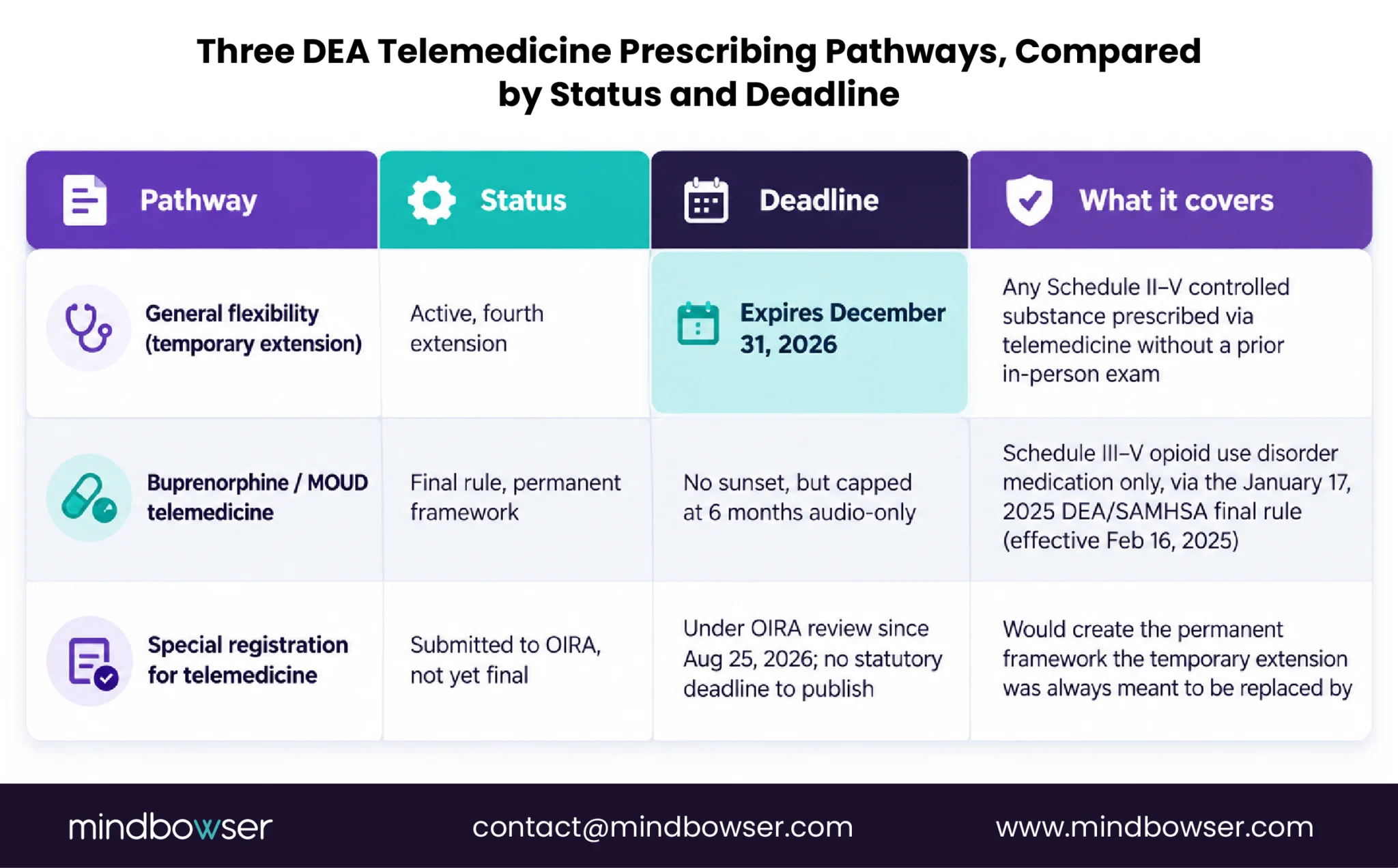
This is the part that trips up most compliance reads. “DEA telemedicine prescribing rules” sounds like one topic. It’s actually three pathways, each with its own clock.
We’ll be honest about one thing here: the buprenorphine rule gets called “permanent” in almost every summary we’ve read, including some of our own early drafts of this piece. That’s half right. The framework is permanent. The audio-only window inside it isn’t. A patient can start on a six-month supply from an audio-only encounter, but continuing past six months requires an audio-visual or in-person evaluation. If your platform’s buprenorphine workflow doesn’t track that six-month clock per patient, “permanent” is doing more work in your head than it’s doing in your code.
What the Current Rule Actually Requires in Your Prescribing Workflow
Set the pending rule aside for a second. The extension in force right now, through December 31, is layered on top of DEA’s existing electronic prescribing controls for controlled substances (EPCS), which were never telemedicine-specific and never went away.
Three requirements matter most for anyone building or auditing an e-prescribing module:
- Identity proofing. 21 CFR 1311.105 requires practitioners to obtain their authentication credential through an approved credential service provider or certification authority. Remote identity proofing is permitted, which matters for a telemedicine-only practice with no physical onboarding site.
- Two-factor authentication at the point of signature. 21 CFR 1311.115 requires two of three factor types: something the practitioner knows, something they have, something they are. A password alone doesn’t clear this. Neither does a single hardware token. We’ve seen platforms pass identity proofing cleanly and then fail here, because the e-prescribe signature step was built against a generic auth flow instead of DEA’s specific two-factor requirement.
- Refill and multi-script limits by schedule. 21 CFR 1306.12 bans refills outright for Schedule II. It allows an individual practitioner to write up to three sequential prescriptions covering a 90-day supply, as long as each one is medically justified and carries an earliest-fill date. Schedule III-V allows refills (up to five within six months, per the underlying statute). Those are different rule sets, and a platform that applies one refill logic across all schedules will eventually generate a prescription DEA would flag.
None of this is new because of telemedicine. What’s new is that telemedicine removed the in-person checkpoint where a lot of this used to get caught manually. If your workflow never had to enforce these programmatically because a human always double-checked at the front desk, the audio-video model is where that gap shows up.
Building or Scaling a Telepsychiatry Platform?
What to Check in Your Platform Before December 31, 2026
We built a HIPAA-compliant telemedicine platform end-to-end in 21 days for a client earlier this year, full video, scheduling, and e-prescribing stack from a blank repo. The fastest part of that build was the video layer. The part that actually took the time was the prescribing-compliance logic, because compliance logic doesn’t fail loudly. It fails quietly, three months later, when an auditor pulls a sample.
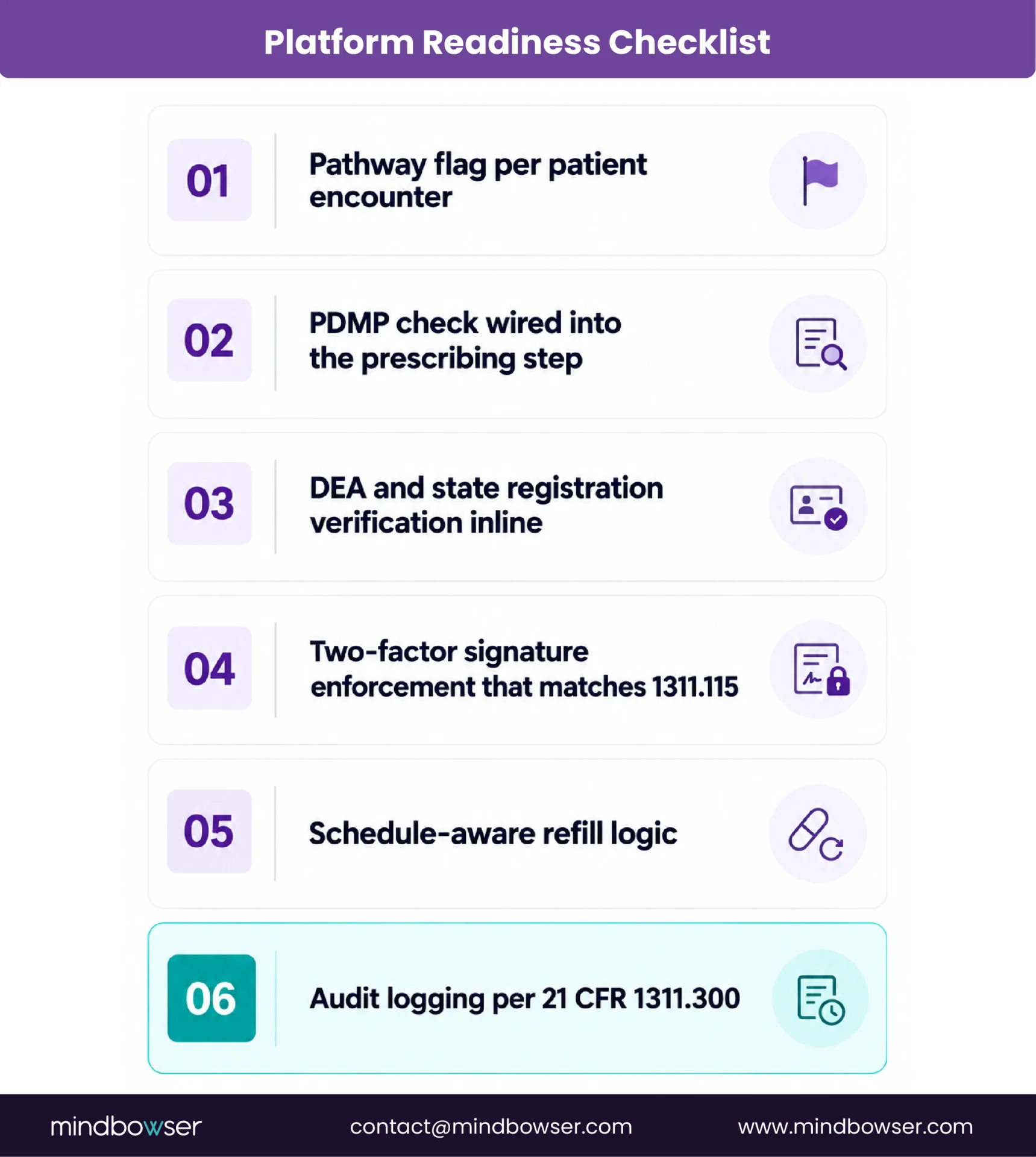
Here’s the checklist we’d run against any telemedicine platform right now, regardless of which direction the special registration rule goes.
- Pathway flag per patient encounter. Does the system know, at the point of prescribing, whether this encounter falls under the general flexibility, the buprenorphine/MOUD pathway, or neither? Most platforms we’ve audited track “controlled substance: yes/no.” Almost none track which of the three pathways applies.
- PDMP check wired into the prescribing step, not a separate manual lookup. State prescription drug monitoring program checks are mandatory in most states before controlled substance prescriptions; bolting this on as a side process is where it gets skipped under time pressure.
- DEA and state registration verification inline, checked against the prescribing provider’s actual state of licensure for that encounter, not just their home state.
- Two-factor signature enforcement that matches 1311.115, not generic app-level 2FA. If your e-prescribe step and your login step share the same auth logic, check whether that logic actually satisfies the factor-type requirement.
- Schedule-aware refill logic. Separate rule paths for Schedule II (no refills, 90-day multi-script with earliest-fill dates) versus III-V (refills allowed, capped).
- Audit logging per 21 CFR 1311.300, with records retained and reviewable, not just a database row with no export path.
What Happens if the Special Registration Rule Publishes Before December 31, and What Happens if It Doesn’t
Nobody on page one of this topic actually walks through both branches. We will, because both are live possibilities right now.
If the special registration rule publishes before December 31: the temporary extension’s deadline becomes moot, but only for platforms that have actually read the new rule’s requirements, which based on the 2025 proposal would likely include separate registration categories for general telemedicine prescribing, a more permissive track for specialties like psychiatry and hospice, and a telemedicine-platform-level registration distinct from the individual practitioner’s DEA number.
If your platform architecture assumes one registration model, you’d need to rebuild part of your onboarding and verification flow fast, inside whatever transition window the final rule allows.
If it doesn’t publish in time: DEA has extended this flexibility four times already, each time before the prior deadline hit. We’d bet on a fifth extension over a hard cliff into the pre-2020 Ryan Haight requirements, which would functionally end audio-video-only controlled substance prescribing for most telehealth-first practices overnight. That said, we’ve been wrong about regulatory timelines before, and “they always extend it” is a pattern, not a guarantee.
Either way, the checklist above holds. Pathway-flagging, PDMP integration, and audit logging aren’t deadline-specific fixes. They’re the foundation any version of this rule, temporary or permanent, is going to require.
Schedule II vs. III-V, and Who the Rule Actually Binds
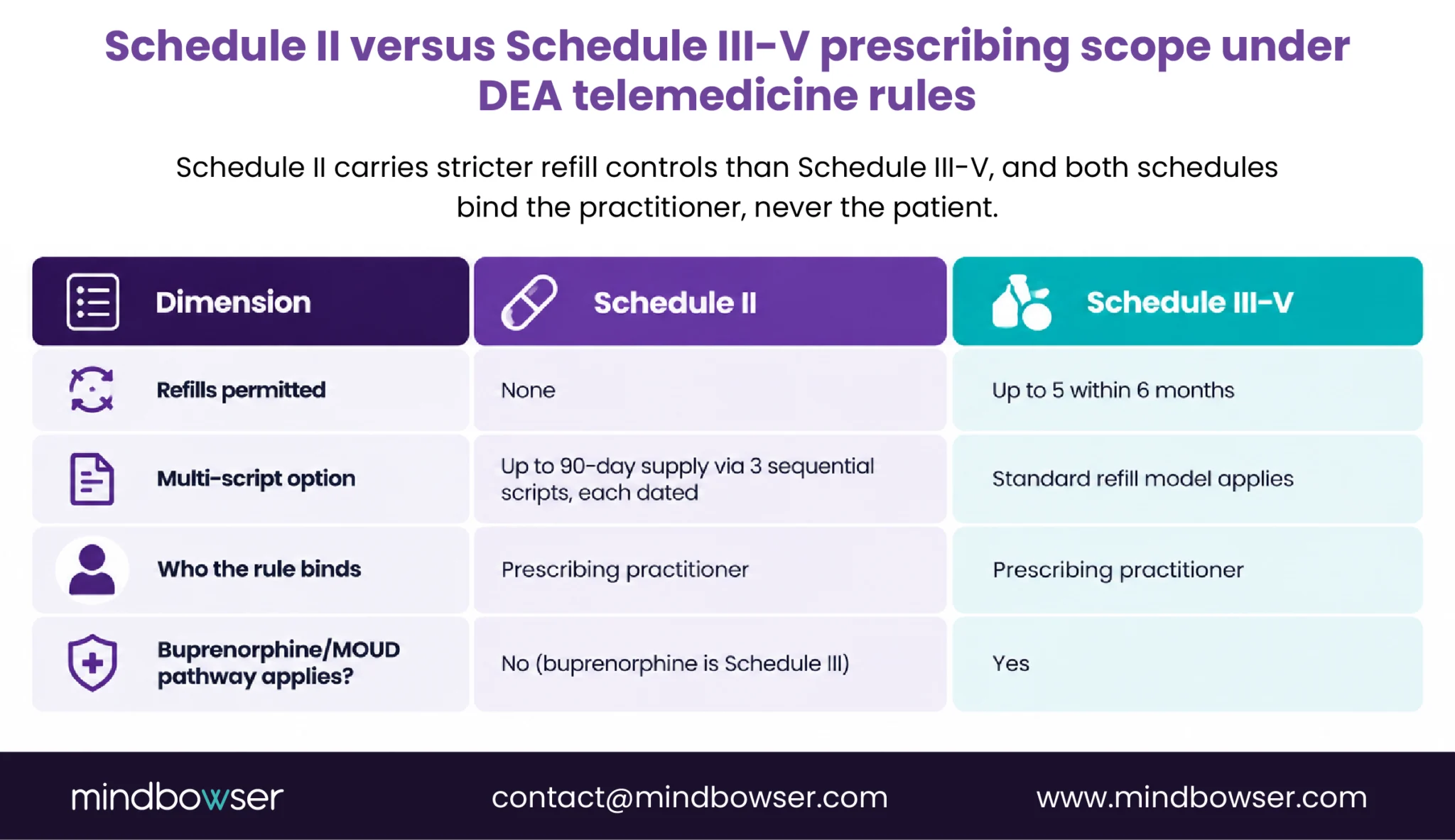
One scope question we get asked constantly, often by people who’ve read three client alerts and are still unsure: does this rule reach the patient, or the practitioner?
It binds the prescribing practitioner, not the patient. A patient receiving a telemedicine prescription has no DEA compliance obligation. The burden, identity proofing, two-factor authentication, PDMP checks, registration verification, sits entirely on the prescriber and, by extension, on the platform that routes their prescribing workflow. We’ve seen more than one scope-confusion case in this space resolve exactly backward, where a team spent weeks building patient-facing consent flows for a rule that never touched the patient side at all.
If your practice touches telepsychiatry or any behavioral-health prescribing specifically, the scope questions get more layered; state licensing compacts like PSYPACT interact with the federal rules here in ways that deserve their own treatment. We covered the EPCS and multistate licensing readiness checklist for telepsychiatry platforms separately, and it’s worth reading alongside this piece if that’s your specialty.
If telepsychiatry is where most of your prescribing volume actually lives, the two pieces together cover more of your real compliance surface than either one alone.
And if the HIPAA side of your architecture, not just the DEA side, is the thing you’re least sure about, our breakdown of HIPAA-compliant telehealth platform requirements is the natural next read. For behavioral-health-specific HIPAA questions, HIPAA rules for behavioral health telehealth go deeper into 42 CFR Part 2’s overlay with HIPAA, which matters more in this specialty than almost anywhere else in telehealth.
Where Does This Leave You
The general flexibility expires December 31, 2026, regardless of what happens with the special registration rule. The buprenorphine pathway is permanent but capped at a six-month audio-only window per patient. The special registration rule is sitting at OIRA, with a review window that could close before the deadline or stretch past it. None of that changes what your platform needs to enforce right now: pathway-aware prescribing logic, inline PDMP checks, two-factor signature controls that actually match 1311.115, schedule-specific refill rules, and audit logging that would survive a real review.
If you’re past the early-stage build and thinking about what else changes in your compliance stack as you scale, this prescribing checklist is one piece of a bigger picture. We’ve written separately about what changes in your compliance stack past Series B, where DEA prescribing controls are one of several requirements that show up once a telehealth platform crosses from early-stage to growth-stage.
We’re watching OIRA’s docket the same way everyone else writing about this topic is. The difference is we’d rather spend December making sure a platform’s prescribing architecture holds up than writing another alert about whether it’s “legal.” If you want a second set of eyes on where your platform actually stands against this checklist.
What we’re still watching closely, and don’t have a clean answer for yet: whether the special registration rule’s platform-level registration category, if it survives from the 2025 proposal into the final text, changes how telemedicine platforms themselves (not just individual prescribers) get treated under DEA’s registration scheme. That one has broad implications most compliance reads won’t catch until it’s published. If you’re tracking it too, we’d genuinely like to compare notes.