










 BLOGS
 NEWSROOM
 CASE STUDIES
 WEBINARS
 PODCASTS
 ASSET HUB
 EVENT CALENDAR



















TL;DR
- Generic EMRs struggle with GI workflows because procedure documentation, pathology results, ASGE metrics, prior authorization, and billing often live in disconnected systems or manual processes.
- Commercial GI EMRs work best for simpler setups, while multi-site practices, multiple pathology labs, ASC-plus-office billing, and advanced quality reporting often expose their limits.
- AI can reduce documentation burden when it is built into the workflow, turning structured procedure data into draft notes while automatically feeding ADR, CIR, withdrawal time, and other quality metrics.
- Custom GI EHR development makes the most sense for complex practices that need multi-lab FHIR routing, population-level reporting, AI-enabled documentation, and tighter integration across clinical, billing, and pathology workflows.
What Makes Gastroenterology Documentation Uniquely Hard for Generic EMRs?
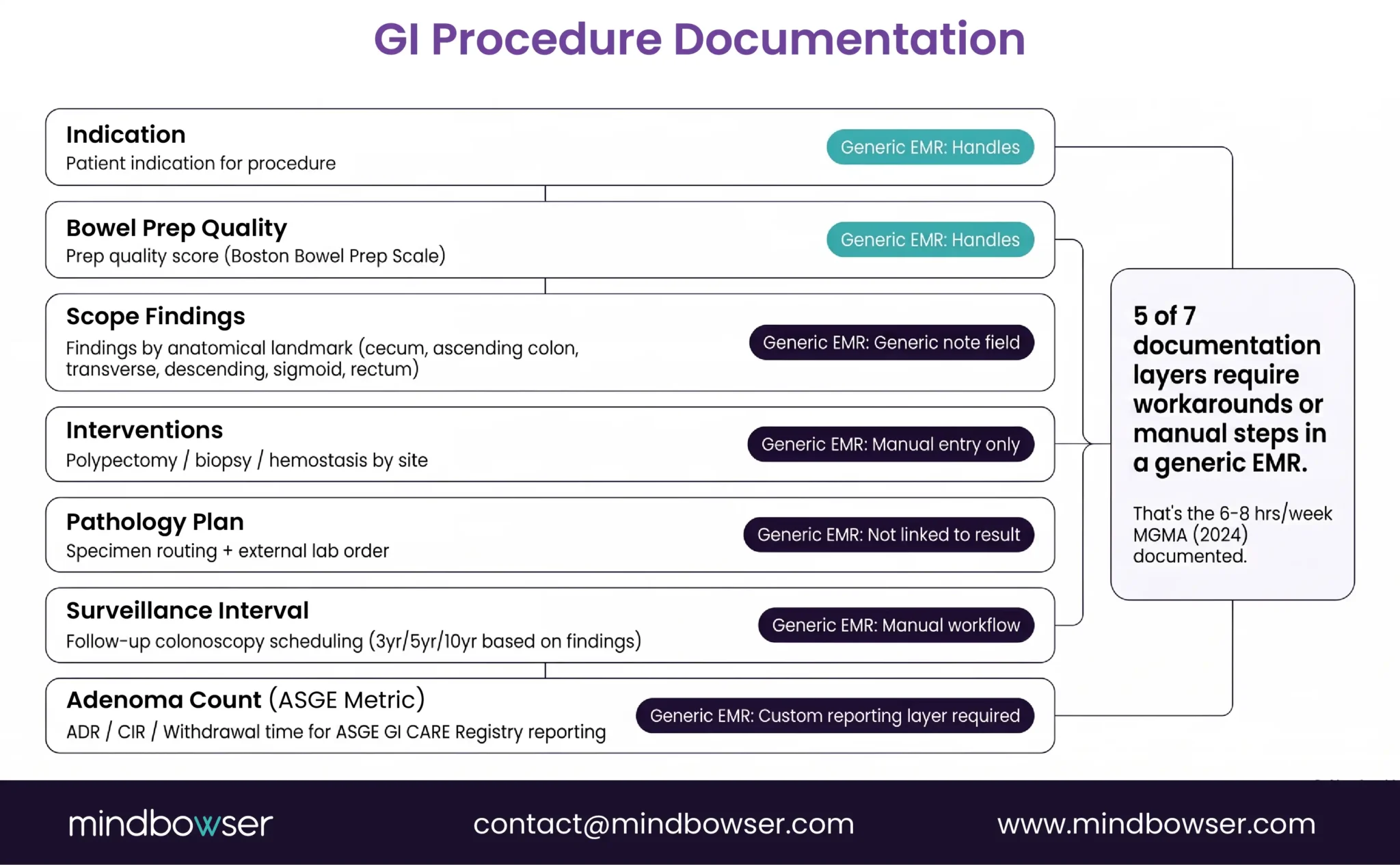
A standard office-visit EMR handles one documentation event: provider sees patient, documents encounter, closes note.
GI procedures generate 5-7 distinct documentation layers from a single visit: indication, bowel prep quality, scope findings at each anatomical landmark, interventions (polypectomy, biopsy, hemostasis), pathology plan, follow-up surveillance interval, and adenoma count for ASGE quality reporting.
Generic EMRs handle the first two. They fall apart on everything after. Every time.
Three specific gaps show up in every GI practice I’ve reviewed running on a generic EMR:
ASGE quality metrics aren’t tracked natively: ADR (adenoma detection rate, target ≥25%), CIR (cecal intubation rate, target ≥95%), withdrawal time (target ≥6 min). These are payer-reportable benchmarks under MIPS and the ASGE GI CARE Registry. ASGE (2023) established them as the standard quality floor for colonoscopy programs. I’ve never seen a generic EMR calculate these natively from the procedure note. Not once. Custom reporting layer bolted on, every time.
Prior auth rates are highest in GI: Colonoscopy and EGD are among the top 5 most-denied outpatient procedures per CMS (2024). Generic EMRs don’t carry GI-specific prior auth logic. Your billing team handles this manually. Every time. For every patient.
Biopsy routing is a manual reconciliation job: Specimen travels to an external pathology lab. Result arrives separately, in a different inbox. Someone manually reconciles it into the procedure note. Every day. No commercial EMR closes this loop automatically.
But the deeper problem is the data model.
Generic EMRs model encounters: GI procedures generate specimen data, procedure events, external lab results, and quality metrics that all need to live in relationship to each other. Not as disconnected encounter-based records. That structural mismatch is what drives the 6-8 hours of weekly admin MGMA documented. No template customization in a generic EMR fixes a data model problem.
You can’t template your way out of a broken architecture. The specimen, the procedure event, the external lab result, the ASGE metric: they need to be first-class objects in the same data model, linked at creation, not assembled by hand after the fact.
What Should You Look for When Comparing Gastroenterology EMR Options?
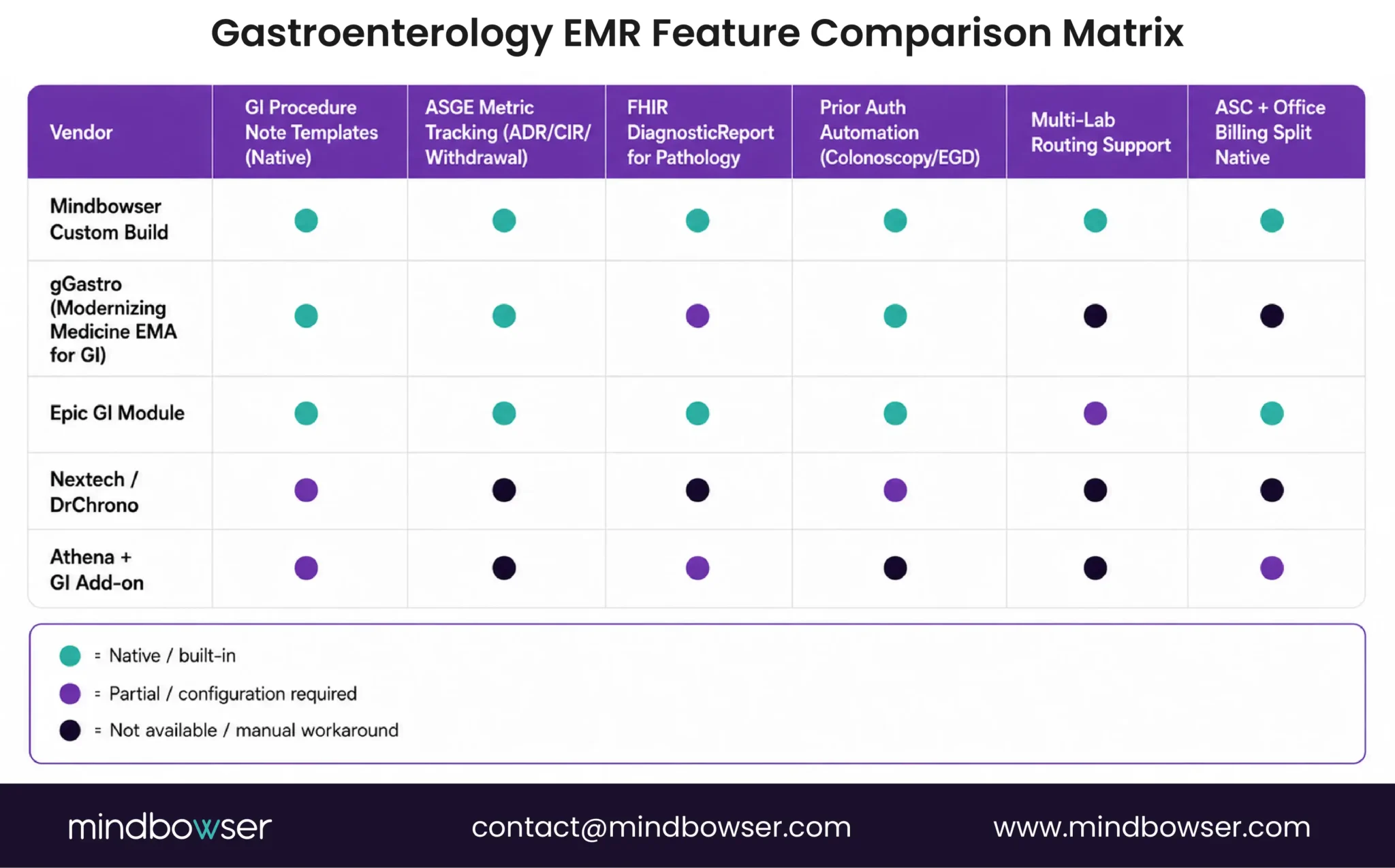
Three vendor categories serve GI practices today, and which one fits your practice depends almost entirely on how many locations you run, how many external lab relationships you manage, and whether your reporting obligations stop at the practice level or extend to payer quality submissions:
Purpose-built GI systems (gGastro, Modernizing Medicine EMA for GI): Strongest for single-site independent practices. ASGE metric tracking and GI procedure templates are native. Multi-site routing and multi-lab pathology integration require additional configuration once you grow past one location. If you’re a single-site group doing standard colonoscopy and EGD volume, this is probably your fastest path.
General specialty EMRs with GI templates (Nextech, DrChrono): Strong scheduling and billing. GI procedure documentation templates exist but are often generic note fields your team customizes manually. ASGE metric tracking isn’t native in either system. You get the scheduling infrastructure; you build the clinical documentation layer yourself.
Enterprise EMRs with GI modules (Epic, Athena): Work well for GI departments embedded in health systems already running Epic. Procedural flexibility requires configuration by Epic’s team. Billed separately. Estimated in additional months. If your health system is on Epic and you’re a GI department within it, this is your realistic option. Independent practice? The implementation overhead rarely justifies it.
What I’d push on in any vendor demo (and what most practices either don’t ask or ask too late):
- Procedure note templates: Built-in GI-specific templates for colonoscopy, EGD, ERCP, manometry, and capsule endoscopy. Or a generic template editor your team builds from scratch?
- ASGE metric dashboard: Does it calculate ADR, CIR, and withdrawal time from the structured procedure note fields, or does your team export data to a separate reporting tool every month and call that tracking?
- Pathology integration: FHIR DiagnosticReport support for lab result routing, or manual reconciliation? For EHR integration architecture, this is the single most important question you can ask.
- Prior auth automation: Colonoscopy and EGD-specific workflows built in, or generic prior auth fields that your team maps to GI procedure codes manually?
- ASC vs. office billing split: If you operate both a procedure suite and an office, does the system handle two billing profiles without a workaround?
And push one thing most practices miss: ask every vendor how they produce the ASGE GI CARE Registry export.
If the answer involves a manual report pull or a separate dashboard login, stop. That’s not real metric tracking. It’s a workaround labeled as a feature.
When Does Commercial GI EMR Fall Short?
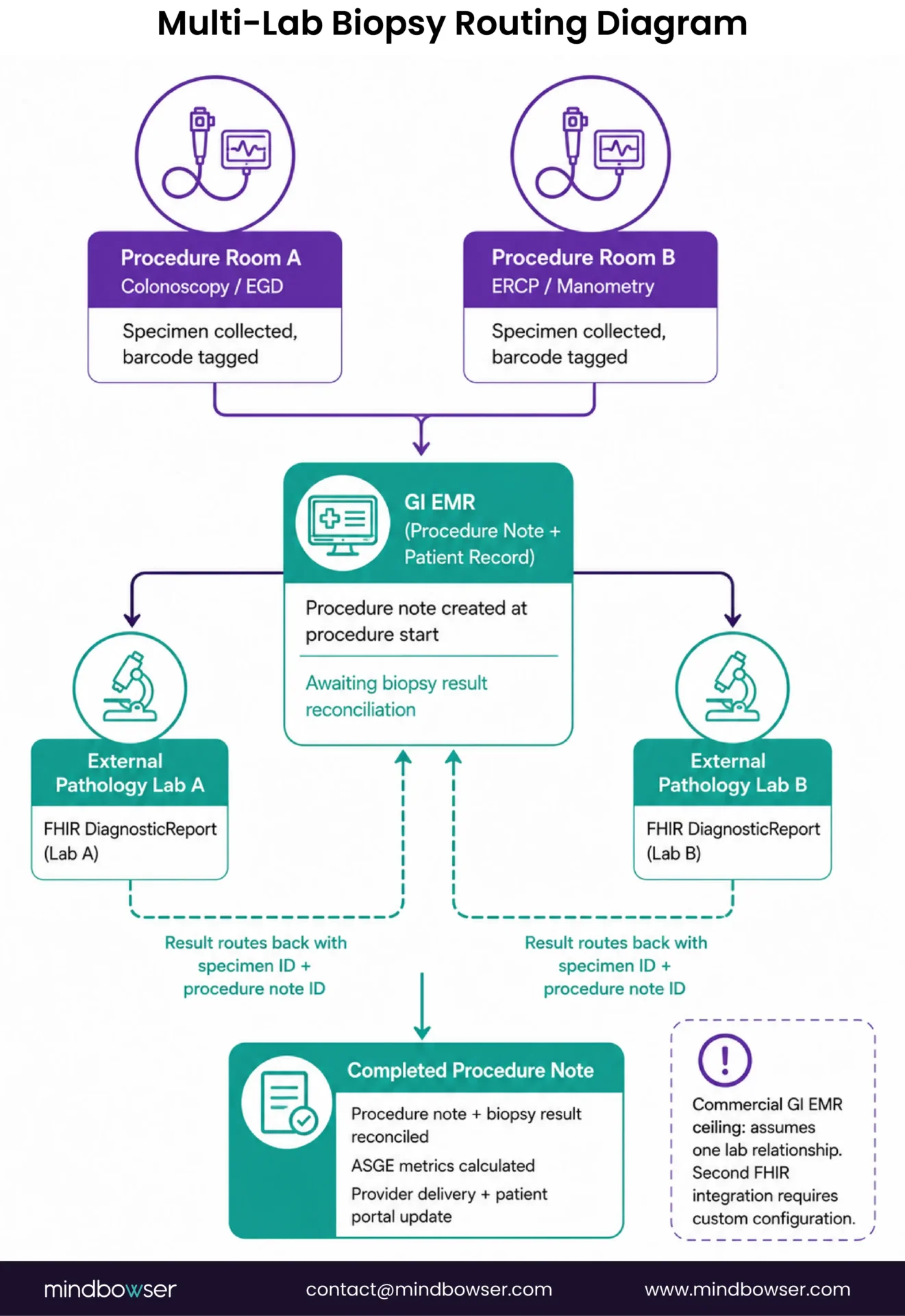
I’ve evaluated EMR systems for 6-physician GI group practices with 3 procedure rooms, an ASC license, and biopsy workflows routing to 2 different external pathology labs.
That configuration breaks every commercial GI EMR I’ve reviewed. Every single one.
Actually, let me be more specific. It’s not the 6-physician scale that causes the break. It’s one thing: the first time a practice tries to route pathology results from two different labs back into the same procedure note with separate FHIR integrations. That’s the moment. That’s when commercial systems hit their ceiling.
Four scenarios where I’d stop recommending commercial:
Multi-lab pathology routing: Commercial GI EMRs assume one lab relationship. One. Practices with 2-3 lab contracts need per-lab FHIR DiagnosticReport integrations with separate result-routing logic. That’s a custom integration layer every time, without exception.
ASC and office billing running simultaneously: GI practices operating both need two billing profiles, two prior auth workflows, and procedure note templates that distinguish facility from professional fee structures. Most commercial systems treat this as a configuration project. I treat it as a scope signal for custom build. If your billing team is currently maintaining two separate workarounds to close the gap, that’s not a configuration problem you’ve solved. That’s a problem you’ve hidden.
Population-level ADR tracking at scale: High-volume screening programs run 200+ colonoscopies per month. ADR needs to be tracked at the provider level, scope level, and time-of-day level for meaningful ASGE reporting. That’s a custom analytics layer in every commercial system I’ve reviewed. No exceptions.
FDA-cleared AI colonoscopy assist (CADe devices): Real-time endoscopy AI is generating image data. That data needs to be captured in the procedure note and reconciled with the adenoma count. No commercial GI EMR has a native integration path for this yet. If you’re running a CADe device in your procedure rooms today, you already know the documentation gap this creates.
But if you’re running a GI practice with multi-lab pathology routing and you’ve found a commercial EMR that handles it without a middleware layer, I’d genuinely want to know which one. We haven’t seen it yet.
Our custom EHR development practice works with GI groups at exactly this decision point. Drop a message and let’s look at your specific configuration.
How Does AI Reduce Documentation Burden for Gastroenterologists?
Gastroenterologists generate some of the highest per-note documentation time of any procedural specialty.
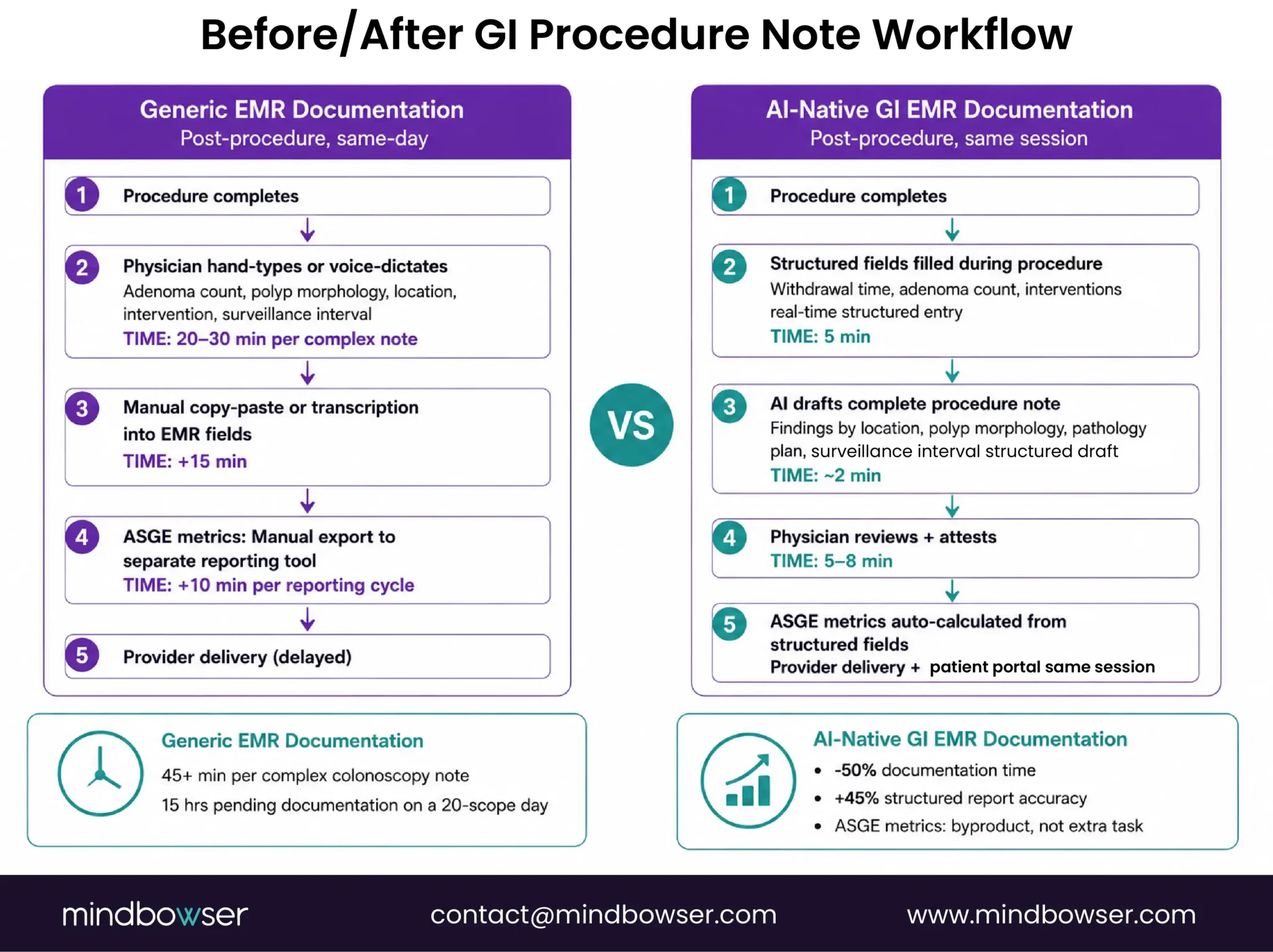
A colonoscopy with polypectomy and biopsy creates 5+ distinct documentation events. The post-procedure note alone averages 45 minutes in practices running on generic EMRs. That’s after the procedure is done. Dead clinical time, not patient time. And it compounds: a high-volume screening day with 20 colonoscopies means 15 hours of pending documentation.
AGA (2023) linked EHR documentation burden directly to physician burnout in GI. The finding was specific: structured procedure note requirements, combined with fragmented lab result routing, create a documentation backlog. It compounds. High-volume screening days are the worst.
I’ve deployed the AI Medical Summary accelerator in EHR environments with equivalent multi-finding complexity, where a single patient visit generates adenoma descriptions, polypectomy records, staining findings, and a pathology referral all in the same procedure event. It delivers a 50% reduction in documentation time and 45% improvement in structured reporting accuracy, validated across complex multi-finding result documentation workflows.
In a GI procedure context, the workflow runs like this:
1. Procedure completes: Withdrawal time logged. Adenoma count recorded. Interventions documented in structured fields.
2. AI drafts the structured procedure note: findings by anatomical location, polyp descriptions (morphology, size, location), interventions, pathology plan, recommended surveillance interval.
3. Physician reviews and signs: Clinical judgment stays with the physician. Always. AI handles the structured drafting.
4. Signed note routes to the patient record: ASGE metrics (ADR, CIR, withdrawal time) calculate automatically from the structured fields. No separate reporting step. No manual export.
The integration point matters more than the AI itself.
AI-native GI EMRs connect the documentation layer to the procedure note structure from day one. Tools bolted onto legacy systems still require copy-paste between the AI draft and the actual result record. That’s where the time savings disappear. Every time.
But if you’ve run a pilot of AI documentation tools in a GI setting, I’m genuinely curious how it handled adenoma description language. General clinical training data doesn’t always transfer cleanly to polyp morphology terminology. Reply and tell me how it went.
Build a GI EHR Around Your Exact Procedure Workflows
How Should GI EMRs Handle Sensitive Patient Data and Biopsy Privacy?
GI data carries specific privacy sensitivities. Cancer findings. Lynch syndrome diagnoses. FAP screening results. Colonoscopy histories tied to insurance eligibility decisions. HIPAA applies at baseline, but genetic polyp syndrome findings trigger additional state-level genetic privacy requirements in many states, and if you’re treating patients across multiple states, your access control design needs to account for the most restrictive jurisdiction in your patient population, not just the baseline federal floor.
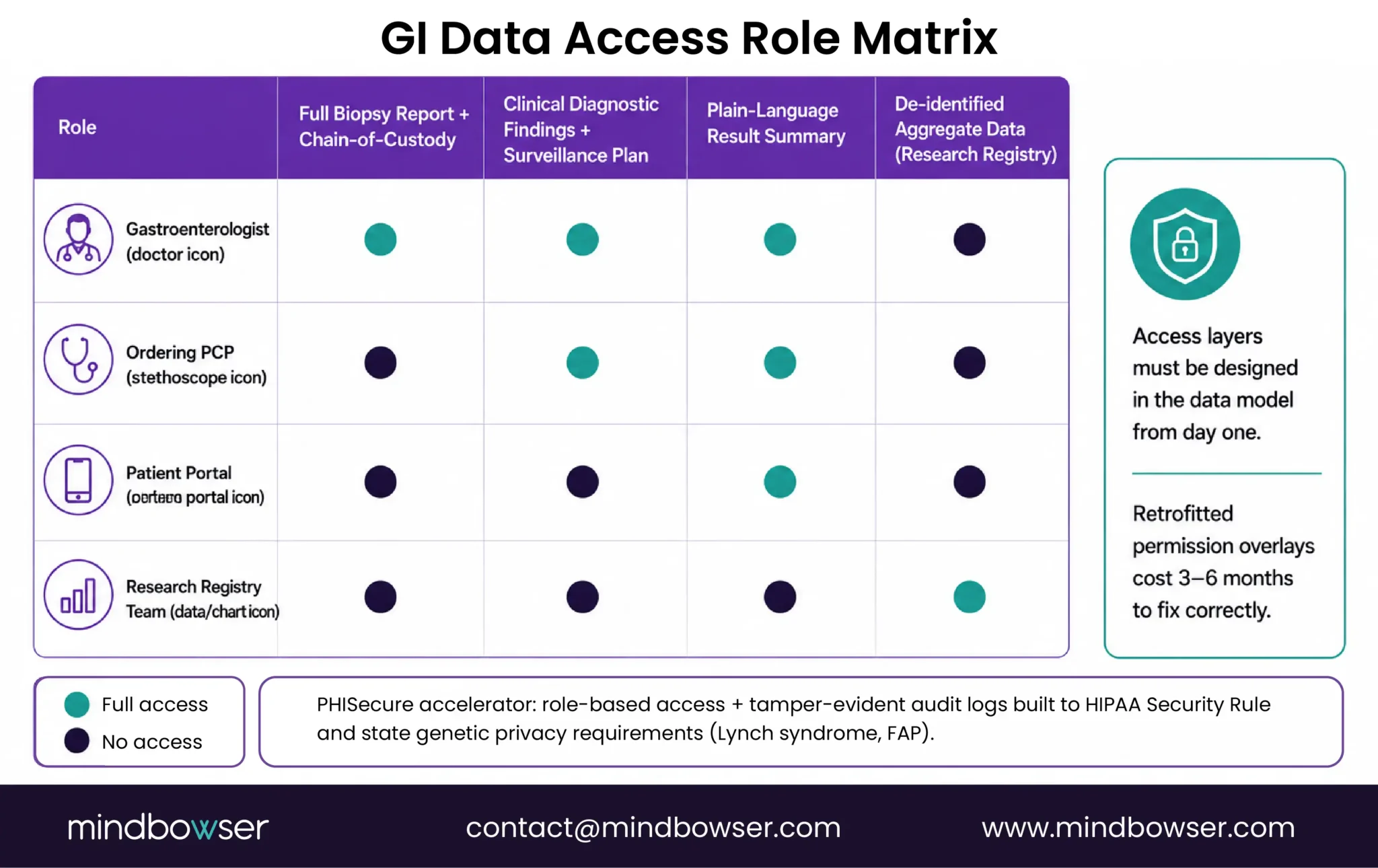
Three security surfaces I design explicitly in every GI EMR build:
Pathology result access control: Gastroenterologist sees the full biopsy report. Ordering PCP sees the clinical finding summary. Patient portal shows results in plain language, not raw pathology text. Research teams: de-identified data only. These layers need to be in the data model from day one.
Not added as permission overlays later. That retrofit always costs more than the original build. The PHISecure accelerator implements role-based access with tamper-evident audit logs built to HIPAA Security Rule requirements and applicable state genetic privacy standards.
Biopsy result data in transit: The most common compliance exposure I find in legacy GI environments: pathology results traveling from an external lab over unsecured connections, sometimes plain HL7 v2 over MLLP with no encryption. Legacy HL7 v2 over plain MLLP is not adequate for a new build. FHIR R4 with OAuth 2.0 and TLS is the current standard we build to.
Research registry data pipelines: Academic GI centers with colorectal cancer registries need de-identified data pipelines architecturally separate from the clinical record. Not retroactively de-identified exports from it. That’s an architecture decision, not a configuration decision. Get it wrong at build time, and it costs 3-6 months to fix later.
CAP accreditation for labs handling GI biopsies includes a data security checkpoint. If your GI EMR integrates with a CAP-accredited pathology lab, design to that accreditation standard from day one, not during prep.
How Do You Evaluate a Custom GI EMR Partner?
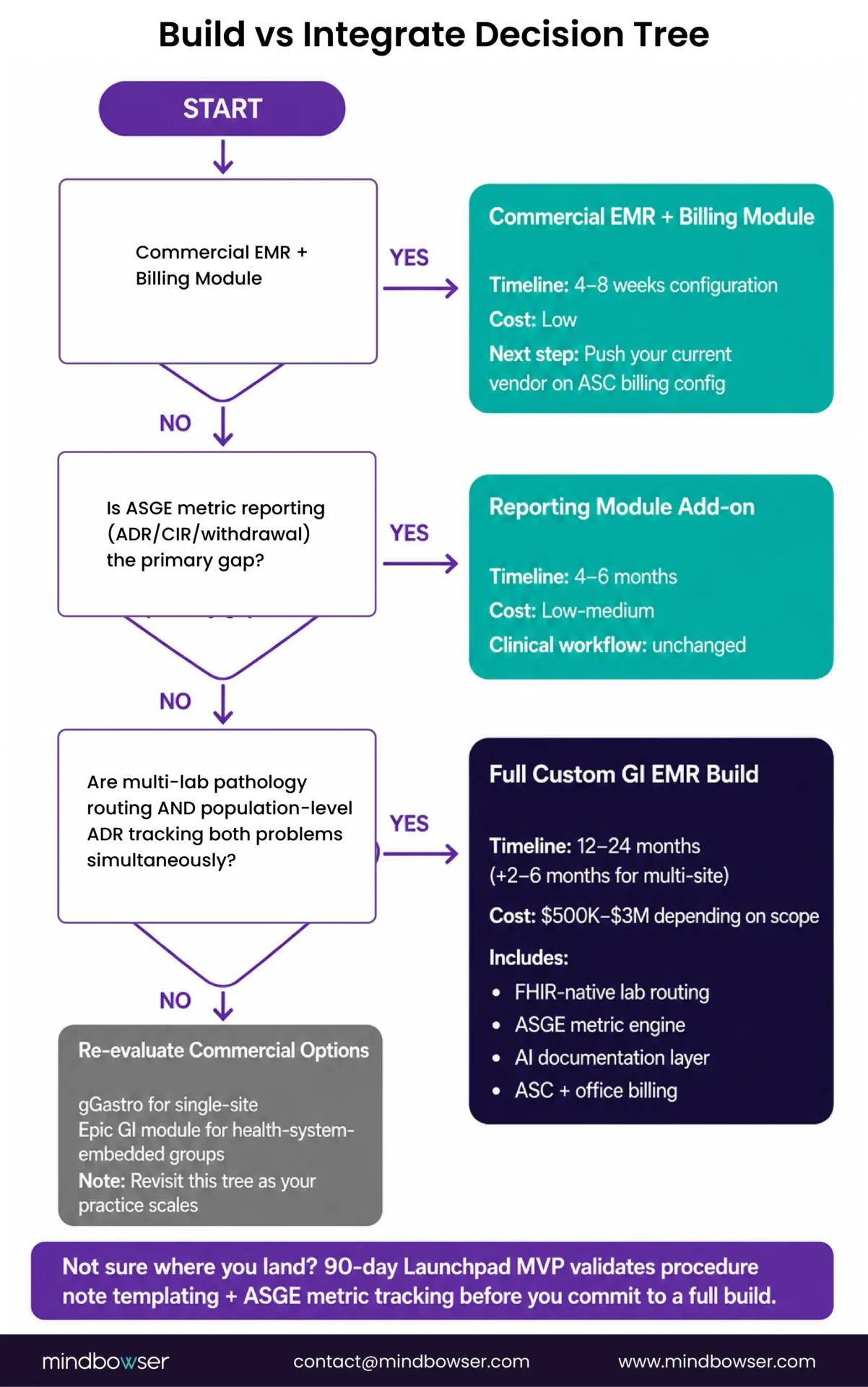
If commercial doesn’t fit, the next question is scope.
“Custom” in GI EMR covers a wide range: a targeted FHIR integration at one end, a full platform build at the other. The right scope determines the right partner, the right timeline, and the right budget.
The decision tree I use with GI practices:
Is ASC billing separation the only gap? Billing configuration. Your current commercial EMR likely handles it with the right module. Don’t build.
Is ASGE metric reporting the primary gap? Reporting module. 4-6 months. Clinical workflow stays intact. Build the layer, not the platform.
Are multi-lab pathology routing and population-level ADR tracking both problems? Custom build. 12-24 months. Multi-site complexity adds 2-6 months. No shortcut here.
When I’m evaluating a partner for this kind of work, four things matter more than anything else:
- GI procedure template depth: Have they built ASGE-standard procedure note templates before? Or starting from generic encounter fields?
- FHIR DiagnosticReport experience: Lab result routing for GI pathology is specific. Ask for a prior example from a GI or diagnostics context. Not just “we’ve done FHIR integrations.”
- Prior auth automation for GI: Colonoscopy and EGD prior auth logic isn’t the same as generic outpatient prior auth. Procedure-specific denial patterns matter.
- ASGE metric calculation: Prior build where ADR, CIR, and withdrawal time were calculated natively from procedure note fields. Not a manual export. Ask to see the schema.
My read: if you’re a GI group with more than 6 physicians running multi-lab biopsy routing, you will hit a commercial EMR ceiling within 2 years of growth.
I could be wrong. The purpose-built vendors are improving. But I’d plan for custom and be pleasantly surprised, not the other way around.
The evaluate EHR development partner framework covers the full vetting process. For practices that want to validate scope before committing, our Launchpad MVP delivers a working proof-of-concept in 90 days: procedure note templating, ASGE metric tracking, and basic pathology result routing, all running against real data before the full build begins. The how to build an EHR playbook covers the full technical architecture for teams earlier in the evaluation.
How Does Mindbowser Build Custom GI EMR Solutions?
I’ve led the architecture on specialty EHR builds for diagnostics-heavy platforms where procedure workflow complexity exceeded what any commercial system could handle.
GI is one of the clearest cases where purpose-built architecture pays for itself. The ROI isn’t theoretical. It shows up in documentation time, ASGE compliance reporting, and billing accuracy within the first year.
Procedure template library built to ASGE standards: GI procedure note templates for colonoscopy, EGD, ERCP, manometry, and capsule endoscopy designed from ASGE documentation guidelines. Not adapted from generic encounter templates. Structured fields for adenoma count, bowel prep quality, withdrawal time, and interventions feed the ASGE metric engine directly from the procedure note. No separate reporting step.
FHIR-native lab integration: DiagnosticReport R4 for pathology result routing. Per-lab FHIR configurations for practices with multiple lab relationships. Result-to-procedure-note reconciliation native to the data model. Not a post-procedure manual step. Never.
ASGE metric dashboard: ADR, CIR, withdrawal time, prep quality score. All calculate automatically from the procedure note fields. Exportable for ASGE GI CARE Registry submissions and payer quality reporting. The dashboard is a byproduct of the procedure note. Not a separate data entry task. Not a monthly export job.
AI documentation layer: The AI Medical Summary accelerator integrates into the post-procedure workflow: structured fields are documented, AI drafts the complete procedure note with polyp morphology, interventions, and pathology plan, physician attests and signs, result updates the patient record and the ASGE metric engine simultaneously.
Scale proof: A national health system deployment validated our multi-site EHR architecture across multiple facility types with centralized reporting across distributed clinical workflows. The same data routing patterns that handled that deployment scale to a GI group with 3 locations and 2 lab relationships. Smaller scope, same architecture principles. Our EHR capabilities and medical specialty EHR development practice cover the full build-to-deploy path.
What’s the Right Gastroenterology EMR Path for Your Practice?
Three paths, depending on where you are today:
Evaluating commercial options. Use the feature criteria from the comparison section as your vendor demo checklist. Push on ASGE metric tracking, multi-lab pathology routing, and ASC billing split support. Ask every vendor how they produce the ASGE GI CARE Registry export, and if they can’t answer that question clearly in the first five minutes of a demo, you’ve learned everything you need to know about how seriously they’ve built for GI.
Considering a targeted integration. If your current EMR works but pathology result reconciliation or ASGE reporting is the specific gap, a FHIR-based integration module solves it in 4-6 months. No need to replace your existing clinical workflow. Fastest path if the pain is localized.
Ready for custom. If you’re running multi-lab biopsy routing, an ASC alongside an office practice, and population-level ADR tracking at scale: custom EHR development is the right call. Start with a scoped assessment before committing to the full build.