











 BLOGS
 NEWSROOM
 CASE STUDIES
 WEBINARS
 PODCASTS
 ASSET HUB
 EVENT CALENDAR



















TL;DR
- CGM data fragmentation is the core workflow pain for most endocrinology groups: device app, EHR, patient portal exist in parallel with no native integration.
- Four realistic vendor paths exist: Epic (enterprise-scale, broadest interop, highest cost and timeline), athenaOne/AdvancedMD (cloud-native, mid-market pricing, 60-90 day go-live), Praxis (specialty-first workflows, 45-60 day setup, narrower interop), or custom build (for 30+ provider groups with non-standard workflows, 90-180 day timeline, $150-500K).
- Build-vs-buy decision hinges on group size, workflow complexity, and whether you’re already locked into Epic or another platform.
It’s 2 pm on a Tuesday. A 25-provider endocrinology group. The CMIO is reviewing a patient flag: the Dexcom G7 hasn’t synced since yesterday. Manual workaround required. This is the 4th time this week.
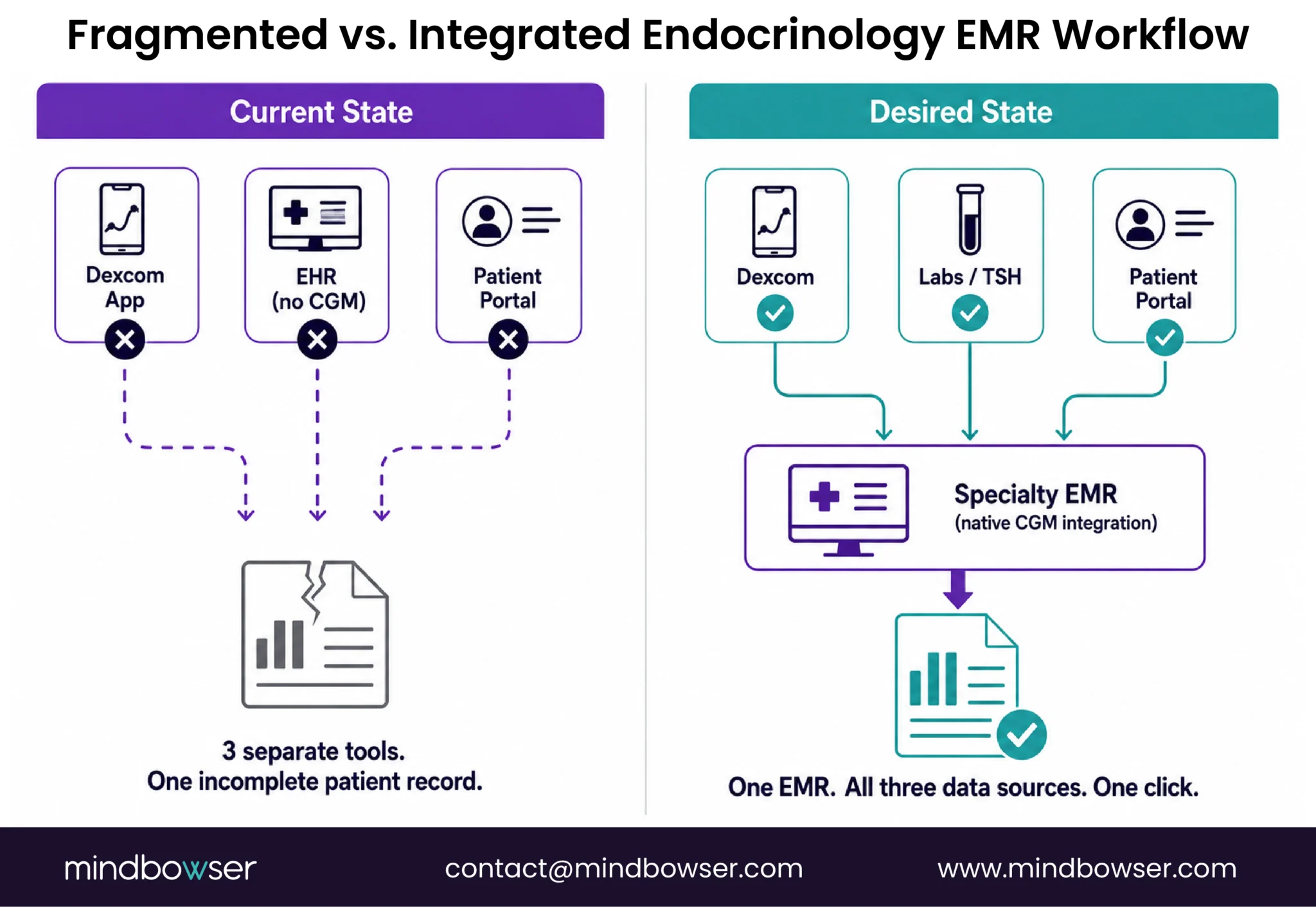
Their EMR has no native CGM integration. They use a separate iPad app just for glucose tracking. Two tools, two data sources, one patient record that’s incomplete.
This isn’t a technology failure. It’s a workflow mismatch, and it’s the most common complaint from endocrinology groups evaluating a switch.
Endocrinologists spend 9 minutes charting for every 15 minutes of patient care (KLAS 2024 Arch Collaborative clinician burnout data). About 70% of US counties lack an endocrinologist, which means the roughly 8,000 practicing in the US carry an outsized load. When the EMR doesn’t match the workflow, that ratio gets worse for patients and clinicians alike.
This guide compares four realistic paths: Epic for large systems, athenaOne and AdvancedMD for mid-market, Praxis for specialty-first workflow design, and custom build for practices that need something vendors don’t offer. We’ll walk through the pre-RFP questions most groups skip, and why they regret it.
Why Do Generic EHRs Fall Short for Endocrinology?
A generic EHR template assumes a 15-minute office visit: a chief complaint, a problem list, a few lab values, a prescription. That works fine for general internal medicine. It doesn’t work for endocrinology.
A Type 1 diabetic with thyroid disease and PCOS visits every 90 days and arrives with thousands of data points. CGM generates readings every 5 minutes. TSH and T3/T4 labs trend across 2 to 3 years. Insulin regimens shift monthly based on seasonal patterns, stress, and activity changes. The EMR has to ingest, display, and annotate this depth without forcing the clinician into 15 clicks per patient.
Most don’t.
The KLAS 2024 Arch Collaborative report identified “excessive navigation” as the top driver of clinician burnout in endocrinology. Specifically, insulin pump records require 90+ clicks per visit to access and annotate. That’s not a clinician issue. That’s a template issue.
Three structural gaps show up consistently.
- CGM fragmentation. CGM data lives in three separate systems for roughly 90% of endocrinology practices today: the device app (Dexcom, FreeStyle Libre), the EHR, and the patient portal. These systems don’t talk to each other natively in most platforms, meaning the clinician is reconciling three records in parallel during the visit. And then doing it again tomorrow with the next patient.
- TSH trending. TSH levels need to be tracked across 36+ months to catch subclinical thyroid disease drift. Generic EHRs rarely surface 36-month trending in a single view. Specialty systems treat it as a 2-click dashboard. The difference is 5 to 15 minutes per patient visit in navigation time alone.
- Template rigidity. Generic diabetes templates are designed for primary care documentation, not for the 3-step endocrinology visit pattern: trend review, medication adjustment, patient education check. Forcing an endocrinology visit into a primary care template creates documentation that’s accurate but clinically shallow. The note gets signed. The work doesn’t actually happen.
Layer on the 2015 Cures Update and USCDI v3 mandates, now baseline requirements for any certified EHR, and the gap widens. Every major vendor claims compliance. Few have executed it in ways that actually serve specialty workflows.
For a breakdown of what specialty EHR requirements look like across different clinical settings: specialty EHR requirements.
Is Epic Right for Endocrinology Groups?
Epic is the safe default: 19.5% of the ambulatory market, and 73% of users rate it favorably in the KLAS 2024 rankings. If you’re part of a large health system, you may not have a choice. If you’re evaluating independently, the calculus is more complicated.
Epic was built as a generalist platform. Its 40+ specialty modules (including diabetes and endocrine) are bolt-ons, not core design priorities. You get depth in interoperability: HL7/FHIR native, bidirectional exchange, full patient portal stack. But shallower depth in specialty-specific workflow design.
For endocrinology specifically:
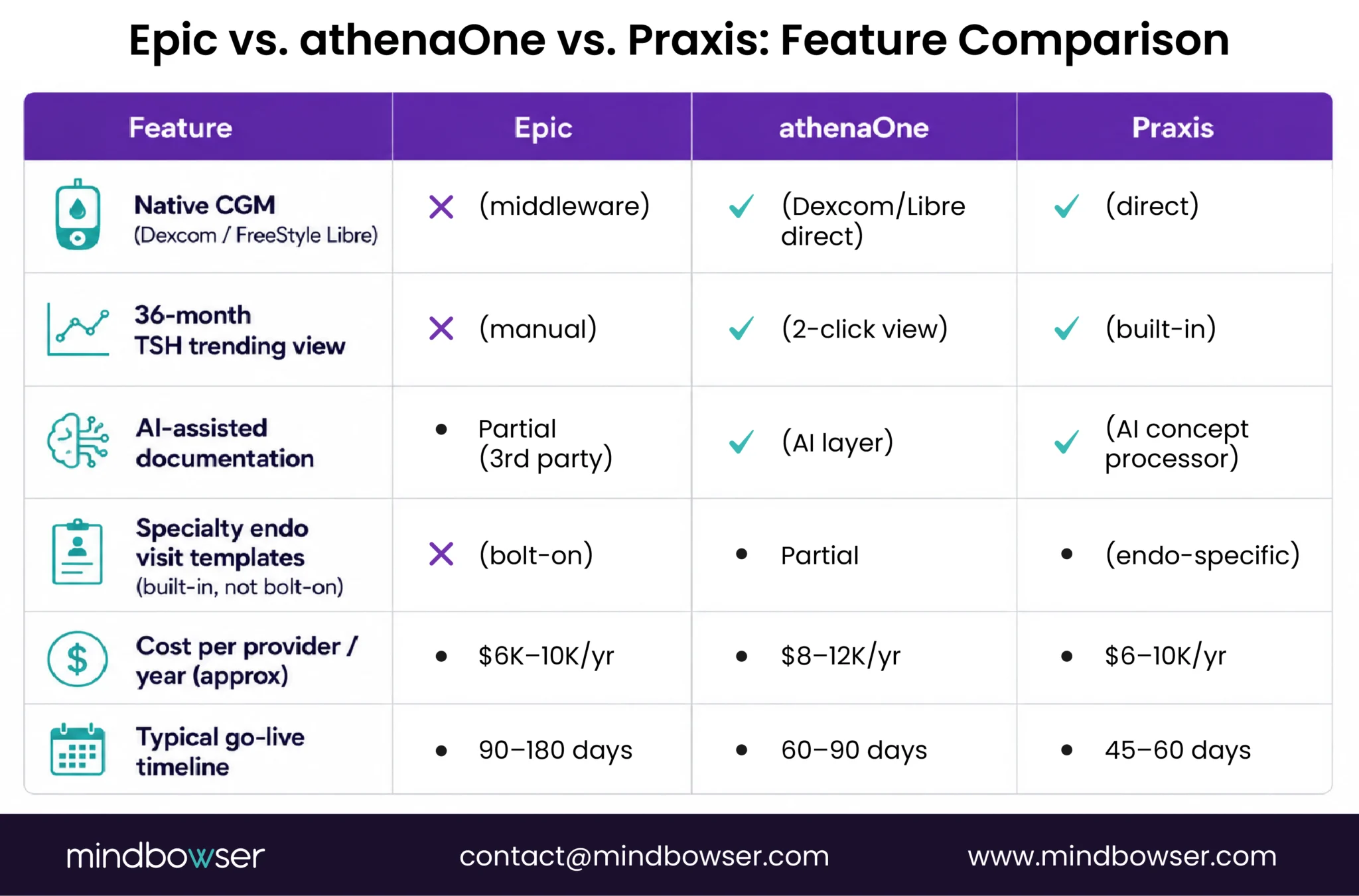
- CGM integration exists, but via third-party app integrations, not native feeds. Dexcom and FreeStyle Libre data routes through middleware before landing in the chart. You’re still reconciling two systems during the visit.
- TSH trending and insulin titration workflows are available, but they use primary-care-flavored templates that require customization to fit endocrinology visits. That customization costs time and money upfront.
- Interoperability is Epic’s real differentiator. If you’re pulling records from referrers and pushing results to patients, Epic’s breadth is hard to beat. For a 20-provider endocrinology group, that’s nice-to-have, not table stakes.
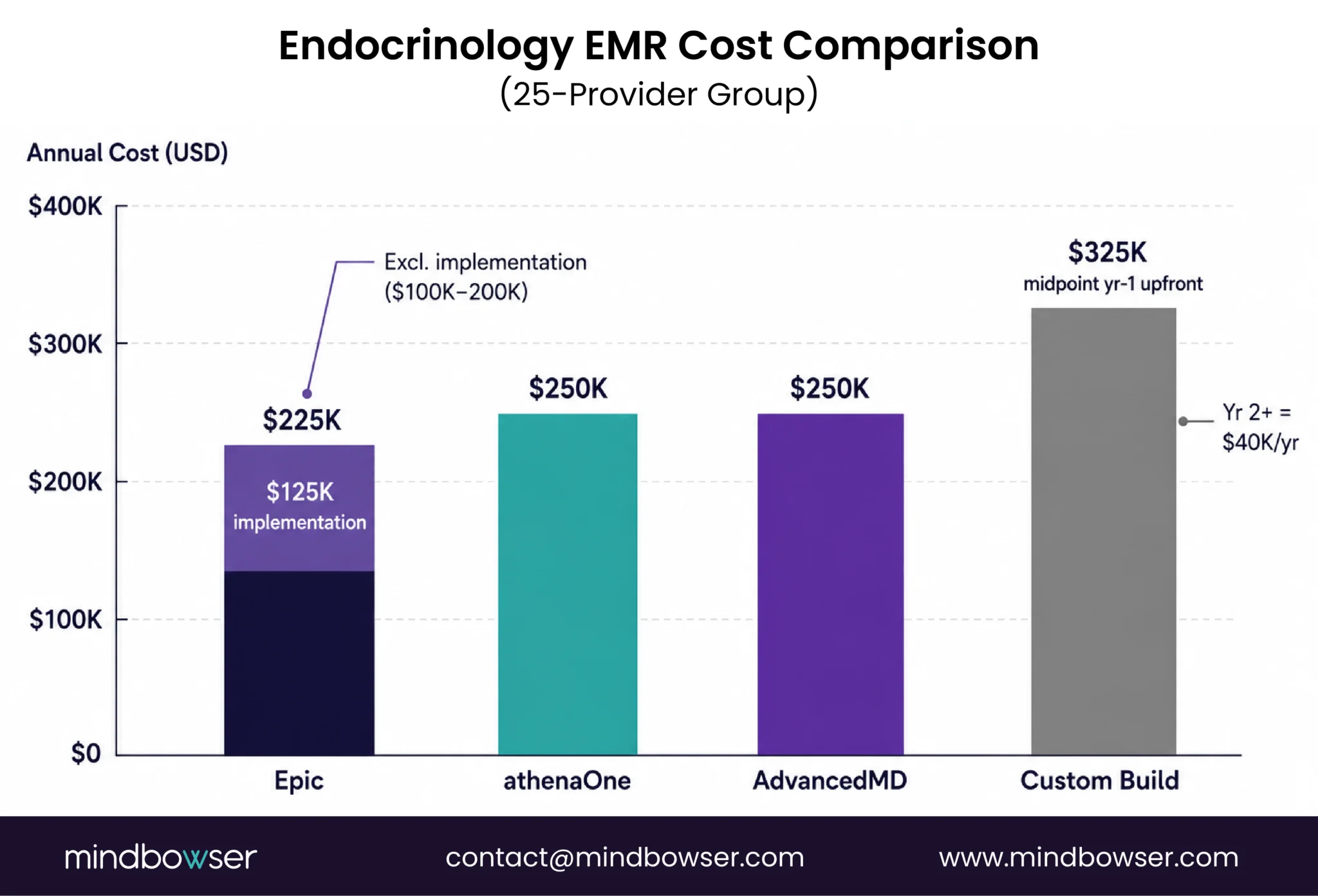
- Cost: $150 to 250K+ annual licensing for a mid-size group. Implementation adds another $100K to 200K in consulting and training.
- Setup: 90 to 180 days minimum, often longer.
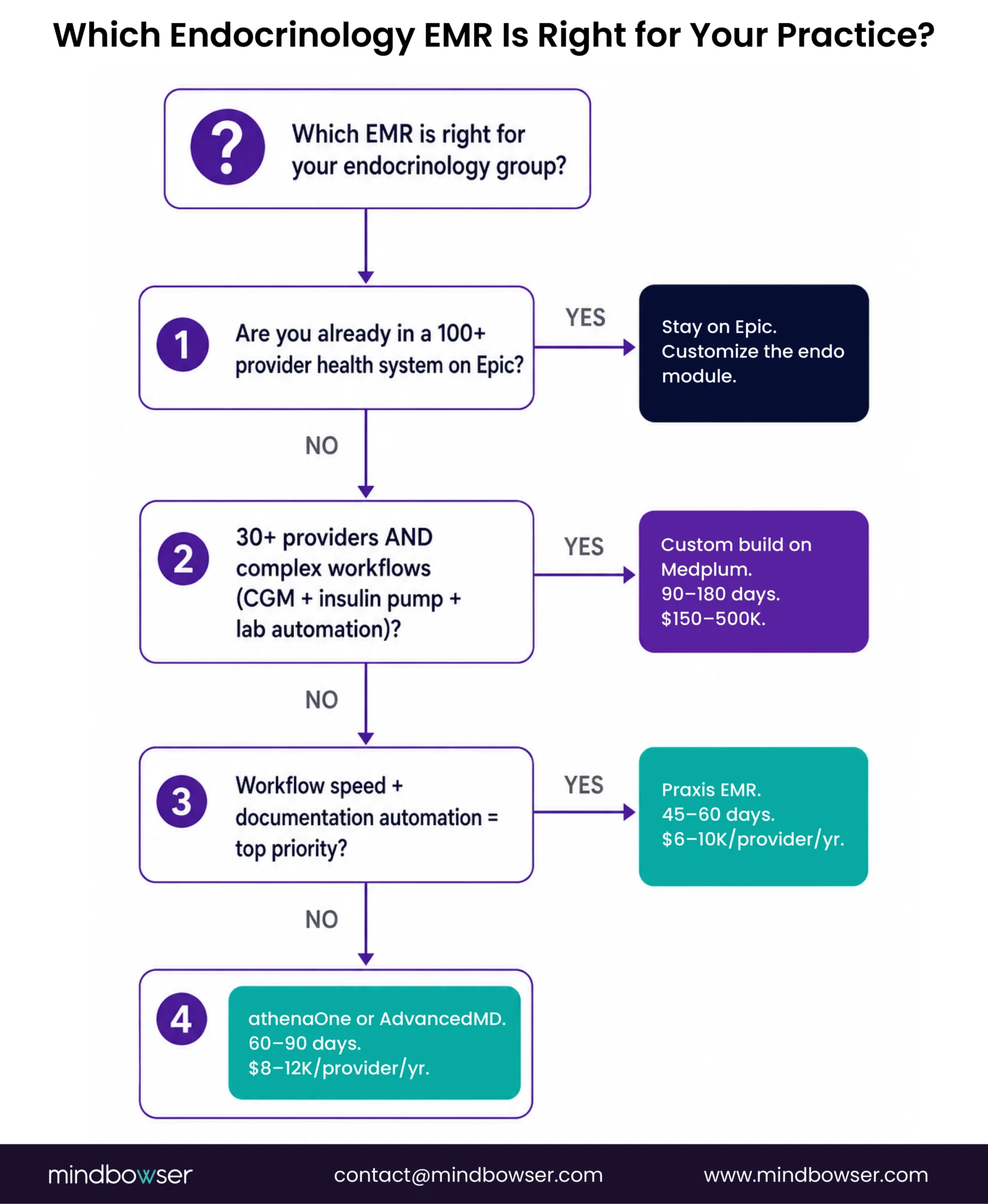
Best fit: 100+ provider health systems already running on Epic, multi-specialty groups where endocrinology is one of many departments, organizations where interoperability breadth outweighs specialty workflow depth.
The honest trade-off: if you’re a 20-provider endocrinology group not already in an Epic system, you’re paying enterprise pricing for capabilities designed at enterprise scale. The features you’d actually use are available in smaller, cheaper systems. The features Epic forces you to buy, you won’t.
What Do athenaOne and AdvancedMD Offer Endocrinology Practices?
athenaOne is KLAS’s top-rated EMR for independent practices (84% recommended, 2024), higher than Epic’s 73%. It’s cloud-native, all-in-one (EHR, practice management, patient portal), and eliminates the multi-vendor coordination that typically costs mid-size specialty groups 10 to 15 hours of admin time per week.
For endocrinology:
- Native CGM partnerships with Dexcom and FreeStyle Libre: direct feeds, not middleware. Data lands in the chart without manual reconciliation. You’re no longer reconciling three tools.
- All-in-one licensing means no separate PM system, no separate portal, and no coordination overhead between three different vendor support lines. One vendor, one contract, one bill.
- Cost: $8K to 12K per provider per year. A 25-provider group pays roughly $200K to 300K annually, with dramatically lower implementation costs than Epic and a 60- to 90-day setup window.
AdvancedMD sits in a similar tier (81% recommended, KLAS 2024). Its differentiator is an AI-assisted documentation layer that cuts documentation time 30 to 40% in specialty practices, a meaningful number for endocrinologists already at 9 minutes of charting per 15 minutes of patient time. Actually, let me refine that: the 30-40% figure is from general specialty practices, not endocrinology-specific pilots. The directional signal is right. Confirm the exact number with the vendor directly.
Best fit: 15 to 100-provider practices avoiding best-of-breed tool sprawl, groups that need a fast go-live without sacrificing specialty functionality, practices scaling toward multi-location without building IT infrastructure.
Both platforms benefit from AI-driven documentation layers for specialty workflows, similar to what’s available at the platform level: AI-driven documentation.
Ready to Improve Your Endocrinology Workflow?
When Does a Specialty-Built Platform Like Praxis Make Sense?
Praxis EMR was built by practicing physicians, not by an IT organization trying to template every specialty. The result is different in ways that matter for endocrinology.
The interface is iPad-first: swipe-to-chart. Templates are customizable per specialty at a detailed level. Endocrinology gets distinct workflows, not diabetes-flavored primary care templates. And the provider base actually uses the system the way it was designed, because the design reflects what they do.
The core differentiator is Praxis’s AI “concept processor,” a natural language documentation engine that auto-structures diabetes and thyroid documentation from voice input. Clinicians speak during the visit. The system structures the note. Documentation time drops 30 to 40% compared to generic EMRs. That’s what KLAS specialty tier rankings show for Praxis users in endocrinology-adjacent practices, not a vendor estimate.
For endocrinology specifically:
- Native CGM integration: Dexcom and FreeStyle Libre direct feeds (not middleware)
- Thyroid trending, PCOS, adrenal, and diabetes templates built in, not bolt-ons
- iPad-first UI reduces click burden versus keyboard-first EHRs
- Cost: $6K to 10K per provider per year
- Setup: 45 to 60 days
Best fit: 5 to 50-provider specialty-focused groups where workflow speed and documentation efficiency outweigh interoperability breadth.
The honest trade-off: Praxis’s interoperability depth is narrower than Epic’s. If bidirectional exchange with referring hospital systems is a hard requirement, you’ll need middleware or a hybrid approach. But for a standalone specialty practice, that’s rarely the constraint. The constraint is usually getting your clinicians to stop using a paper workaround next to the computer.
When Should an Endocrinology Group Build a Custom EMR?
The four options above cover roughly 80% of endocrinology practices. The other 20% hit a wall.
Complex workflows that vendors don’t support create a specific kind of vendor ceiling: molecular endocrinology lab automation, multi-location insulin pump prescription workflows, precision medicine research integration. Every workaround is another tool, another API call, another point of failure.
For those groups, the question isn’t which vendor to pick. It’s whether to build.
When build makes sense:
- Group size 30+ providers (justifies the engineering investment)
- Clinical workflows requiring deep CGM, lab, and insulin pump integration at the platform level
- 3+ year retention plan (the payoff horizon matters)
- Willingness to own and maintain the tech stack long-term
Modern build cost has dropped significantly. Medplum, an open-source FHIR-native backend, cuts build cost 40 to 50% compared to from-scratch EHR development. The ONC CHPL 2024 database lists 700+ ONC-certified EHR products. The custom-build market is real and growing.
A reference point: a precision medicine platform for longevity and functional medicine clinicians built a custom EHR on Medplum in 90 days. The system included an ambient scribe (AI documentation from voice), a patient AI layer, and custom clinical workflow modules. Results: 70% reduction in documentation time, 60% drop in task overhead, $305K total engagement. That’s the ceiling a purpose-built system can reach, and the comparison point for any group weighing vendor licensing against a custom build at scale.
Cost: $150K to 500K initial build, plus $30K to 50K annual support.
Timeline: 90 to 180 days to MVP go-live.
Related resources:
- Custom EHR development
- EHR cost breakdown
- For interoperability architecture: EHR interoperability layer
How Do You Evaluate and Implement an Endocrinology EMR?
Choosing the right EMR is 20% of the work. Implementation is the other 80%.
Here’s what to expect from each path:
Epic: 6 to 12 months setup, high staff time, big bang or phased cutover.
athenaOne / AdvancedMD: 2 to 3 months, moderate staff time, fast cutover with good vendor support.
Praxis: 6 to 8 weeks, light-to-moderate staff time, iPad learning curve.
Custom build: 12 to 20 weeks, heavy design input in the first phase, phased go-live with vendor support throughout.
One universal risk: “pajama time” (charting after hours) spikes 2 to 4 hours per clinician per week for the first 30 to 60 days post-go-live. Every vendor will tell you this is avoidable. It usually isn’t. Plan for it.
And change management kills more implementations than technology does. Buy-in from every endocrinologist in the group before go-live is not optional. The system is only as good as the clinician adoption. A beautifully configured EMR that the team doesn’t use is a sunk cost and a liability.
Questions to ask every vendor before you sign:
- CGM integration: native or workaround? A workaround adds $50K to 100K per year in middleware costs and doesn’t solve the core problem (data fragmentation).
- Thyroid trending: 36-month view in a single screen, or 3 clicks? Single view is a deal-maker. Three clicks defeats the point.
- Customization policy: what’s included, what costs extra? “Unlimited customization” from one vendor means “we’ll charge you for each request” from another.
- Data portability: can you export cleanly if you switch in 5 years? Lock-in gets expensive fast. Confirm upfront.
- Interoperability: can you pull records from referrers, push results to patients, without middleware? This is table stakes for any group with significant referrer traffic.
- USCDI v3 compliance: checked, audited, and dated, not just claimed? Vendor claims compliance. Verify against recent third-party audit.
- Training: how many clinician hours pre-go-live, and who’s responsible for delivery? Budget 20 to 40 hours per clinician depending on the system.
- Go-live support: on-site or remote-only? On-site support for the first week is worth the cost. Remote-only is a red flag.
Back to Tuesday 2pm: which vendor solves the CMIO’s CGM problem?
- Epic: yes, after 6 months and $200K
- athenaOne: yes, in 60 days, at $8K per provider per year
- Praxis: yes, in 45 days, iPad-first, at $7K per provider per year
- Custom build: yes, if your group owns the platform for 3+ years and needs workflow depth no vendor offers
The right answer depends on your size, your workflows, and your timeline. The wrong answer is staying on a system that costs your clinicians 90 clicks per patient visit.
Still in the discovery phase? The EHR selection playbook covers the full evaluation framework from requirements through vendor RFP.
Why This Matters: The Original Pain, Solved
The CMIO from Tuesday 2pm chose athenaOne. Sixty days later, her Dexcom data syncs natively. The separate iPad app is gone. One patient record, three data sources integrated. Documentation time for a diabetes patient dropped from 18 minutes to 11 minutes per visit. That’s meaningful budget recovery for a 25-provider group.
Not every group’s answer is athenaOne. But every group’s answer is “pick the system that makes CGM data work natively, not the system that makes you buy middleware to make it work.”
Start from the pain. The vendor that solves it is the one worth the implementation cost.
Epic dominates large health systems (19.5% market share) and is rated 73% favorably. For independent practices, athenaOne (84% recommended) and Praxis (top-rated for specialty) are the most common choices. Smaller practices often use AdvancedMD or Nextech. No single “standard” exists outside of Epic-based systems.
Epic has native integrations with some CGM devices through partnerships, but Dexcom and FreeStyle Libre typically route through third-party middleware apps. Direct integration does not exist in most Epic installations. If CGM integration is critical, ask specifically about native vs. third-party.
Costs vary by platform and group size: Epic ($150K to 250K+ annually for a mid-size group, often higher), athenaOne ($8K to 12K per provider), AdvancedMD ($10K per provider), Praxis ($6K to 10K per provider). Custom builds run $150K to 500K upfront plus $30K to 50K annually. Factor in implementation costs, training, and ongoing customization.
Praxis has the fastest go-live: 45 to 60 days. athenaOne and AdvancedMD follow at 60 to 90 days. Epic takes 90 to 180 days. Custom builds typically take 90 to 180 days depending on complexity. “Fast” often means less customization and more out-of-the-box reliance, which can be a trade-off.